 English
 Le français
 Türkçe

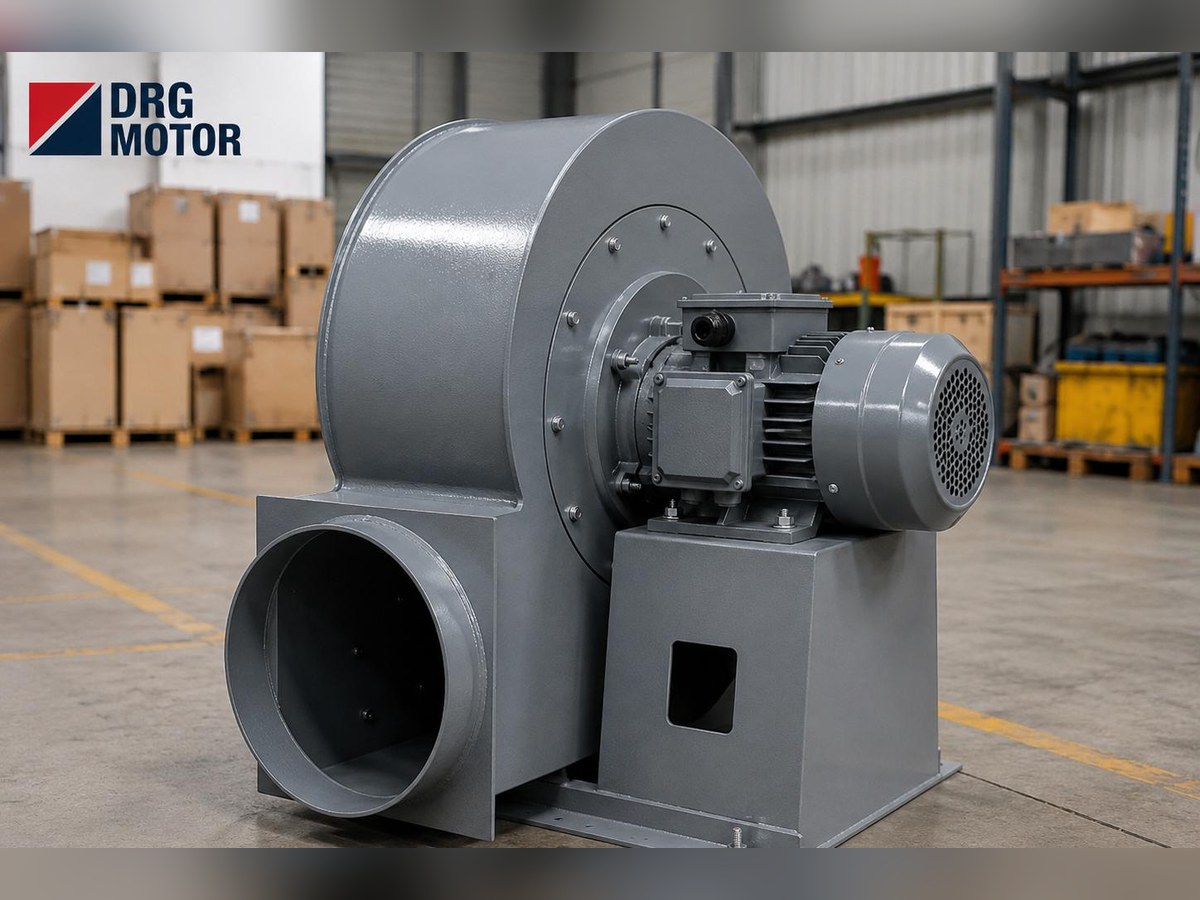
On a brick and ceramic drying line the fans push hot air through the stacks of green product to evaporate their water, expel the humid air and carry hot air from the kiln to the dryer. The electric motor turning the fan is either coupled straight to the fan shaft or kept outside the hot zone, connected by belts and an extended shaft. Maker catalogues show 1.1–4 kW per fan for circulation and travelling fans and 7.5–75 kW for hot air transfer and moisture exhaust fans.
DRG Motor is a manufacturer, supplier and seller of electric motors. We do not sell the fan, impeller, scroll casing, travelling fan carriage, burner or inverter; only the three-phase motor spinning the impeller comes from us. The models are on Buy Electric Motors Online, and details by fan type are in the Fan Motors category.
Brick dryers: chamber, tunnel and fan layouts
A brick plant uses two basic dryer types. In a chamber (cell) dryer, loaded racks or cars go into the chamber, the doors close and the drying curve is managed for that chamber alone. In a tunnel (continuous) dryer, cars enter at one end and leave at the other; air mostly flows against the product and temperature and humidity are staged along the tunnel. The fan layout follows these two designs.
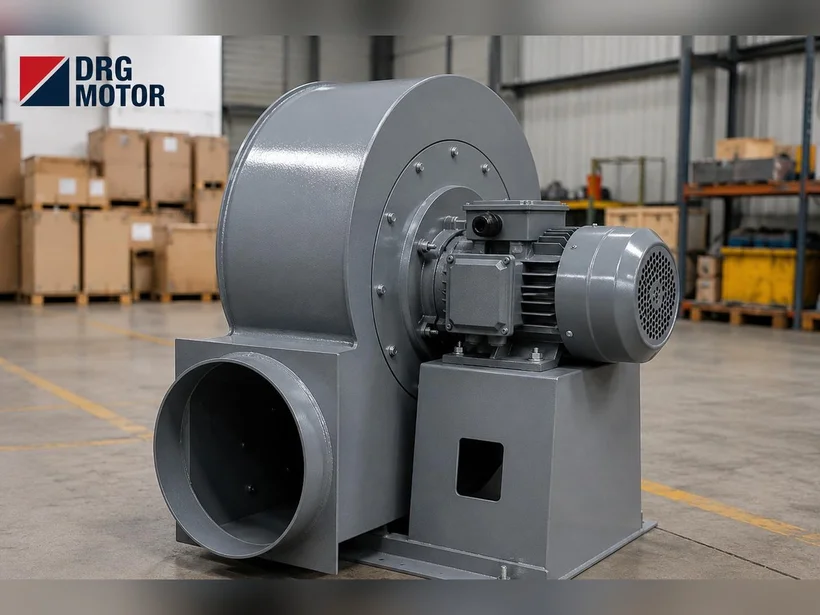
Circulation fans and travelling fans
In chamber dryers, the fans mixing air within the stack are either fixed cone or rotary fans in the ceiling, or travelling (moving) fans running back and forth on a rail. In the first maker’s 38-cell plant, travelling cone fans move about 32,000 m³/h with motors not exceeding 2.4 kW. The travelling fan’s own carriage also runs on a small geared motor; its rating is not given in the source, so we quote no figure.
Moisture exhaust and hot air transfer fans
In a tunnel dryer, humid air is extracted either centrally by one large fan or section by section with smaller fans. The fifth maker’s publication gives, for a 15-section tunnel, 55 kW total motor power for the central layout and 45 kW for the sectional one; on the sectional fans the motor is moved outside the fan and belt-connected. Hot air taken from the cooling zone of the tunnel kiln is carried to the dryer by large transfer fans; the fourth maker gives 7.5–75 kW for these.
Ceramic dryers: vertical and horizontal multi-deck
On a ceramic tile line, tiles leaving the press first enter a vertical dryer or a horizontal multi-deck (roller) dryer. In a vertical dryer the tiles travel up and down in baskets; centrifugal fans in several zones take air from the heater and blow it into the ducts. A horizontal dryer has fan and burner groups along its modules; the sixth maker states a 25,000 m³/h circulation fan per module with fan speed set by inverter, but does not publish the motor rating.
What sets the rating of a ceramic dryer fan motor?
We could not find a reliable catalogue rating for ceramic dryer fans, so we give no figure. The motor is chosen from application data: send us fan flow and pressure (fan plate or dryer data sheet), fan speed, direct or belt drive, temperature where the motor stands, and the speed range used on the inverter. When replacing, the plate of the motor removed is the most reliable source.
Hot zone rule: the motor stays outside the dryer
Air inside a dryer is both hot and close to saturation. The third maker offers its drying room fans with class H insulated, externally cooled special motors for 90 °C in fully saturated air. Special high-temperature motors of that kind are not in our range. Our standard motor is used so that it stays outside the dryer’s hot air: it sits outside the dryer wall or roof, drives the fan shaft by belt or extended shaft, and the ambient temperature around the motor is given to us before ordering. If that temperature exceeds the catalogue limit, derating or another solution is discussed.
Cold start and air density
A fan draws more power in cold air than at working temperature, because cold air is denser. If the dryer is started cold every Monday, the motor is sized for that case or started at reduced speed through an inverter; details are in our drying oven fan motor article.
Click to see current electric motor prices and order nowSEE PRICES →
How many kW is a dryer fan motor? Catalogue values
A) Ratings given in maker catalogues and publications for drying line fans:
| Fan / dryer type | Motor power | Single / total | Note |
|---|---|---|---|
| Chamber dryer, travelling cone fan, ~32,000 m³/h | max. 2.4 kW | per fan | first maker, 38-cell plant |
| Rotary circulation fan, 27,000 m³/h | 3 kW | per fan | second maker’s example |
| Drying room axial fan, 17,000–37,200 m³/h | 1.1–4 kW | per fan | third maker’s catalogue, 4 poles |
| Hot air transfer and moisture exhaust fan | 7.5–75 kW | per fan | fourth maker, 5,000–80,000 m³/h |
| 15-section tunnel dryer, central moisture exhaust | 55 kW | total motor power | fifth maker’s publication |
| Same dryer, sectional moisture exhaust fans | 45 kW | total motor power | fifth maker’s publication |
| Ceramic multi-deck dryer module | 25,000 m³/h per fan | per module; no power given | sixth maker |
Depending on model, flow and dryer design, circulation and travelling fans take roughly 1.1–4 kW per fan, transfer and moisture exhaust fans 7.5–75 kW. The 55 and 45 kW values are tunnel totals, not single fan ratings.
B) Where DRG fits: 1.1–4 kW circulation fan motors match our 4-pole 90S to 112M frames, and 7.5–75 kW transfer and exhaust fan motors the 132M to 280S frames; the whole span is inside our range. Specially insulated fan motors working directly in the hot, humid dryer air remain outside it.
Worked example: travelling cone fan power and speed control
Take the first maker’s 32,000 m³/h fan. Assume a total pressure rise of 150 Pa and a fan efficiency of 0.6 (both values are assumptions); fan shaft power is P = Q × Δp / η. By the fan laws, flow follows speed and power follows the cube of speed:
| Case | Operation | Fan shaft power | Comment |
|---|---|---|---|
| Full speed | 8.89 × 150 / 0.6 | about 2.22 kW | 32,000 m³/h = 8.89 m³/s |
| Speed × 0.9 | 2,222 × 0.9³ | about 1.62 kW | flow falls in the same ratio |
| Speed × 0.8 | 2,222 × 0.8³ | about 1.14 kW | at night or during stops |
| Speed × 0.7 | 2,222 × 0.7³ | about 0.76 kW | in the final drying stage |
About 2.2 kW at full speed agrees with the 2.4 kW motor limit in the source; here a 3 kW DRG-100L2-4 (1,450 rpm, 6.02 A at 400 V) also leaves room for a cold start. Running at 0.8 times full speed roughly halves the power, which is why fans are slowed by inverter in the last stage of the drying curve. A motor running long at low speed cools less with its own fan, so whether a separate cooling fan is needed is checked. Enter your own flow and pressure in the pump and fan power calculator to repeat this check.
Travelling drive, brakes and single phase
Moving a travelling fan carriage is a light load handled by a small geared motor. If a brake motor is asked for precise stops at the rail end, that product is not in our range; position sensors and the gearbox’s own self-locking solve it. Single-phase motors seen on small portable drying fans are not among our products either.
DRG motors for drying line fans
Our 4-pole models matching circulation, travelling, exhaust and transfer fan ratings (current at 400 V):
| Model | Power / speed | Frame · shaft D×E | Current 400 V |
|---|---|---|---|
| DRG-90S-4 | 1.1 kW / 1445 rpm | 90S cast iron · 24×50 | 2.48 A |
| DRG-90L-4 | 1.5 kW / 1445 rpm | 90L cast iron · 24×50 | 3.3 A |
| DRG-100L1-4 | 2.2 kW / 1450 rpm | 100L cast iron · 28×60 | 4.52 A |
| DRG-100L2-4 | 3 kW / 1450 rpm | 100L cast iron · 28×60 | 6.02 A |
| DRG-112M-4 | 4 kW / 1450 rpm | 112M cast iron · 28×60 | 7.95 A |
| DRG-132M-4 | 7.5 kW / 1460 rpm | 132M cast iron · 38×80 | 14.3 A |
| DRG-200L-4 | 30 kW / 1475 rpm | 200L cast iron · 55×110 | 53.8 A |
| DRG-280S-4 | 75 kW / 1486 rpm | 280S cast iron · 75×140 | 129 A |
Belt-driven fans take foot-mounted B3, axial fans flanged to the casing take B5 or B14, and vertical shaft fans a vertical mounting. Every DRG unit is an IP55, three-phase IEC induction motor; 6-, 4- and 2-pole windings give roughly 1000, 1500 and 3000 rpm. Before swapping a fan motor, record what the old plate says (kW, rpm, volts, star or delta), then measure shaft, key, feet or flange and pulley, and tell us how warm it gets around the motor; we compare these with the fan and dryer documents and confirm the fit together. Dimensions are on the technical drawings page.
Live price table
Prices of our models in drying line fan motor sizes come live from the shop:
| Model | Power / speed | Frame · current 400 V | Price |
|---|---|---|---|
| DRG-90L-42 HP | 1.5 kW · 1500 rpm | Cast iron 90L · 3.3 A | $144.14 (€128.73) Details & buy → |
| DRG-100L1-43 HP | 2.2 kW · 1500 rpm | Cast iron 100L · 4.52 A | $188.32 (€168.18) Details & buy → |
| DRG-100L2-44 HP | 3 kW · 1500 rpm | Cast iron 100L · 6.02 A | $203.84 (€182.05) Details & buy → |
| DRG-112M-45.5 HP | 4 kW · 1500 rpm | Cast iron 112M · 7.95 A | $254.38 (€227.18) Details & buy → |
| DRG-132M-410 HP | 7.5 kW · 1500 rpm | Cast iron 132M · 14.3 A | $394.89 (€352.66) Details & buy → |
| DRG-160L-420 HP | 15 kW · 1500 rpm | Cast iron 160L · 27.3 A | $678.13 (€605.61) Details & buy → |
| DRG-200L-440 HP | 30 kW · 1500 rpm | Cast iron 200L · 53.8 A | $1,235.00 (€1,102.93) Details & buy → |
| DRG-280S-4100 HP | 75 kW · 1500 rpm | Cast iron 280S · 129 A | $2,916.93 (€2,605.00) Details & buy → |
DRG MOTOR motors are guaranteed against material and manufacturing defects for 2 years from the delivery date (warranty certificate).
Motors in this power range
- DRG-90L-4 – 1.5 kW – 1445 rpm – 90L cast iron
- DRG-100L1-4 – 2.2 kW – 1450 rpm – 100L cast iron
- DRG-100L2-4 – 3 kW – 1450 rpm – 100L cast iron
- DRG-112M-4 – 4 kW – 1450 rpm – 112M cast iron
- DRG-132M-4 – 7.5 kW – 1460 rpm – 132M cast iron
Click to see current prices and order these motors nowSEE PRICES →
Browse the products, ask for a quote: motors for your dryer fans are on Buy Electric Motors Online. Send the fan plate, the motor plate and one photo showing where the motor sits relative to the dryer on WhatsApp, or call +90 (542) 666 11 11 with the number of fans and the dryer type.
Frequently asked questions
Can I replace the motor of a fan inside the dryer with a standard motor?
Not if the motor sits in the hot, humid air; either a special temperature motor is needed or a belt or extended-shaft layout takes the motor outside.
Does a travelling fan or a fixed fan need less motor power?
It depends on the dryer design; without comparing fan count, pressure loss and running hours at the same airflow there is no general answer.
What does the price of a dryer fan motor depend on?
Rating, pole number and frame; the table above is fed by shop data.
Looking at the whole factory rather than one dryer? Our ceramic plant motor guide covers it. Contact: +90 (542) 666 11 11 · info@drgmotor.com · contact.


