 English
 Le français
 Türkçe

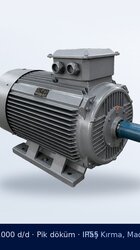
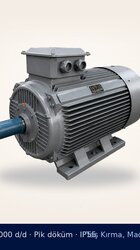
The size of the aggregate a cone crusher produces, its capacity and the power it draws all depend on the speed of the crusher countershaft. If the pulley ratio is not maintained when the motor is replaced, this speed changes; the crusher either exceeds the manufacturer's limit or fails to deliver the expected product. So the aim is to keep the crusher speed rather than the ratio itself; if the new motor has a different speed, the pulley diameter is recalculated accordingly.
What happens if the speed changes?
- If the speed increases: The gyration between the mantle and the concave becomes more frequent; the product gets finer, capacity and power demand change, and the bearings and countershaft may approach their design limit.
- If the speed decreases: The product gets coarser, the crushing chamber fills more easily and the risk of choking rises.
Cone crusher manufacturers give a range for countershaft speed; going outside this range is not recommended for warranty and safety reasons.
Pulley calculation: an example
Machine speed = motor speed × motor pulley diameter ÷ crusher pulley diameter. If the old motor's rated speed on the nameplate is 1485 rpm, the motor pulley 280 mm and the crusher pulley 560 mm, the countershaft turns at about 742 rpm. If a 6-pole motor with a rated speed of 990 rpm is fitted instead, the speed drops to about 495 rpm with the same pulleys. To reach the same crusher speed, the motor pulley must be enlarged to about 420 mm (742 × 560 ÷ 990). Use the on-load speed shown on the motor nameplate in the calculation, not a rounded synchronous value such as 1500 or 1000; belt slip lowers the actual speed a little further.
What else changes if the pulley changes?
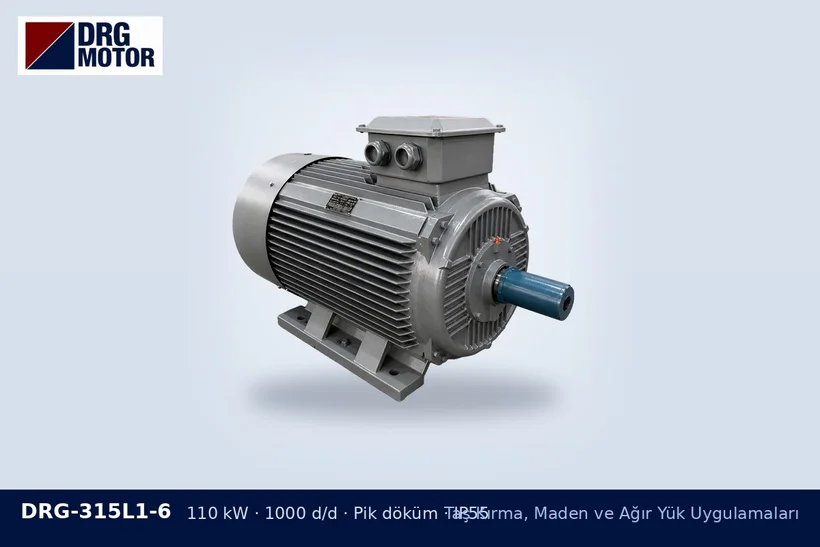
As the motor pulley gets larger, belt speed increases and the belt type and number are checked again; if the pulley gets smaller, the side force on the shaft increases. In addition, if the new motor's shaft size is different, the pulley hub changes too: in DRG records, the 160 kW 1500 rpm DRG-315L1-4-GG model has an 85×170 mm shaft, while the 160 kW 1000 rpm model has a 100×170 mm shaft.
You can verify the speed and diameter calculation with the pulley and belt calculation tool, and for secondary and tertiary crushing see the cone crusher motor page.