 English
 Le français
 Türkçe

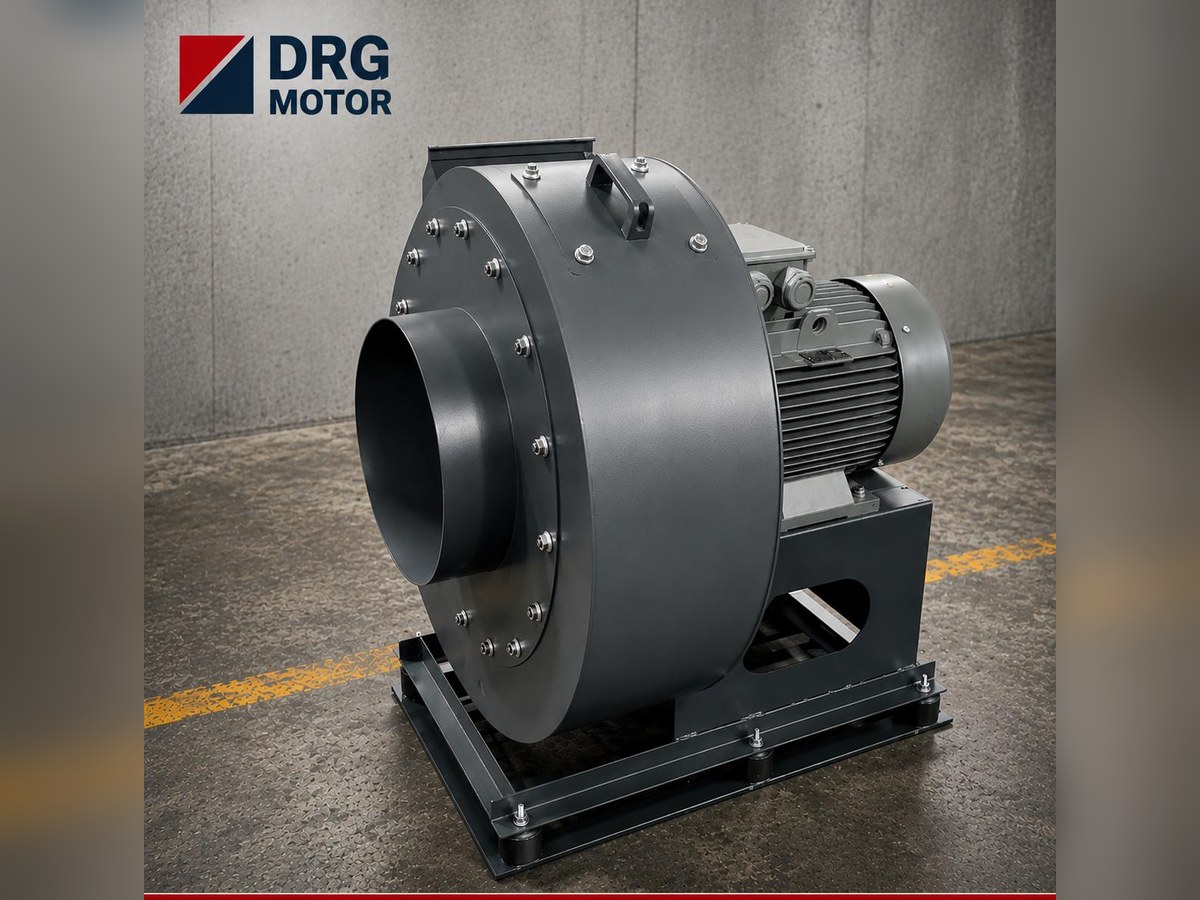
An air blower electric motor turns the rotor or impeller of the machine that pushes air into an aeration basin, carries powder or granules through a pipe, or feeds a process with low-pressure air. Industry uses three blower families: the rotary lobe (roots) blower, the side channel blower and the multistage centrifugal blower. Manufacturer catalogues list motors of 0.37–22 kW for side channel types, 1.5–500 kW for rotary lobe packages and anything from 1 kW to several thousand kW for multistage centrifugal blowers. The blower type, its flow and the pressure it works against decide together which motor is needed.
DRG Motor is a manufacturer, supplier and seller of electric motors. We do not sell the blower itself, the safety and blow-off valves, the silencer, the belt and pulley set or the frequency inverter; the motor that spins it is the piece we provide. Our models appear on the Buy Electric Motors Online page, sorted by kW and rpm.
What separates a blower from a fan: the pressure ratio
A classification widely used in engineering references takes the ratio of discharge pressure to suction pressure: up to 1.11 the machine is a fan, between 1.11 and 1.20 a blower, above that a compressor. For a machine drawing in at atmospheric pressure this limit equals a pressure rise of roughly 111 mbar to 203 mbar. Because rotary lobe blowers go beyond this definition and deliver up to 1,000 mbar, on site the name “blower” is given in practice to every low-pressure air machine.
How this differs from the Fan Motors pages
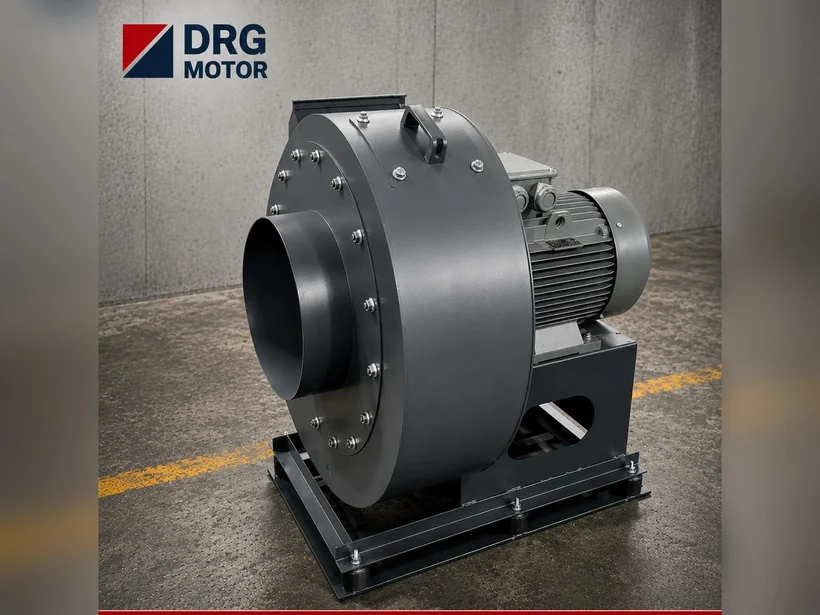
The pages in the Fan Motors category cover ventilation, exhaust, dust collection and duct fans; there the motor is loaded by a large air volume at low pressure and the fan laws, where power changes with the cube of speed, apply. In a blower the air volume is smaller and the pressure is at a level a fan cannot reach. A rotary lobe blower is a positive displacement machine, so the torque on the shaft rises with pressure; it is not a machine whose load drops when it is throttled. This page focuses on the low-pressure air class and does not cover ventilation fans.
Three blower families and where the motor is connected
Rotary lobe (roots) blower: belt or coupling package
Two rotors with two or three lobes turn without touching, held by timing gears, and move a fixed volume of air from suction to discharge on every turn. In packages the motor usually sits on a separate base and drives the blower by belts; a hinged motor plate keeps the belt tension with the weight of the motor. Large packages also use a direct coupling. With a belt drive the motor is a standard foot-mounted IEC (B3) motor and replacement is relatively simple. The power calculation, pulley ratio and star-delta start for this type are covered in detail in our roots blower motor selection article; we do not repeat that calculation here.
Side channel blower: impeller on the motor shaft
In a side channel (regenerative) blower a bladed impeller accelerates the air many times in the ring-shaped channel of the housing and so builds pressure. Up to medium size, the motor shaft carries the impeller itself and the motor flange closes the blower casing. When the motor of a side channel blower burns out, the first job is therefore to find out whether it has a standard IEC shaft and flange. We measure shaft diameter, shaft length and flange holes and compare them with the B5 flange motors in our range; if the dimensions are specific to the blower maker we make no fit promise and look for another solution.
Multistage centrifugal blower: coupled high speed
Several impellers in a row on one shaft compress the air stage by stage. They are common in the large aeration lines of treatment plants, in filter backwashing and in combustion air supply. The motor is connected through a flexible coupling and is usually 2-pole. The largest frames of this family run on motors of several hundred kW and exceed the upper limit of our range.
What kW does an air blower motor need? Values from manufacturer catalogues
A) Motor powers taken from the catalogues and product pages of five makers:
| Blower type / model | Motor power | Single / total | Note |
|---|---|---|---|
| Side channel, single stage, 130 m³/h, +75 mbar | 0.55 kW | one body with the blower | first maker, smallest model |
| Side channel, single stage, 1,050 m³/h, +390 mbar | 15 kW | one body with the blower | first maker, largest model |
| Side channel series, single and double stage, 50 Hz | 0.37–22 kW | series range | second maker |
| Rotary lobe package, 250 m³/h, −500 mbar vacuum | 7.5 kW | package motor | third maker, smallest frame |
| Rotary lobe package, 240 m³/h, 1,000 mbar pressure | 11 kW | package motor | third maker |
| Rotary lobe package, 9,000 m³/h, 1,000 mbar | 355 kW | package motor | third maker, large frame |
| Rotary lobe package, 14,640 m³/h, 800 mbar | 500 kW | package motor | third maker, largest frame |
| Rotary lobe package series | 1.5–250 kW | series range | fourth maker |
| Multistage centrifugal, smallest frame, up to 510 m³/h | 1–15 kW | single coupled motor | fifth maker |
| Multistage centrifugal, largest frame | 186–2,237 kW | single coupled motor | fifth maker |
Across the five catalogues, blower motors range from about 0.37 to 2,237 kW: side channel types at 0.37–22 kW, rotary lobe packages at 1.5–500 kW and multistage centrifugals at 1–15 kW in the small frame and 186–2,237 kW in the largest. The same rotary lobe frame can take a 7.5 kW motor on vacuum and an 11 kW motor on pressure, which shows that the pressure column must be read as carefully as the flow. Every figure refers to one blower, never to a whole station.
B) What the DRG range covers: our aluminium frames at 0.25–11 kW, cast iron frames at 0.55–355 kW and the 3000/1500/1000 rpm options cover, in terms of power, the whole side channel series, rotary lobe packages up to 355 kW and the small and medium frames of multistage centrifugals. The 500 kW rotary lobe package and multistage centrifugals above 355 kW are outside our range; motors of that size are often supplied at medium voltage as well.
Click to see current electric motor prices and order nowSEE PRICES →
Aeration basin and pneumatic conveying: the moments that load the motor
Aeration station: duty and standby blowers
In biological treatment the blowers push air to the diffusers on the basin floor and form the group that draws the most energy in the plant. Stations are usually built as “n duty + 1 standby”, and the standby blower is brought in by rotation to even out running hours. Under inverter control linked to dissolved oxygen, a rotary lobe blower still asks for the same torque at low speed; if a self-ventilated motor is to stay in that region for long periods, forced cooling should be considered. As diffusers foul, pressure and motor current climb slowly; a monthly record of the current reveals this fouling early.
Pneumatic conveying line: blockage and the safety valve
In lines carrying cement, flour, plastic granules or ash, the blower works either under pressure (at the start of the line) or under vacuum (at the end). As material builds up in the line the pressure rises and, at a blockage, reaches the setting of the safety valve. The motor is therefore chosen for the pressure at the valve setting; after any intervention that raises the valve setting, motor power should be checked again. On vacuum lines a filter always sits in front of the blower; when it clogs the vacuum deepens and motor current rises.
Choosing the motor from a catalogue row: an aeration station example
If the blower nameplate cannot be read, the rows of a maker’s catalogue give a good yardstick. Dividing motor power by flow in the rotary lobe packages of one maker gives these ratios (calculated in python):
| Catalogue row | Flow and pressure | Motor | kW / (m³/h) |
|---|---|---|---|
| Rotary lobe package A | 684 m³/h · 1,000 mbar | 30 kW | about 0.0439 |
| Rotary lobe package B | 1,020 m³/h · 700 mbar | 30 kW | about 0.0294 |
| Rotary lobe package C | 1,446 m³/h · 1,000 mbar | 55 kW | about 0.0380 |
| Side channel, same body | 510 m³/h · 190 / 295 / 435 mbar | 4 / 5.5 / 7.5 kW | grows with pressure |
At 700 mbar the motor power per cubic metre is about two thirds of that at 1,000 mbar. Choosing a motor from flow alone, without knowing basin depth and diffuser loss, therefore means either an oversized or an undersized motor.
Example: a basin needing 1,900 m³/h of air
Assumption: the basin needs 1,900 m³/h of air, the blower discharge pressure is 700 mbar and the station will use three blowers similar to catalogue row B (2 duty + 1 standby, each 1,020 m³/h and 30 kW). The 30 kW, 4-pole match in our range is DRG-200L-4: 1475 rpm, 53.8 A at 400 V; with a 400/690 V winding it runs delta-connected at 400 V and accepts star-delta starting.
| Condition | Blowers running | Motor and current | Total current 400 V |
|---|---|---|---|
| Night, low load | 1 | DRG-200L-4 · 53.8 A | 53.8 A |
| Day, full load | 2 | 2 × 53.8 A | 107.6 A |
| Changeover during maintenance | 2 + standby starting | 3 × 53.8 A | 161.4 A (briefly) |
The panel and cables are sized for the 107.6 A drawn by two blowers together; during the short changeover when the standby starts, three motors may run at once and this moment must be allowed for too. The overload-fuse-contactor selection tool helps with contactor and overload values. Where blower and motor speeds differ, the pulley and belt calculator confirms the ratio.
Matches for blower motors in our range
Side channel and small rotary lobe blowers usually carry 2-pole motors, belt-driven medium and large packages mostly 4-pole motors; if the pole number of the old motor is kept on replacement, the pulleys do not need to be touched.
| Model | Power / speed | Frame · shaft D×E | Current 400 V |
|---|---|---|---|
| DRG-90L-2 | 2.2 kW / 2895 rpm | 90L cast iron · 24×50 | 4.35 A |
| DRG-112M-2 | 4 kW / 2905 rpm | 112M cast iron · 28×60 | 7.45 A |
| DRG-132S2-2 | 7.5 kW / 2930 rpm | 132S cast iron · 38×80 | 13.7 A |
| DRG-160M-4 | 11 kW / 1465 rpm | 160M cast iron · 42×110 | 20.4 A |
| DRG-180L-4 | 22 kW / 1470 rpm | 180L cast iron · 48×110 | 39.7 A |
| DRG-200L1-2 | 30 kW / 2960 rpm | 200L cast iron · 55×110 | 52.1 A |
| DRG-200L-4 | 30 kW / 1475 rpm | 200L cast iron · 55×110 | 53.8 A |
| DRG-250M-4 | 55 kW / 1485 rpm | 250M cast iron · 65×140 | 97.6 A |
Belt packages use foot mounting B3, coupled and flanged connections use B5 or B35; dimensions are on the technical drawings page. Our motors are IP55 protected with class F insulation and IC411 surface fan cooling; they deliver their nameplate rating at ambient temperatures of −15 °C to +40 °C and altitudes up to 1000 m. If the blower room is closed and hot, state the ambient temperature in your enquiry.
Not in our range: Ex motors for biogas or dusty explosive atmospheres, the motor and drive of high-speed air-bearing turbo blowers, medium voltage, above 355 kW, brake motors and single-phase motors. The integrated motor of a side channel blower with a special shaft and flange is not recommended without comparing dimensions either. For compressor needs see the Compressor Motors page.
Live price table
Prices for the models that match blower power steps come live from the shop data:
| Model | Power / speed | Frame · current 400 V | Price |
|---|---|---|---|
| DRG-90L-23 HP | 2.2 kW · 3000 rpm | Cast iron 90L · 4.35 A | $154.45 (€137.93) Details & buy → |
| DRG-112M-25.5 HP | 4 kW · 3000 rpm | Cast iron 112M · 7.45 A | $225.65 (€201.52) Details & buy → |
| DRG-132S2-210 HP | 7.5 kW · 3000 rpm | Cast iron 132S · 13.7 A | $369.43 (€329.92) Details & buy → |
| DRG-160M-415 HP | 11 kW · 1500 rpm | Cast iron 160M · 20.4 A | $568.76 (€507.94) Details & buy → |
| DRG-180L-430 HP | 22 kW · 1500 rpm | Cast iron 180L · 39.7 A | $919.45 (€821.13) Details & buy → |
| DRG-200L-440 HP | 30 kW · 1500 rpm | Cast iron 200L · 53.8 A | $1,235.00 (€1,102.93) Details & buy → |
| DRG-225M-460 HP | 45 kW · 1500 rpm | Cast iron 225M · 80.2 A | $1,688.50 (€1,507.94) Details & buy → |
| DRG-250M-475 HP | 55 kW · 1500 rpm | Cast iron 250M · 97.6 A | $2,065.73 (€1,844.82) Details & buy → |
DRG MOTOR motors are guaranteed against material and manufacturing defects for 2 years from the delivery date (warranty certificate).
Motors in this power range
- DRG-112M-2 – 4 kW – 2905 rpm – 112M cast iron
- DRG-132S2-2 – 7.5 kW – 2930 rpm – 132S cast iron
- DRG-180L-4 – 22 kW – 1470 rpm – 180L cast iron
- DRG-200L-4 – 30 kW – 1475 rpm – 200L cast iron
- DRG-250M-4 – 55 kW – 1485 rpm – 250M cast iron
Click to see current prices and order these motors nowSEE PRICES →
See the motors and request an offer: send the blower motor nameplate, the blower type (rotary lobe, side channel or multistage), the working pressure, daily operating hours and switching frequency via WhatsApp; you can also call +90 (542) 666 11 11. All models are on the Buy Electric Motors Online page.
Frequently asked questions about blower motors
Can a standard motor replace the burnt motor of a side channel blower?
If the impeller sits on the motor shaft, shaft diameter, shaft length, key and flange dimensions decide. If they follow the IEC standard, a B5 flange motor of the same power can be used; if not, the motor is specific to the blower maker.
2-pole or 4-pole for an aeration blower?
In belt-driven rotary lobe packages the pulley ratio sets the speed, so both are used. In a directly coupled blower the motor speed must equal the blower speed; the nameplate speed is kept.
For questions: +90 (542) 666 11 11 · info@drgmotor.com · contact.


