 English
 Le français
 Türkçe

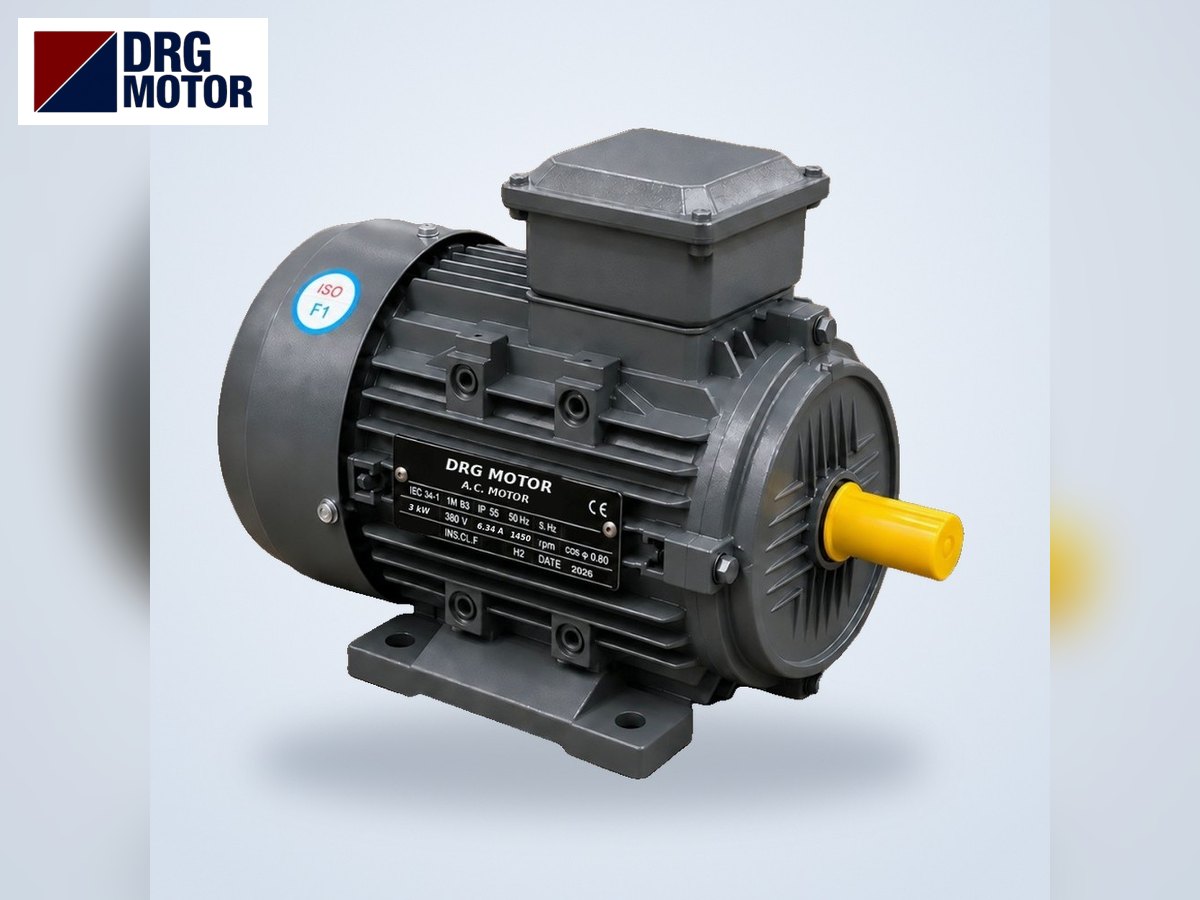
On a pillar drill the electric motor turns the spindle; all the power for drilling, countersinking and tapping comes from it. Larger machines add an automatic feed and a coolant pump next to the main motor, and radial drills add arm-raising and clamping motors on top. This page shows which motor works where on a drilling machine, what an aluminium housing brings to it, and what is measured when the motor is replaced. Removing the old motor, the pulley ratio and the forward-reverse panel are dealt with in our separate article on power and wiring selection for a drill press motor.
DRG Motor is a manufacturer, supplier and seller of electric motors. We do not sell the drilling machine itself, the geared head, chucks, coolant pumps, speed drives or control panels; what we provide is the three-phase induction motor behind the spindle and the auxiliary drives. All our aluminium-housing models are gathered in the Aluminium Housing Electric Motors category.
How motor duties are split on a drilling machine
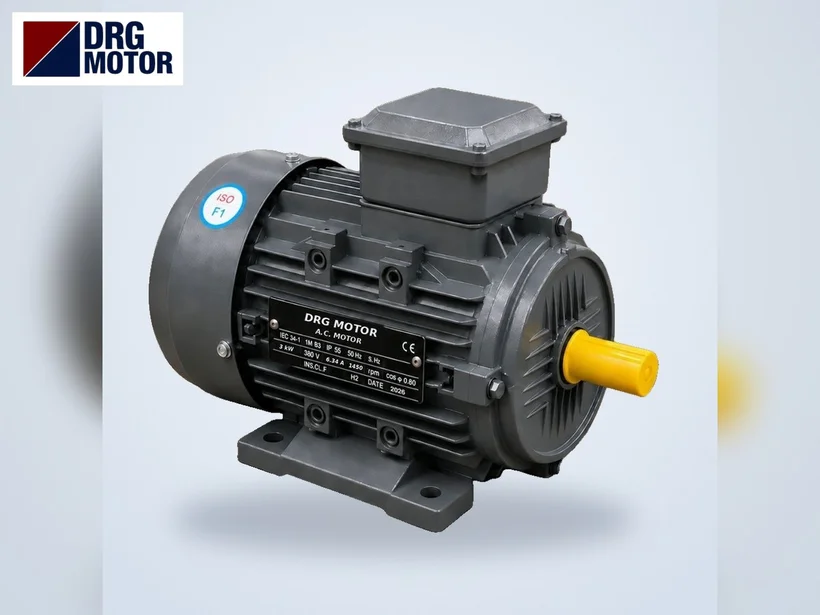
Spindle (main) motor
It sits behind the head, usually with its shaft pointing up. On a belt machine the step pulley on the motor shaft drives the matching pulley on the spindle, and the operator moves the belt between steps to choose a speed. On a geared-head machine the motor feeds the gear train inside the head and speed is changed with a lever. In both cases larger holes need more torque at low speed, so the torque reaching the spindle on the slowest step matters as much as the kW figure.
Automatic feed
On some machines the quill descends under power rather than by hand. The motion is mostly taken from the spindle through gears; where a separate small drive is used, it is a low-power unit working through a gearbox and its plate is read separately from the main motor.
Coolant pump
The pump lifting coolant from the base tank appears in maker sheets with very small ratings such as 0.07–0.1 kW. These pumps usually come as one piece with their motor and are replaced complete; types coupled to a standard IEC motor are rare.
What makes a radial drill different
On a radial drill the head slides along an arm that swings around the column, so large heavy parts are drilled without being moved. Besides the main motor there is a motor raising the arm and a motor for the hydraulic unit that locks arm and column. Arm raising holds a suspended load; the machine maker’s brake or lock keeps it in place, and a brake motor is something we do not carry. The main motor and the clamping unit’s pump motor, however, can be covered by a standard motor.
How many kW is a drilling machine motor? Values from maker sheets
A) Motor ratings given in drilling machine catalogues according to drilling capacity:
| Machine / capacity (steel) | Motor power | Number / type | Note |
|---|---|---|---|
| Step-pulley pillar drill, 25 mm | 0.75 kW | single main motor | first catalogue, smallest model |
| Step-pulley pillar drill, 32 mm | 1 / 1.2 kW | two-speed main motor | first catalogue |
| Geared-head pillar drill, 30–40 mm | 0.9 / 1.5 kW and 2.2 kW | main motor + 0.07 kW pump | second maker’s sheet |
| Geared-head pillar drill, 40 mm | 2.2 / 1.5 kW | two-speed motor + 0.09 kW pump | third maker’s sheet |
| Variable-speed pillar drill, 50 mm | 3 kW | inverter-fed main motor | first catalogue |
| Heavy pillar drill, 70 mm | 5.5 kW | main motor + 0.09 kW pump | second sheet, largest model |
| Radial drill, mid size | 3.75 kW main; 1.5 kW arm; 0.75 kW clamping | four motors (pump 0.1 kW) | radial drill sheet |
| Radial drill, large | 7.5 kW main; 3.75 kW arm | four motors | same sheet, large model |
Pillar drills show main motors of roughly 0.75–5.5 kW depending on model and capacity; on radial drills the main motor reaches 7.5 kW and the arm motor 3.75 kW. The values belong to sample machines; on your own machine the rating plate governs.
B) Overlap with the DRG range: our aluminium range spans 0.25–11 kW, so every main motor in the table fits it by power. What does not overlap is motor type, not power. Pole-changing two-speed main motors, coolant units with pump and motor in one housing, and arm axes that need a brake are outside our range. For heavy radial or multi-spindle machines above 11 kW, see the cast iron models on the General Purpose Electric Motors page.
Aluminium on a drill head: the practical gain
The weight is carried at the top of the head
On a pillar drill the motor hangs at the very top of the column, behind the head. A light housing reduces that overhanging load; the difference is felt when the head is raised or lowered on the column, when the motor plate is slid to tension the belt and when one person removes and refits the motor. A compact housing also fits more easily into the narrow space inside the pulley guard.
The real limit of low weight
A light motor does not raise the drilling capacity of the machine and does not by itself reduce vibration at the head; vibration depends on column stiffness, bearings and the belt. Where a heavy radial drill takes hard shocks, vibrates all day and needs a lot of power, cast iron stands up better. On a workshop pillar drill both housings do the job; the gain of aluminium lies in fitting and servicing.
Click to see current electric motor prices and order nowSEE PRICES →
Dimensions checked when replacing the motor
Power, speed and voltage
Pulley and gear steps are calculated for the motor speed. So if the old motor had 4 poles the new one must have 4 poles as well; otherwise the whole speed chart on the head shifts. The 0.55–3 kW models most drills use carry a 230/400 V label and their terminal links sit in the star position; from 4 kW the label reads 400/690 V and the links go to delta.
Vertical mounting and flange
A flange motor with the shaft up is ordered as V3, a flange motor with the shaft down as V1, a foot motor with the shaft up as V6. Many drill heads use a small B14 flange; we do not give its dimensions here, so the outer diameter, bolt circle and spigot of the old motor are measured and compared. For a large B5 flange connection the catalogue values are:
| Frame | Shaft D×E | Flange P / M / N | Hole S |
|---|---|---|---|
| 80 | 19×40 | 200 / 165 / 130 | 12 |
| 90S/90L | 24×50 | 200 / 165 / 130 | 12 |
| 100L/112M | 28×60 | 250 / 215 / 180 | 14.5 |
| 132S/132M | 38×80 | 300 / 265 / 230 | 14.5 |
Pulley, coupling and gear input
On a belt machine the pulley goes straight onto the motor shaft; if shaft diameter or key width differ, the pulley is bushed or replaced. On a geared-head machine the shaft end enters a pinion or coupling half in the head, so shaft length must match too. Gearboxes and geared heads are not supplied by DRG; only the motor is replaced.
Starting, tapping and working environment
Stop-start and reversing
When tapping, the motor turns forward and back for every hole; each reversal is a new start. Example: DRG-90L-4 (1.5 kW) has a 3.3 A plate current and a starting ratio of 7, so the winding briefly carries around 23.1 A at every reversal. On a machine tapping in series the winding heats up under these current pulses; the remedy is a motor one size larger or a drive that softens the reversal. The thermal relay is set to the rated current on the plate, not to the starting current.
Speed control and two-speed motors
Pole-changing two-speed motors are common on drilling machines; they are not in our range. Such a machine has two routes: a single-speed 4-pole motor with speed chosen through the steps on the head, or feeding the motor from a frequency inverter. DRG does not supply inverters; mention inverter operation when you ask for a quote.
Coolant, chips and IP55
IP55 on our motors means harmful dust stays out and a weak water jet hitting the housing from whatever side does no damage. A high-pressure washer lance, a steam cleaner or immersion in liquid is beyond what that rating covers. Keep the coolant hose away from the motor, turn the terminal box and cable entry to face down, and clean chips off the fan cover regularly. The ambient range is −15…+40 °C.
Example: from sheet value to DRG model
We matched the sheet values above to 4-pole models in our aluminium range; currents come from the product records:
| Main motor on the sheet | Aluminium DRG match | Current 400 V | Watch out |
|---|---|---|---|
| 0.75 kW | DRG-802-4 | 1.75 A | pulley chart assumes 4 poles |
| 1–1.2 kW | DRG-90S-4 | 2.48 A | a two-speed drive becomes one speed |
| 1.5–2.2 kW | DRG-100L1-4 | 4.52 A | gear lever stays as it is |
| 3 kW | DRG-100L2-4 | 6.02 A | inverter bought separately |
| 3.75 kW | DRG-112M-4 | 7.95 A | arm motor may be a brake type |
| 5.5 kW | DRG-132S-4 | 10.7 A | cast iron also worth a look on heavy machines |
If the slowest spindle speed on a 50 mm geared-head machine is 50 rpm, the 19.8 Nm rated torque of the 3 kW DRG-100L2-4 gives at most 19.8 × 1450 / 50 ≈ 574 Nm at the spindle before losses. The real figure is lower by the gear losses; it is this torque that turns a large drill or tap.
Aluminium DRG motors for drilling machines
| Model | Power · speed | Frame · shaft D×E | Current 400 V · torque |
|---|---|---|---|
| DRG-801-4 | 0.55 kW · 1500 rpm (rated 1400) | 80 aluminium · 19×40 | 1.31 A · 3.75 Nm |
| DRG-802-4 | 0.75 kW · 1500 rpm (rated 1420) | 80 aluminium · 19×40 | 1.75 A · 5.04 Nm |
| DRG-90S-4 | 1.1 kW · 1500 rpm (rated 1445) | 90S aluminium · 24×50 | 2.48 A · 7.27 Nm |
| DRG-90L-4 | 1.5 kW · 1500 rpm (rated 1445) | 90L aluminium · 24×50 | 3.3 A · 9.91 Nm |
| DRG-100L1-4 | 2.2 kW · 1500 rpm (rated 1450) | 100L aluminium · 28×60 | 4.52 A · 14.5 Nm |
| DRG-100L2-4 | 3 kW · 1500 rpm (rated 1450) | 100L aluminium · 28×60 | 6.02 A · 19.8 Nm |
| DRG-112M-4 | 4 kW · 1500 rpm (rated 1450) | 112M aluminium · 28×60 | 7.95 A · 26.3 Nm |
| DRG-132S-4 | 5.5 kW · 1500 rpm (rated 1460) | 132S aluminium · 38×80 | 10.7 A · 36 Nm |
Live price table
The table below fetches the store price of these aluminium-housing models every time the page opens:
| Model | Power / speed | Frame · current 400 V | Price |
|---|---|---|---|
| DRG-802-41 HP | 0.75 kW · 1500 rpm | Aluminium 80 · 1.75 A | $97.30 (€86.90) Details & buy → |
| DRG-90S-41.5 HP | 1.1 kW · 1500 rpm | Aluminium 90S · 2.48 A | $118.44 (€105.78) Details & buy → |
| DRG-90L-42 HP | 1.5 kW · 1500 rpm | Aluminium 90L · 3.3 A | $137.59 (€122.88) Details & buy → |
| DRG-100L1-43 HP | 2.2 kW · 1500 rpm | Aluminium 100L · 4.52 A | $179.76 (€160.54) Details & buy → |
| DRG-100L2-44 HP | 3 kW · 1500 rpm | Aluminium 100L · 6.02 A | $194.58 (€173.77) Details & buy → |
| DRG-112M-45.5 HP | 4 kW · 1500 rpm | Aluminium 112M · 7.95 A | $242.82 (€216.85) Details & buy → |
| DRG-132S-47.5 HP | 5.5 kW · 1500 rpm | Aluminium 132S · 10.7 A | $326.47 (€291.56) Details & buy → |
DRG MOTOR motors are guaranteed against material and manufacturing defects for 2 years from the delivery date (warranty certificate).
Motors in this power range
- DRG-802-4 – 0.75 kW – 1420 rpm – 80 aluminium
- DRG-90L-4 – 1.5 kW – 1445 rpm – 90L aluminium
- DRG-100L2-4 – 3 kW – 1450 rpm – 100L aluminium
- DRG-112M-4 – 4 kW – 1450 rpm – 112M aluminium
Click to see current prices and order these motors nowSEE PRICES →
Browse the products, ask for a quote: all models are on the Buy Electric Motors Online page. For a quote, message our WhatsApp line with a picture of the nameplate on the motor being replaced, the drilling capacity of the machine, whether it is belt or geared-head, the shaft direction and flange dimensions, shaft diameter and key, whether the motor is two-speed, the mains voltage, and the daily running time and number of starts. Phone: +90 (542) 666 11 11.
Frequently asked questions
Can I replace the arm-raising motor of a radial drill with a DRG motor?
Not if the arm motor is a brake motor; brake motors are not in our range. If a mechanical lock holds the arm and the motor has no brake, a standard motor is assessed by comparing power, speed and flange on its plate.
Does an aluminium motor cause vibration at the head?
Vibration usually comes from a bent pulley, a worn belt or a loose motor plate. Balanced pulleys and correct belt tension decide it, not the housing material.
My machine came with a single-phase motor; can I switch to three-phase?
Yes, provided three-phase power reaches the workshop; we have no single-phase motors to offer. If only 220 V is on hand, a small 230/400 V motor connected in delta can be run from an inverter that turns the single-phase supply into three phases.
For questions: +90 (542) 666 11 11 · info@drgmotor.com · contact.


