 English
 Le français
 Türkçe

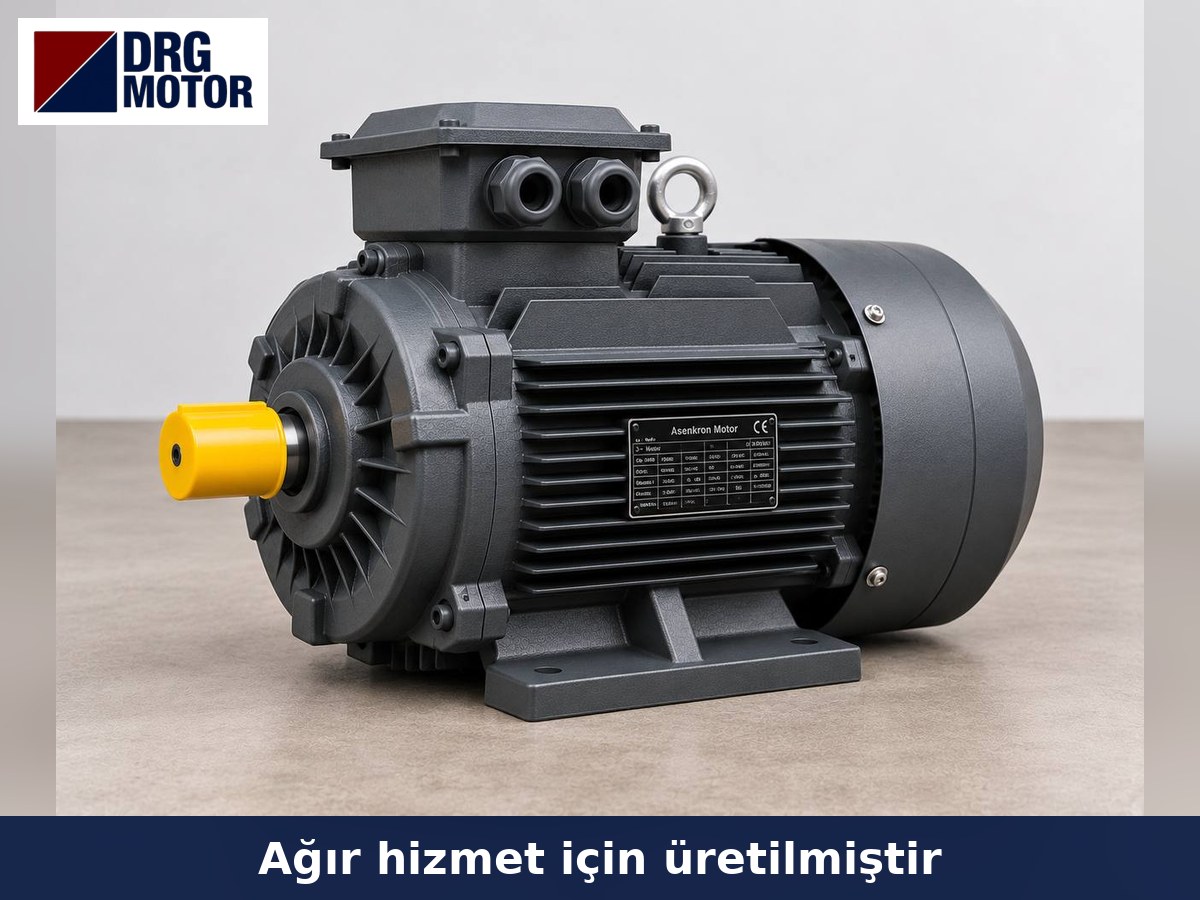
First, the honest distinction: hoisting drives that carry a load in the air, such as cranes, hoists, the rope drive of a goods lift and elevating platforms, need a brake motor that holds the load by itself when power is lost, and brake motors are not part of our range. We therefore do not recommend a standard motor for a hoisting drive; replacing an existing hoist motor with a standard motor that has no brake can let the load fall. What we cover on lifting and handling machines are the drives that need no brake: horizontal pallet and carton conveyors, roller and chain handling lines, ventilation fans for crane cabins and electrical rooms, and pump motors of platforms whose load is held by a hydraulic lock.
DRG Motor is a manufacturer, supplier and seller of electric motors. We do not sell cranes, hoists, platforms, conveyors, gearboxes, hydraulic units, brake assemblies or drives; we supply only the three-phase induction motor for the points on this equipment that need no brake. The model list is on the Buy Electric Motors Online page, and other applications in the series are on General Purpose Industrial Electric Motors.
Why does a hoisting drive need a brake motor?
On a drive that moves a load vertically, the motor does more than lift: it keeps the load at a height and lowers it under control. A spring-applied brake closes when power fails or the control stops, mechanically blocking the drum. A standard motor has no such brake; unless the gearbox is self-locking, the load turns the drum backwards. Details are in our articles what is a brake motor and when a brake motor is needed.
Cranes and hoists: hoisting, trolley and bridge travel
An overhead crane has three axes: hook hoisting, trolley travel and bridge travel. Hoisting is always braked, and most designs also brake the travel axes to stop in position and resist wind. That is why we do not cover any crane axis with a standard motor. The general layout of crane drives is described in electric motors for cranes, selection criteria on the hoisting side in motor selection for cranes and lifting systems, and the travel side in travel motors on overhead cranes.
Where a DRG motor fits on a crane: cabin and ventilation
Fans that change the air in the crane cabin, the electrical panel room on the bridge or the machine room need no brake. Their motors can be standard motors with IP55 frames; fan-type selection is explained on the fan motors page. For general information on the crane supply process see our crane motor supply article; the hoisting motors mentioned there are outside our range.
Horizontal handling without a brake: conveyors, roller and chain lines
Lines that move pallets, crates and cartons horizontally in warehouses, dispatch areas and in-plant logistics are not hoisting machines. Here the motor only moves the load forward on the level; if power fails the pallet stays where it is. These lines are usually driven by a small motor coupled to a gearbox.
Roller lines for pallets and cartons
Driven rollers are linked by chain or belt, and one motor turns all rollers of a section. Section length, pallet weight and speed set the motor power. For gearbox matching and speed control on roller conveyors see our roller conveyor motor article.
Chain transfers and turntables
Chain transfers turn the pallet’s direction by 90°, turntables rotate it on its own axis. The motor for horizontal movement can be supplied without a brake; the unit that raises the transfer above roller level, however, is supplied by the maker with a brake motor, and that part is outside our range.
Inclined belts and roll-back
An inclined belt or chain that carries goods up a level wants to run back under the load when the motor stops. The design then relies on either a backstop or a brake. If the backstop is in the gearbox the motor can be standard; if the designer specified a brake motor, that drive is not within our scope.
Hydraulic platforms: the motor turns the pump, the hydraulics hold the load
On scissor tables, hydraulic goods lifts and dock levellers the electric motor only drives the hydraulic pump. The load stays hydraulically locked thanks to the check valve and the velocity fuse in front of the cylinder; lowering is usually by gravity through an opened valve. When the motor stops, the hydraulic circuit holds the load, not the motor. So if the platform builder confirms that the circuit holds the load with a hydraulic lock, the pump motor can be a standard motor. The kW calculation from pressure and flow is in the hydraulic pump motor selection article.
Some catalogues also offer these units with single-phase motors; for this category we advise against single-phase, and if your site lacks three-phase power, talk to us first. Motors of battery-powered DC work platforms are outside our range as well.
Click to see current electric motor prices and order nowSEE PRICES →
Catalogue values: how many kW?
A) Motor powers stated in manufacturer data sheets for brake-free handling equipment and hydraulic platforms:
| Equipment / model group | Motor power | Single / total | Note |
|---|---|---|---|
| Pallet roller conveyor, 12–18 m/min | 0.37–0.55 kW | per conveyor section | first maker; non-braked as standard |
| Pallet chain transfer, 1500 kg pallet | 0.75–1.1 kW | per transfer | first maker; non-braked as standard |
| Lift unit of the transfer | 0.75 kW | single motor | first maker; supplied BRAKED |
| Pallet chain conveyor, 3000 kg per drive | 0.12–0.75 kW | motor with gearbox | second maker |
| Hydraulic scissor table, 1000 kg | 0.75 kW | pump motor | third maker |
| Hydraulic scissor table, 2000 kg, 1600 mm stroke, 30 s | 2.2 kW | pump motor | fourth maker |
| Hydraulic goods lift, 300–2500 kg | 1.5–5.5 kW | pump motor | fifth maker; 4–7.5 kW at 3000–5000 kg |
| Hydraulic dock leveller, 6–10 t | 0.75–2.2 kW | pump motor | sixth, seventh and eighth makers |
Depending on model and load, this equipment uses roughly 0.12–7.5 kW motors: 0.12–1.1 kW on pallet conveyors, 0.75–2.2 kW on scissor table and dock leveller pumps, 1.5–7.5 kW on hydraulic goods lifts. Pump motors grow with load, stroke and lifting time. The third row of the table is there on purpose: the maker supplies the lift unit of the same transfer with a brake motor.
B) Overlap with the DRG range: brake-free conveyor and pump motors from 0.25 kW upwards are covered by our aluminium (0.25–11 kW) and cast iron frames. Smaller drives such as 0.12 kW, all brake motors and battery DC motors are outside our range.
Worked example: horizontal chain pallet line
Assumptions: two 1500 kg pallets on the line at once (3000 kg in total), rolling resistance factor 0.03, speed 12 m/min, drive roller 89 mm in diameter, and a factor of 1.5 for starting and gearbox losses. The motor is the DRG-712-4 (0.37 kW, 1340 rpm, 2.64 Nm).
| Step | Operation | Result | Note |
|---|---|---|---|
| Rolling resistance | 3000 × 9.81 × 0.03 | about 883 N | μ = 0.03 assumed |
| Shaft power at 12 m/min | 883 × 0.2 | about 177 W | v = 0.2 m/s |
| With start and gearbox margin | 177 × 1.5 | about 265 W | next step up: 0.37 kW |
| Roller speed and ratio | 0.2 × 60 / (π × 0.089); 1340 / 42.9 | 42.9 rpm; ratio ≈ 31.2 | DRG-712-4 |
| Torque at roller / required | 2.64 × 31.2 × 0.95; 883 × 0.0445 | ≈ 78.3 Nm / ≈ 39.3 Nm | about twice the need |
The calculation shows 0.37 kW is enough, which also agrees with the first maker’s 0.37 kW for 12 m/min. Torque at the roller is about twice the need; that margin helps when starting under load and when a pallet foot catches between rollers. To try other roller diameters, use our gearbox calculator.
A quick check for the hydraulic table
The 2000 kg table in the catalogue rises 1600 mm in 30 seconds, about 0.053 m/s. Assuming 2400 kg lifted together with the top and scissor arms, net lifting power is 2400 × 9.81 × 0.053 ≈ 1.26 kW. The maker’s choice of 2.2 kW is explained by the much larger cylinder force when the scissors are closed and by pump and valve losses. Matching that 2.2 kW four-pole pump drive from our records gives the DRG-100L1-4, which draws 4.52 A at 400 V and turns at 1450 rpm.
DRG motors for brake-free drives
| Model | Power / speed | Frame · shaft D×E | Current 400 V |
|---|---|---|---|
| DRG-712-4 | 0.37 kW / 1340 rpm | 71 aluminium · 14×30 | 0.92 A |
| DRG-801-4 | 0.55 kW / 1400 rpm | 80 cast iron · 19×40 | 1.31 A |
| DRG-802-4 | 0.75 kW / 1420 rpm | 80 cast iron · 19×40 | 1.75 A |
| DRG-90S-4 | 1.1 kW / 1445 rpm | 90S cast iron · 24×50 | 2.48 A |
| DRG-90L-4 | 1.5 kW / 1445 rpm | 90L cast iron · 24×50 | 3.3 A |
| DRG-100L1-4 | 2.2 kW / 1450 rpm | 100L cast iron · 28×60 | 4.52 A |
| DRG-112M-4 | 4 kW / 1450 rpm | 112M cast iron · 28×60 | 7.95 A |
| DRG-132S-4 | 5.5 kW / 1460 rpm | 132S cast iron · 38×80 | 10.7 A |
The models in the table are 4-pole; on conveyor drives they work with a gearbox, on pump motors with a bell housing and coupling. Foot, flange or combined builds are possible, and so is an upright V1 version; for a pump motor standing upright on the hydraulic tank, vertical mounting and axial load are confirmed with the unit maker. Protection is IP55, insulation class F; on outdoor dock levellers, consider a canopy to keep rain and snow water off the motor.
Live price table
Prices for models suited to brake-free handling and pump drives come live from the shop:
| Model | Power / speed | Frame · current 400 V | Price |
|---|---|---|---|
| DRG-712-40.5 HP | 0.37 kW · 1500 rpm | Aluminium 71 · 0.92 A | $76.76 (€68.55) Details & buy → |
| DRG-801-40.75 HP | 0.55 kW · 1500 rpm | Cast iron 80 · 1.31 A | $91.72 (€81.91) Details & buy → |
| DRG-802-41 HP | 0.75 kW · 1500 rpm | Cast iron 80 · 1.75 A | $101.93 (€91.03) Details & buy → |
| DRG-90S-41.5 HP | 1.1 kW · 1500 rpm | Cast iron 90S · 2.48 A | $124.09 (€110.82) Details & buy → |
| DRG-90L-42 HP | 1.5 kW · 1500 rpm | Cast iron 90L · 3.3 A | $144.14 (€128.73) Details & buy → |
| DRG-100L1-43 HP | 2.2 kW · 1500 rpm | Cast iron 100L · 4.52 A | $188.32 (€168.18) Details & buy → |
| DRG-112M-45.5 HP | 4 kW · 1500 rpm | Cast iron 112M · 7.95 A | $254.38 (€227.18) Details & buy → |
| DRG-132S-47.5 HP | 5.5 kW · 1500 rpm | Cast iron 132S · 10.7 A | $342.01 (€305.44) Details & buy → |
DRG MOTOR motors are guaranteed against material and manufacturing defects for 2 years from the delivery date (warranty certificate).
Motors in this power range
- DRG-712-4 – 0.37 kW – 1340 rpm – 71 aluminium
- DRG-802-4 – 0.75 kW – 1420 rpm – 80 cast iron
- DRG-90L-4 – 1.5 kW – 1445 rpm – 90L cast iron
- DRG-100L1-4 – 2.2 kW – 1450 rpm – 100L cast iron
- DRG-112M-4 – 4 kW – 1450 rpm – 112M cast iron
Click to see current prices and order these motors nowSEE PRICES →
Browse the products, request a quote: for a quotation send the equipment type (conveyor, transfer, scissor table, goods lift, dock leveller), whether the motor holds the load, a photo of the old nameplate, the gearbox or pump connection, daily operating hours and number of starts on WhatsApp or call +90 (542) 666 11 11. If the nameplate of the motor you want to replace shows a brake voltage, say so: we will not offer a standard motor in its place.
Frequently asked questions
Our hoist motor burned out. Can I fit a standard motor?
No. A hoist holds the load in the air and needs a brake motor; a standard motor cannot do this safely. For that swap, turn to the hoist builder or a specialist in brake motors, which we do not carry.
Can I buy the pump motor of a hydraulic scissor table from you?
Yes, if the check valve and velocity fuse hold the load and the motor only turns the pump. A single-phase unit needs conversion to three-phase; let us discuss that before ordering.
Does a horizontal conveyor need a brake motor?
On most horizontal lines it does not. Where a station must stop precisely or an inclined section is involved and the design specifies a brake, that drive is outside our range.
Questions: +90 (542) 666 11 11 · info@drgmotor.com · contact.


