 English
 Le français
 Türkçe

A broken belt usually does not directly damage the motor winding: the load disappears suddenly, the motor rises to no-load speed and its current drops. The damage tends to come by indirect routes: a flying piece of belt, the remaining belts overloaded because belts have snapped one by one, and the root cause of the break also affecting the motor.
What happens at the moment of breakage?
When the whole belt set breaks, the crusher flywheel keeps turning for a while on its inertia and the motor is left without load. An overcurrent-based protection arrangement does not usually treat no-load running as a fault; the motor idles until the operator notices, which is not harmful in itself. When only part of the set breaks, however, the remaining belts carry the whole load, slip, heat up and soon break as well. At this stage the pulley grooves can wear.
The cause behind the break concerns the motor too
- Jamming: If an oversized or metal piece entered the crusher, the belt may have acted like a fuse; the motor and shaft took a shock at that moment.
- Misalignment: If the pulleys are not in the same plane, the belt wears on its flanks; the same misalignment places axial load on the motor bearing.
- Excessive tension: It shortens belt life and also strains the drive-end bearing.
- Flexing base: It makes the tension fluctuate during operation.
Checklist after a belt break
- Look for signs of impact on the fan cover, the terminal box and the cable entry.
- Turn the motor shaft by hand; there should be no catching or rough noise from the bearings.
- Check that the pulley has not loosened on the shaft and runs true.
- Check pulley groove wear with a gauge.
- Replace the belts as a set from the same length group; do not mix old and new.
- Do not run the machine without refitting the belt guard.
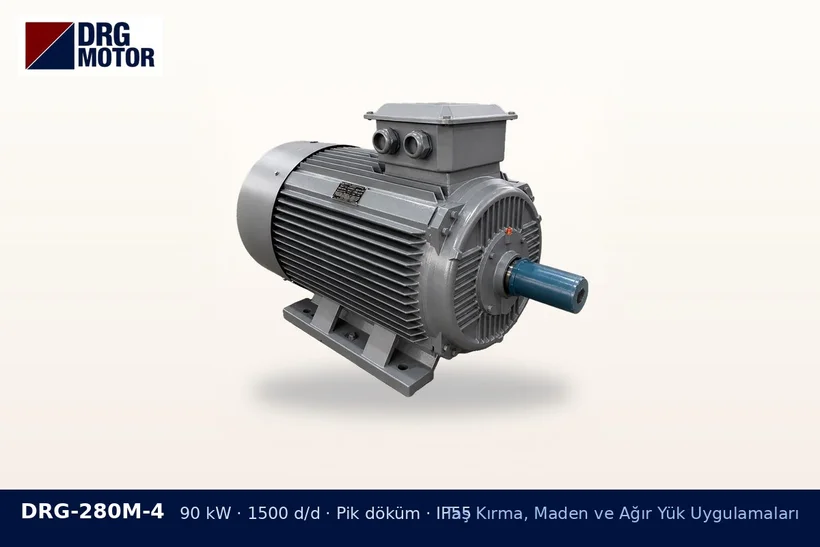
If the motor afterwards shows abnormal noise, vibration or heating, it should not be kept in service without measurements. If the pulley dimensions are to change, the pulley and belt calculator helps; the power ratings used for crusher drives appear on application pages such as secondary impact crusher motor and in the list of cast iron frame motors.