 English
 Le français
 Türkçe

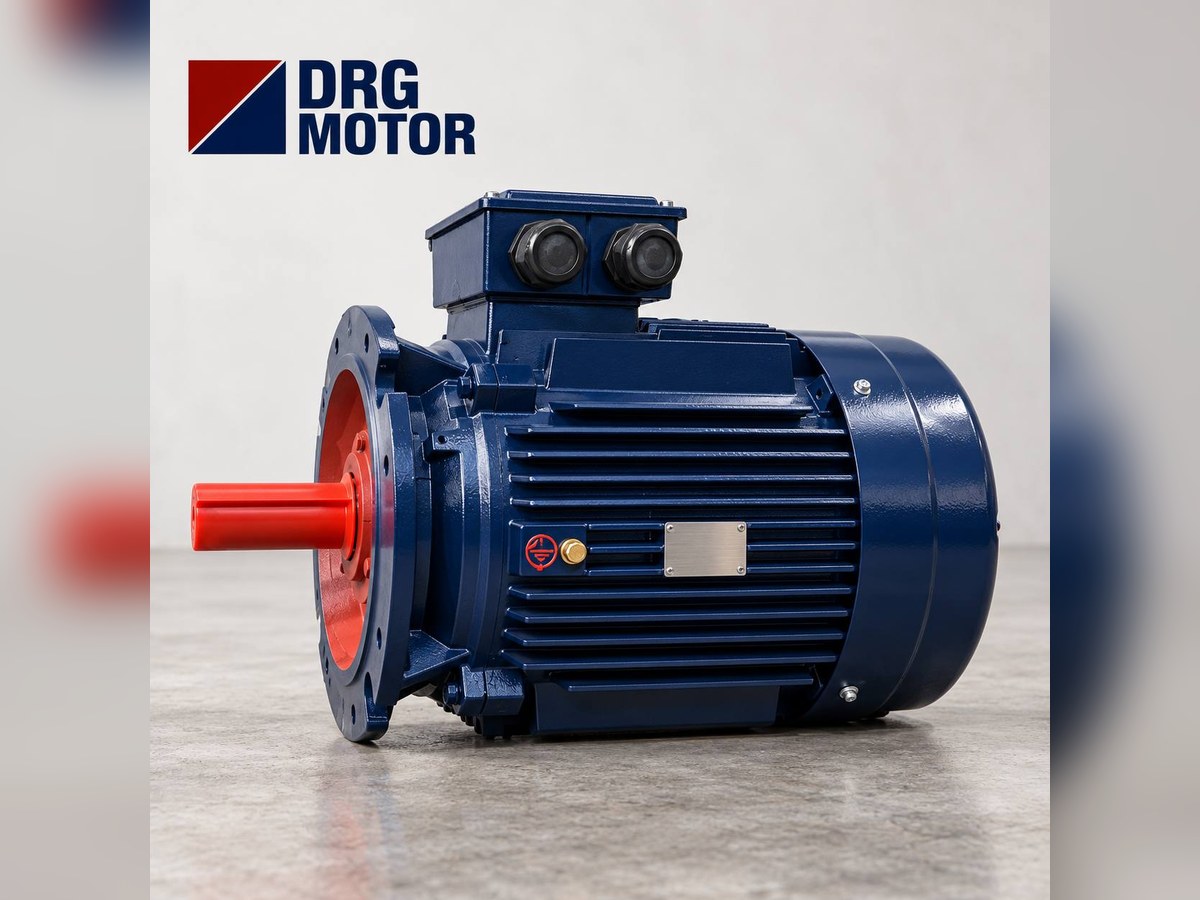
On a marble polishing and slab polishing line, electric motors do three jobs: they spin the polishing heads carrying progressively finer abrasives, swing the bridge that carries those heads back and forth across the slab width, and drive the belt that moves the slab through the line. In maker catalogues a marble line head carries 7.5–11 kW, a granite line head 15 kW, and bridge and belt motors 1.5–2.2 kW. The calibrating and honing machine that brings the face to thickness is not covered here; its motors are explained on a separate page.
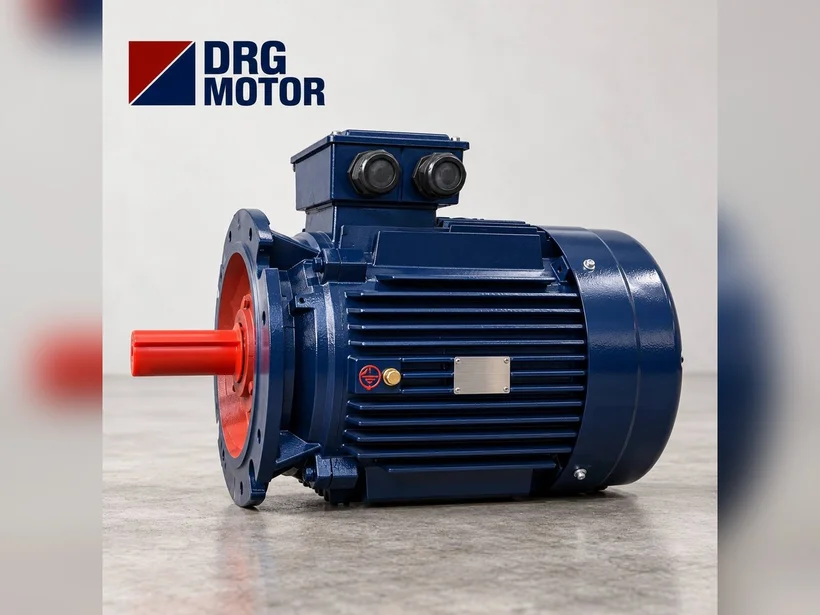
DRG Motor is a manufacturer, supplier and seller of electric motors. We do not sell the polishing line, its heads or abrasives, and the same goes for gearboxes, pneumatic or hydraulic pressing systems, water pump bodies, inverters, electro-spindles and servo motors. We supply only the three-phase induction motors. Matching models are listed on Buy Electric Motors Online.
What the motors do on a polishing line
A slab leaving the calibrating machine enters the polishing line with a flat but matt face. The first heads run with coarse abrasives, the next ones get gradually finer, and the last heads carry felt or polishing tools. Each head is pressed onto the stone, mostly by pneumatic pressure the operator can adjust. Head motor load is set by that pressure, the abrasive grit and the hardness of the stone: coarse heads draw more current than fine ones.
How this differs from the calibrating page
A calibrating machine cuts material away and its heads mostly work at a fixed point; on a polishing line the heads keep moving over the slab with the bridge and take off very little. Polishing head motors are therefore smaller than calibrating head motors, but far more numerous: one line may carry anywhere from 8 to 24 heads. For calibrating and honing machine motors, see our separate page.
Motor groups on the line
Motors on an automatic polishing line fall into four groups: polishing head motors, the bridge traverse motor, the belt drive motor and auxiliaries related to head pressure. Catalogues state that belt and bridge speed can each be set separately by inverter; on one maker’s line both movements run through gearboxes. Water reaches every head through its own nozzles and is usually supplied by a separate pump motor.
Polishing head motor: speed, pulleys and mounting
A polishing head spins on a vertical spindle, and on most lines a belt links motor and spindle: one catalogue states plainly that the polishing spindle is driven by a multi-ribbed V-belt. The belt moves the motor slightly away from the water, cushions sudden load and lets you set head speed by swapping a pulley. On other lines the head motor is flange-mounted straight onto the head.
Order note for vertical mounting
If the motor sits above the head with its shaft pointing down, V1 mounting is needed. Vertical operation requires the motor to be ordered for vertical mounting and the axial load to be confirmed by the machine maker. Do not choose a motor before learning from the machine drawing whether the pneumatic pressing force lands on the head’s own bearings or on the motor bearing. On belt-driven heads tension matters: an over-tight belt wears the motor bearing early, a slack one slips and heats up while polishing.
Head speed and pulley ratio
The data sheet of a single-head bridge polisher gives a head speed of 550 rpm. Our 4-pole motors run at about 1465 rpm, so the belt has to step that down. Too high a head speed heats the abrasive and can leave skid marks, too low a speed slows the gloss; the right value comes from the machine and abrasive makers. Head speed can be changed by inverter, but a motor running slowly for long periods loses cooling from its own shaft fan.
Granite versus marble polishing: the load difference
Marble and travertine are soft, calcite-based stones; granite and quartzite are hard and abrasive. Catalogues show this in motor power: 7.5–11 kW per head on marble lines, 15 kW on granite lines. Granite needs more abrasive pressure, longer dwell and a slower belt. If one line is to run both marble and granite, the head motor is sized for the hard stone, and pressure and belt speed are lowered for marble.
Choosing motors for a granite line
In granite polishing the heads run at high load for long periods, and hard stone dust in the water is very abrasive. Do not go below the old nameplate rating, set the motor protection relay to nameplate current and write down head current every week; a slowly rising current points to abrasive wear or a head bearing problem. With marble the real issue is not current but how evenly the head sits on the stone.
Click to see current electric motor prices and order nowSEE PRICES →
How many kW is a slab polishing line motor? Maker values
A) Motor powers listed in catalogues for automatic polishing lines and single-head bridge polishers:
| Line / machine | Motor power | Single / total | Note |
|---|---|---|---|
| Marble polishing line, 500 mm plate, travelling bridge | 7.5 kW | per head | first maker catalogue |
| Marble polishing line, 690 mm plate, fixed bridge | 11 kW | per head | same catalogue |
| Marble polishing line, 12–24 heads | 11 kW | per head; total = heads × 11 + 32 kW | second maker |
| Granite polishing line, 8–20 heads | 15 kW | per head; line total 141–329 kW | third maker |
| Granite polishing line, 16 heads | 15 kW | per head; line total 208 kW | fourth maker |
| Bridge traverse motor | 1.5–2.2 kW | single motor | first and fifth maker |
| Belt drive motor | 1.5–2.2 kW | single motor | first and fifth maker |
| Single-head bridge polisher | 15 kW | single head; installed 20 kW | sixth maker; another maker gives 550 rpm at the head |
Across these lines, depending on model and stone type, a head carries roughly 7.5–15 kW, and the bridge and belt 1.5–2.2 kW. Total line power grows with head count and can pass 300 kW; that is not the rating of one motor. One catalogue offers head motors of 7.5, 9, 11 or 15 kW: 9 kW is not a standard IEC step, so we pick a replacement for such a motor together with the old nameplate and pulley size.
B) Where DRG fits: a 7.5 kW head matches our 4-pole cast iron 132M, an 11 kW head the 160M and a 15 kW head the 160L, while bridge and belt drives match the 90L and 100L. At 11 kW we also have a compact aluminium 132M model, shorter and lighter and so a candidate for a vertical head, but with a different shaft size (see the table below). If a non-standard long shaft or machine-specific flange was used on the head, that dimension is not in our range.
Worked example: a 16-head granite line
Take a 16-head granite line with 15 kW per head and a head speed of 550 rpm. Using DRG-160L-4 catalogue values (rated torque: DRG-160L-4, 97.8 Nm):
| Step | Operation | Result | Meaning |
|---|---|---|---|
| Pulley ratio | 1465 / 550 | 2.66 | DRG-160L-4 speed / head speed |
| Head pulley diameter | 150 × 2.66 | about 400 mm | with a 150 mm motor pulley |
| Torque at the head spindle | 9550 × 15 / 550 | about 260 Nm | full load, losses ignored |
| Total current of 16 heads | 16 × 27.3 A | about 437 A | all at full load, 400 V |
| Same line with 11 kW heads | 16 × 20.4 A | about 326 A | with DRG-160M-4 |
Not every head draws full load at once, but the panel and transformer must be planned for this total. To try the ratio with your own pulleys, use the pulley and belt calculator. Heads should be started one by one and lifted off the stone; on large head motors, star-delta starting softens the starting surge.
Bridge traverse, belt and the single-head polisher
Bridge traverse motor
The bridge carries the heads from one edge of the slab to the other and reverses at the ends. It can reach tens of metres per minute, and at every reversal the motor goes through a short deceleration and acceleration. The motor is small (1.5–2.2 kW in catalogues), but frequent reversing stresses bearings and gearbox; most lines use an inverter for soft changeover. Some lines have a fixed bridge with heads turning in place, in which case this motor does not exist.
Belt motor
The belt carries the slab slowly under the heads at a speed of metres per minute, set by inverter. Belt motor, gearbox and drum work together; if the motor stays at low inverter frequency for long, consider a separate cooling fan.
Single-head bridge polisher
On a workshop-type single-head bridge polisher, one large head travels over the slab on a bridge moving in two directions. Catalogues give a 15 kW head motor and about 20 kW installed power, the rest belonging to the axis drives. These axes are mostly driven by geared motors or servos; servos and gearboxes are not in our range, but we can supply the standard induction head motor.
DRG motors for the polishing line
4-pole models selected for heads, bridge and belt (current at 400 V):
| Model | Power / speed | Frame · shaft D×E | Current 400 V |
|---|---|---|---|
| DRG-90L-4 | 1.5 kW / 1445 rpm | 90L cast iron · 24×50 | 3.3 A |
| DRG-100L1-4 | 2.2 kW / 1450 rpm | 100L cast iron · 28×60 | 4.52 A |
| DRG-132M-4 | 7.5 kW / 1460 rpm | 132M cast iron · 38×80 | 14.3 A |
| DRG-160M-4 | 11 kW / 1465 rpm | 160M cast iron · 42×110 | 20.4 A |
| DRG-132M-4K | 11 kW / 1465 rpm | 132M aluminium · 38×80 | 20.4 A |
| DRG-160L-4 | 15 kW / 1465 rpm | 160L cast iron · 42×110 | 27.3 A |
When replacing a polishing head motor, power and speed from the old plate, 400 V delta connection, frame size, shaft diameter and key, flange (B5 or V1) and pulley fit are compared with the machine maker’s documents. If the same model is used along the line, keeping one spare motor for all heads shortens downtime. Our motors are IP55; they withstand water splashes but should not stay constantly exposed to the muddy water round the heads, so fit a splash guard. We make no general compatibility promise; we verify the data together.
B5 flange on head motors
B5 values of frames common on polishing heads, from the DRG catalogue (mm):
| Frame | Shaft D×E | Flange P / M / N | Hole S |
|---|---|---|---|
| 132S/132M | 38×80 | 300 / 265 / 230 | 14.5 |
| 160M/160L | 42×110 | 350 / 300 / 250 | 18.5 |
The compact aluminium 132M model has a 38×80 mm shaft, the cast iron 160M a 42×110 mm shaft: even at the same 11 kW, pulley and flange differ.
Live price table
Prices of our models in polishing head, bridge and belt sizes come live from the shop:
| Model | Power / speed | Frame · current 400 V | Price |
|---|---|---|---|
| DRG-90L-42 HP | 1.5 kW · 1500 rpm | Cast iron 90L · 3.3 A | $144.14 (€128.73) Details & buy → |
| DRG-100L1-43 HP | 2.2 kW · 1500 rpm | Cast iron 100L · 4.52 A | $188.32 (€168.18) Details & buy → |
| DRG-132M-410 HP | 7.5 kW · 1500 rpm | Cast iron 132M · 14.3 A | $394.89 (€352.66) Details & buy → |
| DRG-132M-4K15 HP | 11 kW · 1500 rpm | Aluminium 132M · 20.4 A | $515.77 (€460.61) Details & buy → |
| DRG-160M-415 HP | 11 kW · 1500 rpm | Cast iron 160M · 20.4 A | $568.76 (€507.94) Details & buy → |
| DRG-160L-420 HP | 15 kW · 1500 rpm | Cast iron 160L · 27.3 A | $678.13 (€605.61) Details & buy → |
DRG MOTOR motors are guaranteed against material and manufacturing defects for 2 years from the delivery date (warranty certificate).
Motors in this power range
- DRG-100L1-4 – 2.2 kW – 1450 rpm – 100L cast iron
- DRG-132M-4 – 7.5 kW – 1460 rpm – 132M cast iron
- DRG-160M-4 – 11 kW – 1465 rpm – 160M cast iron
- DRG-160L-4 – 15 kW – 1465 rpm – 160L cast iron
Click to see current prices and order these motors nowSEE PRICES →
Browse the products, ask for a quote: every motor suited to your polishing line is on Buy Electric Motors Online. Tell us how many heads the line has and share the head motor plate and pulley size on WhatsApp, or ring +90 (542) 666 11 11.
Frequently asked questions
Must all head motors on a polishing line be replaced together?
No. A failed head can be replaced on its own, but the new motor’s speed and pulley diameter must match the others; otherwise that head turns at a different speed and leaves a mark in the gloss.
Is a marble polishing machine motor enough for granite?
A head sized at 7.5 kW for marble may struggle on granite; catalogues list granite lines with 15 kW heads. Before upsizing, ask the machine maker whether the head spindle, belt and pneumatic pressure can carry that load.
Polishing head motor price: where is it shown?
The live table above shows the current shop value; for a batch sized to your head count, write to us on WhatsApp.
Our line +90 (542) 666 11 11, the mailbox info@drgmotor.com and the contact page are open for your polishing line; let us size the head motors together. For water supply, see the Pump Motors category.


