 English
 Le français
 Türkçe

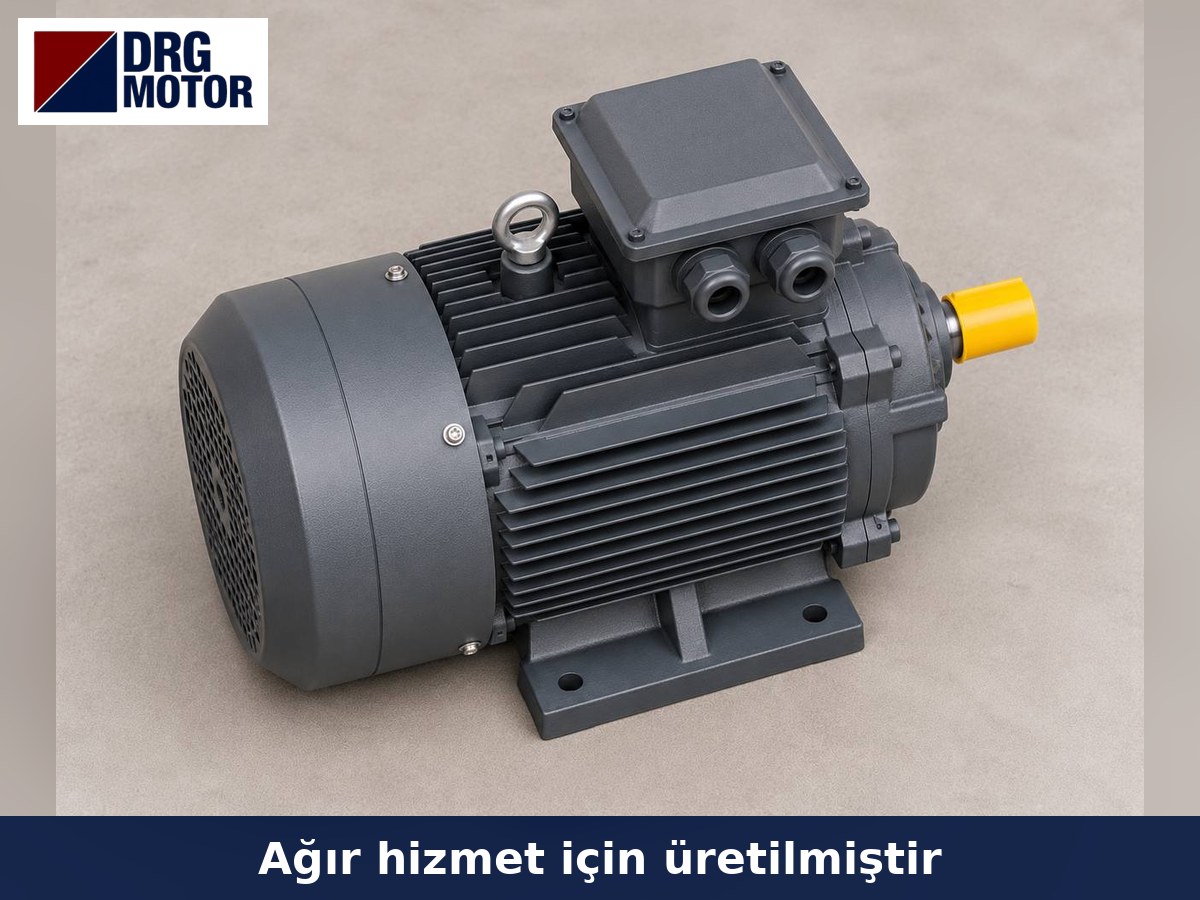
A block cutter (multi-blade block saw) splits a quarry block of marble or granite into strips, tiles and steps with one or more large diamond blades working at the same time. The electric motor’s main job on this machine is to turn the vertical blade shaft; a second motor drives the horizontal blade, and five or six small motors move the bridge, the head and the block carriage. So there is no single block cutter motor: there is a main motor ranging from 37 kW to 160 kW and a family of motors around it.
This page is about those motors. DRG Motor is a manufacturer, supplier and seller of electric motors. We do not sell block cutters, gearboxes, hydraulic units or pumps, drives (inverters), electrospindles or servos; what we supply are the standard three-phase induction motors fitted on the machine. Models by power are listed on Buy Electric Motors Online.
How does a block cutter cut, and how many motors does it carry?
The block is laid on a carriage that runs on rails. Above it sits a bridge on two or four columns; the cutting head travels forward and back along the bridge. At the end of the head one or more vertical blades with diameters between 1,000 and 2,800 mm rotate. The blade enters the block pass by pass, going a little deeper each time. On multi-blade machines several blades lined up on the same shaft open parallel cuts in a single pass.
Vertical blade and horizontal blade
With a vertical blade alone, the slices stay attached to the block at the bottom. On machines with a horizontal blade, a smaller blade (450 mm in one catalogue) follows the vertical cut and undercuts the slices so that each strip comes free. That is why such a machine has two separate cutting motors: the large vertical blade motor and a horizontal blade motor in the 18.5–22 kW range. On some machines the horizontal blade is moved in and out by a small hydraulic unit whose motor is as small as 1.1 kW.
Bridge, head and carriage axes
Depth of cut is set by the bridge moving up and down, slice thickness by the bridge stepping left and right, and cutting speed by the head travelling forward and back. The carriage that brings the block in has its own motor too. On these axes the motor usually works through a gearbox or a lead screw; gearbox, screw and position encoder belong to the machine builder. We only assess the IEC motor bolted to the gearbox.
What separates block cutting from bridge saws, gang saws and wire saws?
A bridge saw brings a slab lying on a table to size with one blade; catalogue examples show blade diameters of 350–600 mm and the motor is of medium power accordingly. A block cutter works on the block itself, not on a slab: the blade is two to three times larger, the depth of cut exceeds half a metre and the main motor climbs into the 100 kW class. A gang saw splits the block into slabs in one go with dozens of reciprocating blades, the motor turning a flywheel, while a wire saw drives an endless diamond wire instead of a rotating disc. For the general relation between blade diameter and speed and power choice on bridge and block saws, see our article Stone Cutting Machine Motor: Bridge and Block Saw Power; below are only the points specific to block cutting.
How many kW is a block cutter motor? Catalogue values
A) Motor powers stated in block cutter makers’ data sheets:
| Machine group | Motor power | Single / total | Note |
|---|---|---|---|
| Single column, 1600 mm blade, 3–8 blades | 37 / 45 / 55 kW | Main blade motor; total 41.4–59.4 kW | maker catalogue, small series |
| Four columns, 2200–2800 mm blades | 37 / 45 / 55 kW | Main blade motor; total 48–66 kW | second maker |
| Gantry type, 2200 mm, 10 blades | 45 kW | Main motor; total 48.3 kW | third maker |
| Vertical 1000–1800 mm + horizontal 450 mm blade | 110 kW + 18.5 kW | Two blade motors; total 144 kW | fourth maker, standard series |
| Same frame, reinforced | 132 kW + 18.5 kW | Total 166 kW | fourth maker, middle series |
| Same frame, strongest series | 160 kW + 22 kW | Total 198 kW | fourth maker, top series |
| Heavy cast-iron strip cutter | 110 kW + 19 kW | Auxiliaries another 7 kW in total | fifth maker |
| Axis and carriage motors | 1.1–7.5 kW | Each a separate motor | fourth maker data sheet |
Depending on model, blade diameter and number of blades, this machine group uses roughly 37–160 kW for the vertical blade motor and 18.5–22 kW for the horizontal blade motor; axis and carriage motors are 1.1–7.5 kW. Total installed power is given as 41.4 kW for the small single-column model and 198 kW for the strongest two-blade series. The main motor grows with blade diameter or when a heavy series is chosen for hard stone such as granite; the same frame may carry 110, 132 or 160 kW.
Do not confuse single motor power with total power
The “total electric power” line in a data sheet is for sizing the panel and the supply; it is not on any motor nameplate. For a machine with 144 kW in total, the split looks like this:
| Motor | Task | Power | Running total |
|---|---|---|---|
| Vertical blade | Main cut | 110 kW | 110 |
| Horizontal blade | Under-cut, frees the strip | 18.5 kW | 128.5 |
| Head forward-back | Cutting travel | 7.5 kW | 136 |
| Bridge up-down | Depth of cut | 3 kW | 139 |
| Carriage | Block trolley | 2.2 kW | 141.2 |
| Bridge left-right | Slice thickness | 1.5 kW | 142.7 |
| Horizontal blade open-close | Small hydraulic unit | 1.1 kW | 143.8 ≈ 144 kW |
When replacing a failed motor, read only that motor’s nameplate, not the total. If the vertical blade motor burnt out, order 110 kW; if the head travel motor failed, order 7.5 kW.
B) Where block cutter motors meet the DRG range
Every single motor rating in the table stays below our 355 kW limit: the 37, 45, 55, 110, 132 and 160 kW main motors, the 18.5 and 22 kW horizontal blade motors and the 1.1–7.5 kW axis motors are standard ratings available in our cast iron series. The 19 kW horizontal blade motor in one sheet is not a standard step; we would offer 22 kW and compare shaft and frame with the old unit one by one. Our range is limited to 1000/1500/3000 rpm; an old 8-pole motor has no direct equivalent. No main motor above 355 kW appears in this table; if such a plate turns up, it falls outside our range.
Click to see current electric motor prices and order nowSEE PRICES →
Driving the main blade: belt, pulley and shaft
Pulley ratio on belt drives
On large block cutters the main motor is not coupled directly to the blade; power goes to the shaft through belts and pulleys, and on some heavy models also through an oil-bath gearbox. That is why catalogues note that shaft speed is changed by pulley: with the same motor, changing pulley diameters gives a peripheral speed suited to another blade size. If the new motor’s rated speed differs from the old one, blade speed changes in the same ratio; you can work out the pulleys with our pulley and belt calculator.
Motors that carry the blade on their own shaft
On some horizontal and strip cutting machines the blade is mounted directly on the motor shaft; the maker describes these motors as long-shaft units with a machine-specific flange. Such motors do not follow standard IEC shaft and flange dimensions and are not in our range. If yours is one of them, send its dimensioned drawing or a photo; we compare it with the B3, B5 and B35 dimensions in our catalogue and tell you plainly when there is no match.
Starting a large main motor: inertia, star-delta and soft starter
At start the main motor accelerates the large blade pack, the shaft, pulleys and belts together. It is a loaded start, but the load is mainly inertia: the blade turns clear of the block and cutting begins only once speed has settled. Our motors from 4 kW upwards have 400/690 V windings, so on a 400 V supply they run in delta and can be started star-delta.
Example: starting values of a 110 kW main motor
Direct-on-line versus star step for DRG-315S-4, using catalogue values:
| Quantity | Direct on line (DOL) | Star step | Basis |
|---|---|---|---|
| Starting current | 7.0 × 187 A ≈ 1309 A | ≈ 436 A | Is/In = 7.0 and In = 187 A |
| Starting torque | 2.0 × 706 Nm = 1412 Nm | ≈ 471 Nm | Ts/Tn = 2.0 and Tn = 706 Nm |
| Supply connection | Delta, 400 V | Star first, then delta | winding 400/690 V |
In the star step, current and torque drop to roughly one third. With a heavy blade pack the motor may switch to delta before getting close enough to rated speed, causing a second current surge. That is why soft starters or drives are also used on large block cutter motors; see our star-delta starting page to compare methods. Drives and starters are part of the machine panel and outside our sales scope.
Water, slurry and auxiliary motors
Block cutting sprays 100–150 litres of cooling water per minute onto the blade; mixed with stone dust it turns into heavy slurry. The main motor usually sits on top of the head, away from the splash zone, but if the belt guard and motor body are not cleaned regularly the slurry clogs the cooling fins and the motor runs hot. Our motors are IP55 and should be placed where they are not hit by a direct water jet or left in standing slurry. In wet areas the terminal box entry should face down and cable glands must be tight.
On some machines the bridge up-down axis holds its weight with the motor brake. If the old motor’s nameplate shows a brake, a brake motor is needed; we cannot supply one, and you will hear that from us before ordering. Where head travel is set by an inverter, the motor itself is standard and the panel drive does the speed control.
DRG motors suitable for block cutters
Sample 4-pole models for main blade, horizontal blade and axis motors (current at 400 V):
| Model | Power / speed | Frame · shaft D×E | Current 400 V |
|---|---|---|---|
| DRG-180M-4 | 18.5 kW / 1470 rpm | 180M cast iron · 48×110 | 33.5 A |
| DRG-180L-4 | 22 kW / 1470 rpm | 180L cast iron · 48×110 | 39.7 A |
| DRG-225M-4 | 45 kW / 1485 rpm | 225M cast iron · 60×140 | 80.2 A |
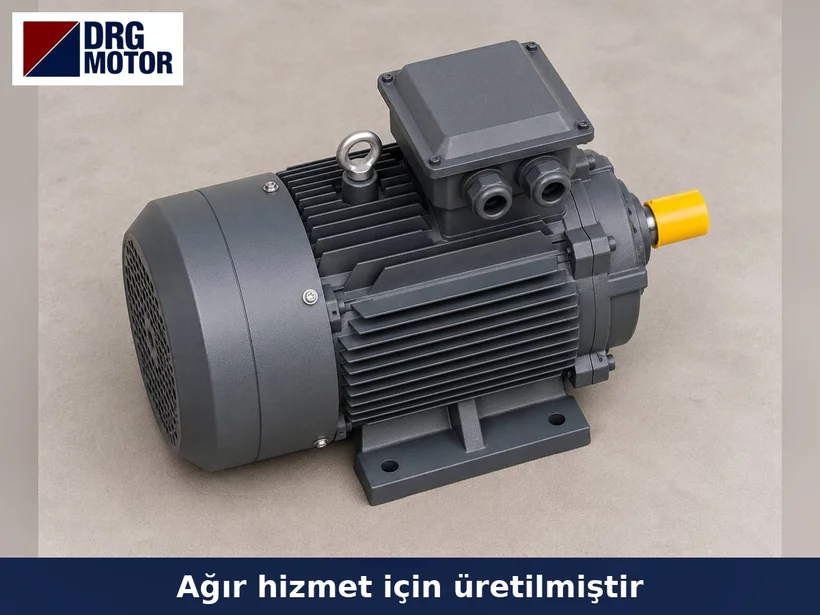
| DRG-315S-4 | 110 kW / 1488 rpm | 315S cast iron · 85×170 | 187 A |
| DRG-315M-4 | 132 kW / 1488 rpm | 315M cast iron · 85×170 | 224 A |
| DRG-315L1-4 | 160 kW / 1488 rpm | 315L cast iron · 85×170 | 271 A |
All these motors are three-phase and IP55. A foot-mounted B3 main motor slides on rails to set belt tension; where an axis needs a flange, B5 or B35 is chosen, and a vertical axis motor calls for the V1 version. We put the old nameplate and the machine data sheet side by side and check power and speed, winding connection, frame size, foot or flange layout, shaft and key, pulley fit and splash exposure one by one. Without that comparison we do not promise a definite fit.
Live price table
The table below pulls current prices for the block cutter power range straight from our shop:
| Model | Power / speed | Frame · current 400 V | Price |
|---|---|---|---|
| DRG-100L2-44 HP | 3 kW · 1500 rpm | Cast iron 100L · 6.02 A | $203.84 (€182.05) Details & buy → |
| DRG-132M-410 HP | 7.5 kW · 1500 rpm | Cast iron 132M · 14.3 A | $394.89 (€352.66) Details & buy → |
| DRG-180M-425 HP | 18.5 kW · 1500 rpm | Cast iron 180M · 33.5 A | $873.49 (€780.08) Details & buy → |
| DRG-225S-450 HP | 37 kW · 1500 rpm | Cast iron 225S · 66.1 A | $1,527.18 (€1,363.87) Details & buy → |
| DRG-250M-475 HP | 55 kW · 1500 rpm | Cast iron 250M · 97.6 A | $2,065.73 (€1,844.82) Details & buy → |
| DRG-315S-4150 HP | 110 kW · 1500 rpm | Cast iron 315S · 187 A | $4,863.00 (€4,342.97) Details & buy → |
| DRG-315M-4180 HP | 132 kW · 1500 rpm | Cast iron 315M · 224 A | $5,621.72 (€5,020.55) Details & buy → |
| DRG-315L1-4200 HP | 160 kW · 1500 rpm | Cast iron 315L · 271 A | $6,135.24 (€5,479.15) Details & buy → |
DRG MOTOR motors are guaranteed against material and manufacturing defects for 2 years from the delivery date (warranty certificate).
Motors in this power range
- DRG-132M-4 – 7.5 kW – 1460 rpm – 132M cast iron
- DRG-180M-4 – 18.5 kW – 1470 rpm – 180M cast iron
- DRG-250M-4 – 55 kW – 1485 rpm – 250M cast iron
- DRG-315S-4 – 110 kW – 1488 rpm – 315S cast iron
- DRG-315L1-4 – 160 kW – 1488 rpm – 315L cast iron
Click to see current prices and order these motors nowSEE PRICES →
Browse products, request a quote: every rating from the main motor to the carriage motor is on Buy Electric Motors Online. Send a photo of the motor’s nameplate and one taken from the pulley side via WhatsApp or call +90 (542) 666 11 11; we will suggest the model whose frame and shaft fit.
Frequently asked questions
Does moving the block cutter main motor up one size help?
Cutting speed is often limited not by the motor but by the blade, bridge stiffness and water flow. A bigger motor means a bigger frame and shaft; pulleys, slide rails and panel protection change as well. Assess any power increase with the machine maker.
If you are stuck on any point of choosing a block cutter motor, call +90 (542) 666 11 11, write to info@drgmotor.com or use our contact form.


