 English
 Le français
 Türkçe

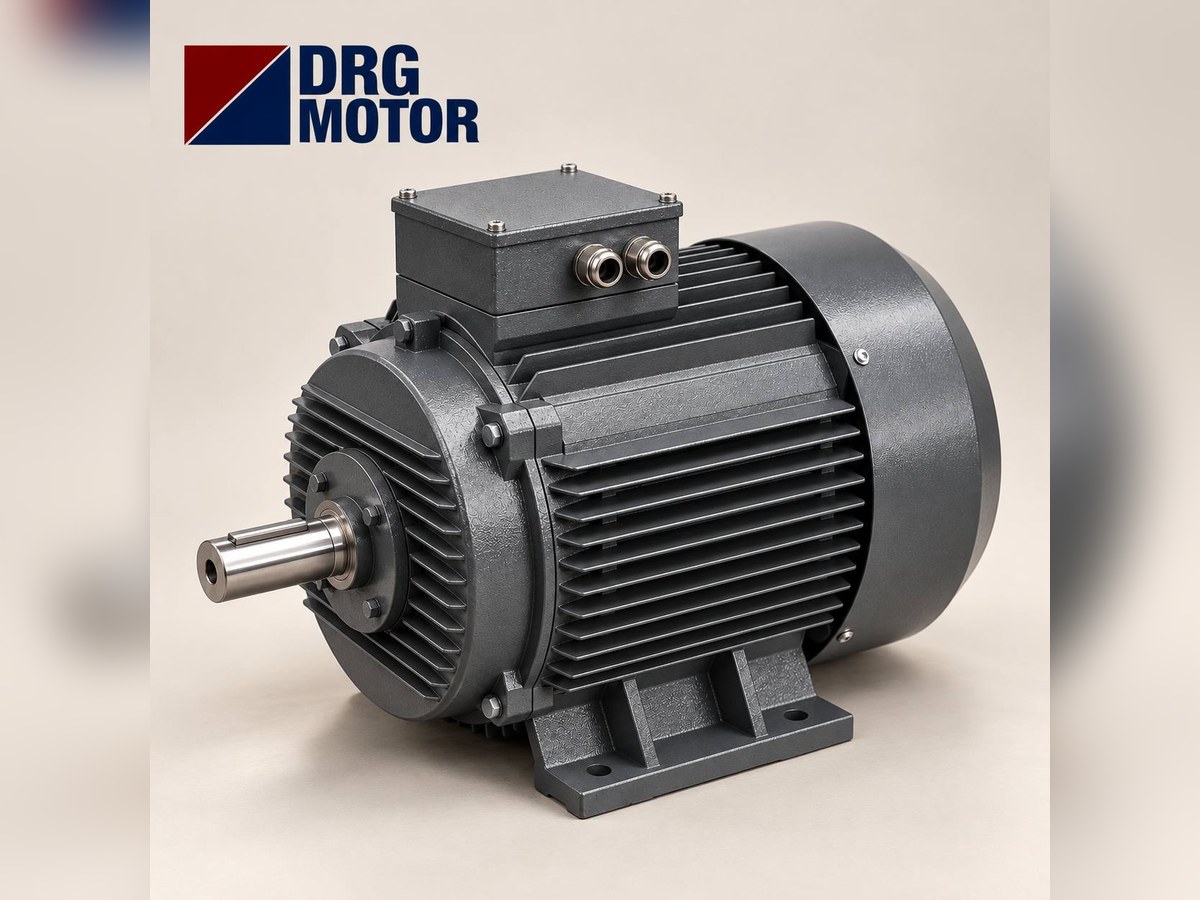
A circulation pump motor drives the pump that circulates water or glycol mixture around a closed pipe loop; it does not lift water anywhere, it only overcomes friction losses in pipes, valves, heat exchangers and the chiller. Motor power is therefore set not by high pressure but by a low head combined with a large flow running all year. In small heating circulators the motor is built into the pump and cannot be replaced on its own; dry-rotor pumps use a standard IEC three-phase motor, and on failure only the motor may need replacing.
This page explains where the head comes from in a closed loop, how wet-rotor and dry-rotor pumps differ from the motor's point of view, what motor power looks like in chiller and cooling tower circuits, and what matches it in the DRG range. Suitable motors and their up-to-date prices can be found among the 120 models on Buy Electric Motors Online. Overview: Pump Motors.
What is a circulation pump and what does it do in a closed loop?
Circulation is the name of an application; by operating principle almost all these pumps are centrifugal, and by casing they are in-line or end-suction. The pump's job is not to move water from one place to another but to keep the same water moving between a heat source and a heat user: from the boiler to radiators, from the chiller to fan-coils, from a machine cooling jacket to a heat exchanger.
In a closed loop the water returns to where it started, so the water columns in the flow and return pipes balance each other. Even if the building is 40 m tall, the pump does not lift those 40 m; the expansion vessel and fill pressure take care of that height. The only resistance the pump overcomes is the pressure loss in pipes, bends and valves, heat exchangers and the chiller evaporator. Head therefore usually stays within about 5–30 m, while flow is large in line with the heat load.
Where is it used?
- Central heating: boiler to radiator or underfloor heating circuits.
- Cooling: chiller primary and secondary loops, fan-coil and air handling unit coils.
- Cooling tower loops: circulating condenser water between the tower and the chiller.
- Industrial process cooling: injection moulds, compressors, welding machines and furnace jackets.
- District heating/cooling networks and data centre cooling loops.
There is one distinction in cooling tower circuits: the tower side is an open loop; water is pumped to the distributor at the top of the tower and falls into the basin. Here the static height between basin level and distributor is added to friction in the head. The chiller evaporator side is a fully closed loop.
Wet-rotor and dry-rotor pumps: can the motor be replaced?
From the motor's point of view there are two separate worlds in circulation pumps, and searching for a motor without knowing which one you are in wastes time.
- Wet-rotor circulator: The motor rotor turns inside the pumped water, pump and motor share one housing and there is no shaft seal. In one manufacturer's catalogue the input power of these circulators ranges from about 16 W to 1,550 W depending on the model [1]. Such a motor has no separate shaft end, flange or IEC frame. When it fails, the pump or the maker's motor-pump head is replaced, not a motor. DRG does not sell these integrated motors.
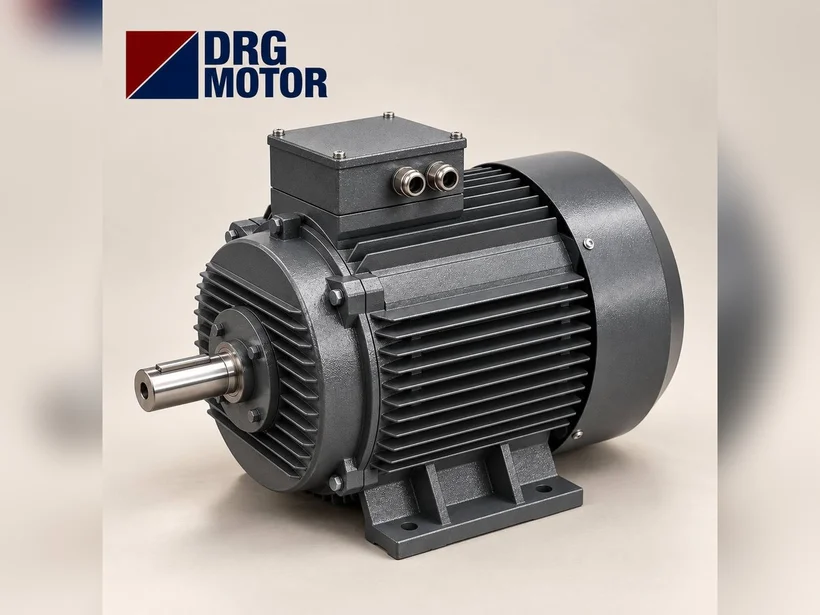
- Dry-rotor pump: The motor is outside the water; the pump shaft is sealed with a mechanical seal and the motor is flanged to the lantern (in-line) or coupled on a baseplate (end-suction). These pumps use a standard IEC induction motor; on failure a motor of the same power, speed, frame and flange is fitted.
- Dry-rotor pump with integrated drive: On some in-line pumps the motor and frequency converter are one unit; one manufacturer offers this design up to 22 kW [4]. These motors cannot be swapped one-for-one with a standard IEC motor either; moving to a standard motor plus separate inverter is done in consultation with the pump maker.
The vertical motor arrangement of the in-line pumps used in these loops is a separate topic; on end-suction pumps the motor sits horizontally on the baseplate.
Motor power: what kW appears on circulation pumps on the market?
A) Motor power in circulation pumps on the market
| Model group / capacity | Motor power | Single / total | Source |
|---|---|---|---|
| Maker A wet-rotor circulator | 16–1,550 W (P1) | Integrated motor | [1] |
| Maker C in-line, small range | 0.12–2.2 kW | Single motor | [3] |
| Maker C in-line, flanged range | 0.25–132 kW | Single motor | [3] |
| Maker B in-line, full range | 0.25–200 kW | Single motor | [2] |
| Maker B dry rotor with drive | 22 kW (example model) | Integrated motor | [4] |
For dry-rotor circulation and cooling water pumps with IEC motors, motor options of roughly 0.12–200 kW are seen depending on the manufacturer's model and capacity [2][3]; wet-rotor circulators are in the watt range [1]. Within one pump family power grows with flow (m³/h) and with the loop's friction loss: if flow doubles, friction loss in the same pipes rises about fourfold, and power rises faster still. Installations usually have two pumps (one standby) or several pumps in parallel; the motor is selected for one pump, and the installed total is not the motor rating.
B) Overlap with the DRG range
The part of range A that overlaps DRG's 0.25–355 kW, 1000/1500/3000 rpm range is 0.25–200 kW. The 0.12–0.18 kW steps fall below the range. Wet-rotor circulators and pumps with a drive integrated in the motor cannot be fitted with a standard motor and are outside the DRG range. In the in-line range reviewed the larger ratings are 4-pole (1500 rpm class) [2]; these motors are available in the DRG range from 0.25 kW to 355 kW.
Click to see current electric motor prices and order nowSEE PRICES →
Worked example: a chiller cooling water loop
The calculation uses P = ρ·g·Q·H / η_pump: flow in m³/s, head in m, density in kg/m³, g = 9.81 m/s², power in W. Example: in a factory process cooling loop, 180 m³/h of water passes through the chiller evaporator. The total loop loss (pipes, valves, strainer, evaporator and plate heat exchanger) has been calculated at 22 m. With an assumed pump efficiency of 0.75, P = 1000 × 9.81 × (180/3600) × 22 / 0.75 ≈ 14.4 kW. With a 10% margin the need is about 15.8 kW; the next standard rating is an 18.5 kW 4-pole motor.
At night and in mid-season the heat load falls. If the motor is slowed to 70% speed with an inverter, flow drops to about 126 m³/h, loss in a pure-friction loop to 22 × 0.7² ≈ 10.8 m, and shaft power to 14.4 × 0.7³ ≈ 4.9 kW. In practice the drop is somewhat smaller: the pump often runs on constant or proportional differential-pressure control [3], so a differential pressure is held at the furthest point and power stays a little above the cube curve. Even so, for a circulation pump turning thousands of hours a year the difference on the electricity bill is large. For speed and power see affinity laws; for your own values use the Pump & Fan Motor Power calculator.
| Model | Power / speed | Frame · current 400 V | Price |
|---|---|---|---|
| DRG-90L-42 HP | 1.5 kW · 1500 rpm | Cast iron 90L · 3.3 A | $144.14 (€128.73) Details & buy → |
| DRG-100L2-44 HP | 3 kW · 1500 rpm | Cast iron 100L · 6.02 A | $203.84 (€182.05) Details & buy → |
| DRG-112M-45.5 HP | 4 kW · 1500 rpm | Cast iron 112M · 7.95 A | $254.38 (€227.18) Details & buy → |
| DRG-132M-410 HP | 7.5 kW · 1500 rpm | Cast iron 132M · 14.3 A | $394.89 (€352.66) Details & buy → |
| DRG-160M-415 HP | 11 kW · 1500 rpm | Cast iron 160M · 20.4 A | $568.76 (€507.94) Details & buy → |
| DRG-160L-420 HP | 15 kW · 1500 rpm | Cast iron 160L · 27.3 A | $678.13 (€605.61) Details & buy → |
| DRG-180M-425 HP | 18.5 kW · 1500 rpm | Cast iron 180M · 33.5 A | $873.49 (€780.08) Details & buy → |
| DRG-180L-430 HP | 22 kW · 1500 rpm | Cast iron 180L · 39.7 A | $919.45 (€821.13) Details & buy → |
| DRG-200L-440 HP | 30 kW · 1500 rpm | Cast iron 200L · 53.8 A | $1,235.00 (€1,102.93) Details & buy → |
Data needed for motor selection, speed and starting
Flow and pressure are a property of the pump, not of the motor; the motor just has to turn the shaft at the right speed with enough power. Before asking for a motor for a circulation pump, clarify:
- Is the pump wet-rotor or dry-rotor? Can you see a shaft and flange between motor and pump?
- Flow and head from the pump nameplate; kW, speed, IEC frame and voltage from the old motor's nameplate.
- Mounting: on in-line pumps the motor is vertical and flanged, on end-suction pumps it is foot-mounted and coupled.
- Fluid: water or glycol mixture? Glycol density and viscosity raise power somewhat.
- Fluid temperature: in a hot water loop, heat passes from the pump casing to the motor flange.
- Control: fixed speed, or inverter with a differential-pressure sensor?
- Environment: boiler rooms can be hot and chiller rooms humid; choose the motor's protection rating for the room.
Speed depends on the pump design. 2-pole in-line pumps are common at small and medium ratings; 4-pole motors come forward on large-flow cooling water pumps, even more so in buildings with noise limits. Do not fit a motor with a different speed from the pump's design speed; a 4-pole motor on a 2-pole pump cuts the head to a quarter.
A circulation pump starts easily: the loop is full, there is no static head and the rotating mass is small. On fixed-speed pumps star-delta is used at larger ratings; on a 400 V network this needs a 400/690 V winding (4 kW and above in the DRG range). Details: star-delta starting. With an inverter, the motor's own fan blows less air at low speed; since load on a circulation pump falls with speed this is usually not a problem, but watch motor temperature at very low speeds. Have the connection made by a qualified electrician.
Matching with DRG motors
DRG Motor is a manufacturer, supplier and seller of electric motors. Our range covers 0.25–11 kW in aluminium frames and 0.55–355 kW in cast iron; 1000, 1500 and 3000 rpm; 3-phase, 230/400 V or 400/690 V; mounting B3, B5, B14 and B35 (specified with the order). In circulation loops, DRG motors are for dry-rotor pumps with standard motors. The table below shows 4-pole models close to the power in the example; for a vertical in-line pump, state V1 mounting and flange size in the order. For vertical operation the motor must be ordered as suitable for vertical mounting and the axial load confirmed with the pump manufacturer.
| Model | Power / speed | Frame | Current 400 V |
|---|---|---|---|
| DRG-132M-4 | 7.5 kW – 1460 rpm | 132M cast iron | 14.3 A |
| DRG-160L-4 | 15 kW – 1465 rpm | 160L cast iron | 27.3 A |
| DRG-180M-4 | 18.5 kW – 1470 rpm | 180M cast iron | 33.5 A |
| DRG-180L-4 | 22 kW – 1470 rpm | 180L cast iron | 39.7 A |
| DRG-200L-4 | 30 kW – 1475 rpm | 200L cast iron | 53.8 A |
For the 15.8 kW need in the example, DRG-180M-4 (18.5 kW, 1470 rpm, 33.5 A at 400 V) fits; if the same loop will later be enlarged to 220 m³/h, DRG-180L-4 (22 kW) can be considered. DRG MOTOR motors are guaranteed against material and manufacturing defects for 2 years from the delivery date (warranty certificate). For pumps and fans together in HVAC circuits see HVAC motor supply, and for data centre cooling loops see data centre cooling.
DRG motors for circulation pumps
- DRG-112M-4 – 4 kW – 1450 rpm – 112M cast iron
- DRG-132M-4 – 7.5 kW – 1460 rpm – 132M cast iron
- DRG-160M-4 – 11 kW – 1465 rpm – 160M cast iron
- DRG-160L-4 – 15 kW – 1465 rpm – 160L cast iron
- DRG-180M-4 – 18.5 kW – 1470 rpm – 180M cast iron
- DRG-180L-4 – 22 kW – 1470 rpm – 180L cast iron
- DRG-200L-4 – 30 kW – 1475 rpm – 200L cast iron
Click to see current prices and order these motors nowSEE PRICES →
Circulation pump motor: frequently asked questions
Can the motor of a heating circulation pump be replaced on its own?
Not on a wet-rotor circulator; the motor is part of the pump and the pump or the maker's motor head is replaced. If there is a shaft and flange between motor and pump (dry rotor), a standard three-phase motor can be fitted.
Is building height included in circulation pump sizing?
Not in a closed loop; the flow and return water columns balance. The pump only overcomes friction losses. In an open cooling tower loop the static height up to the tower distributor is added.
How much does an inverter reduce the power of a cooling water pump?
In a pure-friction loop power falls with the cube of speed: about one third at 70% speed. In systems with differential-pressure control the drop is somewhat smaller.
How many amps does an 18.5 kW 4-pole pump motor draw?
DRG-180M-4 draws 33.5 A at 400 V and 35.3 A at 380 V.
Send us the pump nameplate, the rotor type and the old motor's nameplate; we will tell you which DRG model fits. Phone +90 (542) 666 11 11, e-mail [email protected], contact page. For all models and current prices, see Buy Electric Motors Online.
Sources
- Grundfos – MAGNA3 Model D Data Booklet (60 Hz) – canned-rotor circulator: pump and motor form one unit; input power P1 about 16–1,550 W in the model tables.
- Wilo – Atmos GIGA-I, full range and technical data – dry-rotor in-line pump for heating, air conditioning and cooling; P2 0.25–200 kW in model codes, 4-pole 0.25–200 kW, 2-pole 1.5–55 kW.
- Grundfos – TP, TPD, TPE, TPED Data Booklet – single-stage in-line pump for district heating/cooling and industrial cooling; Series 200 0.12–2.2 kW, Series 300 0.25–132 kW; speed-controlled version with differential-pressure sensor.
- Wilo – Stratos GIGA 65/6-74/22 ürün sayfası – dry-rotor in-line pump with integrated motor and frequency converter; P2 22 kW in the example model.


