 English
 Le français
 Türkçe

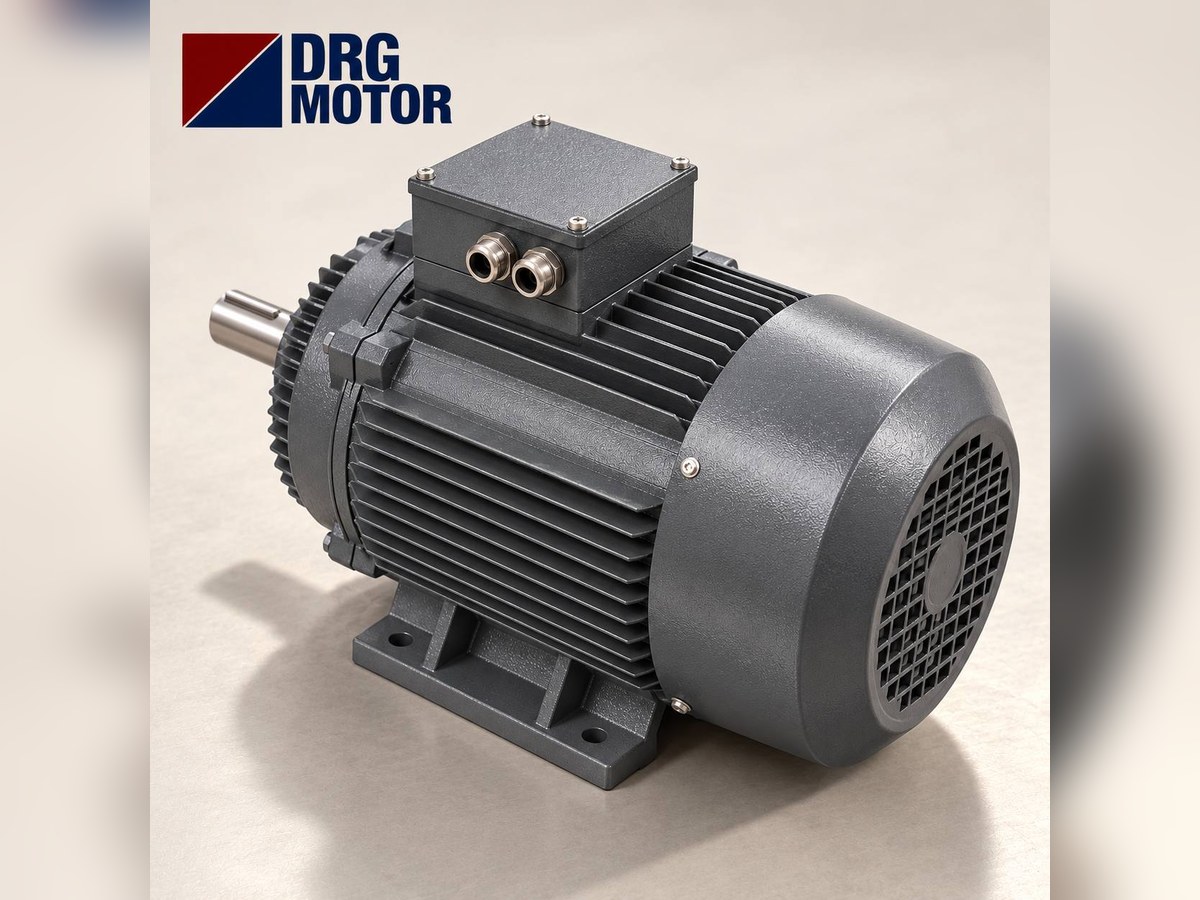
A feed auger motor is the three-phase electric motor that turns the auger shaft through a gearbox or a belt and pushes feed forward inside a tube or a trough. Manufacturer catalogues show 0.37–5.5 kW motors on the flexible and tube augers that carry feed from a farm silo into the animal house, and up to 15 kW on the larger trough augers inside a feed mill. Four things set the power: the throughput, the auger length, the lift height and the feed itself: mash, pellets and cracked maize do not load the same auger in the same way.
This page covers the augers of a feed mill line and of a livestock farm's feed silo; grain augers at intake and storage sites are a separate subject. Below you will find casing types, the effect of incline and fill level, sourced power values, a worked example and the matching DRG motors. Current prices of suitable motors are on the Buy Electric Motors Online page.
Where does an auger work in a feed line?
An auger (screw conveyor) is the simplest way to move feed over a short, enclosed distance. There is no chain and no return run: a single shaft with flights drags the feed along the casing. Dust stays inside and the line empties easily. Because it works by friction, however, its power rises quickly with distance and it can wear fragile pellets.
Silo discharge and distribution on livestock farms
On poultry, beef and dairy farms, feed flows from the cone of an outdoor silo into a boot. From there a flexible spiral or a tube auger carries it into the building, to the hopper at the head of the feeding line. A level switch at the end of the line stops the motor when the hopper is full and restarts it when feed runs low. These motors start dozens of times a day; their power is small and their start count is high. Catalogues list spiral lines up to 100–120 m long, and they can turn corners.
Augers inside a feed mill
In a mill, augers are usually short and enclosed: the auger collecting ground material under the grinding unit, the auger under the discharge gate of the mixing unit, augers drawing from bins and silos, and continuous mixer augers where liquids are added. Where a long horizontal run is needed a chain conveyor takes over, and a bucket elevator handles vertical lifts. Dosing augers feeding a batch scale are a separate group; their motors are chosen for speed control and frequent stop-start.
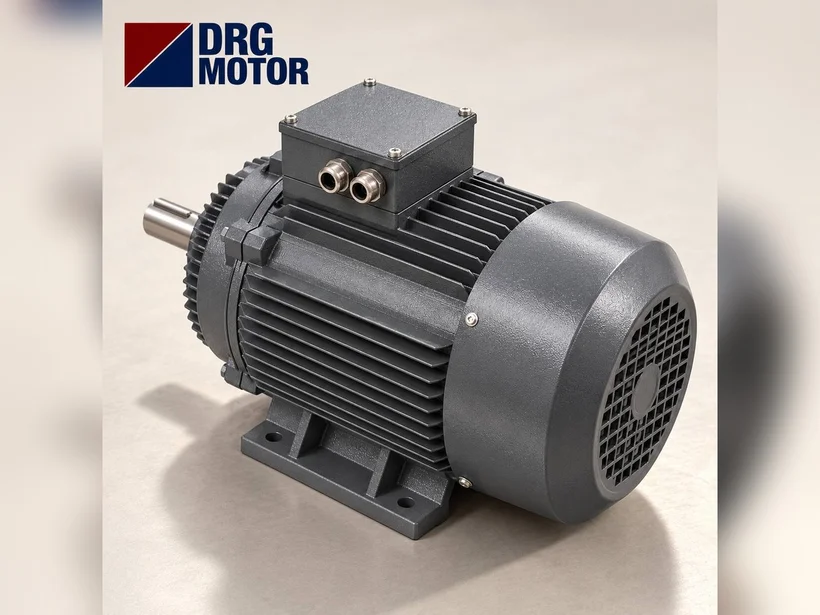
Tube, U-trough or spiral: how does the casing affect the motor?
Tube (tubular) auger
The flighted shaft turns inside a closed tube. Being fully enclosed, it can be installed on an incline and releases no dust. The clearance between flight and tube is small; if feed gets damp and sticky, or a foreign object jams, torque rises suddenly. The motor must be protected against such a jam by an overload relay or current monitoring.
U-trough auger
The flighted shaft turns in a covered U-shaped trough. It is common for horizontal or slightly inclined transfer inside a mill; adding intermediate outlets and cleaning are easy. In long troughs the shaft is carried by hanger bearings.
Spiral (centreless) auger
A spring-steel spiral with no centre shaft turns inside a plastic hose or tube. It is flexible, turns corners and is used on long lines. The drive unit sits at the end of the line and pulls the spiral. Catalogue values show spiral speeds around 280–400 rpm; the motor is brought down to this speed by a belt or a gearbox.
How do incline and fill level change the power?
Fill level
The share of the auger cross-section occupied by feed is the fill level. Cross-section calculations take 40–45 % for free-flowing, low-friction materials and 15–30 % for heavier or stickier ones. Under a mixer, the section fills at once when the discharge gate opens, so the motor is sized with enough margin for that moment.
Incline
As the auger rises, capacity drops and power increases by the lift share. Calculation sheets give a capacity loss of roughly 1–2 % per degree of incline; for a tube auger at 45° one manufacturer states a loss of about 30 %. At 12°, taking 2 % per degree, the auger carries about 76 % of its horizontal capacity. Keeping the same tonnage then needs a larger diameter or a higher speed, and both increase motor power.
Click to see current electric motor prices and order nowSEE PRICES →
How many kW for a feed auger motor? Market values
A) Power values in manufacturer catalogues
| Auger / capacity | Motor power | Single or total | Note |
|---|---|---|---|
| Spiral line, 55–125 mm, 0.5–4.5 t/h | 0.37–1.1 kW | One per line | Two makers, feeding line |
| Tube auger 102 mm, 4.3 t/h, 12 m | 0.75–2.2 kW | Single motor | Maker catalogue, small model |
| Trough auger 17–26 t/h, 25–30 m | 1.5–5.5 kW | Single motor | Same catalogue, large model |
| Mill auger, 3–25 m³/h, 1–6 m | 2.2–3 kW | Single motor | Maker catalogue, short type |
| Mill auger, 10–15 m³/h | up to 5.5 kW | Single motor | Maker catalogue, small series |
| Mill auger, 110–180 m³/h | up to 15 kW | Single motor | Same series, largest model |
Across this machine group, feed augers, manufacturers' models span roughly 0.37–15 kW of motor power depending on model and capacity. Every value is the drive motor of one auger. A feed mill may have fifteen or twenty augers; adding them up gives installed power, not the size of one auger motor.
B) What the DRG range covers
DRG Motor is a manufacturer, supplier and seller of electric motors. For auger drives you can choose aluminium-frame motors from 0.25 kW up to 11 kW and cast iron ones from 0.55 kW up to 355 kW; all are three-phase, run at 1000, 1500 or 3000 rpm and come wound for 230/400 V or 400/690 V. Simply state on the order whether it should be flanged (B5, B14), foot-mounted (B3) or both (B35). The whole 0.37–15 kW range seen on feed augers falls inside this range. Single-phase motors used on some spiral lines and special drive units integrated with their gearbox are not part of the range; on such units the whole unit is usually replaced rather than the motor. For screw conveyor motor prices, the live table below shows current figures:
| Model | Power / speed | Frame · current 400 V | Price |
|---|---|---|---|
| DRG-712-40.5 HP | 0.37 kW · 1500 rpm | Aluminium 71 · 0.92 A | $76.76 (€68.55) Details & buy → |
| DRG-801-40.75 HP | 0.55 kW · 1500 rpm | Cast iron 80 · 1.31 A | $91.72 (€81.91) Details & buy → |
| DRG-802-41 HP | 0.75 kW · 1500 rpm | Cast iron 80 · 1.75 A | $101.93 (€91.03) Details & buy → |
| DRG-90S-41.5 HP | 1.1 kW · 1500 rpm | Cast iron 90S · 2.48 A | $124.09 (€110.82) Details & buy → |
| DRG-90L-42 HP | 1.5 kW · 1500 rpm | Cast iron 90L · 3.3 A | $144.14 (€128.73) Details & buy → |
| DRG-100L1-43 HP | 2.2 kW · 1500 rpm | Cast iron 100L · 4.52 A | $188.32 (€168.18) Details & buy → |
| DRG-100L2-44 HP | 3 kW · 1500 rpm | Cast iron 100L · 6.02 A | $203.84 (€182.05) Details & buy → |
| DRG-112M-45.5 HP | 4 kW · 1500 rpm | Cast iron 112M · 7.95 A | $254.38 (€227.18) Details & buy → |
| DRG-132S-47.5 HP | 5.5 kW · 1500 rpm | Cast iron 132S · 10.7 A | $342.01 (€305.44) Details & buy → |
| DRG-132M-410 HP | 7.5 kW · 1500 rpm | Cast iron 132M · 14.3 A | $394.89 (€352.66) Details & buy → |
How is auger power calculated? Formula and example
Simple formula
A screw flight manufacturer's calculation sheet gives the drive power from the mass flow and the sum of horizontal friction and lift:
P = ṁ · g · (L · f + h) / η
- P: power at the auger shaft (W); ṁ: mass flow (kg/s); g: 9.81 m/s².
- L: auger length (m); h: height difference between inlet and outlet (m).
- f: displacement resistance, 2–4 for horizontal augers and 4–8 for vertical ones. The same sheet lists 2.3 for mixed feed, 2.0 for coarsely ground maize and 2.5 for bran.
- η: loss factor, taken as about 0.8 in the sheet.
Example: discharge auger under the mixing unit
Mixed mash (bulk density 0.5 t/m³) is to be carried at 12 tonnes per hour by a 9 m long, 250 mm U-trough auger and lifted 1.5 m into the pellet bin.
- Volume flow: 12 / 0.5 = 24 m³/h. In the sheet's table a 250 mm auger at 45 % fill carries 27 m³/h at 90 rpm; about 80 rpm is enough for 24 m³/h.
- Mass flow: 12,000 / 3,600 ≈ 3.33 kg/s.
- Power: 3.33 × 9.81 × (9 × 2.3 + 1.5) / 0.8 ≈ 907 W, i.e. about 0.91 kW. Installed level, it would have come to about 0.85 kW.
The 1.1 kW standard step looks sufficient. But when the mixer gate opens the auger starts completely full, and at small powers the calculation uncertainty is large; one engineering guide recommends an overload correction for small auger powers. So the next step, the 1.5 kW 4-pole DRG-90L-4 (1445 rpm, 3.3 A at 400 V), is the safer choice. Had the same auger been 15 m long, the result would rise to about 1.47 kW and 2.2 kW would be needed; on this type of auger, length is what raises power fastest.
Speed and gear ratio
For 80 rpm with a 1445 rpm motor the gear ratio is about 18. In catalogues, mill auger shaft speeds do not exceed 136 rpm, while spiral lines run at 280–400 rpm and therefore use a belt or a low-ratio gearbox. The gearbox output speed and torque calculator gives the ratio and output torque, and the pulley and belt calculator gives pulley diameters for belt drives. This calculation is for preliminary sizing; the final power comes from the auger maker's design.
Motor and gearbox connection: what to check at installation?
On mill augers the motor is mostly flange-mounted (B5 or B14) to the input of a gearbox fitted on the auger shaft, so no coupling alignment is needed. A foot-mounted (B3) motor is used on belt or coupling drives, on a separate base. For the tube augers of livestock farms, catalogues list both belt-drive motors and gear motors. The exact mounting comes from the auger maker's drawing; see the technical drawings page for shaft and flange dimensions.
The direction of rotation sets the conveying direction. After a motor change, the first run should be made with the auger empty and the direction checked; an auger turning backwards pushes feed back to the inlet and floods the hopper. Leave the wiring to a qualified electrician; for maintenance, isolate and lock off the supply first and only then open a cover.
Checklist for choosing a feed auger motor
- Feed handled: mash, pellets, cracked grain or bran. Its density and moisture.
- Capacity (t/h or m³/h), auger diameter, length, incline and height difference.
- Auger shaft speed and gear ratio; pulley diameters for belt drives.
- Starting condition: does the auger start empty or full, as under a mixer or a silo?
- Start frequency: how many times per hour does a level-switched feeding line start?
- Environment: flour dust, moisture, rain outdoors; sealing of terminal box entries.
- Protection: overload setting or current monitoring against jams. Use the overload, fuse and contactor selection tool.
- The old motor's nameplate: power, speed, frame, flange and shaft size.
DRG motor options for feed augers
Below are 4-pole models within the power band of feed augers. Aluminium frames are available up to 11 kW; in a dusty, humid mill, cast iron frames are often preferred.
| Model | Power / speed | Frame | Current 400 V |
|---|---|---|---|
| DRG-801-4 | 0.55 kW / 1400 rpm | 80 cast iron | 1.31 A |
| DRG-90S-4 | 1.1 kW / 1445 rpm | 90S cast iron | 2.48 A |
| DRG-90L-4 | 1.5 kW / 1445 rpm | 90L cast iron | 3.3 A |
| DRG-100L2-4 | 3 kW / 1450 rpm | 100L cast iron | 6.02 A |
| DRG-132S-4 | 5.5 kW / 1460 rpm | 132S cast iron | 10.7 A |
| DRG-160L-4 | 15 kW / 1465 rpm | 160L cast iron | 27.3 A |
DRG MOTOR motors are guaranteed against material and manufacturing defects for 2 years from the delivery date (warranty certificate). For selection differences in other auger uses such as fuel feeding or grain transfer, see our article auger motor selection: kW and speed; motors for the rest of the line are covered in feed machine motor supply.
Motors in this power range
- DRG-802-4 – 0.75 kW – 1420 rpm – 80 cast iron
- DRG-90L-4 – 1.5 kW – 1445 rpm – 90L cast iron
- DRG-100L1-4 – 2.2 kW – 1450 rpm – 100L cast iron
- DRG-112M-4 – 4 kW – 1450 rpm – 112M cast iron
- DRG-132M-4 – 7.5 kW – 1460 rpm – 132M cast iron
Click to see current prices and order these motors nowSEE PRICES →
Feed auger motor: frequently asked questions
What size motor does a silo auger need?
Manufacturer catalogues show 0.37–1.1 kW on livestock spiral lines and 0.75–5.5 kW on tube and trough augers. Longer and steeper lines move towards the upper values; the exact power is in the line maker's table.
Why does the auger motor keep tripping?
The most common causes are damp, sticky feed, foreign matter wrapped around the flight, a blocked outlet and feeding above the line's capacity. Find the mechanical cause first; raising the overload setting leaves the motor unprotected.
Does an auger motor need an inverter?
Conveying augers usually do not; the motor runs at fixed speed. Inverters are used on feeder and dosing augers whose capacity has to be adjusted.
How many amps does a 1.5 kW auger motor draw?
The 4-pole DRG-90L-4 draws 3.3 A at 400 V. The overload relay is set to the nameplate current.
With the auger diameter, length, the feed it carries and the old motor's nameplate in hand, we can pick the motor with you. You can reach us on +90 (542) 666 11 11, at [email protected] or through the contact page. For all models and the feed auger motor price list, visit Buy Electric Motors Online.


