 English
 Le français
 Türkçe

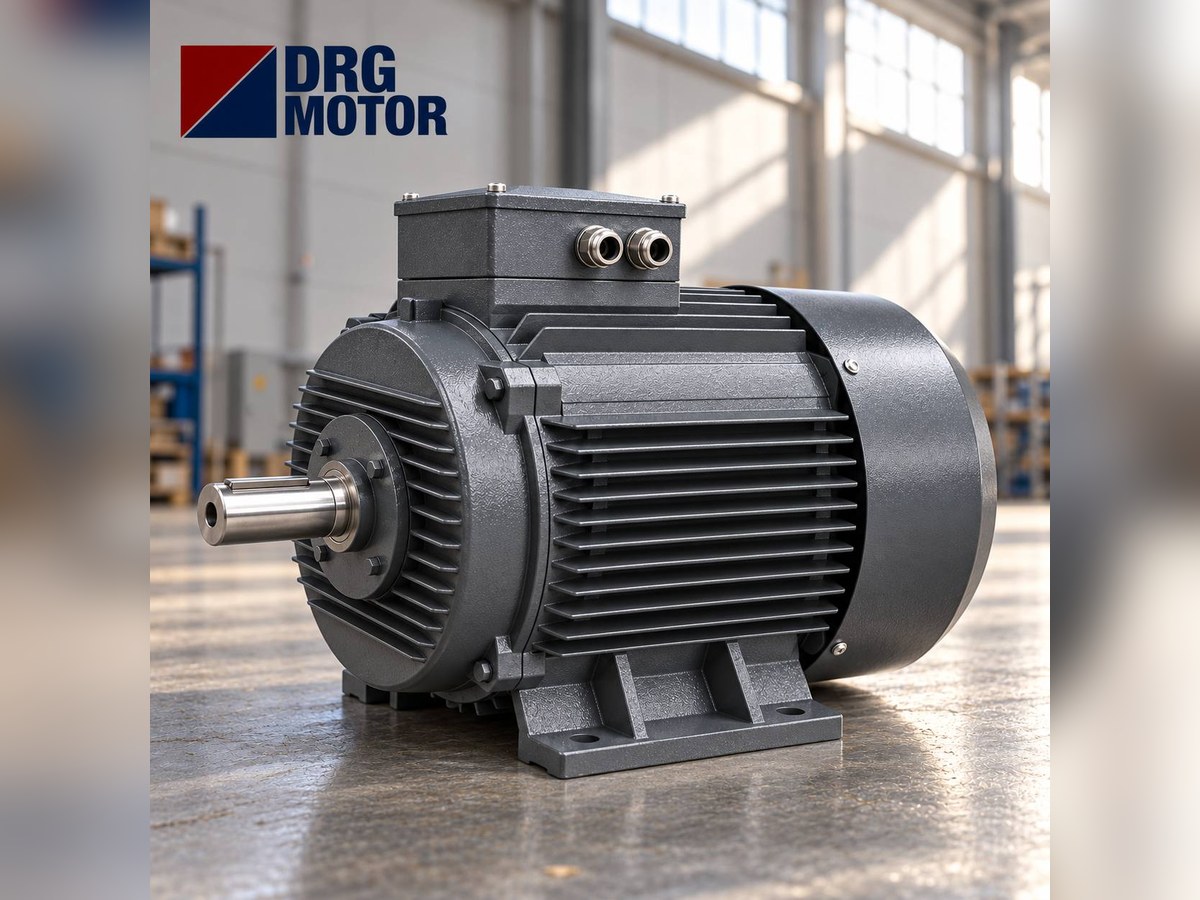
A vibrating feeder motor is the drive that shakes the feeder trough so that material flows steadily into a crusher or screen, and it comes in two different designs. In the common design, two (four on large models) vibration motors are bolted directly to the side or underside of the trough; the motor and the eccentric weight that creates the vibration share one housing. In the other design, a mechanical vibrator (exciter) mounted on the trough creates the vibration, and a standard three-phase induction motor sitting on a fixed base turns that exciter through a cardan shaft. Which motor you need depends on this distinction.
This page explains the difference between the two designs, the power seen on market models, the data needed for motor selection and the matching DRG range. Suitable models for the standard-motor design are listed under Buy Electric Motors Online; for motors across the whole plant see our Stone Crushing Plant Motors page.
What is a vibrating feeder and where does it sit in the plant?
A vibrating feeder is a steel trough resting on springs plus a drive that shakes it in a set direction. The trough makes short, fast forward-and-upward strokes; at each stroke the material hops forward and travels towards the discharge end. Feed rate is adjusted through amplitude, frequency and trough inclination.
It is used in two places in a crushing and screening plant:
- Primary feeding: It takes quarry rock dumped by a truck or loader from the hopper and delivers it to a jaw crusher or primary impact crusher. Most of these units have a bar grizzly at the discharge end, so fines are removed before the crusher.
- Under-silo and intermediate feeding: It meters material from a surge silo to a secondary crusher, cone crusher or screen. Here the lumps are small, the trough is short and the motors are small.
It is used on limestone, basalt, granite, river gravel and recycled concrete. Very sticky, clayey material clogs the trough; an apron feeder is chosen there. The hopper (bunker) feeder and the grizzly screen, which only scalps, are separate machines.
Vibration-motor design versus mechanical-vibrator design
The two designs look alike from outside, but from the motor's point of view they are completely different products.
| Item | Vibration motors | Mechanical vibrator | Effect on motor |
|---|---|---|---|
| Vibration source | Weights in motor housing | Separate exciter box | Motor type changes |
| Number of motors | 2 or 4 | Usually 1 | Total power counted apart |
| Motor location | On the vibrating trough | On a fixed base | Standard motor only in type 2 |
| Connection | Bolted directly | Cardan shaft | Foot-mounted (B3) motor |
In the vibration-motor design the two motors rotate in opposite directions; the horizontal forces of the weights cancel, the vertical components add up and the trough vibrates in one direction (linear) [2]. The two motors must therefore be the same model and run at the same eccentric setting. When one fails, both are replaced together or the weight setting of the new motor is matched to the old one.
In the mechanical design the exciter box holds two gear-linked shafts with weights; a cardan shaft carries the motion into the box, and the cardan is driven by either a 3-phase asynchronous motor or a hydraulic motor [4]. The electric motor sits outside the trough on a non-vibrating base. This design is found in heavy primary feeding; a major manufacturer's catalogue offers the same feeder with an electric or hydraulic drive option [3].
Motor power seen on market feeders
A) Values in manufacturer catalogues
| Model group / capacity | Motor power | Single or total | Source |
|---|---|---|---|
| Maker A, under-silo, 100–150 t/h | 2 × 1.1 kW, 1500 rpm | Per motor; total 2.2 kW | [1] |
| Maker B, primary, 80–100 t/h | 2 × 3 kW | Per motor; total 6 kW | [2] |
| Maker A, grizzly screen, 300–600 t/h | 4 × 10.2 kW | 4 motors; total 40.8 kW | [1] |
| Maker A, largest, 1000–1500 t/h | 2 × 11.5 – 2 × 19 kW | Per motor; total 23–38 kW | [1] |
| Maker C, mechanical, 450 t/h | 15 kW | Single drive | [3] |
| Maker C, mechanical, 1000 t/h | 30 kW | Single drive | [3] |
| Maker C, 2 vibrators, 1800 t/h | 55 kW | Total (2 vibrators) | [3] |
| Maker D, cardan-driven exciter | 18.5–37 kW | Per exciter | [4] |
In this machine group, motor options of roughly 1.1–55 kW are seen depending on the manufacturer's model and capacity [1][3]. On vibration-motor designs these values are per motor (1.1–19 kW) and are multiplied by two or four to get the total; on mechanical-vibrator designs they are the power of the single drive motor or the total of two vibrators (15–55 kW).
Capacity is not the only driver: trough size, material load, stroke and grizzly length add vibrating mass, and the same amplitude then needs a stronger motor. At the same manufacturer, a 100–150 t/h under-silo feeder runs on 2 × 1.1 kW while a 1000–1500 t/h grizzly-screen model goes up to 2 × 19 kW [1].
B) The part covered by the DRG range
DRG Motor is an electric motor manufacturer, supplier and seller. The store range covers 0.25–11 kW in aluminium frames and 0.55–355 kW in cast iron frames; 1000, 1500 and 3000 rpm; 3-phase, 230/400 V or 400/690 V; B3, B5, B14 and B35 mounting with an order note. For these feeders the overlap is as follows:
- Mechanical-vibrator design (15–55 kW): The drive motor is a standard IEC motor and the whole range lies within the DRG cast iron range.
- Vibration-motor design: These motors cannot be replaced with the standard motors in the store. The DRG vibration motor range shown on our Vibration Motors page is 0.12–15 kW; it covers the vibration motors up to 15 kW in the table. Large grizzly-screen models above 15 kW per motor (such as 2 × 19 kW) are outside this range.
- If an exciter designed for 750 rpm is to be coupled directly to the motor, an 8-pole motor is needed; the DRG range has no 750 rpm motor. In that case an intermediate pulley or gearbox arrangement should be discussed with the manufacturer.
| Model | Power / speed | Frame · current 400 V | Price |
|---|---|---|---|
| DRG-180L-620 HP | 15 kW · 1000 rpm | Cast iron 180L · 29.3 A | $834.75 (€745.48) Details & buy → |
| DRG-200L1-625 HP | 18.5 kW · 1000 rpm | Cast iron 200L · 35.9 A | $1,133.87 (€1,012.62) Details & buy → |
| DRG-200L2-630 HP | 22 kW · 1000 rpm | Cast iron 200L · 42.5 A | $1,194.62 (€1,066.87) Details & buy → |
| DRG-180L-430 HP | 22 kW · 1500 rpm | Cast iron 180L · 39.7 A | $919.45 (€821.13) Details & buy → |
| DRG-225M-640 HP | 30 kW · 1000 rpm | Cast iron 225M · 56.2 A | $1,487.70 (€1,328.61) Details & buy → |
| DRG-200L-440 HP | 30 kW · 1500 rpm | Cast iron 200L · 53.8 A | $1,235.00 (€1,102.93) Details & buy → |
| DRG-250M-650 HP | 37 kW · 1000 rpm | Cast iron 250M · 68.1 A | $2,056.71 (€1,836.77) Details & buy → |
| DRG-225S-450 HP | 37 kW · 1500 rpm | Cast iron 225S · 66.1 A | $1,527.18 (€1,363.87) Details & buy → |
| DRG-280M-675 HP | 55 kW · 1000 rpm | Cast iron 280M · 98.1 A | $2,805.93 (€2,505.87) Details & buy → |
Click to see current electric motor prices and order nowSEE PRICES →
Data needed for motor selection
Fill in this list for anything not on the nameplates:
- Feeder type: are the motors on the trough, or is there a closed exciter box on the trough and a cardan shaft?
- For vibration-motor designs: number of motors, power, speed (1000 or 1500 rpm) and centrifugal force (kgf or kN) of each. With these motors the decisive value is force, not kW.
- Eccentric weight setting: photograph the angle or percentage setting of the weights.
- For mechanical designs: motor power, speed, frame size and base hole spacing; shaft diameter and key size of the cardan flange.
- Panel: direct-on-line, star-delta, soft starter or inverter; does each of the two motors have its own overload relay?
- Environment: open air, rain, heavy dust; is the feeder hosed down?
On a two-motor feeder the overload relays must be interlocked: when one trips, the other must stop too. A trough running on one motor vibrates in a circular rather than linear pattern and strains the springs and frame. This wiring must be done by a qualified electrician.
Speed, mounting and starting: feeder-specific points
On a vibration motor, speed is the vibration frequency. In one manufacturer's catalogue, small under-silo feeders come with 1500 rpm motors and primary grizzly feeders with 1000 rpm motors [1]. At lower frequency the same force gives a longer stroke, which is what a primary trough carrying large rock needs. Fitting a 1500 rpm motor in place of a 1000 rpm one therefore changes how the feeder behaves.
On the mechanical design the motor is not fixed to the vibrating trough but to the fixed base next to it, on its feet (B3). The cardan shaft absorbs angular misalignment and vibration, which protects the motor bearings. An exciter brochure gives a standard operating frequency in the 750–1000 rpm range [4]. Whether the motor drives the exciter directly through the cardan or via pulleys is taken from the machine manufacturer's drawing.
At start and stop the trough passes through the spring resonance zone and briefly swings with a large amplitude; a soft starter or inverter smooths this. On the mechanical design the exciter weights are heavy and the motor starts under load; for motors of 15 kW and above, check the panel and motor voltage match for star-delta starting on our star-delta starting page.
Worked example: how much does lowering frequency with an inverter reduce force?
In most plants the feed rate is set with an inverter; one manufacturer's catalogue states that feed rate is adjusted by motor speed or trough angle [2]. The centrifugal force of a vibration motor follows F = m·r·ω², so it changes with the square of speed. If frequency is lowered from 50 Hz to 45 Hz, force drops to (45/50)² = 0.81 times; at 40 Hz to 0.64 times. At very low frequency such as 35 Hz (0.49 times) the trough may approach resonance. Get the lower limit from the feeder manufacturer.
On the mechanical design the calculation is about starting torque. For the 30 kW drive seen on a 1000 t/h primary feeder [3], if the 6-pole DRG-225M-6 is chosen, its rated torque is 292.3 Nm and its starting torque ratio Ts/Tn is 2.0, so the motor can deliver about 584.6 Nm at start. The inertia of the exciter weights is overcome with this torque. Because star connection cuts starting torque to one third, a soft starter or inverter is the safer route on heavy exciters.
DRG motor matching by feeder type
On mechanical-vibrator feeders, motor power and speed are taken from the nameplate and a cast iron motor of the same rating is chosen. The table lists candidates in the 15–55 kW range:
| Model | Power / speed | Frame | Current 400 V |
|---|---|---|---|
| DRG-180L-6 | 15 kW / 978 rpm | 180L cast iron | 29.3 A |
| DRG-200L2-6 | 22 kW / 980 rpm | 200L cast iron | 42.5 A |
| DRG-225M-6 | 30 kW / 980 rpm | 225M cast iron | 56.2 A |
| DRG-250M-6 | 37 kW / 985 rpm | 250M cast iron | 68.1 A |
| DRG-280M-6 | 55 kW / 985 rpm | 280M cast iron | 98.1 A |
| DRG-200L-4 | 30 kW / 1475 rpm | 200L cast iron | 53.8 A |
Standard store motors are not used on vibration-motor feeders. Request a quote for the right motor and current price: send the number of motors, the kW, speed and force values on the nameplate and a photo of the weight setting via the contact page or WhatsApp. Vibration motors are not sold in the online store; they are supplied on quotation.
DRG MOTOR motors are guaranteed against material and manufacturing defects for 2 years from the date of delivery (warranty certificate). For the working principle of vibration motors, read our article on how vibration motors work; to see why crushers need high torque, see our article on high torque in stone crushing plants.
DRG motors for mechanical-vibrator feeders
- DRG-180L-6 – 15 kW – 978 rpm – 180L cast iron
- DRG-200L2-6 – 22 kW – 980 rpm – 200L cast iron
- DRG-225M-6 – 30 kW – 980 rpm – 225M cast iron
- DRG-250M-6 – 37 kW – 985 rpm – 250M cast iron
- DRG-280M-6 – 55 kW – 985 rpm – 280M cast iron
Click to see current prices and order these motors nowSEE PRICES →
Vibrating feeder motor: FAQ
Why do the two vibration motors on a vibrating feeder rotate in opposite directions?
The side forces of two weights turning in opposite directions cancel each other, the remaining force acts in one direction and the trough vibrates linearly. If the motors turn the same way, the trough swings in a circle and material does not flow evenly.
Can a normal electric motor replace a vibration motor?
No. A vibration motor is built with weights, reinforced bearings and a housing designed to create vibration. A normal motor is only used when the feeder has a separate mechanical exciter, to turn it through a cardan shaft.
If one motor of the feeder burns out, is only that one replaced?
It can be replaced with the same model and the same weight setting. If a motor of a different make or force is fitted, the two sides do not produce equal force and the trough vibrates with a sideways tilt; this is why most operators renew both motors together.
How many amps does a 30 kW feeder motor draw?
The 6-pole DRG-225M-6 draws 56.2 A at 400 V, the 4-pole DRG-200L-4 53.8 A at 400 V. The overload relay is set from the nameplate current.
Send us the feeder nameplate, the motor label and the panel's starting method, and we will identify the right motor together. Phone +90 (542) 666 11 11, e-mail [email protected], contact page. For all standard motors and current prices, visit Buy Electric Motors Online.
Sources
- MEKA – MF Series Vibrating Feeders / Vibrating Grizzly Feeders (katalog) – 1.1–19 kW per motor; 2 or 4 motors; 1000/1500 rpm.
- Constmach – CPG-09 Vibrating Feeder – 80–100 t/h, 2 × 3 kW; counter-rotating motors, speed adjustment.
- Metso – Opti-Flo feeders and screens range (VF primary feeders) – VF series 15–55 kW, 450–1800 t/h; electric or hydraulic drive.
- OLI – MVM Mechanical Exciter (broşür, 12/2024) – cardan drive by induction or hydraulic motor; 18.5–37 kW, 750–1000 rpm.


