 English
 Le français
 Türkçe

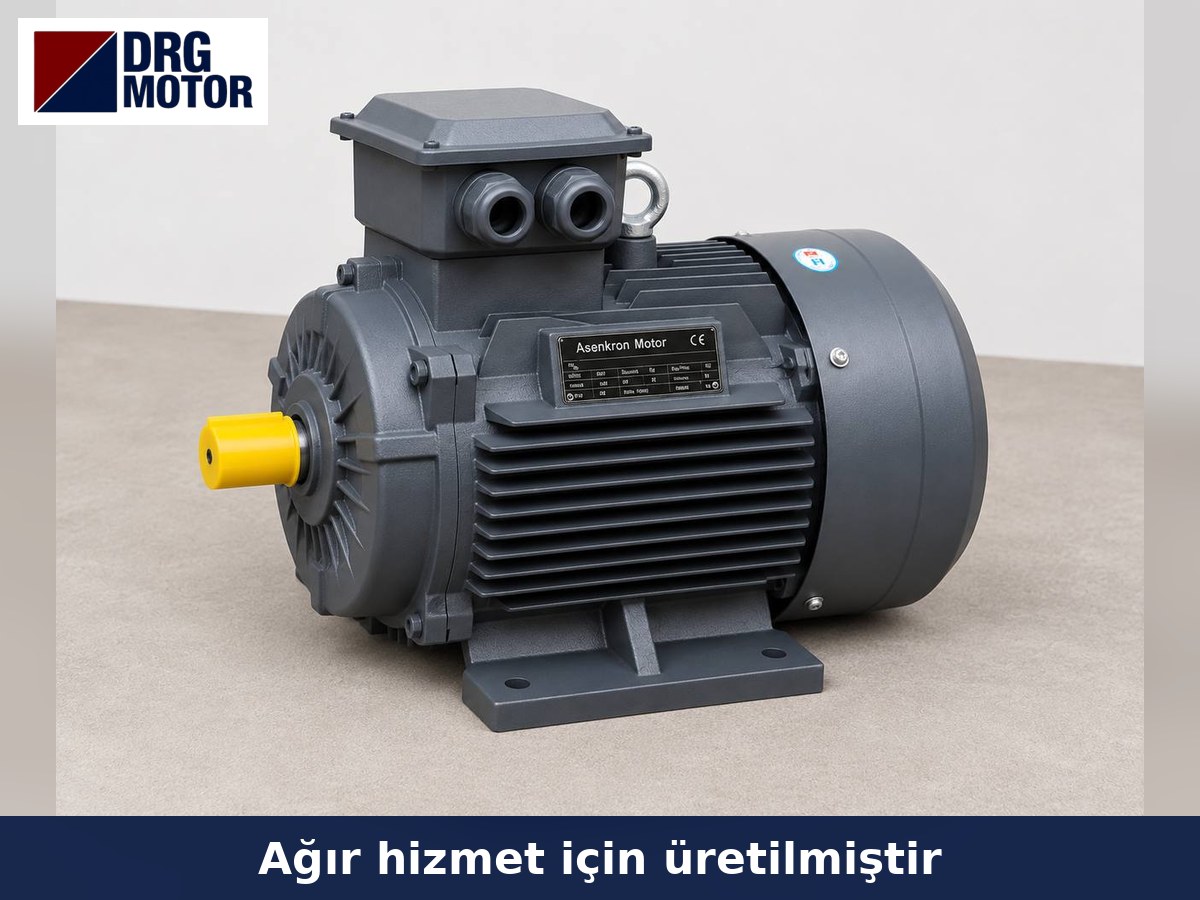
An industrial centrifuge electric motor spins the bowl, basket or disc stack of a machine that separates solids from liquid or two liquids from each other. Industry uses three main groups: the continuously running decanter centrifuge, the disc stack separator, which also runs continuously, and the basket centrifuge, which works in batches. Maker data sheets put basket machines at 0.75–90 kW, up to 22 kW for disc stack separators, and 11–480 kW for the main drive and 5.5–75 kW for the conveyor drive of decanters. The motor does a different job in each group; even motors of the same power are not chosen the same way.
DRG Motor is a manufacturer, supplier and seller of electric motors. We do not sell the centrifuge, the bowl, the planetary or direct drive gearbox, the separator gear train or the frequency inverter; we supply the three-phase induction motors fitted to them. Use the kW and rpm filters of the Buy Electric Motors Online page to narrow it down.
Three different jobs for the motor in the centrifuge family
All centrifuges share a large rotating mass; they differ in how often the motor has to accelerate it. A decanter or a separator turns at the same speed for hours: the motor starts once and carries load for a long time. In a basket centrifuge the basket is accelerated again for every batch, the speed programme changes and the machine is stopped. This difference decides the starting method, the drive and the braking question more than the motor power does.
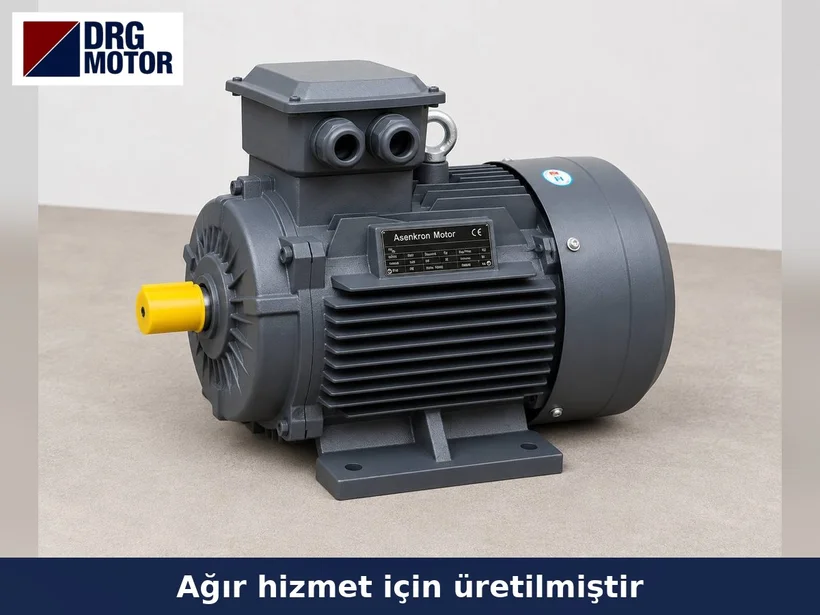
Decanter: main bowl motor and conveyor (back drive) motor
In a decanter a horizontal bowl with a conical section turns at high speed; the scroll conveyor inside turns a few revolutions faster or slower and pushes the settled solids towards the conical end. According to manufacturer brochures an electric motor drives the bowl through V-belts and a planetary gearbox passes power to the conveyor. On the conveyor side there is either a second motor (back drive) or a counter-shaft without a motor. With a second motor the differential speed is set by inverter without changing belts; the main motor can also run on an inverter. This is the most widely used continuous centrifuge in sewage sludge, olive oil, starch and chemical processes. The choice between decanter and belt press in sludge dewatering is explained in our sludge dewatering motor article.
Disc stack separator: vertical bowl, high speed
A separator has a vertical bowl filled with stacked conical discs; milk skimming, vegetable oil, fuel and lube oil treatment, and beer and juice clarification are done on this machine. The bowl turns faster than the motor; between them sits a gear train or, on newer machines, a rigid coupling and an inverter. Catalogue pages give the motor of this class as “maximum motor power” at about 18.5–22 kW. Because the bowl is light but very fast, start-up takes a long time.
Basket centrifuge: three-column, peeler and pusher types
The three-column basket centrifuge filters wet crystals, powders or fibres in chemical, pharmaceutical and textile dyeing plants. One maker’s data sheet states that the electrical control of this machine uses a two-speed motor and that the cycle runs slow start, high speed and electric braking. In the horizontal peeler type a knife scrapes the cake while the basket turns; the same data sheet lists inverter control, dynamic or regenerative braking and speed detection among its protections. In the pusher centrifuge the basket turns continuously and a hydraulic piston pushes the cake. Start-up time, brake resistor and balancing for this family are covered in our centrifugal dryer motor article; that calculation is not repeated here.
What kW does an industrial centrifuge motor need? Catalogue values
A) Motor powers taken from the data sheets and brochures of three makers:
| Centrifuge type / model | Motor power | Single / total | Note |
|---|---|---|---|
| Three-column basket, 300 mm basket, 1900 rpm | 0.75 kW | single motor | first maker, smallest model |
| Three-column basket, 1000 mm basket, 1000 rpm | 7.5 kW | single motor | first maker |
| Three-column basket, 1500 mm basket, 650 rpm | 15 kW | single motor | first maker, largest model |
| Horizontal peeler, 600 mm, 2400 rpm | 22 kW | main motor | second maker, smallest model |
| Horizontal peeler, 1600 mm, 950 rpm | 90 kW | main motor | second maker, largest model |
| Disc stack separator, 10 m³/h | 18.5 kW (maximum) | single motor | third maker |
| Disc stack separator, 20 m³/h | 22 kW (maximum) | single motor | third maker |
| Decanter, small frame | 18.5–30 kW main + 5.5 kW conveyor | two separate motors | third maker |
| Decanter, smallest of pulp and paper series | 11–18.5 kW main + 7.5 kW conveyor | two separate motors | third maker |
| Decanter, largest of the same series | 132–480 kW main + 37–75 kW conveyor | two separate motors | third maker |
Taken as a whole, centrifuge motors in these documents span about 0.75–480 kW: 0.75–15 kW on three-column basket machines, 22–90 kW on horizontal peelers, up to 22 kW on disc stack separators, and 11–480 kW for the main drive and 5.5–75 kW for the conveyor drive of decanters. The decanter rows list the two motors separately; the installed power of the machine is the sum of main and conveyor motors. Note that speed falls as the basket grows: a 300 mm basket turns at 1900 rpm, a 1500 mm basket at 650 rpm.
B) Where our range applies: our 0.25–11 kW aluminium and 0.55–355 kW cast iron frames cover, in power, both the main and conveyor motors of the basket machines, separators and small and medium decanters in the table. The largest decanter main drives above 355 kW are outside our range. The two-speed (pole-changing) motor shown in a data sheet as 15/11 kW is not in our range either; for these machines a single-speed motor with an inverter is considered.
Click to see current electric motor prices and order nowSEE PRICES →
High inertia: starting method and motor protection
The problem with direct-on-line start on a long run-up
When a heavy bowl or a loaded basket is brought up to full speed, the motor draws starting current for a long time. On direct-on-line start a standard overload relay may treat this time as a fault and trip; star-delta lowers the current but also cuts the torque to one third, which makes the run-up even longer. That is why centrifuge makers’ data sheets put inverter control forward. A side-by-side of starting options is on our motor starting page.
Braking: inverter, brake resistor and holding brake
In a basket centrifuge the basket is stopped at the end of each batch and the lid opens only at zero speed. The inverter with a brake resistor or regenerative feedback carries the main load of stopping; a mechanical brake is for holding and emergencies. Brake motors are not in our range; braking has to be solved in the machine’s own system or in the drive.
Explosive atmospheres: solvent-wet products
In pharmaceutical and chemical plants, peeler centrifuges handling solvent-wet products run under a nitrogen blanket; if the area where the machine stands is classed as an explosive atmosphere, an Ex motor is required. Ex motors are not in our range. In such areas choose the motor according to the plant’s zone classification and consult us.
Example: matching the motors of a decanter with catalogue data
The operating manual of a decanter gives a 30 kW main motor (on inverter), a 5.5 kW, 3000 rpm conveyor motor in IEC 132 frame, a bowl operating speed of 4200 rpm and 3549 G at the bowl wall. Let us match these values with our range and do a few simple calculations (calculated in python):
| Quantity | Catalogue value | DRG match | Calculation / result |
|---|---|---|---|
| Main motor | 30 kW, on inverter | DRG-200L1-2 · 2960 rpm | 52.1 A at 400 V |
| Conveyor (back drive) motor | 5.5 kW, 3000 rpm, IEC 132 | DRG-132S1-2 · 2930 rpm | 10.1 A at 400 V |
| Bowl operating speed | 4200 rpm | — | pulley ratio 4200 / 2960 ≈ 1.42 |
| Acceleration at bowl wall | 3549 G | — | radius ≈ 0.18 m, diameter ≈ 360 mm |
| Panel total | — | both motors together | 52.1 + 10.1 = 62.2 A |
Because the bowl turns faster than the motor, the motor pulley is about 1.42 times larger than the bowl pulley; staying with the same pole number when replacing the main motor keeps this ratio. The IEC 132 frame in the manual has the same shaft height as the 132S frame of our DRG-132S1-2; even so, no order is placed before the flange or foot dimensions and the shaft diameter are compared with the old motor. The conveyor motor is 2-pole and inverter-driven; it sets the differential speed. On the panel side the combined rated current of 62.2 A is used, and the inverters limit the starting current of both motors. For overload and contactor values use the overload-fuse-contactor selection tool.
DRG motors that can be used in centrifuges
Our models covering the power steps from small basket machines to decanter main drives:
| Model | Power / speed | Frame · shaft D×E | Current 400 V |
|---|---|---|---|
| DRG-801-4 | 0.55 kW / 1400 rpm | 80 cast iron · 19×40 | 1.31 A |
| DRG-90L-4 | 1.5 kW / 1445 rpm | 90L cast iron · 24×50 | 3.3 A |
| DRG-132S1-2 | 5.5 kW / 2930 rpm | 132S cast iron · 38×80 | 10.1 A |
| DRG-132M-4 | 7.5 kW / 1460 rpm | 132M cast iron · 38×80 | 14.3 A |
| DRG-160L-4 | 15 kW / 1465 rpm | 160L cast iron · 42×110 | 27.3 A |
| DRG-200L1-2 | 30 kW / 2960 rpm | 200L cast iron · 55×110 | 52.1 A |
| DRG-250M-4 | 55 kW / 1485 rpm | 250M cast iron · 65×140 | 97.6 A |
| DRG-280M-4 | 90 kW / 1486 rpm | 280M cast iron · 75×140 | 155 A |
On most machines the main motor sits foot-mounted (B3) on the base and drives by belts; flanged connections use B5 or B35. If the motor stands vertically on a machine with a vertical bowl, the motor must be ordered for vertical mounting and the axial load confirmed by the machine maker. Our motors are IP55, insulation class F and IC411 cooled; for a motor that will run at full torque at low speed on an inverter for long periods, forced cooling is discussed separately. Dimensions can be checked on the technical drawings.
Outside our range: brake motors, Ex motors, two-speed pole-changing motors, single-phase motors, above 355 kW and medium voltage. The centrifuge gearbox and drive belong to the machine side.
Live price table
Current prices of the models in centrifuge power steps are read automatically from the shop:
| Model | Power / speed | Frame · current 400 V | Price |
|---|---|---|---|
| DRG-90L-42 HP | 1.5 kW · 1500 rpm | Cast iron 90L · 3.3 A | $144.14 (€128.73) Details & buy → |
| DRG-132S1-27.5 HP | 5.5 kW · 3000 rpm | Cast iron 132S · 10.1 A | $338.72 (€302.50) Details & buy → |
| DRG-132M-410 HP | 7.5 kW · 1500 rpm | Cast iron 132M · 14.3 A | $394.89 (€352.66) Details & buy → |
| DRG-160L-420 HP | 15 kW · 1500 rpm | Cast iron 160L · 27.3 A | $678.13 (€605.61) Details & buy → |
| DRG-180M-425 HP | 18.5 kW · 1500 rpm | Cast iron 180M · 33.5 A | $873.49 (€780.08) Details & buy → |
| DRG-200L1-240 HP | 30 kW · 3000 rpm | Cast iron 200L · 52.1 A | $1,273.02 (€1,136.88) Details & buy → |
| DRG-250M-475 HP | 55 kW · 1500 rpm | Cast iron 250M · 97.6 A | $2,065.73 (€1,844.82) Details & buy → |
| DRG-280M-4125 HP | 90 kW · 1500 rpm | Cast iron 280M · 155 A | $3,268.56 (€2,919.03) Details & buy → |
DRG MOTOR motors are guaranteed against material and manufacturing defects for 2 years from the delivery date (warranty certificate).
Motors in this power range
- DRG-132S1-2 – 5.5 kW – 2930 rpm – 132S cast iron
- DRG-132M-4 – 7.5 kW – 1460 rpm – 132M cast iron
- DRG-160L-4 – 15 kW – 1465 rpm – 160L cast iron
- DRG-200L1-2 – 30 kW – 2960 rpm – 200L cast iron
- DRG-250M-4 – 55 kW – 1485 rpm – 250M cast iron
Click to see current prices and order these motors nowSEE PRICES →
Review the products and request a quote: send the centrifuge type (decanter, separator or basket), a photo of the motor nameplate, the bowl or basket speed, belt or coupling drive, hours of operation per day and starts per day via WhatsApp; you can also call +90 (542) 666 11 11. The full list sits on the Buy Electric Motors Online page.
Questions about centrifuge motors
Why is the decanter conveyor motor smaller than the main motor?
The main motor spins the bowl and the slurry inside at high speed; the conveyor motor only provides, through the gearbox, the small differential speed between bowl and scroll. In the catalogue rows the conveyor motor is roughly one fifth to one half of the main motor.
Can a separator motor be replaced with a standard motor?
Yes, if the motor has IEC dimensions and connects to the coupling or gear train with a standard shaft. Motors whose shaft end or flange is specific to the machine are not replaced without comparing dimensions.
What replaces the two-speed motor on a basket centrifuge?
A single-speed motor sized for the high-speed step; low speed and a soft start come from an inverter. The panel and braking arrangement are rebuilt accordingly.
For questions: +90 (542) 666 11 11 · info@drgmotor.com · contact.


