 English
 Le français
 Türkçe

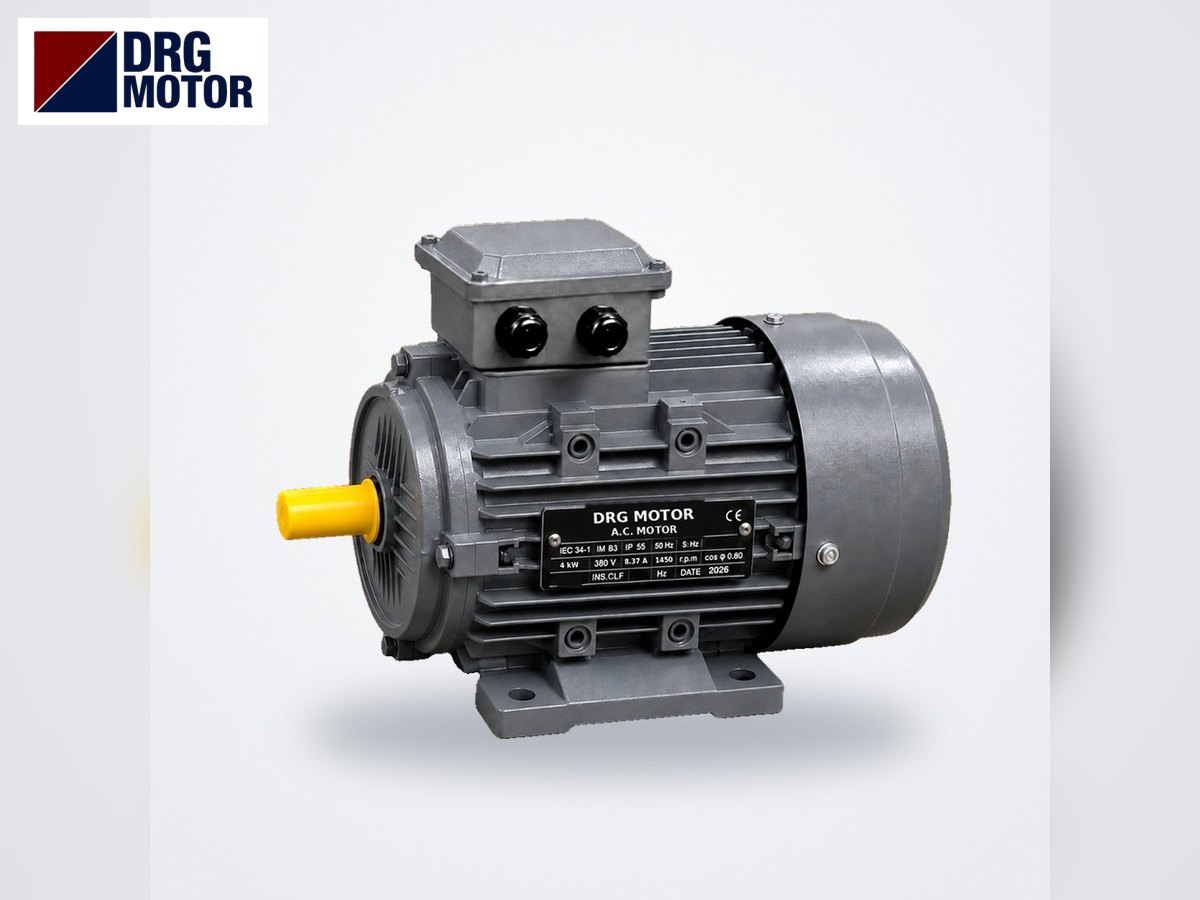
On a metal-cutting band saw the main electric motor drives the wheel that carries the endless blade; sections, tubes and solid steel are cut by the teeth of that blade. The blade has to run at only a few tens of metres per minute, so nearly every machine places a worm gearbox between motor and wheel. Semi-automatic and double-column saws add a hydraulic unit that raises and lowers the bow, a vice with feed and a coolant pump. This page maps the motors on such a saw and explains what an aluminium housing adds to the saw bow. Gearbox ratio, removing the old motor and what to do on two-speed machines are covered in our article on metal band saw motors and gearbox matching.
DRG Motor is a manufacturer, supplier and seller of electric motors. We do not sell the saw, the worm gearbox, blades, hydraulic pumps and cylinders, inverters or control panels; our part is the three-phase cage motor behind the saw wheel and the auxiliary units. All our light-housing options are listed on the Aluminium Housing Electric Motors page.
Where do motors work on a band saw?
Saw drive: motor, gearbox and wheel
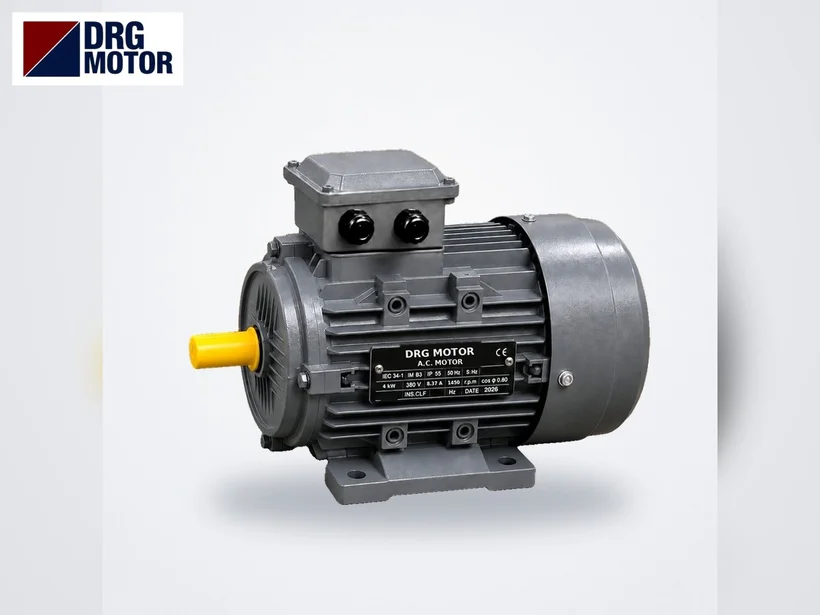
The motor usually bolts by its flange to the gearbox at the rear end of the saw bow, and the gearbox output carries the drive wheel. Small workshop machines put a step pulley between motor and gearbox, and blade speed is chosen by moving the belt. DRG does not supply worm gearboxes; we supply only the motor that fits to one. General rules for choosing a flange motor for a gearbox are on our Electric Motors for Gearboxes page.
Lowering the bow: gravity, oil cylinder or hydraulic unit
On the simplest machine the bow descends under its own weight and a valve in an oil cylinder slows it; there is no separate motor. Semi-automatic machines have a small hydraulic unit that lifts the bow and controls the descent; maker sheets list this motor between 0.19 and 0.75 kW. For motor choice on hydraulic units, see our Hydraulic Power Unit Electric Motors page.
Coolant pump and automatic feed
The soluble-oil pump is around 0.04–0.125 kW and is usually replaced together with its motor. On fully automatic machines the feed vice that pushes the bar forward moves by hydraulic cylinder or servo motor. Servo axes are outside our range.
How many kW is a metal band saw motor? Catalogue values
A) Motor ratings found in metal band saw catalogues:
| Machine / cutting capacity | Saw (main) motor | Auxiliary motors | Note |
|---|---|---|---|
| Workshop swing-arm saw, step pulley | 0.75 kW | none (descent via oil cylinder) | first catalogue, smallest model |
| Swing-arm saw, variable 15–90 m/min | 1.5 kW (three-phase version) | coolant pump | first catalogue |
| Semi-automatic, 24–110 m/min | 1.5 kW | hydraulic 0.19 kW; coolant 0.1 kW | first catalogue |
| Semi-automatic, 31–115 m/min | 2.2 kW | hydraulic 0.19 kW; coolant 0.1 kW | first catalogue |
| Double column, 200 mm | 1.5 kW | hydraulic 0.55 kW; coolant 0.04 kW | second maker, smallest model |
| Double column, largest model | 5.5 kW | hydraulic 0.75 kW; coolant 0.125 kW | second maker |
| Large double column, variable speed | 5.6 kW | hydraulic pump 0.75 kW | first catalogue, largest model |
Going by the catalogues, the saw drive starts at 0.75 kW on a small workshop machine and rises to 5.5–5.6 kW on a large double-column saw, while the auxiliaries stay below 1 kW. On your own machine the value on the plate applies.
B) Overlap with the DRG range: every main motor in the table lies inside our 0.25–11 kW aluminium range, and so do the 0.55 and 0.75 kW hydraulic unit motors. Outside the range are pole-changing two-speed main motors, the feed servo, coolant pumps built in one housing with their motor and the worm gearbox itself. For heavy block-cutting saws above 11 kW, move on to the cast iron options on the General Purpose Electric Motors page.
Click to see current electric motor prices and order nowSEE PRICES →
How it differs from a wood band saw: low speed, high force
In woodworking the blade runs at tens of metres per second and the wheel is usually belted to the motor; we cover those machines on our Band Saw Machine Motors page and in our article on sawmill and band saw motor selection. In metal cutting the blade runs slowly, at something like 15–115 metres per minute. For the same motor power the force delivered to the blade is inversely proportional to speed:
- 2.2 kW at 60 m/min blade speed (metal): upper limit without losses about 2200 N
- 2.2 kW at 30 m/s blade speed (wood): upper limit without losses about 73 N
The gap is close to thirty times. What loads a metal saw motor is not high speed but the large torque expected at the gearbox output. That is why most machines pair a 4-pole motor with a high-ratio gearbox; never fit a motor taken off a wood machine without checking its pole count against the gearbox ratio.
Aluminium housing on the saw bow
The motor rises and falls with the bow
On swing-arm and semi-automatic machines the motor and gearbox sit at the end of the bow and move with it on every cut. A light motor reduces that moving mass; the hydraulic unit and balance spring that lift the bow carry less load, and the motor is easier to take off during service.
Cutting pressure may need resetting
On a gravity-fed machine the mass of the bow is part of the cutting pressure. If an old cast iron motor is replaced by a lighter aluminium one, the pressure on the blade drops, and the descent valve or balance spring is readjusted. On large machines with heavy shocks and strong vibration, the robustness of a cast iron housing is still an advantage.
What to check when choosing or replacing the motor
Power, speed and supply voltage
The gearbox ratio was chosen for the motor speed, so the pole count stays the same: if the old motor ran at about 1400 rpm, the new one is 4-pole too. Connection follows the voltage on the plate: in our range 3 kW and below run in star, 4 kW and above in delta.
Flange, shaft and gearbox input
The motor shaft slides with its key into the gearbox input bore; shaft diameter, shaft length and key must match exactly. Many small gearboxes use a B14 flange whose dimensions we do not give, so the bolt circle and spigot of the old flange are measured. Large-flange (B5) connection dimensions in the catalogue are:
| Frame | Shaft D×E | Flange P / M / N | Hole S |
|---|---|---|---|
| 80 | 19×40 | 200 / 165 / 130 | 12 |
| 90S/90L | 24×50 | 200 / 165 / 130 | 12 |
| 100L/112M | 28×60 | 250 / 215 / 180 | 14.5 |
| 132S/132M | 38×80 | 300 / 265 / 230 | 14.5 |
Starting, stop-start and speed setting
The saw stops after every cut and starts again for the next; batch cutting can mean hundreds of starts a day. The blade starts unloaded, so each start is light, but frequent switching heats the winding. Two-speed (Dahlander) motors are common on these machines and are not in our range; a single-speed motor with an inverter, or the gear selector on the gearbox, is used instead. DRG does not supply inverters.
Coolant and the IP55 limit
The IP55 class of DRG motors protects against dust ingress and against water sprayed at low pressure from any direction. High-pressure washing, steam cleaning and running in liquid lie outside that class. Route the coolant line clear of the housing, point terminal box and gland to the floor, and keep the condensate drain hole unplugged so liquid thrown up by the chip tray cannot pool inside the frame. Shop temperature should stay within −15…+40 °C.
Example: current of a semi-automatic saw
Assumption: a 2.2 kW saw drive and a 0.55 kW hydraulic unit, both 4-pole aluminium DRG models; values come from the product records:
| Duty | Aluminium DRG model | Current 400 V | Starting ratio Is/In |
|---|---|---|---|
| Saw drive 2.2 kW | DRG-100L1-4 | 4.52 A | 7.6 |
| Hydraulic unit 0.55 kW | DRG-801-4 | 1.31 A | 5.2 |
| Both together | — | 5.83 A | — |
While cutting, the two motors together draw about 5.83 A. When the main motor starts direct-on-line, about 34.4 A appears briefly, so fuse and thermal relay are chosen separately for each motor from its rated plate current. Try the starting methods with our star-delta starting tool and the speed and torque at the gearbox output with our gearbox calculator.
Aluminium DRG motors for metal band saws
| Model | Power · speed | Frame · shaft D×E | Current 400 V · torque |
|---|---|---|---|
| DRG-801-4 | 0.55 kW · 1500 rpm (rated 1400) | 80 aluminium · 19×40 | 1.31 A · 3.75 Nm |
| DRG-802-4 | 0.75 kW · 1500 rpm (rated 1420) | 80 aluminium · 19×40 | 1.75 A · 5.04 Nm |
| DRG-90S-4 | 1.1 kW · 1500 rpm (rated 1445) | 90S aluminium · 24×50 | 2.48 A · 7.27 Nm |
| DRG-90L-4 | 1.5 kW · 1500 rpm (rated 1445) | 90L aluminium · 24×50 | 3.3 A · 9.91 Nm |
| DRG-100L1-4 | 2.2 kW · 1500 rpm (rated 1450) | 100L aluminium · 28×60 | 4.52 A · 14.5 Nm |
| DRG-100L2-4 | 3 kW · 1500 rpm (rated 1450) | 100L aluminium · 28×60 | 6.02 A · 19.8 Nm |
| DRG-112M-4 | 4 kW · 1500 rpm (rated 1450) | 112M aluminium · 28×60 | 7.95 A · 26.3 Nm |
| DRG-132S-4 | 5.5 kW · 1500 rpm (rated 1460) | 132S aluminium · 38×80 | 10.7 A · 36 Nm |
Live price table
The current price of these aluminium-housing models is pulled live from the store into the table below:
| Model | Power / speed | Frame · current 400 V | Price |
|---|---|---|---|
| DRG-801-40.75 HP | 0.55 kW · 1500 rpm | Aluminium 80 · 1.31 A | $87.55 (€78.19) Details & buy → |
| DRG-90S-41.5 HP | 1.1 kW · 1500 rpm | Aluminium 90S · 2.48 A | $118.44 (€105.78) Details & buy → |
| DRG-90L-42 HP | 1.5 kW · 1500 rpm | Aluminium 90L · 3.3 A | $137.59 (€122.88) Details & buy → |
| DRG-100L1-43 HP | 2.2 kW · 1500 rpm | Aluminium 100L · 4.52 A | $179.76 (€160.54) Details & buy → |
| DRG-100L2-44 HP | 3 kW · 1500 rpm | Aluminium 100L · 6.02 A | $194.58 (€173.77) Details & buy → |
| DRG-112M-45.5 HP | 4 kW · 1500 rpm | Aluminium 112M · 7.95 A | $242.82 (€216.85) Details & buy → |
| DRG-132S-47.5 HP | 5.5 kW · 1500 rpm | Aluminium 132S · 10.7 A | $326.47 (€291.56) Details & buy → |
DRG MOTOR motors are guaranteed against material and manufacturing defects for 2 years from the delivery date (warranty certificate).
Motors in this power range
- DRG-801-4 – 0.55 kW – 1400 rpm – 80 aluminium
- DRG-90L-4 – 1.5 kW – 1445 rpm – 90L aluminium
- DRG-100L1-4 – 2.2 kW – 1450 rpm – 100L aluminium
- DRG-112M-4 – 4 kW – 1450 rpm – 112M aluminium
Click to see current prices and order these motors nowSEE PRICES →
Browse the products, ask for a quote: the full set of models is on the Buy Electric Motors Online page. To get a quote, pass on via WhatsApp the cutting capacity of the saw, the old motor’s plate, whether it joins the gearbox by flange or pulley, flange and shaft sizes, whether it is two-speed, the plate of the hydraulic unit motor, the mains voltage and how many cuts a day the saw makes. Phone: +90 (542) 666 11 11.
Frequently asked questions
The blade stalls during a cut; is the motor too small?
Usually not. A blunt blade, a descent valve opened too far or slack blade tension push the current up. Check blade and descent speed first and measure motor current during the cut; only if it stays above the plate current is power lacking.
Can a small single-phase saw take a three-phase motor?
Where the workshop has three phases, the motor is swapped and the switch and cable are renewed for three phases; there is no single-phase motor in our range. With 220 V only, a motor labelled 230/400 V can be connected in delta and driven by an inverter with single-phase input.
Does the bow need a holding brake?
The bow is held by the hydraulic cylinder, so no motor brake is needed. Should the maker’s drawing call for a motor brake, contact us before ordering, as DRG offers no brake motor.
For questions: +90 (542) 666 11 11 · info@drgmotor.com · contact.


