 English
 Le français
 Türkçe

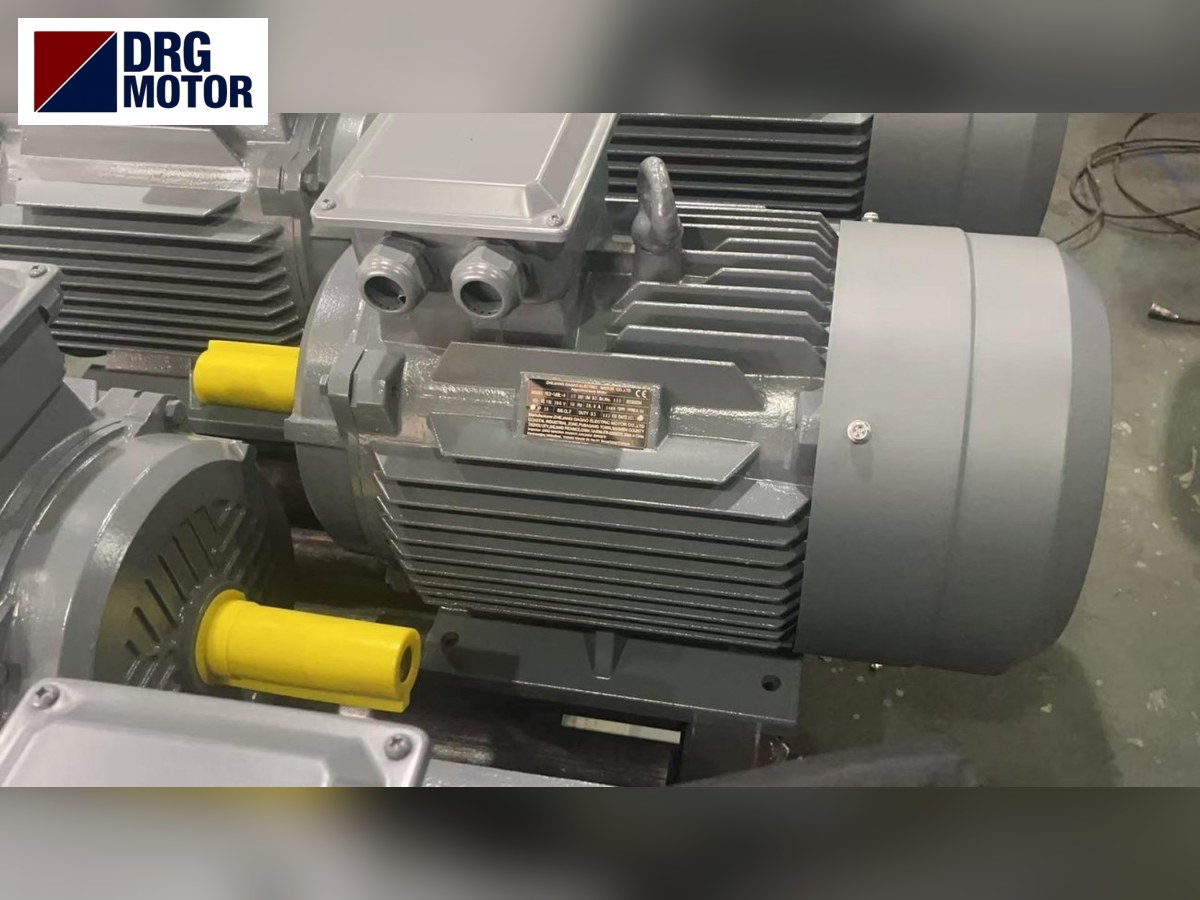
A four-sided planer (moulder) machines timber on all four faces in one pass: the bottom spindle trues the base, the side spindles size both edges and the top spindle gives the thickness; fit profile knives and the same machine produces skirting, architrave, cladding or door frames. Every spindle has its own electric motor, and the timber is driven by a separate feed motor. Maker catalogues for 4–8 spindle machines show 4–18.5 kW per spindle, 1.1–5.5 kW on the feed and 0.37–0.75 kW on the feed beam lift. Single-face machines, the surface planer and the thicknesser, are not the subject of this page.
DRG Motor is a manufacturer, supplier and seller of electric motors. The moulder itself, spindle units, tool holders, profile knives, cardan shafts and gearboxes, inverters and brake modules are not things we sell, and the same goes for reducers, hydraulic units, electro-spindles and servo drives. On a moulder we cover the three-phase induction motors that turn spindles, feed wheels and the beam. Options are on Buy Electric Motors Online.
Spindle layout and motor count on a moulder
The usual order is bottom (truing) spindle first, then right vertical, left vertical and top horizontal; larger machines add a second top, a second bottom or a universal spindle. One catalogue offers layouts from four to eight spindles. The rule is simple: one motor per spindle, plus a feed motor and often a beam lift motor. Seven or eight motors on a six-spindle machine are therefore normal.
Bottom and top horizontal spindles
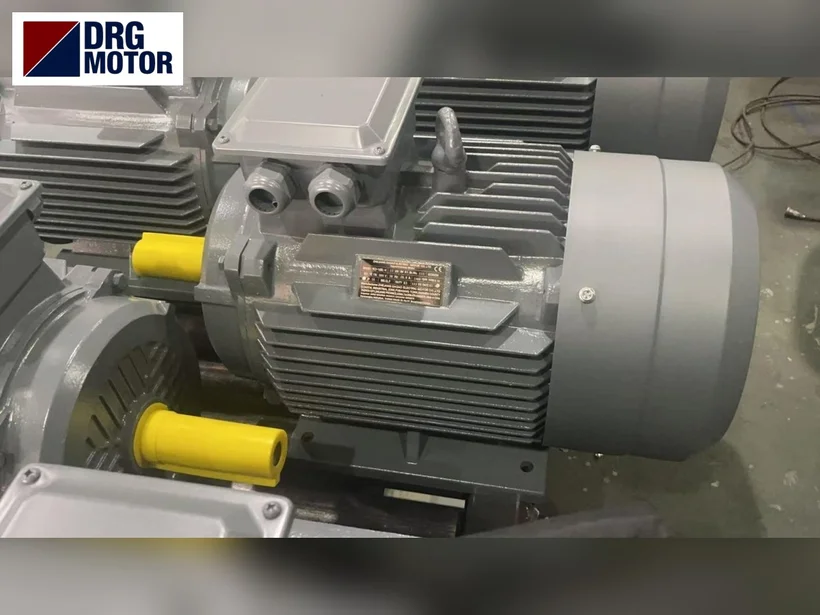
The bottom spindle trues the underside of the timber and usually takes off the most wood on the first pass. The top spindle sets the thickness and cuts across the full width. Catalogues show larger motors on horizontal than on vertical spindles: in one maker’s range vertical spindles carry 7.5 kW and horizontal ones 11 kW, and on another six-spindle machine the second bottom spindle has 15 kW.
Right and left vertical spindles
The vertical spindles work the edges; the right spindle cuts the edge running against the fence, the left one gives the width. For profiles these spindles carry tongue, groove or bead cutters. Because the cut section is narrow, motor power is smaller than on the horizontal spindles on most machines, though a deep profile can change that balance.
Feed and beam motors
The feed motor drives the upper feed wheels through a gearbox and cardan shafts or a chain; catalogues give feed rates of roughly 6–45 m/min, adjustable steplessly by inverter. Some machines have a two-speed (pole-changing) feed motor. The beam motor raises and lowers the traverse that carries the top spindle and pressure wheels to suit the timber thickness.
Moulder versus jointer and thicknesser
A surface planer trues one face and one edge, is fed by hand and has one motor. A thicknesser brings the opposite face to size with powered feed but still uses one block. The four-sided planer does both jobs plus the two edges in a single pass; with a spindle and motor for each face, its installed power is much higher. In series production it removes two separate machines and the handling between them.
Profiling versus plain planing
The same machine can turn out plain planed-all-round timber or pull a profile. When a profile knife takes off more wood, the load on that spindle rises, so feed is usually slowed for profile work. Choose the motor by the figure the machine maker gives for that spindle, not by this load difference.
How many kW does a moulder motor need? Catalogue values
A) Motor ratings published by four-sided planer builders:
| Machine | Motor power | Single / total | Note |
|---|---|---|---|
| 4 spindles, 180 mm width | 4 kW per spindle · feed 1.5/1.1 kW two-speed | separate motor per spindle | maker catalogue, smallest model |
| 4 spindles, 180 mm width | 4 kW per spindle · feed 1.5/1 kW · beam lift 0.37 kW | separate motor per spindle | second maker |
| 4 spindles, 180 mm, 6800–8000 rpm | bottom 4 · right 4 · left 4 · top 5.5 kW · feed 5.5 kW · beam 0.75 kW | six motors | third maker |
| 6 spindles, 220 × 100 mm | 7.5 / 5.5 / 5.5 / 11 / 11 / 15 kW · feed 5.5/4 kW two-speed | spindles total 55.5 kW | fourth maker |
| 4–8 spindles, 230 mm | vertical 7.5 kW · horizontal 11 kW, up to 18.5 kW on request · feed 4 kW | per spindle | fifth maker |
Depending on model and spindle count, this group shows roughly 4–18.5 kW per spindle, 1.1–5.5 kW on the feed and 0.37–0.75 kW on the beam lift. Installed power grows with spindle count; a total in the table is never the rating of one motor.
B) Where DRG fits in: for 4–18.5 kW spindles we offer 2-pole cast-iron motors (frames 112M, 132S, 160M, 160L); 1.1–5.5 kW feed motors by 4-pole frames from 90S to 132S; 0.37–0.75 kW beam motors by 71 and 80 frames. A two-speed feed motor is not in our range; one option is then a single-speed motor with speed set by a drive, but we do not sell drives either. Some machines couple the spindle directly to a special high-speed motor; such motors are not standard IEC and fall outside our range.
Click to see current electric motor prices and order nowSEE PRICES →
Worked example: starting current on a six-spindle machine
Build the six-spindle layout from the table (7.5 / 5.5 / 5.5 / 11 / 11 / 15 kW) from DRG equivalents, with a single-speed 5.5 kW DRG-132S-4 on the feed; spindle motors are DRG-132S2-2, DRG-132S1-2, DRG-160M1-2 and DRG-160M2-2:
| Case | Operation | Result | Comment |
|---|---|---|---|
| Seven motors running together | 13.7 + 2×10.1 + 2×19.6 + 26.5 + 10.7 | about 110 A | sum of rated currents at 400 V |
| 15 kW spindle motor started DOL | 26.5 × 8.1 | about 215 A | Is/In = 8.1 |
| Same motor with star-delta | 214.7 / 3 | about 72 A | in the star step |
| Total while the last motor starts in star | 71.6 + (110.3 − 26.5) | about 155 A | others already started in turn |
| All started DOL at once | sum of In × Is/In for each motor | about 893 A | situation to avoid |
| Spindle pulley ratio | 6000 / 2930 | about 2.05 | from 2-pole motor to 6000 rpm spindle |
The result explains why every spindle on a moulder has its own button and is switched on in turn: starting all motors direct-on-line together would push the inrush past eight times the running current. With star-delta on the large spindles plus sequential starting, the worst moment stays around 155 A. See the star-delta starting page for the method and the pulley and belt calculator for ratios.
Spindle speed, belts and braking: moulder-specific topics
Belt-driven spindles
Catalogues list 6000 rpm as standard spindle speed with 7200–8000 rpm also listed, and spindles driven by V or multi-ribbed belts. Stepping up from about 2930 rpm on a 2-pole motor to 6000 rpm needs a ratio slightly above 2. One catalogue offers 4200 and 6000 rpm spindle speeds through two pulley steps. When changing a motor, pulley size and belt line must stay as before, or spindle speed and finish will change.
Stopping and hood interlock
Profile tooling is heavy and large in diameter; the sound enclosure door should not open before the spindle has stopped completely. Fast stopping is mostly provided by an electronic brake using direct current: after switch-off, a short DC injection is fed to the winding. This works with a standard induction motor. A friction-lined mechanically braked motor is not in the DRG range; if your machine has one, be sure to tell us.
Chips, dust and cooling
Each spindle has its own extraction outlet; catalogues show 120–125 mm diameters. When extraction weakens, chips pack into spindle housings and the motor bay and cover the motors’ cooling fins. On a moulder the motors sit inside the sound enclosure, so air circulation is limited; clean the bay regularly. The central extractor is a separate machine; its fan motor is discussed in our article on motors for dusty, extracted workshops and listed under Fan Motors.
DRG motors for four-sided planers
Models from our range for spindle, feed and beam drives (current at 400 V):
| Model | Power / speed | Frame · shaft D×E | Current 400 V |
|---|---|---|---|
| DRG-112M-2 | 4 kW / 2905 rpm | 112M cast iron · 28×60 | 7.45 A |
| DRG-132S1-2 | 5.5 kW / 2930 rpm | 132S cast iron · 38×80 | 10.1 A |
| DRG-160M1-2 | 11 kW / 2945 rpm | 160M cast iron · 42×110 | 19.6 A |
| DRG-160L-2 | 18.5 kW / 2940 rpm | 160L cast iron · 42×110 | 32.5 A |
| DRG-90S-4 | 1.1 kW / 1445 rpm | 90S cast iron · 24×50 | 2.48 A |
| DRG-132S-4 | 5.5 kW / 1460 rpm | 132S cast iron · 38×80 | 10.7 A |
| DRG-802-4 | 0.75 kW / 1420 rpm | 80 cast iron · 19×40 | 1.75 A |
Spindle motors use cast-iron frames (0.55–355 kW); small beam and feed drives can use aluminium frames (0.25–11 kW) where suitable. Our motors come in 2, 4 and 6 poles (3000/1500/1000 rpm) and can be ordered for B3, B5, B14, B34, B35 or V1, V3, V5, V6 mounting. On a moulder most spindle motors are foot-mounted, with belt tension set by the motor plate. For every motor you replace, record the nameplate data, shaft diameter, key and pulley diameter separately; we check them against the moulder’s documents and agree the choice with you. We make no promise that a motor suits every machine.
B5 dimensions for flange-mounted spindle motors
On some machines the spindle motor is flanged to the spindle unit. B5 dimensions from the DRG catalogue for frames in this power range (mm):
| Frame | Shaft D×E | Flange P / M / N | Hole S |
|---|---|---|---|
| 112M | 28×60 | 250 / 215 / 180 | 14.5 |
| 132S/132M | 38×80 | 300 / 265 / 230 | 14.5 |
| 160M/160L | 42×110 | 350 / 300 / 250 | 18.5 |
Foot-mounting dimensions and drawings are on our technical drawings page.
Live price table
Live shop prices for models at spindle and feed motor ratings:
| Model | Power / speed | Frame · current 400 V | Price |
|---|---|---|---|
| DRG-90L-42 HP | 1.5 kW · 1500 rpm | Cast iron 90L · 3.3 A | $144.14 (€128.73) Details & buy → |
| DRG-112M-25.5 HP | 4 kW · 3000 rpm | Cast iron 112M · 7.45 A | $225.65 (€201.52) Details & buy → |
| DRG-132S-47.5 HP | 5.5 kW · 1500 rpm | Cast iron 132S · 10.7 A | $342.01 (€305.44) Details & buy → |
| DRG-132S1-27.5 HP | 5.5 kW · 3000 rpm | Cast iron 132S · 10.1 A | $338.72 (€302.50) Details & buy → |
| DRG-132S2-210 HP | 7.5 kW · 3000 rpm | Cast iron 132S · 13.7 A | $369.43 (€329.92) Details & buy → |
| DRG-160M1-215 HP | 11 kW · 3000 rpm | Cast iron 160M · 19.6 A | $527.95 (€471.49) Details & buy → |
| DRG-160M2-220 HP | 15 kW · 3000 rpm | Cast iron 160M · 26.5 A | $570.23 (€509.25) Details & buy → |
| DRG-160L-225 HP | 18.5 kW · 3000 rpm | Cast iron 160L · 32.5 A | $714.00 (€637.65) Details & buy → |
DRG MOTOR motors are guaranteed against material and manufacturing defects for 2 years from the delivery date (warranty certificate).
Motors in this power range
- DRG-112M-2 – 4 kW – 2905 rpm – 112M cast iron
- DRG-132S1-2 – 5.5 kW – 2930 rpm – 132S cast iron
- DRG-160M2-2 – 15 kW – 2945 rpm – 160M cast iron
- DRG-132S-4 – 5.5 kW – 1460 rpm – 132S cast iron
- DRG-90L-4 – 1.5 kW – 1445 rpm – 90L cast iron
Click to see current prices and order these motors nowSEE PRICES →
Browse the products, ask for an offer: send each motor’s nameplate from your moulder via WhatsApp, noting which spindle it belongs to, and we will list equivalents in spindle order. All models are on Buy Electric Motors Online, and you can phone us on +90 (542) 666 11 11.
Frequently asked questions
Can every spindle get a motor of the same power?
On some small machines that is already the case: all four spindles share one rating. On large machines the horizontal spindles are stronger. Spindle units and belts are designed for the maker’s rating, so consult the maker before fitting a motor above the catalogue value on any spindle.
Does raising spindle speed require a new motor?
No, spindle speed is set by the pulley ratio. But a higher speed must not exceed the maximum allowed for the tooling; always check the speed limit marked on the tool.
What if the feed motor is two-speed?
Since a two-speed motor is not in our range, there are two routes: source the same motor elsewhere, or move to a single-speed motor and set speed with a drive. The second route means changes to the control circuit; let us look at the machine diagram together before deciding.
For questions about your moulder motors, write to info@drgmotor.com or reach us through our contact page. On spindle motors of spindle moulders, our milling motor selection article offers a different angle.


