 English
 Le français
 Türkçe

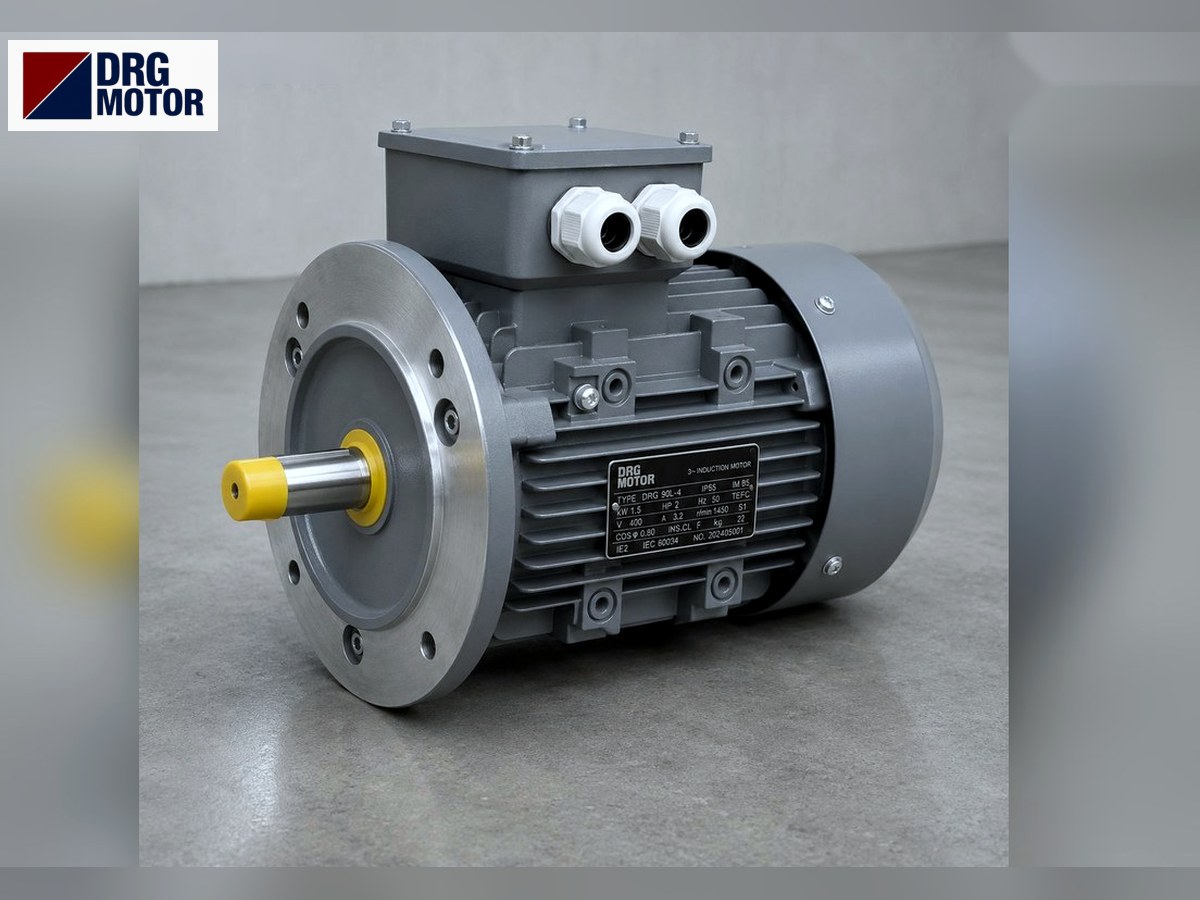
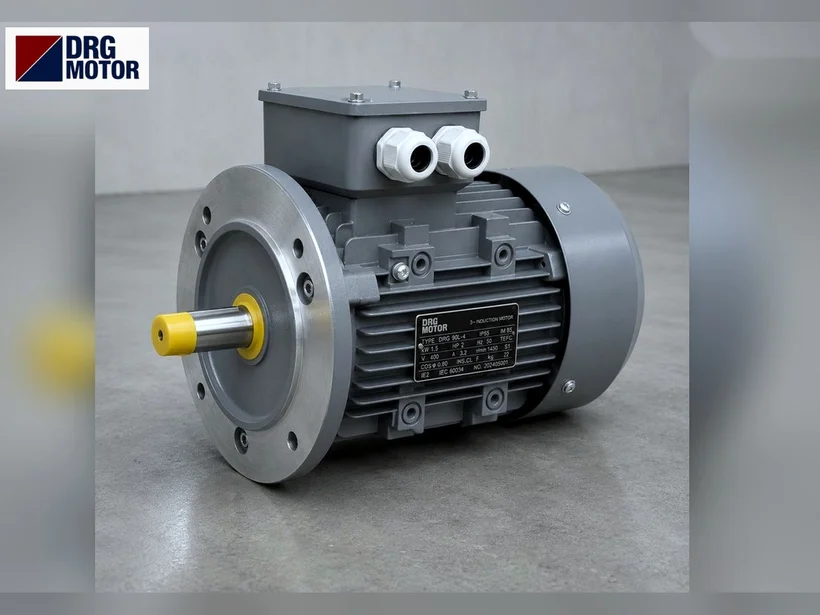
A helical gearbox electric motor is a three-phase asynchronous motor, usually 4-pole with a B5 flange, connected to the input flange of a coaxial (in-line) helical gear unit. Because helical gearing loses little, the motor power is found by adding a small efficiency allowance to the power required at the output; the real selection is made through the ratio, the output torque and the gearbox input flange.
Let us say it up front: DRG Motor does not sell helical gearboxes. Our part of the drive is the motor that bolts onto your helical unit's input. Models listed by frame and speed are available on our Buy Electric Motors Online page.
What kind of gear unit is a coaxial helical gearbox?
The input shaft and the output shaft lie on the same axis, with the gear pairs arranged stage by stage around it. Because the teeth are cut at an angle (helix), meshing is smooth and transmission happens almost entirely by rolling. This layout puts the motor, the gearbox and the machine shaft in one line; belt conveyors, mixers, pumps, crane travel drives, extruder feeders and general industrial drives are its most typical uses.
Foot-mounted or flange-mounted output
The same helical gearbox often comes in two housing versions: a foot-mounted version bolted to the machine base by its feet, and a flange-mounted version fixed directly to the machine housing by a flange on the output side. This difference concerns how the gearbox is attached to the machine; the IEC input on the motor side is the same in both. So a foot-mounted gearbox does not mean the motor must have feet; the motor still sits in the input flange.
Helical versus worm
In a worm gearbox the output turns through 90° and losses climb quickly with the ratio. In a helical gearbox the axis does not change, losses per stage are low, and even when the ratio grows the motor power hardly rises. Where a right angle is needed in a tight space, a worm or bevel helical unit is chosen; where high power and efficiency are needed in a straight line, helical is preferred. This distinction is covered separately on our Worm and Bevel Helical gearbox pages.
Number of stages, ratio and efficiency
One helical gearbox catalogue we reviewed lists single, two and three-stage versions for each size in its motor flange tables. The ratio range and average efficiency change with the number of stages as follows (output speed calculated for a 4-pole motor at 1460 rpm):
| Stages | Ratio range in catalogue | Average efficiency | Output speed (1460 rpm) |
|---|---|---|---|
| 1 | 1.23–8.75 | 0.97 | 166.9–1187 rpm |
| 2 | 4.70–56.11 | 0.96 | 26–311 rpm |
| 3 | 45.77–282.10 | 0.94 | 5.2–32 rpm |
The ratio ranges of two and three stages overlap; for the same ratio the two-stage version is slightly more efficient, while the three-stage version may allow a more compact size. Another manufacturer also gives the gearing efficiency of helical units as up to 0.98, 0.97 and 0.96 depending on the number of stages.
How does high efficiency affect power selection?
Since efficiency stays between 0.94 and 0.97, the motor power is only a few per cent above the output power. That means a smaller motor than a worm gearbox needs for the same work. High efficiency has a side effect, though: the motor torque reaches the gearbox output almost without loss, so during a jam or shock the gearbox and the machine see the full motor torque. Oversizing the motor is therefore particularly undesirable on a helical gearbox.
Input speed
Performance tables in catalogues are mostly given for an input of 1400–1500 rpm. The same catalogue advises consulting the manufacturer for input speeds above 2000 rpm and ambient temperatures above 40 °C; this should be checked if a 2-pole motor is to be connected. A 6-pole motor, on the other hand, gives a lower output speed and a higher torque at the same ratio.
Click to see current electric motor prices and order nowSEE PRICES →
Input flange: B5 and compact B14 types
On coaxial helical gearboxes the motor input is mostly B5. In the catalogue we reviewed, every ratio is marked "B5" or "B5-B11"; B11 is an extra option the manufacturer offers for its compact motor versions. Small helical gearboxes may also use the B14 small flange. B14 is available from us, yet its dimensions are not printed in our catalogue, so a B14 order is checked against your gearbox input before production.
B5 dimensions: frames 80–160
B5 flange and shaft values from the DRG catalogue for the motor frames that most often pair with helical gearboxes (mm):
| Frame | Shaft D×E | Flange P / M / N | Hole S |
|---|---|---|---|
| 80 | 19×40 | 200 / 165 / 130 | 12 |
| 90S/90L | 24×50 | 200 / 165 / 130 | 12 |
| 100L/112M | 28×60 | 250 / 215 / 180 | 14.5 |
| 132S/132M | 38×80 | 300 / 265 / 230 | 14.5 |
| 160M/160L | 42×110 | 350 / 300 / 250 | 18.5 |
If the IEC input flange of the gearbox and the flange and shaft diameter of the motor belong to the same frame size, they generally fit; still, check by placing this table next to the input dimensions in the gearbox catalogue.
Supporting the motor on large frames
As the gearbox size grows, a larger motor frame is fitted to its input; in the catalogue we reviewed, the small sizes take frame 63–112 motor flanges and the largest sizes frame 132–225. The same catalogue asks for a check, from IEC frame 180 upwards, of whether the motor needs additional support on feet. In such a layout a B35 motor carrying both feet and flange can be used; at DRG the B35 option is stated in the order note.
Worked example: 900 Nm at about 45 rpm
Suppose a mixer shaft needs 900 Nm of torque at around 45 rpm. The 4-pole DRG-132S-4 is 5.5 kW, 1460 rpm and 36.0 Nm.
- Required ratio: 1460 / 45 ≈ 32.4. One of the nearest two-stage ratios in the catalogue is 34.38, and a frame 132 B5 input is available at this ratio.
- Output speed: 1460 / 34.38 ≈ 42.5 rpm.
- Theoretical output torque: 36.0 × 34.38 × 0.96 ≈ 1188 Nm; above 900 Nm.
- With the next step down, DRG-112M-4 (4 kW, 26.3 Nm): 26.3 × 34.38 × 0.96 ≈ 868 Nm; below the required torque.
- At 42.5 rpm, 900 Nm corresponds to about 4.0 kW at the output and about 4.2 kW required from the motor. 5.5 kW is therefore the right step.
The rated output torque of the selected gearbox and the service factor required for the mixer are checked separately in the gearbox catalogue. Repeat the steps with your own load in our output speed and torque tool. A broader explanation with ratio, service factor and a conveyor example is in our article on motor and gearbox selection.
Starting, mounting position and oil
How does starting torque reach the output?
A helical gearbox also multiplies the motor's starting torque almost without loss. At start our 4-pole 5.5 and 7.5 kW motors give twice their rated torque, the 11 and 15 kW ones 2.2 times. In the example above, a direct-on-line start produces about twice the rated torque at the output; this value should be compared with the peak torque of the gearbox. A soft starter or an inverter can be used to reduce the shock; star-delta on 400 V is an option from 4 kW, where our windings are 400/690 V.
Mounting position and oil level
According to the helical gearbox catalogue we reviewed, the horizontal foot-mounted position (B3) gives less oil splash, better lubrication and less heating. The same catalogue requires the mounting position to be stated in the order for two and three-stage units; in the vertical V1 and V5 positions the larger sizes come with double oil seals. On the motor side, when the gearbox is installed vertically the motor also runs vertically; note that in the order, since vertical motor versions differ by frame.
Brake
Crane travel, inclined belts or machines that must not roll back when stopped need a brake motor. Brake motors are not in the DRG range; in that case please talk to us in advance.
What to send us with the order
- Gearbox type, size, number of stages and ratio (from the nameplate).
- Input designation: for example "132 B5" or "100/112 B5"; for B14, the flange dimensions.
- Power, speed, voltage and mounting code of the old motor.
- Mounting position of the gearbox and whether the motor runs horizontally or vertically.
- For motor frames 180 and above, whether foot support is needed (B5 or B35).
- Starting method: direct, star-delta, soft starter or inverter.
DRG motors: models suited to helical gearbox inputs
DRG Motor is a manufacturer, supplier and seller of electric motors. Below is a selection of our 4-pole motors, the type most used with helical gearboxes, that suit small and medium sizes. Small ratings come in aluminium (up to 11 kW) and larger ones in cast iron, which spans 0.55–355 kW; every motor is IP55 and runs at 1000, 1500 or 3000 rpm.
| Model | Power / speed | Frame · shaft D×E | Current 400 V |
|---|---|---|---|
| DRG-90L-4 | 1.5 kW / 1445 rpm | 90L cast iron · 24×50 | 3.3 A |
| DRG-112M-4 | 4 kW / 1450 rpm | 112M cast iron · 28×60 | 7.95 A |
| DRG-132S-4 | 5.5 kW / 1460 rpm | 132S cast iron · 38×80 | 10.7 A |
| DRG-160M-4 | 11 kW / 1465 rpm | 160M cast iron · 42×110 | 20.4 A |
| DRG-180L-4 | 22 kW / 1470 rpm | 180L cast iron · 48×110 | 39.7 A |
| DRG-200L-4 | 30 kW / 1475 rpm | 200L cast iron · 55×110 | 53.8 A |
| DRG-225S-4 | 37 kW / 1485 rpm | 225S cast iron · 60×140 | 66.1 A |
The B5, B35 or B14 mounting option is stated in the order note. Flange dimensions of frames 180 and above are also in the B5 table of the DRG catalogue; ask us to confirm dimensions.
Live price table
Current prices of our motors to be fitted to a helical gearbox are taken from the shop data:
| Model | Power / speed | Frame · current 400 V | Price |
|---|---|---|---|
| DRG-90L-42 HP | 1.5 kW · 1500 rpm | Cast iron 90L · 3.3 A | $144.14 (€128.73) Details & buy → |
| DRG-100L2-44 HP | 3 kW · 1500 rpm | Cast iron 100L · 6.02 A | $203.84 (€182.05) Details & buy → |
| DRG-112M-45.5 HP | 4 kW · 1500 rpm | Cast iron 112M · 7.95 A | $254.38 (€227.18) Details & buy → |
| DRG-132S-47.5 HP | 5.5 kW · 1500 rpm | Cast iron 132S · 10.7 A | $342.01 (€305.44) Details & buy → |
| DRG-132M-410 HP | 7.5 kW · 1500 rpm | Cast iron 132M · 14.3 A | $394.89 (€352.66) Details & buy → |
| DRG-160M-415 HP | 11 kW · 1500 rpm | Cast iron 160M · 20.4 A | $568.76 (€507.94) Details & buy → |
| DRG-160L-420 HP | 15 kW · 1500 rpm | Cast iron 160L · 27.3 A | $678.13 (€605.61) Details & buy → |
| DRG-180L-430 HP | 22 kW · 1500 rpm | Cast iron 180L · 39.7 A | $919.45 (€821.13) Details & buy → |
| DRG-200L-440 HP | 30 kW · 1500 rpm | Cast iron 200L · 53.8 A | $1,235.00 (€1,102.93) Details & buy → |
| DRG-225S-450 HP | 37 kW · 1500 rpm | Cast iron 225S · 66.1 A | $1,527.18 (€1,363.87) Details & buy → |
DRG MOTOR motors are guaranteed against material and manufacturing defects for 2 years from the delivery date (warranty certificate).
Motors in this power range
- DRG-112M-4 – 4 kW – 1450 rpm – 112M cast iron
- DRG-132S-4 – 5.5 kW – 1460 rpm – 132S cast iron
- DRG-132M-4 – 7.5 kW – 1460 rpm – 132M cast iron
- DRG-160L-4 – 15 kW – 1465 rpm – 160L cast iron
- DRG-200L-4 – 30 kW – 1475 rpm – 200L cast iron
Click to see current prices and order these motors nowSEE PRICES →
Frequently asked questions
What kW motor does a helical gearbox need?
Turn the output torque and speed into kW, add the small stage loss (efficiency 0.94–0.97), round up to a standard motor and confirm that motor torque × ratio × efficiency still covers the load.
Can a helical gear motor be 2-pole?
It can, but the input speed becomes about 2900 rpm. The catalogue we reviewed recommends consulting the manufacturer for inputs above 2000 rpm; get the gearbox manufacturer's approval before choosing.
Does a foot-mounted helical gearbox need a foot-mounted motor?
No. Whether the gearbox has feet or a flange is how it is attached to the machine. The motor sits in the IEC input flange of the gearbox; if large frames need extra foot support, B35 is chosen.
Where can I see the price of a helical gearbox motor?
The live table on this page shows the current price of the motors to be fitted to the gearbox. Power, pole count and housing material set the figure.
Tell us what the gearbox label and the old motor plate say, and we will propose the motor: phone +90 (542) 666 11 11, e-mail [email protected], contact page. For all models and the helical gearbox motor price list, see Buy Electric Motors Online.


