 English
 Le français
 Türkçe

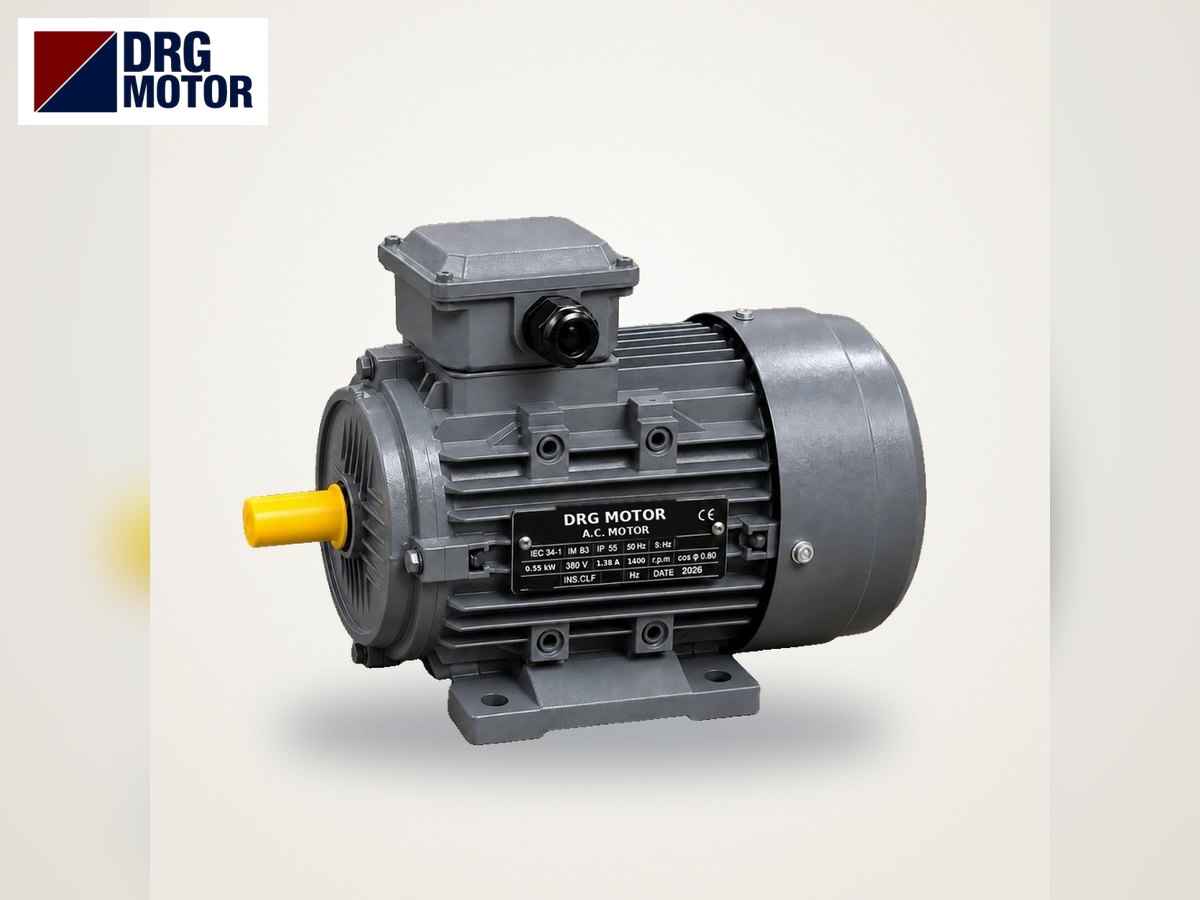
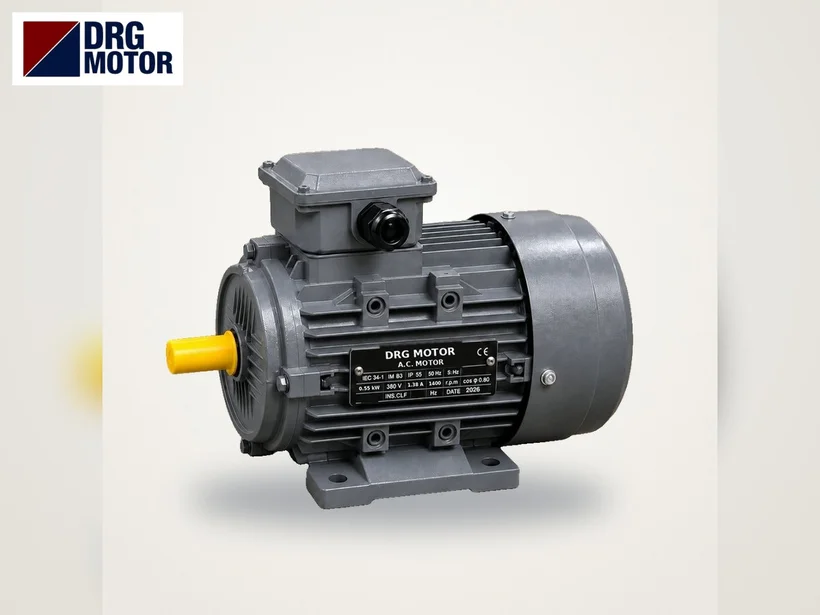
An automatic feeding system runs on motors that are small but many. The unloading auger under the silo carries feed into the house; inside, each pan or chain line has its own drive unit at the end, which starts when a sensor reports an empty hopper. Most of these motors fall within 0.37–1.5 kW, exactly the zone that aluminium housing electric motors cover. Crushing, mixing and pellet machines at a feed mill are a separate world; for their motors see our Feed Machine Electric Motors category. This page covers distribution inside the poultry house on the farm.
DRG Motor is a manufacturer, supplier and seller of electric motors. We do not sell silos, flex augers, tubes, pans, chains, feed trolleys, gearboxes, level sensors, control boxes or drives; DRG covers just the three-phase induction motor at each feeding drive. Models with prices are on the Buy Electric Motors Online page.
What job do motors do on a feeding line?
Silo unloading and the flex auger fill line
The unloading unit under the silo cone connects to a flexible spiral turning inside a tube. The spiral carries feed through the house wall to the small hoppers at the head of the pan lines. The motor sits at one end of the line and turns the spiral through a gear unit; a sensor in the last hopper stops it once it is full. Long, wide lines ask for a bigger motor.
The gear motor at the end of a pan line
In broiler and turkey houses feed is spread to the pans by a spiral inside a tube running above them. The drive unit at the line end is a motor with a single-stage gear; once the control pan at the far end fills, the motor stops. There are as many drives as lines.
Chain feeders and cage feed trolleys
In layer cages and aviary systems feed travels in the trough on a circulating chain; a corner unit pulls the chain and the circuit length sets the power. In multi-tier cages a trolley runs back and forth on rails and drops feed into each tier’s trough; the motors moving the trolley and turning its hopper auger are separate. In breeder houses a spin feeder that throws feed over the litter comes with its own motor too.
Motor power on systems on the market
A) Values stated in poultry equipment makers’ sheets:
| System / section | Motor power | Single motor? | Note |
|---|---|---|---|
| Pan line drive unit | 0.37 / 0.55 kW | one per line | 230/400 V three-phase, gear output 325 rpm |
| Another pan system | 0.55 / 0.75 kW | one per line | 356 / 560 rpm; lines up to 120 m |
| Flex auger fill line gear unit | 0.37 / 0.55 / 0.75 / 1.1 / 1.5 kW | one per line | 4-pole, 3-phase, B5; 14 mm hollow shaft at 0.37 kW |
| Cross fill line, 90 mm tube | 1.1 kW | one per line | 380 V three-phase, with level sensor |
| Chain feeder (aviary, cage) | 0.37–2.2 kW | one per circuit | by circuit length; 12 / 18 / 36 m/min |
| Breeder spin feeder | 0.55 kW | one per feeder | speed-controlled |
| Cage feed trolley chain | 1 HP | one per tier and row | cage system maker |
In this system group motors of about 0.37–2.2 kW per line or circuit are found. A house usually has several pan or chain lines and one or two fill lines; the installed feeding power of the house is their sum, not the rating of one line.
B) Overlap with the DRG range: feeding drives that are three-phase, 4-pole and 0.37–2.2 kW find their aluminium match among the 71, 80, 90 and 100 frame sizes. Honestly outside our range: single-phase motors, which are very common in small houses; special gear motors with motor and gearing cast in one housing (many pan line drives are built this way); servo and stepper motors used for precise dosing; and winches for height adjustment that need a brake motor. In these cases the machine maker’s motor data and connection dimensions are checked; a DRG motor is not taken as a direct fit.
Click to see current electric motor prices and order nowSEE PRICES →
The real advantage of aluminium in a poultry house
Light weight on suspended lines
Pan lines hang from the ceiling on steel cables so they can be raised as the birds grow; the motor at the line end rides on the same suspension. A light motor eases the load on the winch and cables and keeps the line end from sagging. We give no housing weight; our product records do not hold that data.
Small size, many motors
One house holds many small motors of the same type, and a spare is kept on the shelf. A compact aluminium housing fits narrow corner units, can be carried one-handed up a ladder, and keeping a few spares of one frame size is simple.
Where cast iron comes first
Distribution inside the house is a light, vibration-free load, and cast iron gives no clear advantage here. On the feed mill side, crushers and pellet presses are heavy, high-power duty; cast iron suits that side better, and any mill drive over 11 kW already falls beyond what our aluminium frames offer.
Dimensions to look at when choosing a motor
Power, speed and flange
Almost all feeding drives are 4-pole and join the gear unit with a B5 flange. The hollow input shaft of the gear sets the motor shaft diameter: 14 mm on frame 71, 19 mm on frame 80, 24 mm on frame 90. Flange and shaft values:
| Frame | Shaft D×E | Flange P / M / N | Hole S |
|---|---|---|---|
| 71 | 14×30 | 160 / 130 / 110 | 10 |
| 80 | 19×40 | 200 / 165 / 130 | 12 |
| 90S/90L | 24×50 | 200 / 165 / 130 | 12 |
If the old motor runs at around 1400 rpm, the new one must also be 4-pole; a 2-pole motor turns the spiral twice as fast, and the line blocks or spills feed.
Voltage and connection
The 0.25–2.2 kW aluminium feeding motors in the table have 230/400 V windings and are wired in star to the house’s 400 V three-phase panel. Fill and pan lines are fed from the same panel; every motor needs its own overload protection.
Belt, gear or auger?
On spiral lines the motor sits straight on the gear; belts and couplings appear only on older rigid augers. On a belt-driven auger the pulley ratio may change the motor speed, so the auger speed is checked again. Power sizing for augers and inclined conveying is covered separately on our feed auger motors page.
Sensor stop-start, dust and poultry house air
Frequent starts and running on an empty line
A feeding motor starts and stops on its sensor dozens of times a day. That is no problem for a small motor, but turning for long on an empty line wears the spiral and tube; a clean, well-set sensor also lengthens motor life. Direct-on-line starting is enough at this size. Where a spin feeder or dosing needs speed control an inverter is used; DRG does not supply drives.
Feed dust and ammonia
Poultry house air carries feed dust, feathers and ammonia. Dust builds up on the fan cover and fins and heats the motor; clean cover and fins between flocks. Ammonia attacks bolts, cable glands and terminal connections; keep the gland tight and the terminal box closed.
The IP55 limit during washing between flocks
DRG motors are IP55: they withstand settled dust and low-pressure water from any direction. Washing the house with a pressure washer and disinfectant after a flock leaves, steam cleaning or the motor ending up under water are beyond that protection. Wrap the motors in plastic before washing or keep the jet off them; terminal box and cable entry should face down.
Houses with single-phase motors
In small and village-type houses, pan line and fill motors often come as single-phase 220 V units. For poultry feeding we offer no single-phase motor. Using a DRG motor needs a three-phase supply to the house; if the ventilation fans are already three-phase this is usually possible at the panel. For house fans see also our Fan Motors category.
Worked example: a broiler house with four pan lines
Assumption: four pan lines, each with a 0.55 kW 4-pole motor and a single-stage gear of ratio 1:3.94; one cross fill line at 1.1 kW. The figures are an example:
| Point | DRG aluminium equivalent | Current 400 V | Number |
|---|---|---|---|
| Pan line end, 0.55 kW | DRG-801-4 | 1.31 A | 4 |
| Cross fill line, 1.1 kW | DRG-90S-4 | 2.48 A | 1 |
| All together | — | 7.72 A | 5 |
The pan line spiral turns at about 1400 / 3.94 ≈ 355 rpm. If every motor runs at once the total current is about 7.72 A; the fill line motor briefly draws 16.9 A on starting. Because the sensors start motors at different moments, the real load is usually lower.
Suitable DRG aluminium models and prices
4-pole aluminium housing models for pan, spiral and chain drives (values from our product records):
| Model | Power · synchronous / rated speed | Aluminium frame · torque | Current 400 V |
|---|---|---|---|
| DRG-711-4 | 0.25 kW · 1500 / 1340 rpm | IEC 71 · 1.78 Nm | 0.66 A |
| DRG-712-4 | 0.37 kW · 1500 / 1340 rpm | IEC 71 · 2.64 Nm | 0.92 A |
| DRG-801-4 | 0.55 kW · 1500 / 1400 rpm | IEC 80 · 3.75 Nm | 1.31 A |
| DRG-802-4 | 0.75 kW · 1500 / 1420 rpm | IEC 80 · 5.04 Nm | 1.75 A |
| DRG-90S-4 | 1.1 kW · 1500 / 1445 rpm | IEC 90S · 7.27 Nm | 2.48 A |
| DRG-90L-4 | 1.5 kW · 1500 / 1445 rpm | IEC 90L · 9.91 Nm | 3.3 A |
| DRG-100L1-4 | 2.2 kW · 1500 / 1450 rpm | IEC 100L · 14.5 Nm | 4.52 A |
Today’s prices for these models are pulled from the shop and listed below:
| Model | Power / speed | Frame · current 400 V | Price |
|---|---|---|---|
| DRG-711-40.37 HP | 0.25 kW · 1500 rpm | Aluminium 71 · 0.66 A | $73.16 (€65.33) Details & buy → |
| DRG-712-40.5 HP | 0.37 kW · 1500 rpm | Aluminium 71 · 0.92 A | $76.76 (€68.55) Details & buy → |
| DRG-801-40.75 HP | 0.55 kW · 1500 rpm | Aluminium 80 · 1.31 A | $87.55 (€78.19) Details & buy → |
| DRG-802-41 HP | 0.75 kW · 1500 rpm | Aluminium 80 · 1.75 A | $97.30 (€86.90) Details & buy → |
| DRG-90S-41.5 HP | 1.1 kW · 1500 rpm | Aluminium 90S · 2.48 A | $118.44 (€105.78) Details & buy → |
| DRG-90L-42 HP | 1.5 kW · 1500 rpm | Aluminium 90L · 3.3 A | $137.59 (€122.88) Details & buy → |
| DRG-100L1-43 HP | 2.2 kW · 1500 rpm | Aluminium 100L · 4.52 A | $179.76 (€160.54) Details & buy → |
DRG MOTOR motors are guaranteed against material and manufacturing defects for 2 years from the delivery date (warranty certificate).
Motors in this power range
- DRG-712-4 – 0.37 kW – 1340 rpm – 71 aluminium
- DRG-801-4 – 0.55 kW – 1400 rpm – 80 aluminium
- DRG-90S-4 – 1.1 kW – 1445 rpm – 90S aluminium
- DRG-90L-4 – 1.5 kW – 1445 rpm – 90L aluminium
Click to see current prices and order these motors nowSEE PRICES →
Browse the products, ask for a quote. Every model is on the Buy Electric Motors Online page. For a quote, send a photo of the motor plate, the line type (pan, spiral fill, chain, cage trolley), line length and tube diameter, the gear unit’s input size, whether the house supply is single- or three-phase, and how many times a day the motor switches on: WhatsApp or +90 (542) 666 11 11.
Frequently asked questions
My pan line motor is single-phase; can I fit a three-phase motor?
Yes if the house has a three-phase line and the gear input matches the motor’s flange and shaft; the control box must also be wired for a three-phase motor.
Motor and gear are one piece; can I change only the motor?
Not if they are cast in one housing; the drive unit then comes from the system maker. If they separate, flange and shaft are measured and a standard motor is chosen.
Will a bigger motor cure blockages on the spiral fill line?
Usually not; the cause is damp feed, a broken spiral or a faulty sensor. Power goes up only when the line was extended or the tube enlarged.
For questions: +90 (542) 666 11 11 · info@drgmotor.com · contact.


