 English
 Le français
 Türkçe

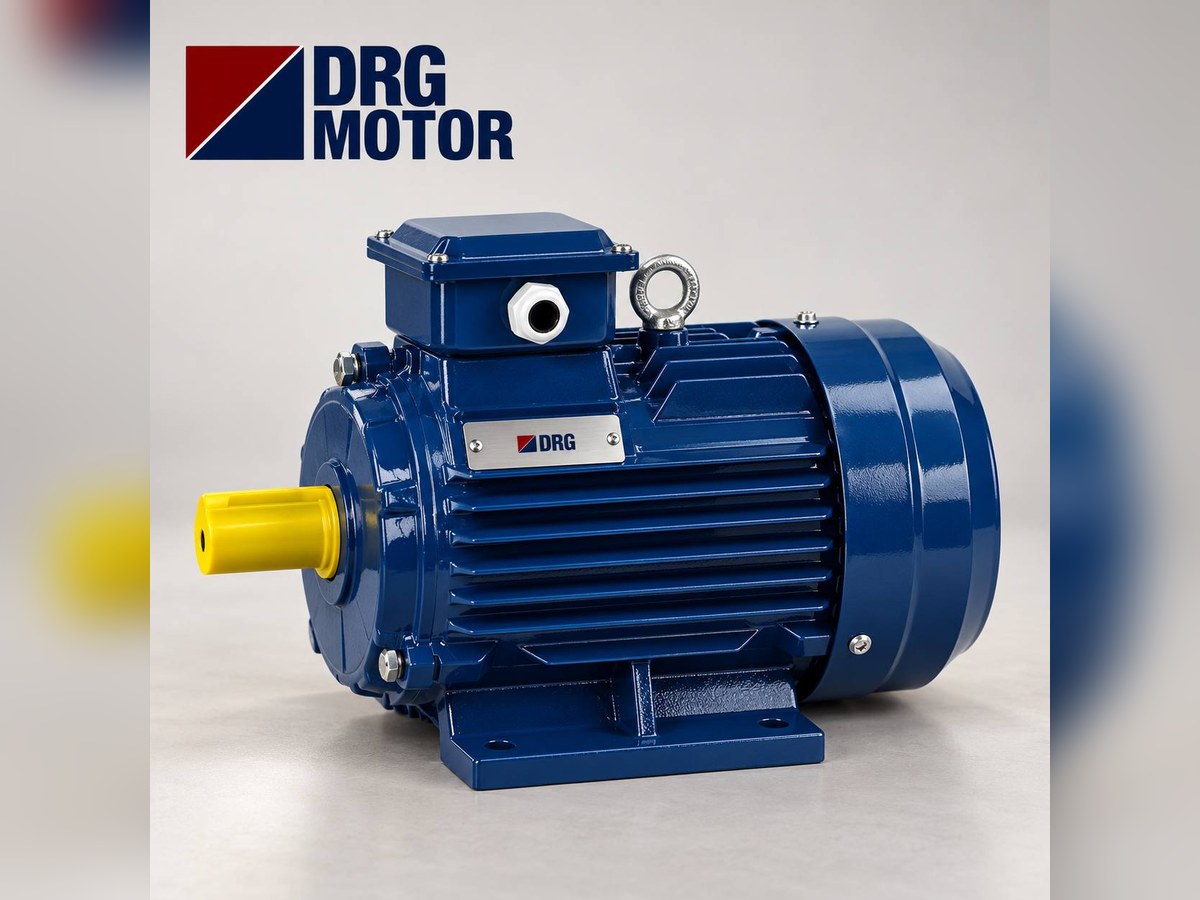
A stone splitter does not cut the stone: it squeezes it between two toothed blades pressing from above and below until it cracks in two. Kerbs, paving setts, cubes, walling stone and slate are produced this way with a natural split face. The blade is moved by a hydraulic cylinder, while the electric motor turns the pump in the hydraulic unit. The power of a splitter motor therefore comes not from how many tonnes the machine presses but from how much oil the pump delivers at what pressure. Maker catalogues list this motor between 5.5 kW and 49 kW.
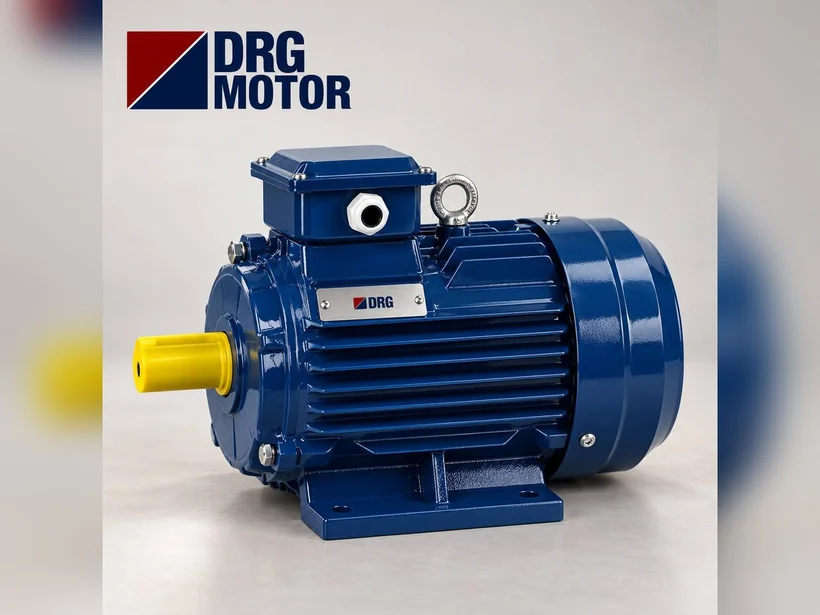
DRG Motor is a manufacturer, supplier and seller of electric motors. We do not sell splitters, press frames, cylinders, hydraulic pumps, valve blocks or the hydraulic unit itself; our product is the three-phase motor driving that pump. Models of suitable power are listed on Buy Electric Motors Online.
How does a hydraulic guillotine splitter work?
The stone is placed on the lower blade with the intended split line under the blade. The upper blade comes down on the cylinder; steel teeth on both blades press on two faces of the stone at once and it cracks along that line. Blade teeth may be individually spring-loaded or hydraulically backed so that each tooth touches even an uneven surface. Blade length is 150–400 mm on paving splitters and 1,200–1,840 mm on large block splitters.
Motor, pump and cylinder: who does what?
The energy path is: electric motor → coupling → pump → valve → cylinder → blade. Splitting force is cylinder area times system pressure and does not change with the motor. What the motor affects is speed: at the same pressure a stronger motor pushes more oil, the blade descends faster and the cycle is shorter. Fitting a motor of the same power after a burnout does not change the machine’s tonnage.
Splitting, cutting and crushing compared
Cutting with a disc or wire divides the stone by abrasion and leaves a flat face; splitting separates it with a single pressure stroke and a natural fracture face. Crushing plants aim not at sized pieces but at aggregate and chippings; for that topic see our Stone Crushing Plant Motors page. Some firms also call a horizontal disc saw that divides a slab into two thinner slabs a “horizontal splitter”; there the motor turns the disc and it should not be confused with the hydraulic splitting covered here.
Types of stone splitter and where they are used
Paving, cube and mosaic splitting
These machines produce cubes and setts from sawn strips or rough stone. The operator works seated and cycle rates are high; the blade comes down often with a short stroke. Catalogues show 16–83 t splitting force and a 5.5 kW pump motor; one maker states that thanks to its pump design 5.5 kW is enough where similar machines use 7.5 kW.
Kerb, walling and building stone splitting
These split larger sections and kerbs, with 400–600 mm strokes and 100–180 t splitting force. Pump motors are listed as 7.5 and 11 kW. For layered stones such as slate and gneiss there are side-splitting types with special blades in the same power class.
Large block splitting
Heavy machines with 320–1,000 t force, used for retaining-wall blocks and large building stones. The hydraulic tank holds more than a thousand litres and the pump motor is a single 49 kW unit. At this power a motor change should be handled together with the panel and starting arrangement.
Motor power from pump flow and pressure
The working formula is P = p × Q / (600 × η): kW from bar and L/min, divided by the pump’s overall efficiency η. Nominal pressure in splitter catalogues is 250–300 bar. Details of the formula and values for different pump types are in our article Electric Motor Selection and kW Calculation for a Hydraulic Pump; here we apply it to a splitter.
Example: a 43-tonne paving stone splitter
Take a machine whose catalogue gives 43 t splitting force, 300 bar nominal pressure and a 5.5 kW motor. Assuming a pump efficiency of 0.85, work backwards:
| Step | Operation | Result | Meaning |
|---|---|---|---|
| 1 | 5.5 × 600 × 0.85 / 300 | ≈ 9.35 L/min | flow deliverable at 300 bar on full power (η = 0.85 assumed) |
| 2 | 43,000 × 9.81 / 30,000,000 | ≈ 0.0141 m² | piston area needed for 43 t |
| 3 | √(4 × 0.0141 / π) | ≈ 134 mm | equivalent cylinder bore |
| 4 | 9.35 L/min / 0.0141 m² | ≈ 11 mm/s | blade speed at full pressure |
| 5 | 11 × 600 × 0.85 / 300 | ≈ 18.7 L/min | flow with 11 kW at the same pressure |
So the motor can push roughly 9 L/min of oil at full pressure. To let the blade drop quickly in free travel, most machines have a second pump stage giving high flow at low pressure or a pump that reduces flow as pressure rises; once the blade meets the stone, pressure goes up and flow drops. So the right motor size comes from the pump’s power setting; multiplying peak pressure by peak flow would oversize it. We ask for the old motor plate and the pump label together.
Click to see current electric motor prices and order nowSEE PRICES →
How many kW is a stone splitter motor? Catalogue values
A) Power of the hydraulic unit motor given in splitter makers’ data sheets:
| Splitter group | Pump motor | Single / total | Note |
|---|---|---|---|
| Small paving / cube stone, 16–30 t | 5.5 kW | Single motor; cooler 0.75 kW extra | maker catalogue, smallest |
| Paving and mosaic stone, 43–83 t, 300 bar | 5.5 kW | Single motor; cooler 0.75 kW | same catalogue |
| Four-blade sawn stone splitter, 50 t | 7.5 kW | Single motor | second maker |
| Four-blade, 70 t | 11 kW | Single motor | second maker |
| Wall and building stone, 100–120 t | 7.5 kW | Single motor; cooler 0.75 kW | first catalogue |
| Building stone and kerb, 150–180 t | 11 kW | Single motor; cooler 0.75 kW | first catalogue |
| Layered stone (side splitting), 100–120 t | 11 kW | Single motor; cooler 0.75 kW | first catalogue |
| Large block splitter, 320–1,000 t | 49 kW | Single motor; cooler 1 kW | first catalogue, largest series |
Depending on model and splitting force, this machine group uses pump motors of roughly 5.5–49 kW. The oil cooler’s fan motor (0.75–1 kW) is a separate motor and is not added to the pump motor; the tank heater is not a motor at all. The table also shows that tonnage alone does not set the motor: the 100–120 t walling stone machine comes with 7.5 kW, the layered stone machine of the same force with 11 kW.
B) Splitter pump motors we can supply
5.5, 7.5 and 11 kW motors are in our aluminium and cast iron series, and the 0.75 kW cooler fan motor in small frames; all are far below our 355 kW limit. The 49 kW unit on the large block splitter corresponds to our 55 kW step; as the frame is larger, bell housing and coupling are measured again. As we have no single-phase motors, small single-phase splitters are outside the scope of this page.
Connecting the motor to the hydraulic unit
B35, B5 and bell housing
A bell housing usually carries the pump on the motor flange, and a flexible coupling joins the two shafts inside it. If the motor sits on the tank on both feet and flange, B35 is chosen; if it hangs from the bell housing alone, B5. On units where the pump is inside the tank and the motor stands upright, vertical (V1) mounting is needed; in that case the motor is ordered for vertical running and the axial load coming from the pump is checked with the unit maker.
Speed and direction of rotation
1500 rpm (4-pole) is common on hydraulic units; as long as the pump’s allowed speed and suction conditions stay the same, the motor should keep the same pole count. If the pump is unidirectional, check the arrow on its body; after connecting the new motor, verify direction with a short run and swap two phases if it turns the wrong way.
Starting and load
On a splitter the motor usually keeps running while the pump idles unloaded; the motor sees full load only while the blade squeezes the stone. Because starting is unloaded it is not demanding. From 4 kW up, our windings are 400/690 V, which allows a star-delta start; for the starting method in the 49–55 kW class see our star-delta starting page.
Working environment: dust, water and oil temperature
Splitting is dry work but stone dust is heavy; on some lines stones are washed before splitting and the floor stays wet. Our motors are IP55; they are protected against dust and splashing water, but if the cooling fins clog with dust the motor runs hot, so clean them regularly. Under heavy cycling the hydraulic oil heats up; the cure is an oil cooler, not a larger motor. If the hydraulic unit is in a closed cabinet, cabinet ventilation is also needed for motor cooling.
DRG motors suitable for stone splitters
Sample 4-pole models for driving the hydraulic pump (current at 400 V):
| Model | Power / speed | Frame · shaft D×E | Current 400 V |
|---|---|---|---|
| DRG-132S-4 | 5.5 kW / 1460 rpm | 132S cast iron · 38×80 | 10.7 A |
| DRG-132M-4 | 7.5 kW / 1460 rpm | 132M cast iron · 38×80 | 14.3 A |
| DRG-160M-4 | 11 kW / 1465 rpm | 160M cast iron · 42×110 | 20.4 A |
| DRG-160L-4 | 15 kW / 1465 rpm | 160L cast iron · 42×110 | 27.3 A |
| DRG-200L-4 | 30 kW / 1475 rpm | 200L cast iron · 55×110 | 53.8 A |
| DRG-225M-4 | 45 kW / 1485 rpm | 225M cast iron · 60×140 | 80.2 A |
Our motors are three-phase and IP55; B3, B5, B35 and their vertical versions are chosen when ordering. The fit is confirmed from the old motor plate read together with the machine maker’s documents. We start with the bell housing and coupling hub, then flange diameter, shaft and key, frame and mounting style, the winding voltage (230/400 on small ratings, 400/690 from 4 kW), and finally plate power and speed. Without that comparison no promise of a definite fit is given.
Live price table
For the pump motor ratings above, the shop feeds live prices into this table:
| Model | Power / speed | Frame · current 400 V | Price |
|---|---|---|---|
| DRG-132S-47.5 HP | 5.5 kW · 1500 rpm | Cast iron 132S · 10.7 A | $342.01 (€305.44) Details & buy → |
| DRG-132M-410 HP | 7.5 kW · 1500 rpm | Cast iron 132M · 14.3 A | $394.89 (€352.66) Details & buy → |
| DRG-160M-415 HP | 11 kW · 1500 rpm | Cast iron 160M · 20.4 A | $568.76 (€507.94) Details & buy → |
| DRG-160L-420 HP | 15 kW · 1500 rpm | Cast iron 160L · 27.3 A | $678.13 (€605.61) Details & buy → |
| DRG-180M-425 HP | 18.5 kW · 1500 rpm | Cast iron 180M · 33.5 A | $873.49 (€780.08) Details & buy → |
| DRG-180L-430 HP | 22 kW · 1500 rpm | Cast iron 180L · 39.7 A | $919.45 (€821.13) Details & buy → |
| DRG-200L-440 HP | 30 kW · 1500 rpm | Cast iron 200L · 53.8 A | $1,235.00 (€1,102.93) Details & buy → |
| DRG-225M-460 HP | 45 kW · 1500 rpm | Cast iron 225M · 80.2 A | $1,688.50 (€1,507.94) Details & buy → |
DRG MOTOR motors are guaranteed against material and manufacturing defects for 2 years from the delivery date (warranty certificate).
Motors in this power range
- DRG-132S-4 – 5.5 kW – 1460 rpm – 132S cast iron
- DRG-160M-4 – 11 kW – 1465 rpm – 160M cast iron
- DRG-180L-4 – 22 kW – 1470 rpm – 180L cast iron
- DRG-225M-4 – 45 kW – 1485 rpm – 225M cast iron
- DRG-250M-4 – 55 kW – 1485 rpm – 250M cast iron
Click to see current prices and order these motors nowSEE PRICES →
Browse products, request a quote: suitable powers for the splitter pump motor are on Buy Electric Motors Online. Send photos of the motor plate, pump label and bell housing via WhatsApp or call +90 (542) 666 11 11.
Frequently asked questions
Will a stronger motor make the machine press more tonnes?
No. Tonnage is set by cylinder bore and the relief valve setting. A stronger motor only raises blade speed, if the pump allows it.
The splitter has slowed down; is the motor faulty?
Measure motor current and speed first. If current is normal and speed does not drop but the blade is slow, the cause may be pump wear, a valve or a filter; changing the motor will not solve it.
Can a stone splitter motor run at 3000 rpm?
Only if the pump catalogue allows that speed. At higher speed the same pump delivers more flow but the risk of suction cavitation rises; most units prefer 1500 rpm.
Hydraulic unit motor queries: phone +90 (542) 666 11 11, e-mail info@drgmotor.com, or fill in our contact page.


