 English
 Le français
 Türkçe

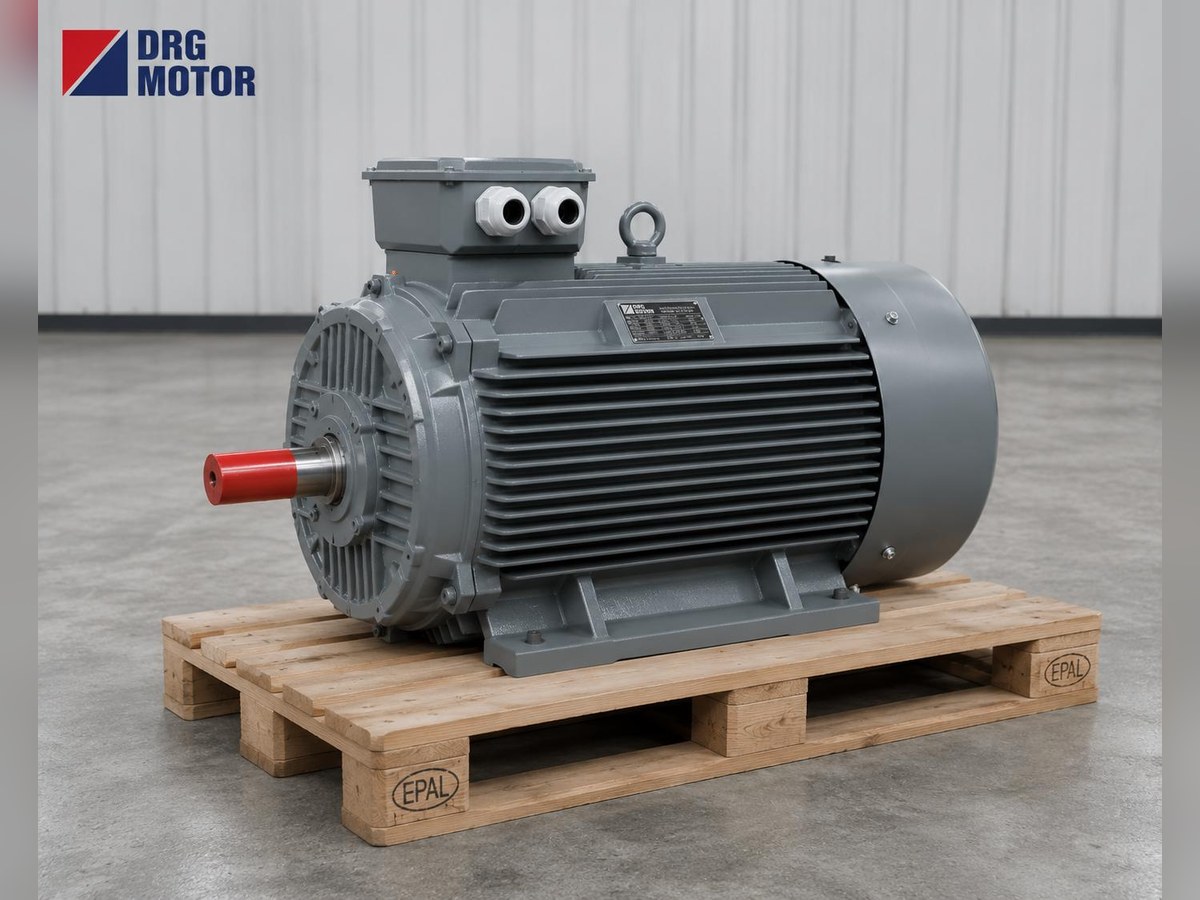
In ceramic raw material preparation, “mixers and grinders” covers three machine families: slow tank stirrers that keep slip from settling, blungers that disperse clay and reclaimed body in water, and pendulum or hammer grinders that turn raw material into powder in the dry process. The electric motor does a different job in each: on a tank stirrer it turns a large blade at the end of a shaft geared down to 6–16 rpm, on a blunger a turbine running at a hundred-plus rpm, and on a dry grinder the main shaft, the separator and the air fan. Maker catalogues give 1.1–22 kW for tank stirrers, 11–110 kW for blungers and 37–400 kW for the main motor of dry grinding mills.
DRG Motor is a manufacturer, supplier and seller of electric motors. We do not sell stirrer blades, turbines, tanks, gearboxes, drives or the dry mill itself; those belong to the machine maker. Our part is the three-phase motor driving them; current models are on Buy Electric Motors Online. The drum ball mill is not the subject of this page: that machine, with its heavy drum drive, is covered separately under “Ceramic Slip Preparation Mills”.
After the mill, or instead of it: the duties in body preparation
In the wet process raw material is ground in a ball mill and the slip goes to tanks; a stirrer runs without stopping so that the density of the stored slip stays even. In sanitaryware and floor tile plants, plastic clay and reclaimed press and casting scrap are first dispersed in water in a blunger, then sent to the mill or straight to the tank. In the dry process grinding uses air instead of water: a pendulum mill turns the raw material into powder, and a wetting and granulating machine then forms pressable granules. In short, the machines on this page either keep slip ready behind the mill or take the mill’s place.
Slip tank stirrers
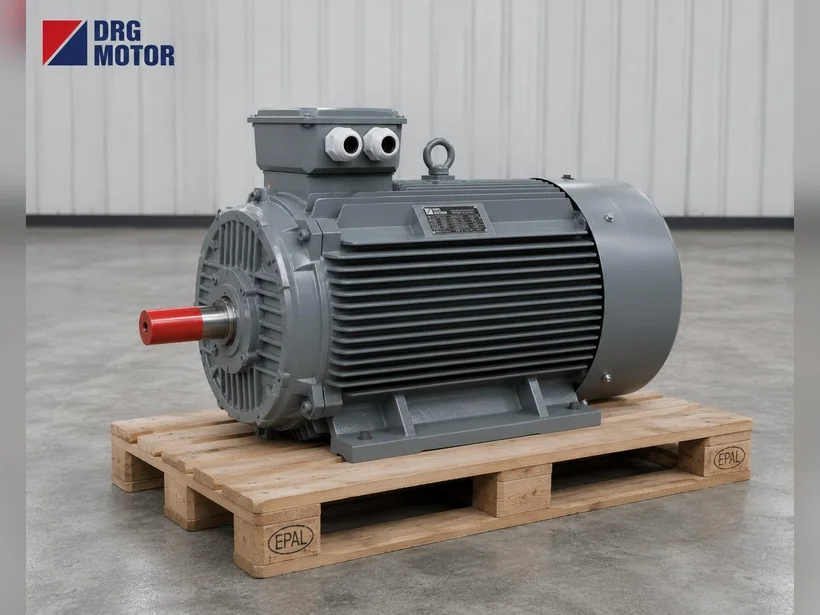
A tank stirrer consists of a frame across the tank mouth, a vertical shaft and two tiers of blades at the bottom. In one maker’s catalogue the motor is a closed three-phase motor coupled directly to an epicyclic (planetary) gearbox; with the motor at 1450 rpm the blades turn at 16, 12, 9 and 6 rpm, slowing as the tank grows. Another maker does the same job with a parallel-shaft helical gearbox and 4-pole motors of 2.2–11 kW. The motor stands on a vertical axis with the shaft end pointing down; in this position the motor must be ordered for vertical mounting and the axial load confirmed by the stirrer maker.
Small stirrers on glaze tanks
On the wheeled tanks of the glazing line the blade turns slowly so that no air bubbles form in the glaze. In one maker’s model a single 1.1 kW motor drives both the stirrer and a vertical centrifugal pump; tank sizes from 124 l to 330 l share the same motor. Low power, frequent moving and wet floors are typical for this equipment.
Blungers: blade blungers and turbine dissolvers
Unlike a tank stirrer, a blunger relies on high peripheral speed. On blade types the rotor turns at 120–220 rpm and breaks up clay lumps returned from pressing, glazing or casting lines, dispersing them in water. Turbine dissolvers have a rotor and fixed disperser inside a wear-resistant shell; the motor drives the rotor through a parallel-shaft gearbox that carries both axial and radial loads.
One-speed or two-speed drive
The catalogue’s blade blunger series offers both single-speed motors (30 kW, 75 kW) and two-speed motors (30÷20 kW, 63÷42 kW) for the same machine; on the two-speed version the blades turn at 180÷123 or 202÷134 rpm. The low speed lets lumps break up at the start of blunging without splashing too much water. Two-speed (pole-changing) motors are not in our catalogue; a single-speed motor with an inverter gives the same flexibility. The inverter is not our product; for a motor that will run long at low speed, review cooling together with the drive supplier.
Starting with a full tank
A blunger usually starts in a tank loaded with water and clay. The load behaves like a pump’s and rises quickly with speed, so the starting shock is lighter than on a ball mill, but in the 45–110 kW class direct-on-line starting strains the supply. The turbine dissolver catalogue lists inverter starting and speed control as an option.
Dry grinding and granule preparation
There is no slip in the dry process. Raw material is first broken in a hammer pre-grinder, then crushed in a pendulum mill under pendulums pressed against a track by centrifugal force. Air flowing through the mill carries the powder upwards, the separator splits fine from coarse, and the fines are collected in a filter. This layout has three motor groups: the mill’s main motor, the separator motor and the filter fan that draws the air. In the fourth maker’s 30 t/h reference line, pre-grinding takes 132 kW, the main motor 250 kW, the separator 11 kW, the process filter fan 315 kW and two wetting machines 18.5 kW each.
Hammer pre-grinder and separator motor
The hammer pre-grinder is a fast, high-inertia rotor; for starting and inertia see our hammer mill motor article. Separator speed sets the fineness; the catalogue states that bladed and cell separators are adjusted with a frequency converter, so the separator motor is chosen for inverter operation. For the filter fan motor, look at the Fan Motors category.
Dust and explosion risk
In a dry grinding room fine clay and feldspar dust gets everywhere. Our IP55 motors are protected against dust; the fan cowl and cooling fins should still be cleaned regularly. If the plant’s risk assessment defines an Ex/ATEX zone around the mill’s drying burner or elsewhere, motors in that zone need certification; our standard motors are not supplied with it. Dust, humidity and heat across the whole factory are discussed in our ceramic plant motor guide.
Click to see current electric motor prices and order nowSEE PRICES →
How many kW is a ceramic mixer motor? Catalogue values
A) Motor ratings given in maker catalogues for stirrers, blungers and dry grinders:
| Machine | Motor rating | Single / total | Note |
|---|---|---|---|
| Glaze tank, slow stirrer + pump, 124–330 l | 1.1 kW | one motor does both jobs | first maker |
| Slip tank flat-blade stirrer, blade dia. 1.45–5 m | 2.2–11 kW | single motor, 4-pole, shaft 13–9 rpm | second maker |
| Slip tank stirrer, tank 5–200 m³ | 3–22 kW | single motor, 1450 rpm, blades 16–6 rpm | third maker |
| Blade blunger (turbo crusher), tank 4–43 m³ | 11–75 kW; two-speed 30÷20 and 63÷42 kW | single motor | third maker |
| Turbine dissolver, 7–16 m³ effective | 45–110 kW | single motor, rotor 120–110 rpm | third maker |
| Pendulum dry mill, main motor | 37–400 kW | mill motor | fourth maker |
| Filter fan and separator of the same mill | fan 37–450 kW; separator 5.5–18.5 kW | separate motors | fourth maker |
| 30 t/h dry preparation line | pre-grinding 132 kW; wetting 2×18.5 kW | line total 745 kW | fourth maker, reference plant |
Motor power stays at 1.1–22 kW on tank stirrers and 11–110 kW on blungers; on dry grinding mills the main motor reaches 37–400 kW and the filter fan up to 450 kW. Within one machine type, tank volume, slip density (1.7–1.8 kg/l in the catalogue), blade diameter and raw material hardness decide the rating; the plant’s total installed power is not the rating of a single machine.
B) Overlap with the DRG range: all stirrers and blungers (1.1–110 kW), plus dry mill main motors and fans up to 355 kW, are covered by our range. Large pendulum mills with a 400 kW main motor and a 450 kW filter fan are outside it. Single-phase motors seen on small studio blungers, pole-changing two-speed motors and brake motors are also outside our range.
Worked example: torque at the blade shaft
On a stirrer the torque the gearbox must carry matters more than motor power. We matched catalogue values with our counterparts and took rated torque from the data sheet (DRG-160M-4: 71.7 Nm; DRG-112M-4: 26.3 Nm; DRG-280S-4: 482 Nm, 129 A, Is/In 6.9):
| Mixer | Operation | Result | Comment |
|---|---|---|---|
| 11 kW tank stirrer, blades 9 rpm | 1,465 / 9 | ratio about 163 | with DRG-160M-4 |
| Same stirrer, torque at blade shaft | 71.7 × 163 | about 11,700 Nm | the gearbox is sized for this |
| 4 kW flat-blade stirrer, shaft 14 rpm | 26.3 × 1,450 / 14 | about 2,720 Nm | with DRG-112M-4 |
| 75 kW turbine dissolver, rotor 115 rpm | 482 × 1,486 / 115 | about 6,230 Nm | with DRG-280S-4, ratio ≈ 12.9 |
| Same dissolver, direct-on-line start | 129 × 6.9 | about 890 A | star-delta ≈ 297 A |
The slow 11 kW stirrer carries roughly twice the shaft torque of the fast 75 kW blunger; on a tank stirrer the gearbox and shaft matter far more than the motor. When replacing the motor, keep the pole count so that gearbox input speed stays the same. To check ratios use our gearbox output speed and torque calculator; to lower starting current see the star-delta starting page.
Mixer and grinder drives with DRG motors
Suitable 4-pole models for tank stirrers, blungers and dry grinding auxiliaries; currents are for 400 V:
| Model | Power / speed | Frame · shaft D×E | Current 400 V |
|---|---|---|---|
| DRG-90S-4 | 1.1 kW / 1445 rpm | 90S cast iron · 24×50 | 2.48 A |
| DRG-100L1-4 | 2.2 kW / 1450 rpm | 100L cast iron · 28×60 | 4.52 A |
| DRG-112M-4 | 4 kW / 1450 rpm | 112M cast iron · 28×60 | 7.95 A |
| DRG-132M-4 | 7.5 kW / 1460 rpm | 132M cast iron · 38×80 | 14.3 A |
| DRG-160M-4 | 11 kW / 1465 rpm | 160M cast iron · 42×110 | 20.4 A |
| DRG-180L-4 | 22 kW / 1470 rpm | 180L cast iron · 48×110 | 39.7 A |
| DRG-200L-4 | 30 kW / 1475 rpm | 200L cast iron · 55×110 | 53.8 A |
| DRG-225M-4 | 45 kW / 1485 rpm | 225M cast iron · 60×140 | 80.2 A |
| DRG-280S-4 | 75 kW / 1486 rpm | 280S cast iron · 75×140 | 129 A |
| DRG-315S-4 | 110 kW / 1488 rpm | 315S cast iron · 85×170 | 187 A |
On a tank stirrer the motor bolts onto the gearbox by its flange (B5, V1 when vertical); on blunger and dry mill drives a foot-mounted (B3) motor works through belts or a coupling. From a small glaze tank to a large dissolver, all these duties fall within our three-phase asynchronous IEC range; the aluminium body stops at 11 kW, cast iron goes to 355 kW, with speeds of 1000, 1500 or 3000 rpm. For a replacement we need the old motor’s power, speed, voltage and connection, flange type and size, shaft diameter and keyway, and the gearbox input bore. We compare these with the machine documents and confirm the suitable model with you; we give no firm fit promise without dimensions.
B5 flange dimensions for stirrer gearboxes
B5 values of frames often used on tank stirrers (mm):
| Frame | Shaft D×E | Flange P / M / N | Hole S |
|---|---|---|---|
| 100L | 28×60 | 250 / 215 / 180 | 14.5 |
| 112M | 28×60 | 250 / 215 / 180 | 14.5 |
| 132S/132M | 38×80 | 300 / 265 / 230 | 14.5 |
| 160M/160L | 42×110 | 350 / 300 / 250 | 18.5 |
On a gearbox-mounted motor the N spigot, D shaft diameter and E shaft length must match exactly; detailed drawings are on our technical drawing page.
Live price table
Prices of the models matching stirrer, blunger and dry grinder ratings come live from shop data:
| Model | Power / speed | Frame · current 400 V | Price |
|---|---|---|---|
| DRG-100L1-43 HP | 2.2 kW · 1500 rpm | Cast iron 100L · 4.52 A | $188.32 (€168.18) Details & buy → |
| DRG-112M-45.5 HP | 4 kW · 1500 rpm | Cast iron 112M · 7.95 A | $254.38 (€227.18) Details & buy → |
| DRG-132M-410 HP | 7.5 kW · 1500 rpm | Cast iron 132M · 14.3 A | $394.89 (€352.66) Details & buy → |
| DRG-160M-415 HP | 11 kW · 1500 rpm | Cast iron 160M · 20.4 A | $568.76 (€507.94) Details & buy → |
| DRG-180L-430 HP | 22 kW · 1500 rpm | Cast iron 180L · 39.7 A | $919.45 (€821.13) Details & buy → |
| DRG-200L-440 HP | 30 kW · 1500 rpm | Cast iron 200L · 53.8 A | $1,235.00 (€1,102.93) Details & buy → |
| DRG-225M-460 HP | 45 kW · 1500 rpm | Cast iron 225M · 80.2 A | $1,688.50 (€1,507.94) Details & buy → |
| DRG-280S-4100 HP | 75 kW · 1500 rpm | Cast iron 280S · 129 A | $2,916.93 (€2,605.00) Details & buy → |
| DRG-315S-4150 HP | 110 kW · 1500 rpm | Cast iron 315S · 187 A | $4,863.00 (€4,342.97) Details & buy → |
DRG MOTOR motors are guaranteed against material and manufacturing defects for 2 years from the delivery date (warranty certificate).
Motors in this power range
- DRG-112M-4 – 4 kW – 1450 rpm – 112M cast iron
- DRG-160M-4 – 11 kW – 1465 rpm – 160M cast iron
- DRG-180L-4 – 22 kW – 1470 rpm – 180L cast iron
- DRG-280S-4 – 75 kW – 1486 rpm – 280S cast iron
- DRG-315S-4 – 110 kW – 1488 rpm – 315S cast iron
Click to see current prices and order these motors nowSEE PRICES →
Browse the products, ask for a quote: motors for your stirrer or blunger are on Buy Electric Motors Online. Send the tank volume, blade speed and a photo of the gearbox flange to our WhatsApp line; for a call, +90 (542) 666 11 11.
Frequently asked questions
What happens if a slip tank stirrer motor stops?
Solids settle and pack at the bottom of the tank; on restart the blade has to break this sediment. That is why keeping a spare motor for tank stirrers matters for production.
Can an inverter replace a two-speed motor on a blunger?
Yes; a single-speed motor with an inverter gives stepless speed. For long running at low speed, review motor cooling together with the drive choice.
What sets the price of a mixer motor?
Rating, pole count, frame material and mounting set the price; the table above is updated from the shop.
Contact: +90 (542) 666 11 11 · info@drgmotor.com · contact page.


