 English
 Le français
 Türkçe

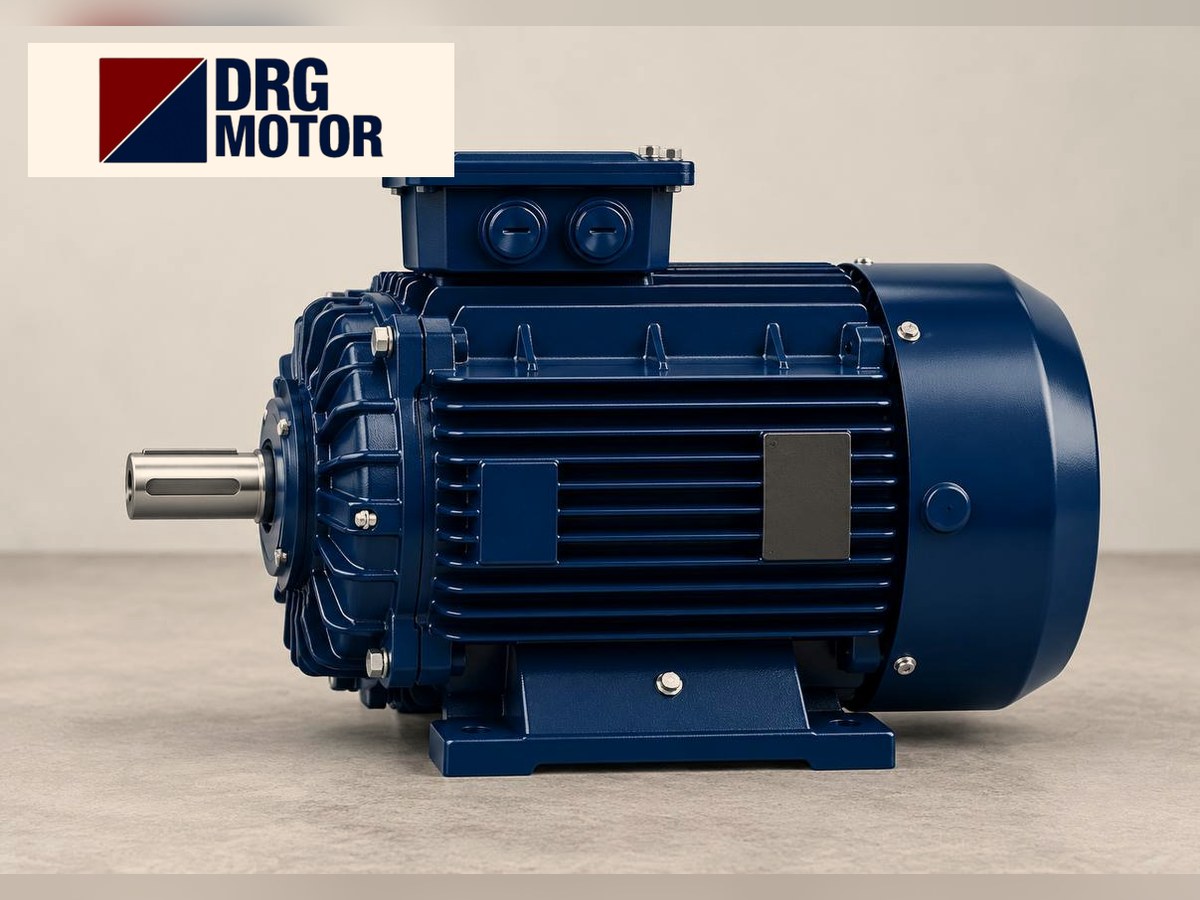
Marble loading and unloading systems are the machines that take a slab from an A-frame or stacking rack, place it at the infeed of a processing line and, at the end of the line, stack the finished slab again. They have no single main motor: the motor of the pump that creates the holding vacuum, the motor of the hydraulic unit that tilts the table and the geared motors that drive the carriage and the rollers all work separately. Manufacturer sheets give a total electrical power of 6 to 23.25 kW for a loader or unloader, yet each motor inside that total is only a few kilowatts.
Our scope is as follows: DRG Motor is a manufacturer, supplier and seller of electric motors. We do not sell the loading machine, the vacuum pump itself, the hydraulic unit, the gearbox, the drive (inverter) or the servo motors on robot axes; we sell the standard three-phase IEC motors coupled to that equipment. Brake motors are not in our range either; we come back to this below. Suitable models are on Buy Electric Motors Online.
Types of loading and unloading machines
Which motors are needed depends on how the slab is held and how it is brought to the horizontal. Three layouts are common in stone plants.
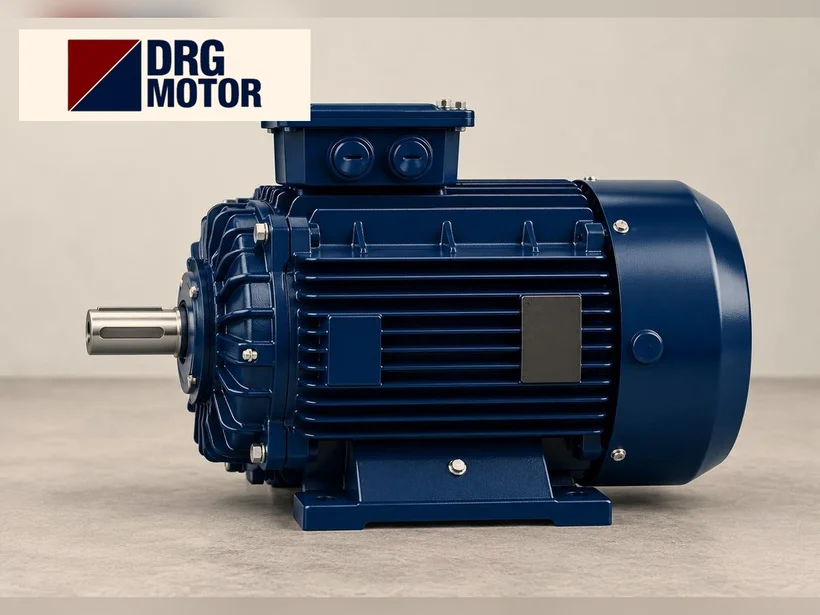
Tilting loading carriage
A carriage running on rails moves up to the upright slab rack. Its table is raised almost vertical by a hydraulic cylinder, the suction cups grip the slab, the table lowers again and motorised rollers pass the slab to the first conveyor of the line. One maker’s sheet states that carriage travel uses an inverter-controlled geared motor while the table is tilted by a hydraulic cylinder.
Bridge-type (flying) vacuum loader-unloader
A suction frame travelling on a bridge above the line picks the slab off a horizontal stack and puts it on the conveyor; the same machine can unload at the line end and lay slabs with polished faces matched (book match). Its movements are controlled by inverter and encoder; robot versions with numerically controlled axes use servo motors, which are not in our range.
Tilting unloading carriage and tilting table
The unloading carriage at the end of the line takes the slab arriving on rollers, lifts the table by a hydraulic cylinder and rests the slab against an upright rack. Fixed tilting tables work the same way: a steel table, bolted down or on wheels, lifted by one or two cylinders. One stone line maker’s tilting table sheet gives 8 motorised rollers and a capacity of 1000 kg, or 1500 kg in the heavy version.
Motors in the system and what they do
Vacuum pump motor
The pump feeding the suction cups is usually an oil-lubricated or dry rotary vane vacuum pump. The motor drives it through a coupling and a flanged adaptor housing and runs as long as the machine is working. Rotary vane pump catalogues show 1.5 kW for 60 m³/h, 2.2 kW for 100 m³/h and 5.5 kW around 300 m³/h. The flow and motor power on the pump label are the starting point when choosing a replacement.
Hydraulic unit motor
Table tilting, slab clamps and sliding saddles are cylinder-operated on most machines. The motor driving the gear pump of the unit is loaded only during the short cylinder strokes; in between, the pump idles unloaded or the motor stops. Its power is calculated from pump flow and relief valve pressure.
Carriage travel and roller motors
Carriage movement on its rails and the motorised rollers on the table are driven by geared motors. These are small; speed is set with inverter ramps so the slab approaches without a jolt. Where the carriage must be held on a slope or at standstill, the machine maker uses a brake motor on that axis.
Motor power in loading systems: market values
A) Power figures from manufacturer sheets and catalogues:
| System / size | Motor power | Single / total | Note |
|---|---|---|---|
| Tilting vacuum loading carriage, 1000–1500 kg slab, 63 m³/h vacuum | 7 kW | Machine total | maker sheet, standard and mid model |
| Same carriage, 2500 kg slab, 100 m³/h vacuum | 9.25 kW | Machine total | same sheet, heavy model |
| Tilting unloading carriage, 1000–2500 kg | 6–6.25 kW | Machine total | same maker, hydraulic table and saddles |
| Bridge-type loader-unloader, 1200–2500 kg, 100–400 m³/h | 10.75–17.75 kW | Machine total | same maker, four models |
| Flying loader, 1200 kg, 100–400 m³/h | 16.25–23.25 kW | Machine total | same maker, second series |
| Rotary vane vacuum pump, 25–300 m³/h | 0.75–5.5 kW | Single motor | vacuum pump catalogue |
| Gantry crane, 5 t: hoist / trolley | 13 kW / 1.8 kW | Separate motors | crane maker sheet, braked drives |
| Gantry crane, 10 t: hoist / trolley | 17 kW / 4 kW | Separate motors | same sheet |
Across loaders and unloaders the sheets show roughly 6–23.25 kW of total electrical power by model and slab load; the vacuum pump motor inside it is roughly 0.75–5.5 kW on its own. Do not read the total as one motor: a 7 kW carriage counts the vacuum pump, hydraulic unit, travel and roller motors together. The sheets do not give that split, so check the machine’s wiring diagram and the motor nameplates.
B) Overlap with the DRG range: vacuum pump motors of 0.75–5.5 kW and hydraulic unit motors of similar size are covered by our 4-pole (1500 rpm) aluminium and cast iron models. For non-standard catalogue values such as 4.5 kW, either the next size up allowed by the pump maker is chosen or you consult us. Hoist and crane travel drives that need a brake motor, servo axes and DC motors of battery carriers are outside our range.
Click to see current electric motor prices and order nowSEE PRICES →
Where a brake motor is needed: an honest distinction
Any movement that carries a slab in the air or holds a load up must stop by itself when power is lost. The hoists of gantry and overhead cranes, inclined travel paths and the vertical axes of some loading bridges are therefore fitted with brake motors, often special drives selected to crane standards. Brake motors are not in our range, and we do not offer our standard motor for these axes: putting an unbraked motor on a hoist drive is a safety problem. If you have such a need, ask us; we will say plainly what our range covers and what it does not.
A vacuum pump motor, by contrast, does not have to be braked: the check valve and vacuum tank in the suction circuit hold the slab for a while after the pump stops. That safety is part of the machine design, and motor choice does not replace it. Vacuum gauge, alarm and tank volume that keep a slab from dropping during a power cut are the machine maker’s responsibility.
Worked example: tilting table hydraulic unit
Hydraulic power is pressure times flow: P = p × Q / (600 × η) (P in kW, p in bar, Q in L/min). Assumption: the table cylinder lifts with a 100 bar relief setting and 12 L/min flow; gear pump efficiency is taken as 0.85.
| Step | Operation | Result | Comment |
|---|---|---|---|
| 1 | 100 × 12 | 1200 | bar × L/min |
| 2 | 600 × 0.85 | 510 | constant × pump efficiency |
| 3 | 1200 / 510 | 2.35 kW | power at pump shaft |
| 4 | next standard size | 3 kW | DRG-100L2-4 |
| 5 | 9550 × 2.35 / 1450 | 15.5 Nm | below the motor’s 19.8 Nm rated torque |
| 6 | 12 × 1000 / 1450 | 8.3 cm³/rev | required pump displacement |
These figures are an illustration; real pressure and flow come from the unit label or the hydraulic diagram. Because the pump is joined to the motor by a bell housing and coupling, the motor is ordered as B5 or B35. The formula is explained in our article on electric motor selection for hydraulic pumps.
Replacing a vacuum pump motor
Label, speed and rotation
Rotary vane pumps turn one way only; after connecting the new motor, a short run is used to compare rotation with the arrow on the pump body. A pump turning backwards makes no vacuum and may damage its vanes. The 50 Hz speed on the pump label sets the motor’s pole count; never exceed the speed the pump allows.
Flange, shaft and coupling
The adaptor housing between pump and motor is machined to the motor’s flange size. Shaft diameter, shaft length and flange spigot of the old motor must match the new one, or the coupling hub and adaptor change too. The pump maker’s motor connection drawing is the reference; send us the dimensions and we compare them with our catalogue.
Water, slurry and heating
Loaders are not at the wettest end of the line, but on the unloading side slabs arrive washed and dripping. A vacuum pump that draws in water spoils its oil and its current rises; servicing the water separator and filter in front of the pump is the most effective way to protect the motor. Our motors are IP55 and should not be left under a direct water jet.
DRG motors for loading systems
Our 4-pole models in the powers common for vacuum pumps and hydraulic units (current at 400 V):
| Model | Power / speed | Frame · shaft D×E | Current 400 V |
|---|---|---|---|
| DRG-802-4 | 0.75 kW / 1420 rpm | 80 cast iron · 19×40 | 1.75 A |
| DRG-90S-4 | 1.1 kW / 1445 rpm | 90S cast iron · 24×50 | 2.48 A |
| DRG-90L-4 | 1.5 kW / 1445 rpm | 90L cast iron · 24×50 | 3.3 A |
| DRG-100L1-4 | 2.2 kW / 1450 rpm | 100L cast iron · 28×60 | 4.52 A |
| DRG-100L2-4 | 3 kW / 1450 rpm | 100L cast iron · 28×60 | 6.02 A |
| DRG-132S-4 | 5.5 kW / 1460 rpm | 132S cast iron · 38×80 | 10.7 A |
Our range is three-phase and IP55, with 1000/1500/3000 rpm options. Mounting is set with the order: B3, B5, B14, B34, B35 and vertical V1/V3/V5/V6. On replacement, power, speed, winding voltage, frame, shaft and key, flange and coupling are compared with the old nameplate and the machine maker’s documents; we make no fit promise without that comparison. Gearbox choice for travel and roller drives can be tested on the gearbox output speed and torque calculator.
Live price table
Prices for our models matching the vacuum and hydraulic motor sizes of loading and unloading systems come live from the shop:
| Model | Power / speed | Frame · current 400 V | Price |
|---|---|---|---|
| DRG-802-41 HP | 0.75 kW · 1500 rpm | Cast iron 80 · 1.75 A | $101.93 (€91.03) Details & buy → |
| DRG-90S-41.5 HP | 1.1 kW · 1500 rpm | Cast iron 90S · 2.48 A | $124.09 (€110.82) Details & buy → |
| DRG-90L-42 HP | 1.5 kW · 1500 rpm | Cast iron 90L · 3.3 A | $144.14 (€128.73) Details & buy → |
| DRG-100L1-43 HP | 2.2 kW · 1500 rpm | Cast iron 100L · 4.52 A | $188.32 (€168.18) Details & buy → |
| DRG-100L2-44 HP | 3 kW · 1500 rpm | Cast iron 100L · 6.02 A | $203.84 (€182.05) Details & buy → |
| DRG-112M-45.5 HP | 4 kW · 1500 rpm | Cast iron 112M · 7.95 A | $254.38 (€227.18) Details & buy → |
| DRG-132S-47.5 HP | 5.5 kW · 1500 rpm | Cast iron 132S · 10.7 A | $342.01 (€305.44) Details & buy → |
| DRG-132M-410 HP | 7.5 kW · 1500 rpm | Cast iron 132M · 14.3 A | $394.89 (€352.66) Details & buy → |
DRG MOTOR motors are guaranteed against material and manufacturing defects for 2 years from the delivery date (warranty certificate).
Motors in this power range
- DRG-90L-4 – 1.5 kW – 1445 rpm – 90L cast iron
- DRG-100L1-4 – 2.2 kW – 1450 rpm – 100L cast iron
- DRG-100L2-4 – 3 kW – 1450 rpm – 100L cast iron
- DRG-112M-4 – 4 kW – 1450 rpm – 112M cast iron
- DRG-132S-4 – 5.5 kW – 1460 rpm – 132S cast iron
Click to see current prices and order these motors nowSEE PRICES →
Browse the products, ask for a quote: the full range is on Buy Electric Motors Online. You can send a nameplate photo of the vacuum pump or hydraulic unit motor via WhatsApp or phone +90 (542) 666 11 11.
Frequently asked questions
The vacuum on my slab loading machine is weak; should the motor be replaced?
First check the suction cup rubbers, hose joints, filter and pump oil. If the motor runs at rated speed with normal current, the problem is most likely a leak or a worn pump.
Can I buy a motor for the crane of a marble unloading system?
Hoisting and crane travel need brake motors, and these are not in our range. A crane maker or crane motor supplier is the right contact.
How is the speed chosen for a marble loading system motor?
Vacuum and hydraulic pumps are matched to the speed on their labels; most applications use a 4-pole motor. The exact value is read from the pump data sheet.
For questions, phone +90 (542) 666 11 11, write to info@drgmotor.com or fill in the contact form. Marble loading system motor options are on Buy Electric Motors Online.


