 English
 Le français
 Türkçe

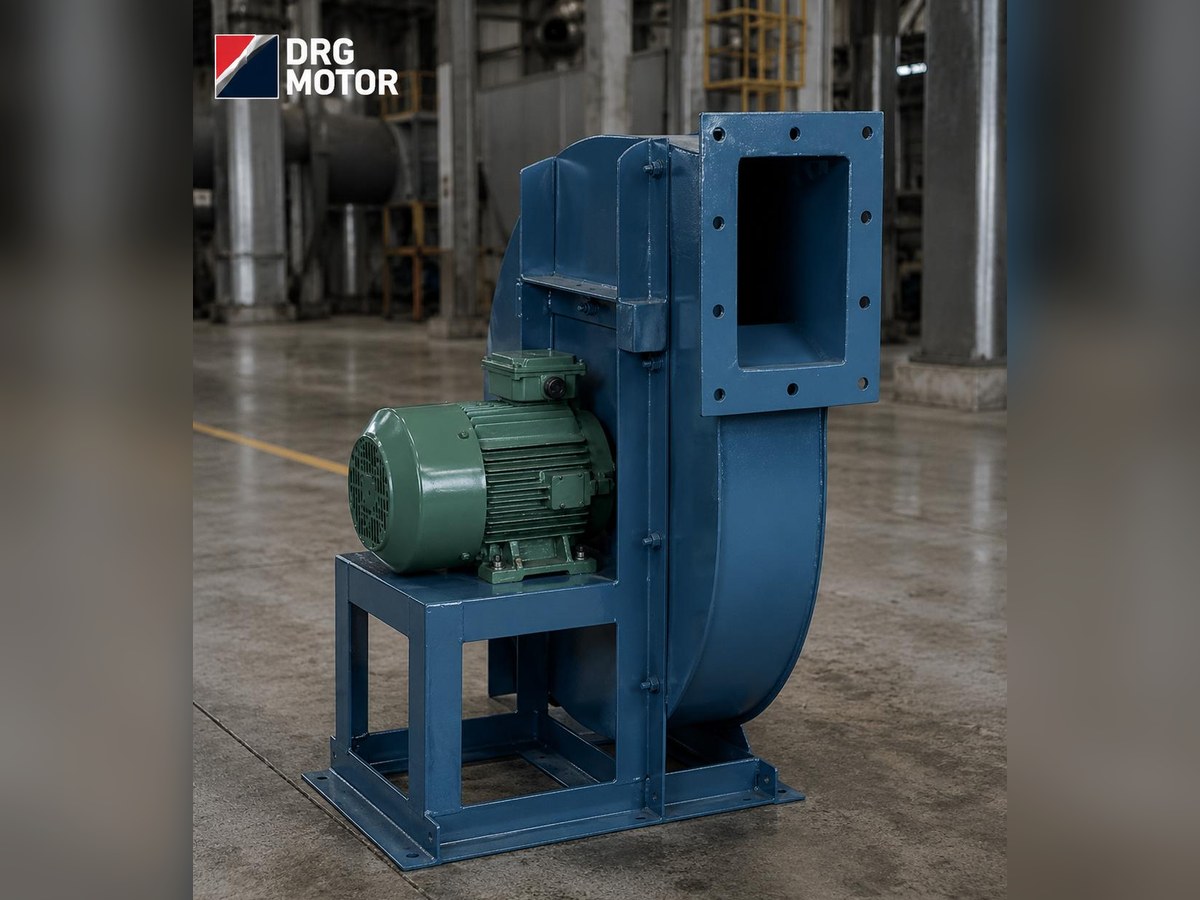
An industrial dryer is a plant machine that dries a wet product such as sand, fertiliser, sewage sludge, mineral concentrate or chemical powder with hot air or hot gas. In a dryer the electric motors do not produce the heat; they move the product and carry the air: they turn the drum, pull the belt, run the fan and blower, and drive the feed screw and the discharge conveyor. Manufacturer catalogues list 3–110 kW main motors for rotary drum dryers, 5.5–55 kW induced-draught fans and 2.2–45 kW fluid bed blowers; on small spray dryers the fan motor goes down to 1.1 kW.
DRG Motor is a manufacturer, supplier and seller of electric motors. We do not sell the dryer, the burner, the hot air generator, the fan impeller and casing, the bag filter, the gearbox or the inverter; what we supply is the three-phase induction motor that turns them. This page is about industrial dryers; for agricultural product dryers see Grain Dryer Electric Motors, for the fans of brick and ceramic drying lines Brick and Ceramic Dryer Fan Motors, and for the resin and drying line of marble slabs Resin, Epoxy and Drying Line Motors. All models are on the Buy Electric Motors Online page.
Types of industrial dryer and where the motors sit
The choice of dryer depends on the particle size, stickiness and heat sensitivity of the product; the duty and number of motors change with each type. The column and fan layout of a grain dryer, the chambers and travelling fans of a brick dryer and the marble slab oven are not discussed here; this page covers coarse, heavy bulk materials and process dryers that turn liquid into powder.
Rotary drum dryer
A slightly inclined cylinder turns slowly and internal flights lift the product and shower it through the hot gas. It is the most common type for sand, clay, fertiliser granules, coal, slag and sewage sludge. The main motor turning the drum is connected through a gearbox, a chain or a girth gear; the induced-draught fan at the other end draws the gas through the drum and the cyclone or bag filter. A drum dryer and a rotary kiln look alike from outside; the dryer runs at a lower temperature and often without refractory.
Belt and fluid bed dryers
In a belt dryer the product moves slowly on a perforated belt and each section has its own circulation fan; it is used for sewage sludge, biomass and granules. In a fluid bed a blower below pushes air through a perforated floor and keeps the particles suspended; it is common for chemical, pharmaceutical and mineral powders. A vibrating fluid bed also has two vibration motors that shake the deck; they belong to a different product family, described in our vibration motors article.
Spray dryer
In a spray dryer, a liquid or slurry is atomised at the top of the tower and turned into powder by hot air within seconds. Ceramic granulate, detergent, milk powder and chemicals are dried this way. The main electrical load of the tower is the exhaust fan and the feed pump. The disc of a rotary atomiser turns at 15,000–25,000 rpm; this special high-speed drive is not in our range, while the exhaust fan and pump motors are covered by standard motors.
The motor stays outside the hot zone: layout and environment
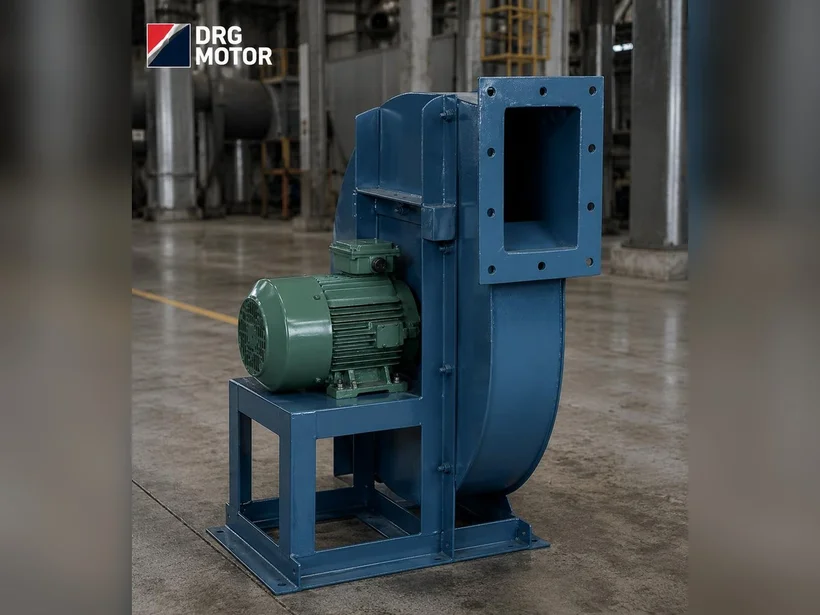
All dryer motors sit outside the product and the hot gas. The drum motor stands on a base beside the drum; the exhaust fan motor stays outside the fan casing, usually connected by belts or an extended shaft. Because the fan carries hot gas, heat can travel to the motor through the shaft and bearings; the arrangements against this are explained on the High Temperature Fan Motors page.
Dust, humidity and sludge
Around a sand or mineral dryer the dust is abrasive; around a sludge dryer the air is humid and odorous. IP55 protection is adequate against dust and water splashes; still, the motor is not placed where water is sprayed directly or sludge collects, and the cooling fins are cleaned regularly. Our ratings assume surrounding air between −15 °C and +40 °C, so a motor mounted near the warm dryer casing needs that air temperature written on the order. Where organic dust or solvent vapour makes the dryer an ATEX zone, an explosion-proof motor is needed, and we do not offer one.
Click to see current electric motor prices and order nowSEE PRICES →
Industrial dryer motor kW: catalogue values
A) Published catalogue ratings, listed per dryer family and per drive:
| Dryer / drive | Motor power | Single / total | Note |
|---|---|---|---|
| Rotary drum Ø600×6000 mm, 3–8 rpm | 3 kW | drum main motor | first maker, smallest model |
| Rotary drum Ø1500×12000 mm, 2–6 rpm | 15 kW | drum main motor | first maker |
| Rotary drum Ø2200×20000 mm, 1.5–6 rpm | 30 kW | drum main motor | first maker |
| Rotary drum Ø3200×25000 mm, 1.5–5 rpm | 110 kW | drum main motor | first maker, largest model |
| Drum dryer induced-draught (ID) fan | 5.5–55 kW | per fan | second maker, by air volume |
| Multi-layer belt dryer, 1.2–2 m belt | 9.9–22.2 kW fans; 11.4–23.7 kW total | sum of the fans | third maker |
| Fluid bed dryer, 2–300 kg batch | 2.2–45 kW | blower motor | fourth maker |
| Vibrating fluid bed | 0.8×2 – 5.5×2 kW | two vibration motors | fifth maker |
| Spray dryer, 5 kg/h evaporation | 1.1 kW | induced-draught fan | sixth maker, small model |
| Pressure spray dryer, 50–1000 kg/h | 8.5–82 kW | installed power, heater separate | seventh maker |
Read together, the table shows about 3–110 kW for the drum drive of industrial dryers, 5.5–55 kW for the induced-draught fan, 2.2–45 kW for the fluid bed blower and 1.1 kW for the fan of a small spray dryer. Drum power is set by diameter and length, filling ratio and speed; fan power by air volume, pressure loss and gas temperature. Capacity in t/h changes with the initial moisture of the product in the same drum, so it is not used on its own to select power.
B) Overlap with the DRG range: every drum, belt, fan or blower rating listed above has a counterpart in our line-up: aluminium frames cover the small duties, cast iron frames go on to 355 kW. What lies outside is not the power but the drive type: the high-speed drive of a rotary atomiser, the vibration motors of vibrating beds and the Ex motor required in explosive atmospheres. On very large mineral dryers the fan may be medium-voltage; that is also outside our range.
Worked example: motor list of a Ø1500×12000 mm drum dryer
Take the 15 kW drum from the catalogue and complete the line with four motors. We assume the exhaust fan draws 22 kW in 120 °C gas, the feed screw 3 kW and the discharge conveyor 4 kW; these three figures are assumptions chosen for the example, not catalogue values. When the fan starts in cold morning air the density rises: with the ratio (273+120)/(273+20) ≈ 1.341, 22 kW becomes about 29.5 kW when cold. A 30 kW motor is therefore allocated to the fan. We computed the values with python:
| Drive | DRG match | Current 400 V | Note |
|---|---|---|---|
| Drum, 15 kW | DRG-160L-4 | 27.3 A | catalogue Ø1500×12000 mm drum |
| ID fan, 29.5 kW when cold | DRG-200L-4 | 53.8 A | 22 kW × 1.341 = 29.5 kW → 30 kW |
| Feed screw, 3 kW | DRG-100L2-4 | 6.02 A | assumption |
| Discharge conveyor, 4 kW | DRG-112M-4 | 7.95 A | assumption |
| All four running | — | 95.07 A | sum of rated currents |
The line draws about 95.1 A at full load. The heaviest start is the exhaust fan; starting with the damper closed or ramping it up on an inverter eases the supply. How fan power changes on a cold start is explained in detail in drying oven fan motor selection. For cables and fuses, the overload-fuse-contactor selection tool can be used.
Drum speed and gearbox
The catalogue drum turns between 2 and 6 rpm. With a 1465 rpm motor, the top drum speed needs a reduction of about 244; with a fixed-ratio gearbox the lowest speed corresponds to about 16.7 Hz on an inverter. Because drum speed sets how long the product stays inside, any speed change is made together with the dryer builder. The gearbox output speed calculator lets you test different ratios.
How it differs from other dryers and what is outside the range
Basket dryers that remove water by centrifuging work by spinning, not heat; the load and start seen by the motor are entirely different, see centrifugal dryer motor. The squeezer and dryer of a plastic washing line is another topic. Holding a drum dryer still with a brake motor is not something we can supply; such braking is normally built into the gearbox. We have no single-phase models; leaving aside bench-top laboratory units, industrial dryers are fed three-phase anyway.
Dryer drives with DRG motors
Models we would shortlist for a dryer line, small screw drive first, big drum motor last:
| Model | Power / speed | Frame · shaft D×E | Current 400 V |
|---|---|---|---|
| DRG-90L-4 | 1.5 kW / 1445 rpm | 90L cast iron · 24×50 | 3.3 A |
| DRG-100L2-4 | 3 kW / 1450 rpm | 100L cast iron · 28×60 | 6.02 A |
| DRG-112M-4 | 4 kW / 1450 rpm | 112M cast iron · 28×60 | 7.95 A |
| DRG-132M-4 | 7.5 kW / 1460 rpm | 132M cast iron · 38×80 | 14.3 A |
| DRG-160L-4 | 15 kW / 1465 rpm | 160L cast iron · 42×110 | 27.3 A |
| DRG-200L-4 | 30 kW / 1475 rpm | 200L cast iron · 55×110 | 53.8 A |
| DRG-225M-4 | 45 kW / 1485 rpm | 225M cast iron · 60×140 | 80.2 A |
| DRG-250M-4 | 55 kW / 1485 rpm | 250M cast iron · 65×140 | 97.6 A |
Most drum and fan motors in the catalogues are 4-pole; direct-coupled fans also use 2 or 6 poles, and the fan speed is kept on replacement. Drum and fan motors are foot-mounted B3; screw motors connected to a gearbox use flange B5 or B35. No fit is promised before shaft, key, pulley and flange dimensions have been compared with the old motor.
Live price table
The grid below pulls today’s shop figures for each dryer-line power step:
| Model | Power / speed | Frame · current 400 V | Price |
|---|---|---|---|
| DRG-802-41 HP | 0.75 kW · 1500 rpm | Cast iron 80 · 1.75 A | $101.93 (€91.03) Details & buy → |
| DRG-90L-42 HP | 1.5 kW · 1500 rpm | Cast iron 90L · 3.3 A | $144.14 (€128.73) Details & buy → |
| DRG-100L2-44 HP | 3 kW · 1500 rpm | Cast iron 100L · 6.02 A | $203.84 (€182.05) Details & buy → |
| DRG-112M-45.5 HP | 4 kW · 1500 rpm | Cast iron 112M · 7.95 A | $254.38 (€227.18) Details & buy → |
| DRG-132M-410 HP | 7.5 kW · 1500 rpm | Cast iron 132M · 14.3 A | $394.89 (€352.66) Details & buy → |
| DRG-160L-420 HP | 15 kW · 1500 rpm | Cast iron 160L · 27.3 A | $678.13 (€605.61) Details & buy → |
| DRG-180L-430 HP | 22 kW · 1500 rpm | Cast iron 180L · 39.7 A | $919.45 (€821.13) Details & buy → |
| DRG-200L-440 HP | 30 kW · 1500 rpm | Cast iron 200L · 53.8 A | $1,235.00 (€1,102.93) Details & buy → |
| DRG-225M-460 HP | 45 kW · 1500 rpm | Cast iron 225M · 80.2 A | $1,688.50 (€1,507.94) Details & buy → |
| DRG-250M-475 HP | 55 kW · 1500 rpm | Cast iron 250M · 97.6 A | $2,065.73 (€1,844.82) Details & buy → |
DRG MOTOR motors are guaranteed against material and manufacturing defects for 2 years from the delivery date (warranty certificate).
Motors in this power range
- DRG-100L2-4 – 3 kW – 1450 rpm – 100L cast iron
- DRG-160L-4 – 15 kW – 1465 rpm – 160L cast iron
- DRG-200L-4 – 30 kW – 1475 rpm – 200L cast iron
- DRG-225M-4 – 45 kW – 1485 rpm – 225M cast iron
- DRG-250M-4 – 55 kW – 1485 rpm – 250M cast iron
Click to see current prices and order these motors nowSEE PRICES →
Dryer motors and quotations: you will find drum, fan and screw drive models on our Buy Electric Motors Online page. Send the dryer type, the product it dries, a nameplate photo of each motor and the gas temperature via WhatsApp, or call +90 (542) 666 11 11; we will review every motor of the line in one list.
Frequently asked questions
Why does a dryer exhaust fan motor trip in the morning?
If the fan was sized for hot gas, it moves denser air when starting cold and draws more power. Throttling the damper at start, using an inverter or sizing the motor for the cold condition solves it.
What speed should a drum dryer motor have?
Drum speed comes from the gearbox and gear ratio; the motor is usually 1500 rpm. On replacement the speed of the old motor is kept.
Where can I see prices of dryer motors?
Current prices of the models matching dryer drives are listed in the live table above.
Contact: +90 (542) 666 11 11 · info@drgmotor.com · our contact page.


