 English
 Le français
 Türkçe

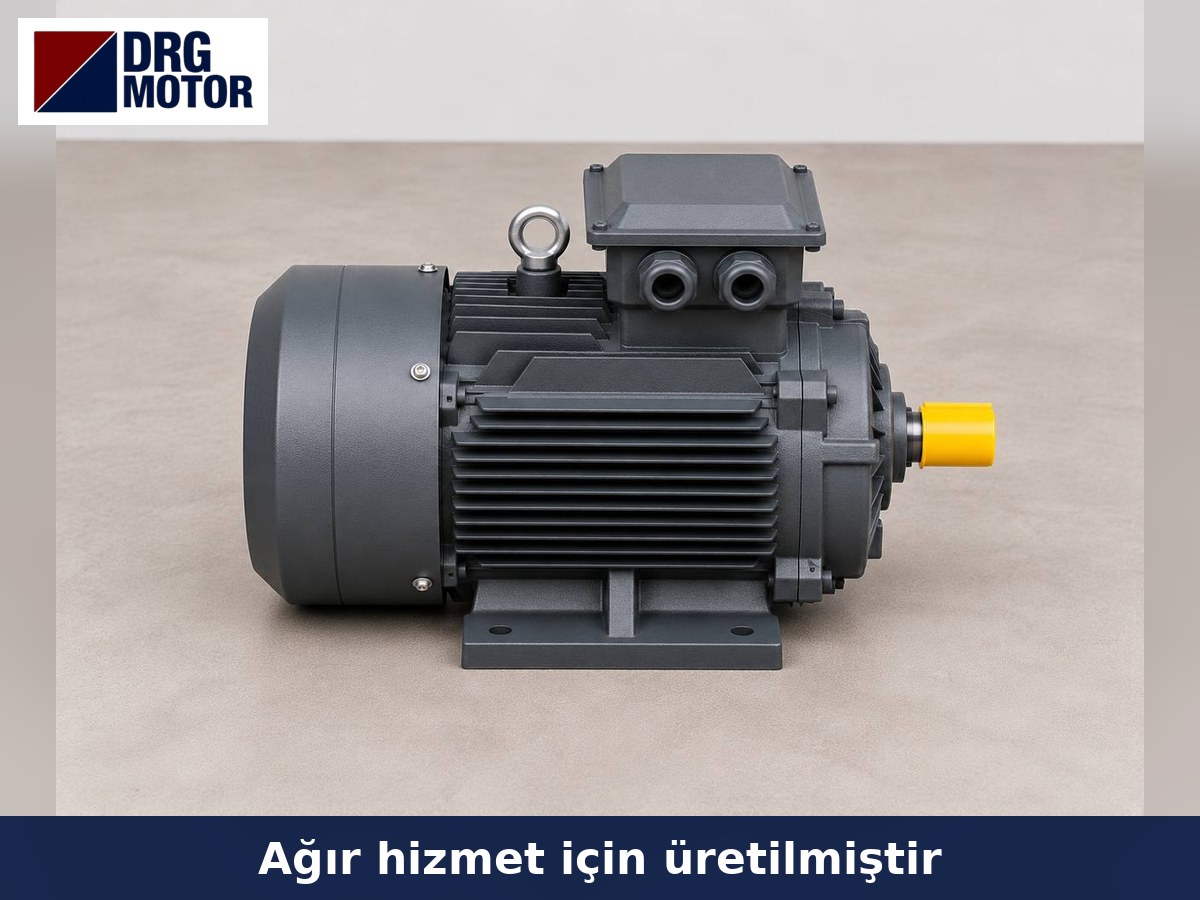
An ice cream production machine runs several electric motors: the main motor turning the dasher inside the freezing cylinder, the pump motor feeding the mix to the cylinder, the agitator of the ageing tank, the filler drive and the condenser fan. The refrigeration compressor is a separate matter: it is usually hermetic, its motor is sealed inside the casing and it is not replaced on its own. Maker data show 0.75–18.5 kW for the dasher motor and 0.37–1.5 kW for the mix pump. Below we sort these drives into those a standard three-phase DRG motor can take over and those it cannot.
DRG Motor is a manufacturer, supplier and seller of electric motors. We do not sell the ice cream machine, the freezing cylinder, pump bodies, gearboxes, inverters or the refrigeration compressor. What we supply is the IEC-frame three-phase induction motor used on the dasher, pump, agitator and filler drive; models are on Buy Electric Motors Online.
Where do the motors work on an ice cream line?
On an industrial line the process runs like this: the mix is prepared and pasteurised, held cold for some hours in the ageing (maturation) tank, then pumped to the freezer. In the freezer the mix is whipped with air and scraped off the cylinder wall as it freezes; the ice cream then goes to the filler.
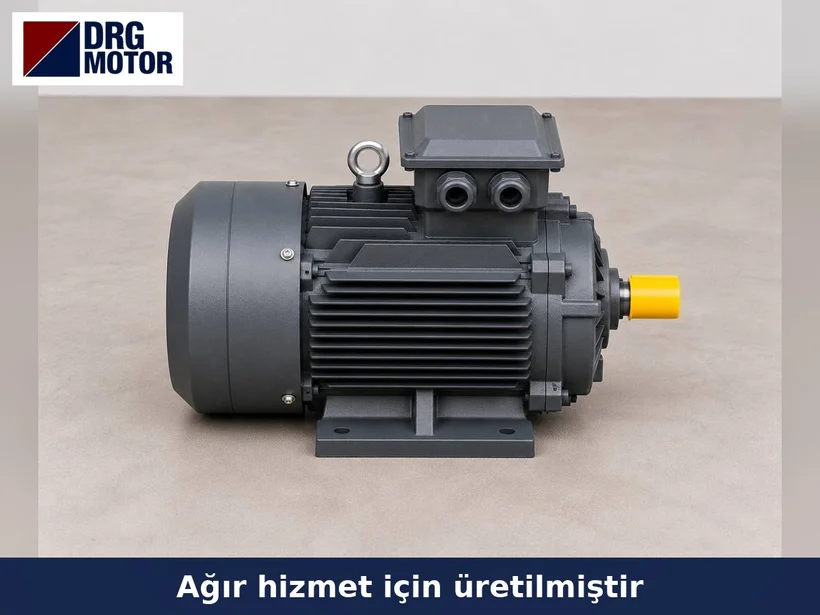
Dasher motor
The dasher is the bladed body turning inside the cold cylinder. It scrapes frozen ice cream off the wall and spreads air through the mix. As the ice cream stiffens, dasher torque rises; machines therefore carry an ammeter showing dasher motor current. In one maker’s manual the dasher is turned by a geared motor; another maker’s manual states that a soft starter is applied to the dasher drive.
Mix pump and filler drive
On a continuous freezer the mix enters the cylinder through one pump and the ice cream leaves through a second. The first maker’s sheet runs the mix pump on a variable-speed AC drive, so flow and overrun can be set. Fillers have cup feeding, dosing and lid drives; two makers give 1.2 kW total for their rotary fillers.
Continuous freezer versus batch machine
As far as motor choice goes, the two machine types are apart.
Continuous freezer
Used on industrial lines: mix goes in and ice cream comes out without a break. The dasher is large and works under load for long periods, and the pumps have their own motors. On the first maker’s 100–500 L/h series the dasher is 0.75–3.75 kW; on the second maker’s 600–1500 L/h series 7.5–18.5 kW. At these ratings a three-phase IEC motor with star-delta or soft starting is used.
Batch machine and soft-serve machine
In a batch machine one charge of mix is frozen in the cylinder and discharged. These machines are small: the third maker’s bench model has a 185 W beater motor, and the fourth maker’s soft-serve machine a 0.37 kW single-phase dasher. Small batch freezers usually carry a compact single-phase unit built for that machine, which DRG has no equivalent for. Larger batch machines may be three-phase, but catalogues usually give only total power, and that total includes the compressor.
Why is the refrigeration compressor outside our range?
One of the largest power users on an ice cream machine is the refrigeration compressor. The first maker’s sheet lists hermetic compressors on the small models and a semi-hermetic one on the largest. In a hermetic compressor the electric motor sits in the same welded casing as the compressor and is cooled by the refrigerant; removing it and fitting a standard motor is not possible. When it fails, the compressor is replaced as a whole. The refrigeration compressor and its motor are therefore outside our range; that is work for the refrigeration service and the compressor supplier. Older open-type compressors driven by belt from outside are different: there the motor may be standard, but this too must be checked against the compressor maker’s data.
How many kW is an ice cream machine motor? Catalogue values
A) Motor ratings given in maker sheets and manuals for ice cream machines:
| Machine / section | Motor power | Single / total | Note |
|---|---|---|---|
| Continuous freezer 100–500 L/h: dasher | 0.75–3.75 kW | single motor | first maker |
| Same series: mix pump | 0.37–1.5 kW | single motor, inverter | first maker |
| Same series: refrigeration compressor | 1.8–7.5 kW | hermetic / semi-hermetic | first maker; outside our range |
| Continuous freezer 600–1500 L/h: dasher | 7.5 / 11 / 18.5 kW | single motor | second maker’s manual |
| Same series: pump drive | 0.75 / 1.1 / 1.5 kW | single motor | second maker’s manual |
| The 600 model of that series | 20.2 kW | machine total | second maker’s manual |
| Bench batch machine: beater | 185 W | single motor | third maker’s manual |
| Soft-serve machine: dasher | 0.37 kW, single-phase | single motor | fourth maker’s sheet |
| Rotary filler | 1.2 kW | machine total | fifth and sixth maker |
Depending on model and hourly capacity, this group shows roughly 0.75–18.5 kW for the dasher motor and 0.37–1.5 kW for the mix pump. The machine total (for example 20.2 kW) covers the compressor and all auxiliaries; it is not the dasher motor’s rating. Dasher power rises clearly with capacity.
B) Where DRG fits: a dasher of 0.75–18.5 kW or a mix pump of 0.37–1.5 kW finds its 4-pole counterpart between our frame 71 and frame 180. Dasher speed and gearbox coupling come from the machine documents. The refrigeration compressor (hermetic or semi-hermetic) and single-phase small-machine motors are outside our range. For the ageing tank agitator and the condenser fan we found no sourced catalogue value; there the motor is chosen from application data: plate power, speed, gear ratio and mounting type should be sent.
Click to see current electric motor prices and order nowSEE PRICES →
Worked example: current of the dasher and pump motors
On the second maker’s 600 L/h freezer the dasher is 7.5 kW and the pump drive 0.75 kW. Take their equivalents in our range: DRG-132M-4 for the dasher, DRG-802-4 for the pump.
| Case | Operation | Current (400 V) | Note |
|---|---|---|---|
| 7.5 kW dasher running | DRG-132M-4 rated current | 14.3 A | data file |
| 0.75 kW pump running | DRG-802-4 rated current | 1.75 A | data file |
| Both motors together | 14.3 + 1.75 | about 16 A | compressor excluded |
| Dasher direct-on-line start | 14.3 × 7.5 | about 107 A | Is/In = 7.5 |
| Dasher star-delta start | 107.2 / 3 | about 36 A | star step |
Restarting the dasher with stiff ice cream left in the cylinder is the hardest case for the motor; manuals warn against product freezing in the cylinder and locking the dasher. On direct-on-line start, current climbs to about 7.5 times rated; star-delta or a soft starter cuts that shock but also lowers starting torque. Where a restart without emptying the cylinder is expected, the starting method should be agreed with the machine maker. See our star-delta tool for details.
Ageing tank, condenser fan and motor position
In the ageing tank the mix rests cold under a slow agitator. The agitator is usually a geared motor standing vertically on top of the tank. For vertical running the motor must be ordered for vertical mounting and the axial load confirmed by the tank maker. Gearbox and flange questions on a milk tank agitator are covered in our milk tank agitator motor article; mix and product pumps are discussed in the milk and food transfer pump motor article.
Condenser fan
On air-cooled machines the condenser fan carries away the compressor’s heat; water-cooled machines have no fan, the condenser is cooled by water. On compact machines the fan motor is part of the refrigeration unit and often machine-specific. If a separate condenser or cooling tower fan uses a standard motor, browse the Fan Motors category.
Motor outside the product-contact zone
On an ice cream machine the dasher and pump motors stand in the machine compartment behind the side panels, outside the product-contact zone. When the machine is cleaned by CIP or by hand, no water is aimed into that compartment. Should the room demand stainless-bodied washdown motors, note that DRG does not produce them and contact us first. A brake motor is not offered either; where filler axes needing precise stops use servos, that part is outside our range too.
DRG motors for ice cream machines
Our 4-pole models for dasher, pump and agitator drives (current at 400 V):
| Model | Power / speed | Frame · shaft D×E | Current 400 V |
|---|---|---|---|
| DRG-712-4 | 0.37 kW / 1340 rpm | 71 aluminium · 14×30 | 0.92 A |
| DRG-802-4 | 0.75 kW / 1420 rpm | 80 cast iron · 19×40 | 1.75 A |
| DRG-90S-4 | 1.1 kW / 1445 rpm | 90S cast iron · 24×50 | 2.48 A |
| DRG-90L-4 | 1.5 kW / 1445 rpm | 90L cast iron · 24×50 | 3.3 A |
| DRG-112M-4 | 4 kW / 1450 rpm | 112M cast iron · 28×60 | 7.95 A |
| DRG-132M-4 | 7.5 kW / 1460 rpm | 132M cast iron · 38×80 | 14.3 A |
| DRG-160M-4 | 11 kW / 1465 rpm | 160M cast iron · 42×110 | 20.4 A |
| DRG-180M-4 | 18.5 kW / 1470 rpm | 180M cast iron · 48×110 | 33.5 A |
A freezer rarely needs more than the middle of our span, which itself is broad: aluminium to 11 kW, cast iron on to 355 kW, everything three-phase IEC with IP55 and 2, 4 or 6 poles. A dasher motor is identified by its plate and by how it meets the gearbox: kW and rpm, voltage and winding link, shaft and key, B5 or B14 flange, input bore of the reducer. With those readings and the freezer manual side by side we confirm the swap with you; without them nothing is declared a fit.
B5 dimensions for geared drives
B5 values of the small frames used on pump and agitator gearboxes, mm:
| Frame | Shaft D×E | Flange P / M / N | Hole S |
|---|---|---|---|
| 71 | 14×30 | 160 / 130 / 110 | 10 |
| 80 | 19×40 | 200 / 165 / 130 | 12 |
| 90S/90L | 24×50 | 200 / 165 / 130 | 12 |
On a motor seated on a gearbox, D, E and the N spigot must be identical; for larger dasher motors see the technical drawings page.
Live price table
Prices of our models in dasher, pump and agitator ratings are drawn live from the shop:
| Model | Power / speed | Frame · current 400 V | Price |
|---|---|---|---|
| DRG-712-40.5 HP | 0.37 kW · 1500 rpm | Aluminium 71 · 0.92 A | $76.76 (€68.55) Details & buy → |
| DRG-802-41 HP | 0.75 kW · 1500 rpm | Cast iron 80 · 1.75 A | $101.93 (€91.03) Details & buy → |
| DRG-90S-41.5 HP | 1.1 kW · 1500 rpm | Cast iron 90S · 2.48 A | $124.09 (€110.82) Details & buy → |
| DRG-90L-42 HP | 1.5 kW · 1500 rpm | Cast iron 90L · 3.3 A | $144.14 (€128.73) Details & buy → |
| DRG-112M-45.5 HP | 4 kW · 1500 rpm | Cast iron 112M · 7.95 A | $254.38 (€227.18) Details & buy → |
| DRG-132M-410 HP | 7.5 kW · 1500 rpm | Cast iron 132M · 14.3 A | $394.89 (€352.66) Details & buy → |
| DRG-160M-415 HP | 11 kW · 1500 rpm | Cast iron 160M · 20.4 A | $568.76 (€507.94) Details & buy → |
| DRG-180M-425 HP | 18.5 kW · 1500 rpm | Cast iron 180M · 33.5 A | $873.49 (€780.08) Details & buy → |
DRG MOTOR motors are guaranteed against material and manufacturing defects for 2 years from the delivery date (warranty certificate).
Motors in this power range
- DRG-802-4 – 0.75 kW – 1420 rpm – 80 cast iron
- DRG-90L-4 – 1.5 kW – 1445 rpm – 90L cast iron
- DRG-112M-4 – 4 kW – 1450 rpm – 112M cast iron
- DRG-132M-4 – 7.5 kW – 1460 rpm – 132M cast iron
- DRG-160M-4 – 11 kW – 1465 rpm – 160M cast iron
Click to see current prices and order these motors nowSEE PRICES →
Browse the products, ask for a quote: suitable motors for your ice cream machine are on Buy Electric Motors Online. Send the dasher and pump motor plates by WhatsApp; telling us on +90 (542) 666 11 11 the hourly capacity and whether the machine is continuous or batch is enough to begin.
Frequently asked questions
Is the compressor motor of an ice cream machine replaced separately?
Not on a hermetic compressor; the motor is inside it and the compressor is changed as a unit. That is a refrigeration service job.
Why does the dasher motor draw too much current?
The ice cream may be too stiff, frozen in the cylinder, or the blades may be worn; the ammeter shows it.
What does an ice cream machine motor price depend on?
Rating, pole count and frame; the table above shows the current figure.
Questions: +90 (542) 666 11 11 · info@drgmotor.com · contact.


