 English
 Le français
 Türkçe

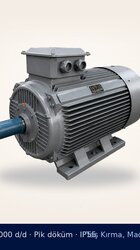
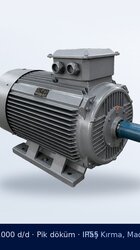
Two separate kinds of vibration are assessed on a mobile crusher: the effect of road shocks on the bearings and fixings while the motor is stationary, and the transfer of crushing impacts to the motor through the baseframe while it is running. In selection, frame robustness and connection dimensions are decisive; in installation, the rigidity of the baseframe and the security of the fasteners.
During transport: the problem of a stationary motor
When the motor is not turning, road shocks make the bearing balls strike the raceway at the same spot again and again; over time small marks can form in the raceway, and when the motor runs they show up as noise and vibration. Before transport, the transport locking recommended by the crusher manufacturer should be applied, and after a long journey the bearing sound should be listened to at the first start-up. If the belts are left tensioned during transport, the shaft end stays under constant side load; this too is assessed according to the manufacturer's instructions.
During operation: crushing vibration
- Baseframe: If the motor base sits on flexing sheet metal, vibration increases; a reinforced, flat seating surface is needed.
- Fixing: Foot bolts should be of a suitable grade, locked and checked periodically.
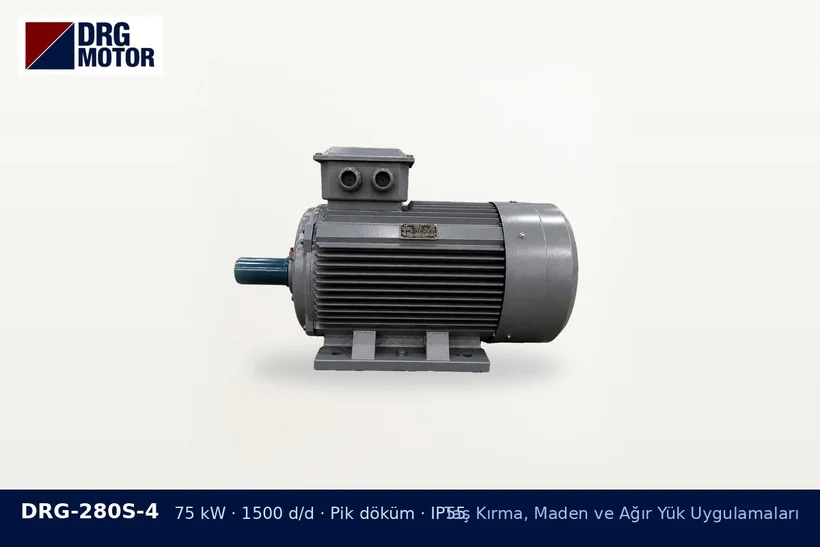
- Frame: In this application, where impact and vibration are intense, a cast iron frame is preferred.
- Cable: Cable entries and glands should be secured so that they do not loosen under shocks, and the cable must not rub against moving parts.
Dust and weather
A mobile plant is often set up in the open and in dusty conditions. DRG motors are IP55-protected and self-ventilated (IC411); if the fan cover grille clogs with dust and mud, cooling is reduced. After setting up on site, make sure the cover grille is open and that there is room behind the motor for air intake.
Power supply
If the mobile crusher is fed from a generator rather than the grid, the generator must be able to supply the starting current of the main motor without letting the voltage drop too far. The starting method and generator compatibility depend on the motor nameplate, the manufacturer's documentation and the assessment of qualified electrical personnel.
For the main crusher and auxiliary machines in a mobile plant, see the stone crushing plant motors, and for sample dimensions the page of the 37 kW 225S cast iron model.