 English
 Le français
 Türkçe

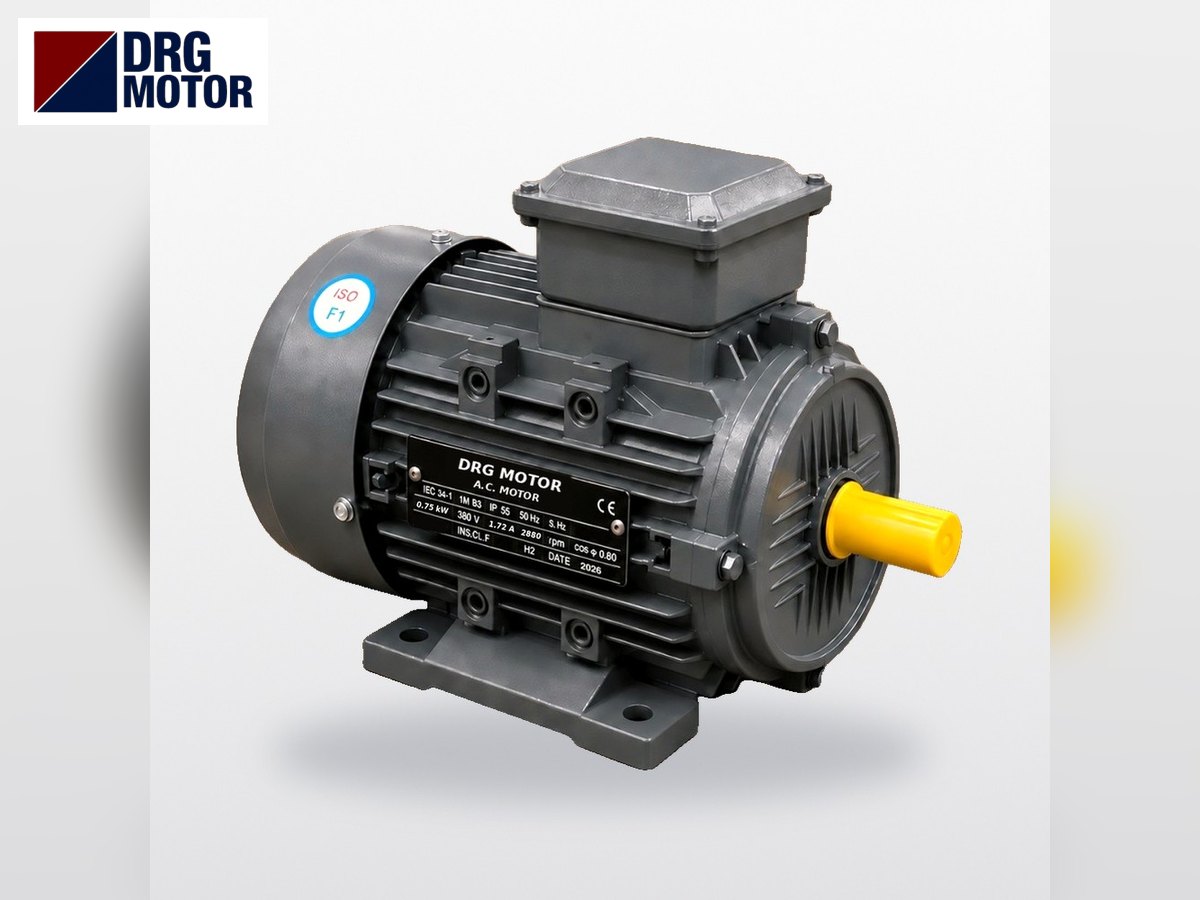
In a milking machine the electric motor works in two places: it turns the vacuum pump that applies suction to the teats, and the transfer pump that sends milk collected in the parlour to the cooling tank. Clusters, pulsators and buckets contain no motor-driven parts; the pumps are the only loads that need continuous energy. This page explains which aluminium housing motor sits in which type, what is measured on replacement and where the limits are. The kW calculation from vacuum pump flow is in our article how many kW is a milking machine motor; it is not repeated here.
DRG Motor is a manufacturer, supplier and seller of electric motors. We do not sell the milking machine itself, the vacuum pump, pulsators, milk pump housings, gearboxes or speed drives; we supply only the three-phase asynchronous motor that turns them. All small and mid-size frames are in our Aluminium Housing Electric Motors category, and purchases are made on the Buy Electric Motors Online page.
Which part of the milking system does the motor drive?
Vacuum pump: the main load
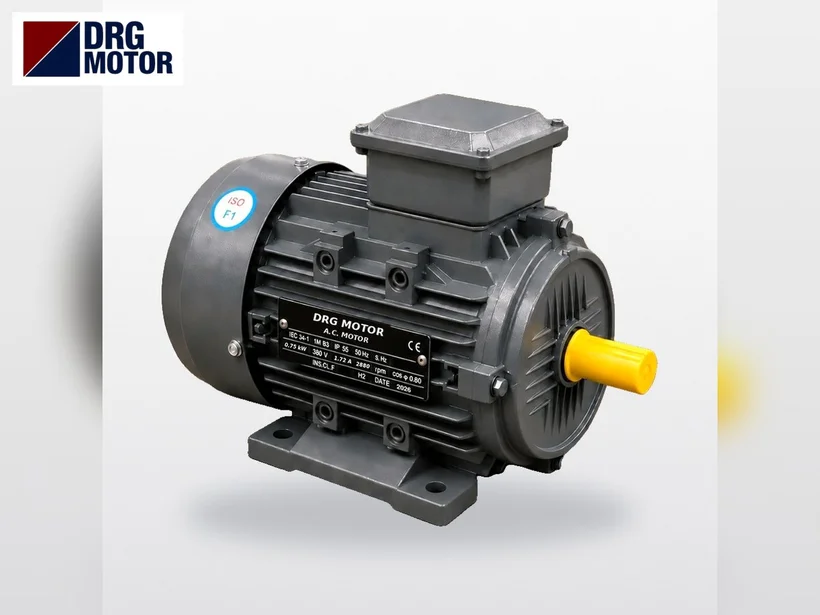
Rotary vane pumps run oil-lubricated or dry; the motor turns the pump either through a belt and pulleys or directly through a coupling. The pump feeds the vacuum line running along the barn and the regulator. During milking the motor never stops; the regulator admits extra air to keep the vacuum steady, so the motor load is set by the amount of air the pump draws, not by the number of cows being milked. For general pump types and coupling layouts see our Vacuum Pump Electric Motors page.
Milk transfer pump: short, frequent runs
In a fixed parlour, milk first fills a receiver; a level float starts and stops the pump. This pump is usually centrifugal and its motor is small, yet it starts dozens of times during one milking. What heats the motor is that start frequency, not its rating. Pump-side selection is covered in our article on the milk and food transfer pump.
How tasks split between portable and fixed systems
A portable (trolley) machine has one motor, and it turns the vacuum pump; milk fills the bucket under vacuum and no pump is needed. In a fixed system the vacuum unit stands in the plant room, while the milk pump runs on its own motor at the end of the pit. The two motors are supplied and protected separately; when one trips, the other does not have to stop.
What does an aluminium housing bring to the parlour?
Almost every motor in a milking installation falls between 0.55 and 7.5 kW, which is the range where aluminium housings are common. Lower weight pays off in three concrete ways here: on a trolley machine the wheeled frame carries less and the person pulling it from pen to pen feels it; on a belt unit the motor slides more easily on the tensioning plate; and a pump set hung on a ceiling or wall bracket stops being a two-person job. The compact housing also fits the tight tank-and-pump layout of a plant room.
The strengths of cast iron should be stated too: for drives facing hard knocks, heavy vibration or ratings above 11 kW, cast iron is preferred. A large rotary parlour whose main vacuum pumps go past 11 kW is served by the cast iron motors listed on our General Purpose Industrial Electric Motors page. Feet may be fixed or removable; the catalogue lists B3, B5, B14 and B35 options.
How many kW are milking pump motors? Values from maker catalogues
A) Motor ratings found in milking equipment catalogues:
| Unit | Motor power | Pump flow / speed | Note |
|---|---|---|---|
| Portable machine, single pump | 0.55 kW | 250 L/min, 50 kPa | sold with a single-phase 230 V motor |
| Electric pump on tank | 0.75–1.3 kW | 140–450 L/min, 1400 rpm | small barn group |
| Belt-driven pump unit on plate | 0.55–7.5 kW | 280–3000 L/min, 970–1500 rpm | fixed parlour |
| Direct-coupled silent pump | 1.1–5.5 kW | 430–2100 L/min, 1400 rpm | coupling, no belt |
| Same pump, three pulley options | 2.2 / 3 / 4 kW | 1020 / 1250 / 1450 L/min | pump speed 925 / 1175 / 1350 |
| Milk transfer pump | 0.55–0.75 kW | 14 m³/h | parlour milk line |
The range in the table runs from a small trolley machine to a large fixed parlour, 0.55–7.5 kW; transfer pumps stay at 0.55–0.75 kW. The values belong to sample models; your own pump plate governs.
B) Match in the DRG range: our aluminium models with frame 80 for 0.55 and 0.75 kW, 90S for 1.1 kW, 100L for 2.2–3 kW and 112M for 4 kW cover this range; aluminium models in frame 132 exist for 5.5 and 7.5 kW. Single-phase portable machines fall outside our range: DRG offers no single-phase motor, see details below.
Click to see current electric motor prices and order nowSEE PRICES →
Dimensions and connection checked on replacement
Power, speed, voltage and frame
Plate power and pole count stay the same; vane pumps run on 4-pole motors. The voltage line matters too: up to 3 kW, the sizes most often found on milking pumps, our plates read 230/400 V and the motor runs with star links on the barn panel’s 400 V supply; at 4 kW and above the plate shows 400/690 V, so the terminal links are set in delta. Put the new motor beside the old one and compare frame number, foot hole pitch, shaft diameter and key, and on a flanged unit the flange diameter, one by one.
Pulley on belt units, alignment on coupled units
On a belt pump the motor pulley sets pump speed. The same pump gives three flows with three motor pulleys; a larger pulley raises both flow and drawn power. We recalculated a catalogue’s 160 mm pump pulley with the nominal speed of DRG motors:
| Motor | Motor pulley | Pump speed (160 mm pulley) | Catalogue pump speed |
|---|---|---|---|
| DRG-100L2-4 · 3 kW | 130 mm | 1178 rpm | 1175 rpm |
| DRG-112M-4 · 4 kW | 150 mm | 1359 rpm | 1350 rpm |
The results match the catalogue; if the new motor’s nominal speed differs from the old one, pump speed shifts in the same ratio. Use our pulley and belt calculator for your own diameters. Coupled (direct drive) pumps have no gearbox or pulley; the motor shaft must sit on the pump shaft axis, and on a B5 flanged unit the flange spigot provides that alignment by itself.
Barn conditions, starting and single-phase machines
Moisture, washing and the IP55 limit
In a parlour the IP55 mark on our motors promises this much: dust stays out of the housing and a hose spraying at low pressure from any angle does no harm. A pressure-washer lance, steam cleaning and a motor sitting in water are beyond what that rating covers. Where the parlour floor gets a pressure-washer clean, keep the motor away from where the lance points, fit a small roof or hood over it, turn the cable entry downwards and do not let dirt block the drain holes of the housing. The catalogue allows −15…+40 °C around the motor; in a freezing plant room the cold start of an oil-lubricated pump strains the motor.
Starting and stop-start duty
A vane pump starts under load. Our 3 kW model draws 7.6 times its rated current at start, about 45.8 A; the time is short, but overload relay and fuse are chosen for it. For frequently started motors such as the transfer pump, ask the machine maker for the allowed starts per hour. Systems that slow the vacuum pump with a drive to match demand are spreading; DRG does not supply drives, the motor can run on one, but since fan cooling drops at low speed the minimum speed is set to the drive maker’s advice. Compare starting methods with our star-delta tool.
Single-phase portable machines
Trolley machines built for family farms with a few cows are often sold with a 230 V single-phase motor; a single-phase version is not something we offer. If the barn panel has three phases, a three-phase aluminium model can take the place of the motor on the trolley. Without three phases, the maker’s motor data and fixing dimensions are checked, and a single-phase spare also has to come from that maker.
Information we ask for on replacement
- Photo of the old motor’s plate (kW, speed, voltage, current).
- Pump type and flow: vane or liquid ring; the L/min value on its plate.
- Connection: belt, coupling or flange; pulley diameters.
- Shaft diameter and length, foot hole spacing or flange dimensions.
- Supply: is three-phase available; plant room conditions.
- Daily running time and number of starts.
DRG aluminium housing motors for milking machines
Models suited to vacuum and milk pumps (values from our product records):
| Model | Power / speed | Frame · torque | Current 400 V |
|---|---|---|---|
| DRG-801-4 | 0.55 kW · 1500 → 1400 rpm | 80 aluminium · 3.75 Nm | 1.31 A |
| DRG-802-4 | 0.75 kW · 1500 → 1420 rpm | 80 aluminium · 5.04 Nm | 1.75 A |
| DRG-801-2 | 0.75 kW · 3000 → 2880 rpm | 80 aluminium · 2.49 Nm | 1.64 A |
| DRG-90S-4 | 1.1 kW · 1500 → 1445 rpm | 90S aluminium · 7.27 Nm | 2.48 A |
| DRG-100L1-4 | 2.2 kW · 1500 → 1450 rpm | 100L aluminium · 14.5 Nm | 4.52 A |
| DRG-100L2-4 | 3 kW · 1500 → 1450 rpm | 100L aluminium · 19.8 Nm | 6.02 A |
| DRG-112M-4 | 4 kW · 1500 → 1450 rpm | 112M aluminium · 26.3 Nm | 7.95 A |
The 2-pole DRG-801-2 is listed only for the centrifugal milk pump; vane vacuum pumps take 4-pole models. Live prices come straight from the shop:
| Model | Power / speed | Frame · current 400 V | Price |
|---|---|---|---|
| DRG-801-40.75 HP | 0.55 kW · 1500 rpm | Aluminium 80 · 1.31 A | $87.55 (€78.19) Details & buy → |
| DRG-802-41 HP | 0.75 kW · 1500 rpm | Aluminium 80 · 1.75 A | $97.30 (€86.90) Details & buy → |
| DRG-801-21 HP | 0.75 kW · 3000 rpm | Aluminium 80 · 1.64 A | $83.41 (€74.49) Details & buy → |
| DRG-90S-41.5 HP | 1.1 kW · 1500 rpm | Aluminium 90S · 2.48 A | $118.44 (€105.78) Details & buy → |
| DRG-100L1-43 HP | 2.2 kW · 1500 rpm | Aluminium 100L · 4.52 A | $179.76 (€160.54) Details & buy → |
| DRG-100L2-44 HP | 3 kW · 1500 rpm | Aluminium 100L · 6.02 A | $194.58 (€173.77) Details & buy → |
| DRG-112M-45.5 HP | 4 kW · 1500 rpm | Aluminium 112M · 7.95 A | $242.82 (€216.85) Details & buy → |
DRG MOTOR motors are guaranteed against material and manufacturing defects for 2 years from the delivery date (warranty certificate).
Motors in this power range
- DRG-802-4 – 0.75 kW – 1420 rpm – 80 aluminium
- DRG-100L2-4 – 3 kW – 1450 rpm – 100L aluminium
- DRG-112M-4 – 4 kW – 1450 rpm – 112M aluminium
Click to see current prices and order these motors nowSEE PRICES →
Browse the products, ask for a quote: every model is on the Buy Electric Motors Online page. Send plate photos of the pump and the old motor to our WhatsApp line; we will check power, speed, pulley and flange with you. Phone: +90 (542) 666 11 11.
Frequently asked questions
Will a bigger motor milk better?
No. The regulator holds the vacuum; a bigger motor on the same pump only leaves unused current margin. To raise flow, the pump or pulley changes and the motor follows.
Why must the vacuum pump motor not run backwards?
A vane pump turning backwards produces pressure instead of vacuum and its lubrication stops working. To correct it, two of the three supply leads in the terminal box change places; look at the arrow cast on the pump body when you first switch on.
Can a float fault burn the milk pump motor?
If the float sticks and the pump keeps running in an empty receiver, the pump seal suffers; the motor carries no load and usually survives. The real risk is a fluttering float that starts and stops the motor several times a minute; then the overload setting and start count are checked.
For questions: +90 (542) 666 11 11 · info@drgmotor.com · contact.


