 English
 Le français
 Türkçe

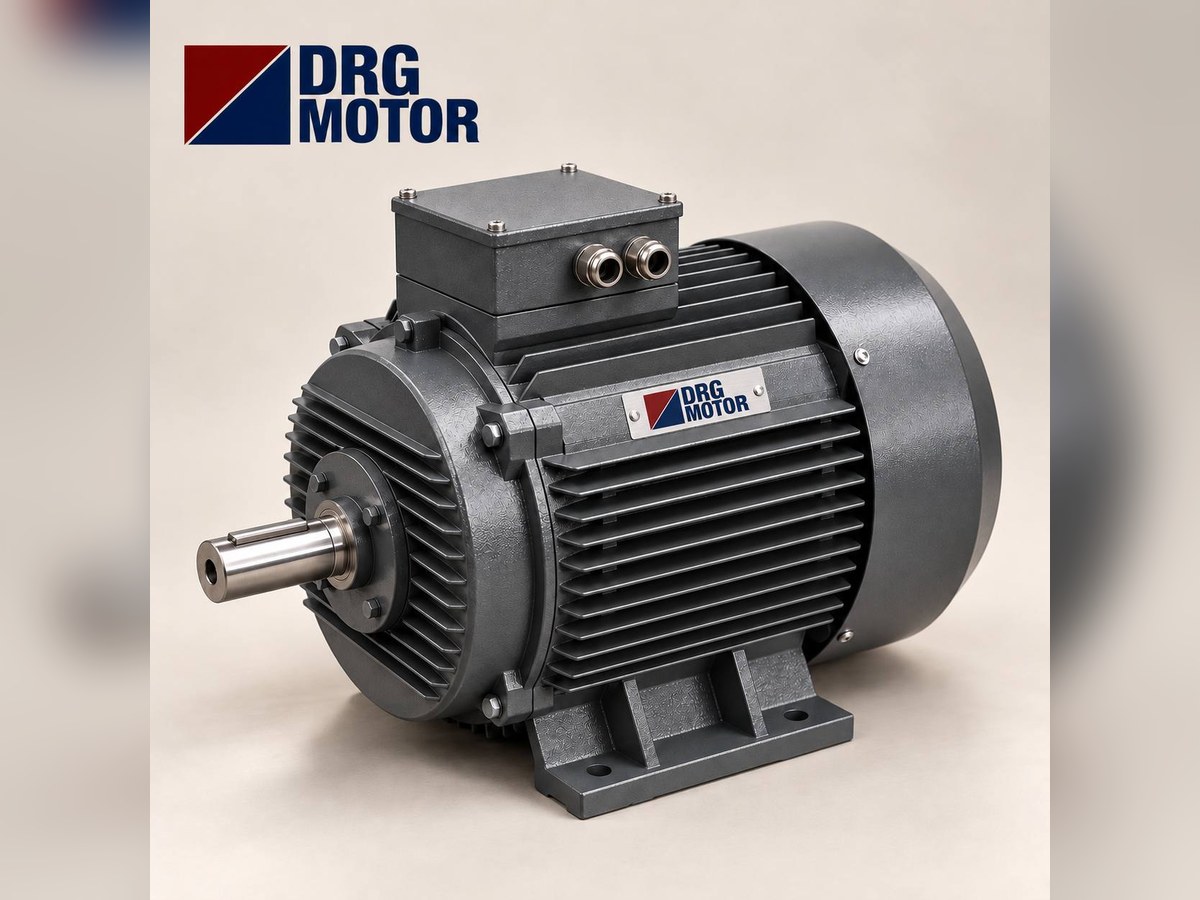
Behind every plastic shredder shaft there is a gearbox, and behind the gearbox a three-phase induction motor: that motor is what this page is about. The shredder reduces bulky plastic such as crates, drums, pipes, purgings and bales by tearing it on one or two shafts turning at a few tens of rpm; the motor's task, together with the gearbox, is to deliver the high torque needed at that low speed. In manufacturer catalogues the main motor of single-shaft plastic shredders starts at 22 kW and reaches 2 × 160 kW with two motors on wide models; twin-shaft machines usually have one motor per shaft, with 3–75 kW per shaft.
In a shredder the motor never works alone: with the gearbox, coupling, belts and, on most machines, a drive, it forms a drive train. DRG Motor does not sell shredders, gearboxes, hydraulic pumps or inverters; we supply the electric motor link of that chain. The other parts are chosen from the machine builder's data, and the motor is matched to them.
What is a shredder, and how does it differ from a granulator?
The shredder is the first size-reduction machine in the line. It brings thick, long or bulky parts that cannot enter a granulator down to a size the granulator can handle. A granulator spins fast and makes granules by cutting; a shredder turns slowly and divides by tearing. This difference hits the motor directly: on a granulator the motor provides speed and cutting energy, on a shredder it produces torque reaching tens of thousands of newton-metres at the gearbox output. Motors for machines that cut to granule size are covered on a separate page, Plastic Crusher Machine Motors.
Where are shredders used?
Injection lumps and purge piles, thick-walled crates and pallets, long pipes and profiles, film and fibre bales, large blow-moulded containers and mixed industrial plastic waste are the most frequent examples. The same machines also run in wood, paper and municipal waste lines; for the motor, what matters is the hardness of the material and the size of the part.
Single-shaft versus twin-shaft
| Feature | Single-shaft | Twin-shaft | What it means for the motor |
|---|---|---|---|
| Cutting | between rotor knife and bed knife | between hooked discs of two shafts | on twin-shaft the load is split between two motors |
| Feeding | hydraulic ram presses material on the rotor | gravity, sometimes a hold-down | single-shaft has a separate ram motor |
| Output | through a screen, more controlled size | strips or coarse pieces, often no screen | a blocked screen loads the single-shaft motor |
| Drive | belt + gearbox or direct gearbox | motor + gearbox on each shaft, or one motor + gear case | twin-shaft needs two matching motors |
Drive on a single-shaft shredder
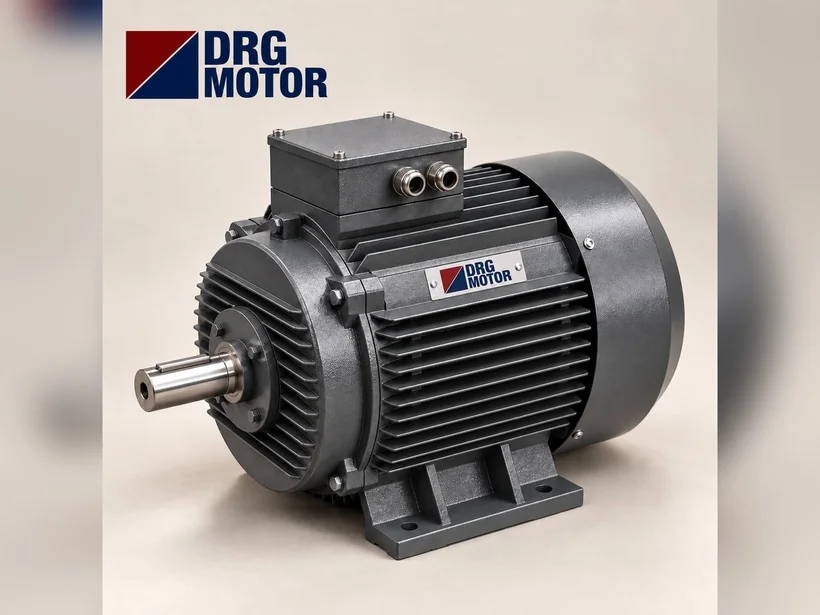
In a single-shaft machine a horizontal rotor turns against bed knives in the housing. Material is tipped into the hopper, a hydraulic ram pushes it against the rotor and the cut pieces pass through the screen under the rotor. This layout has two separate electric motors: the main motor turning the rotor and the small motor running the ram's hydraulic unit.
Belt and gearbox drive
In the common layout the main motor stands foot-mounted (B3) beside the rotor and drives the input of an oversized gearbox through V-belts; the gearbox then brings the rotor down to about 70–100 rpm. One manufacturer catalogue places belt and gearbox at one end of the rotor shaft, with the rotor at 74 rpm. The belt protects the gearbox from shock by allowing a little slip when the rotor jams. On some machines the motor is flanged (B5) straight onto the gearbox with a hydrodynamic start-up coupling in between.
Main motor and rotor torque: an example
Take a single-shaft machine with its rotor at 74 rpm and a 55 kW 4-pole DRG-250M-4 as main motor: 1485 rpm, rated torque 353.7 Nm. The overall ratio is 1485 / 74 ≈ 20.1. Assuming 0.95 for belt and gearbox losses, rated rotor torque ≈ 353.7 × 20.1 × 0.95 ≈ 6.7 kN·m. With a Ts/Tn ratio of 2.2, about 14.8 kN·m reaches the rotor at start with direct-on-line starting. Star-delta starting cuts this to one third, so the method is chosen accordingly on a machine that must start with a full hopper.
Ram hydraulic unit motor
The ram works from a separate hydraulic power unit: the electric motor turns the pump, the pump pushes oil into the cylinder. This motor is independent of the main motor and catalogues list 3.75–15 kW. Its power follows from pump flow and pressure: for 120 bar and 22 L/min, P = 120 × 22 / (600 × 0.85) ≈ 5.2 kW; the next step is 5.5 kW, covered by DRG-132S-4. On a hydraulic unit the motor is usually joined to the pump with a B35 or B5 flange through a bell housing and coupling; details are in our article on hydraulic pump motor kW calculation.
Click to see current electric motor prices and order nowSEE PRICES →
Drive on a twin-shaft shredder
In a twin-shaft machine two parallel shafts turn towards each other and their hooked discs grab and tear the material. Speed is even lower than on single-shaft machines; one manufacturer data sheet gives 14–23 rpm. Often there is no screen, and disc thickness sets the size of the output.
Two motors, or one motor and a gear case
The common solution gives each shaft its own motor and shaft-mounted (hollow-shaft) gearbox. One manufacturer stresses that two separate gear units give a low-inertia drive and constant torque on the shafts. Small machines instead turn both shafts from one motor through a gear case; the speed difference between the shafts is then fixed by the gears. On a two-motor machine both motors must have the same power, speed and pole count; replacing one with a motor of another speed upsets the speed ratio of the shafts.
Shaft torque example
Say the shafts turn at 20 rpm with a 22 kW 6-pole DRG-200L2-6 on each: 980 rpm, 214.4 Nm. The gearbox ratio is 980 / 20 = 49.0; with 0.9 for gearbox losses, rated torque per shaft ≈ 9.5 kN·m. With a 4-pole motor of the same power the gearbox ratio roughly doubles; which one is chosen depends on the ratios the gearbox maker offers.
Gearbox, coupling and drive are chosen with the motor
Gearbox and service factor
Shredder load is shock load; gearbox makers ask for a high service factor for it and publish the value in their catalogues. When motor power is increased, the rated output torque of the gearbox must be checked again: a stronger motor sends a bigger shock into the gearbox when the shaft jams.
Drive, reversing and jam protection
Most modern shredders run the motor from a frequency inverter. The control watches motor current; when a part jams it stops the shaft, reverses briefly to release the material and runs forward again. The same drive softens the start and adjusts speed to the material. DRG does not sell drives; the nameplate data of a motor that will run on an inverter goes to the drive supplier and the settings are made in the drive. You can see the link between frequency, torque and power in our VFD frequency, torque and power calculator.
Hydraulically driven shredders
For very hard material some makers turn the shaft with a hydraulic motor. On these machines the electric motor does not turn the shaft; its job is to spin the pump of the power pack, so the kW follows from pump flow and pressure. The motor is then selected like a pump motor, and the pump and bell housing details come from the machine builder's data.
How many kW for a plastic shredder motor?
A) Power seen in manufacturer catalogues
| Machine group | Motor power | Single / total | Note |
|---|---|---|---|
| Single-shaft with ram, 400–460 mm rotor | 22–90 kW | one main motor | two manufacturer catalogues; rotor 74–104 rpm |
| Single-shaft, wide-rotor models | 2 × 55 – 2 × 160 kW | two main motors | two manufacturer catalogues, 74–104 rpm |
| Heavy single-shaft series, 750 mm rotor | 2 × 75 – 2 × 132 kW | two main motors | manufacturer catalogue, 46 rpm |
| Hydraulic unit of the single-shaft ram | 3.75–15 kW | auxiliary motor (separate) | three manufacturer catalogues |
| Twin-shaft small and medium series | 2 × 3 – 2 × 22 kW | one motor per shaft | manufacturer catalogue, shaft-mounted gear units |
| Large twin-shaft pre-shredder | 2 × 30 – 2 × 75 kW | one motor per shaft | manufacturer data sheet, 14–23 rpm, with inverter |
Per shaft or rotor, these shredders carry roughly 3 to 160 kW; wide single-shaft models reach 320 kW in total with two main motors, large twin-shaft machines 150 kW with two motors. The ram's hydraulic unit motor is not included in these figures.
B) Where DRG motors cover this
All the single-motor powers in the table lie inside the DRG range: we have 4-pole and 6-pole cast iron motors from 3 kW to 160 kW, and two matching motors can be supplied for a two-motor machine. Low shaft speed comes from the gearbox; as there is no 750 rpm motor in our range, where a very high ratio is needed a 6-pole motor and a suitable gearbox are considered together.
DRG motors and the fit check
DRG Motor is a manufacturer, supplier and seller of electric motors. Frames of ours often used on shredders:
| Model | Power / speed | Frame · shaft D×E | Current 400 V |
|---|---|---|---|
| DRG-132S-4 | 5.5 kW / 1460 rpm | 132S cast iron · 38×80 | 10.7 A |
| DRG-200L2-6 | 22 kW / 980 rpm | 200L cast iron · 55×110 | 42.5 A |
| DRG-225M-6 | 30 kW / 980 rpm | 225M cast iron · 60×140 | 56.2 A |
| DRG-225S-4 | 37 kW / 1485 rpm | 225S cast iron · 60×140 | 66.1 A |
| DRG-250M-4 | 55 kW / 1485 rpm | 250M cast iron · 65×140 | 97.6 A |
| DRG-280M-4 | 90 kW / 1486 rpm | 280M cast iron · 75×140 | 155 A |
Outside this table the range continues on the same basis, three-phase IEC induction motors only: the light-alloy line stops at 11 kW, the cast iron line climbs to 355 kW, and both come in 2, 4 and 6 pole versions with foot, flange or vertical mounting. Brake motors, servo motors and motors with integrated drives are not in our range. A replacement is only proposed once the old plate (kW, rpm, voltage, connection), the frame and mounting, shaft and key, and the flange or pulley joining it to the gearbox have been checked against the shredder documents; an exact fit is not promised before that.
Live price table
Current prices of our motors in the powers seen on shredder main drives and ram units:
| Model | Power / speed | Frame · current 400 V | Price |
|---|---|---|---|
| DRG-132S-47.5 HP | 5.5 kW · 1500 rpm | Cast iron 132S · 10.7 A | $342.01 (€305.44) Details & buy → |
| DRG-160L-420 HP | 15 kW · 1500 rpm | Cast iron 160L · 27.3 A | $678.13 (€605.61) Details & buy → |
| DRG-200L2-630 HP | 22 kW · 1000 rpm | Cast iron 200L · 42.5 A | $1,194.62 (€1,066.87) Details & buy → |
| DRG-180L-430 HP | 22 kW · 1500 rpm | Cast iron 180L · 39.7 A | $919.45 (€821.13) Details & buy → |
| DRG-225M-640 HP | 30 kW · 1000 rpm | Cast iron 225M · 56.2 A | $1,487.70 (€1,328.61) Details & buy → |
| DRG-200L-440 HP | 30 kW · 1500 rpm | Cast iron 200L · 53.8 A | $1,235.00 (€1,102.93) Details & buy → |
| DRG-225S-450 HP | 37 kW · 1500 rpm | Cast iron 225S · 66.1 A | $1,527.18 (€1,363.87) Details & buy → |
| DRG-250M-475 HP | 55 kW · 1500 rpm | Cast iron 250M · 97.6 A | $2,065.73 (€1,844.82) Details & buy → |
| DRG-280S-4100 HP | 75 kW · 1500 rpm | Cast iron 280S · 129 A | $2,916.93 (€2,605.00) Details & buy → |
| DRG-280M-4125 HP | 90 kW · 1500 rpm | Cast iron 280M · 155 A | $3,268.56 (€2,919.03) Details & buy → |
DRG MOTOR motors are guaranteed against material and manufacturing defects for 2 years from the delivery date (warranty certificate).
Motors in this power range
- DRG-180L-4 – 22 kW – 1470 rpm – 180L cast iron
- DRG-200L2-6 – 22 kW – 980 rpm – 200L cast iron
- DRG-225S-4 – 37 kW – 1485 rpm – 225S cast iron
- DRG-250M-4 – 55 kW – 1485 rpm – 250M cast iron
- DRG-280S-4 – 75 kW – 1486 rpm – 280S cast iron
Click to see current prices and order these motors nowSEE PRICES →
Browse the motors, ask for a quote. Tell us the number of shafts, the shaft speed and the gearbox nameplate of your shredder, and we will match the motor to the gearbox. Compare codes for the main motor and the ram motor in Buy Electric Motors Online, send the plate photo via WhatsApp or reach us at +90 (542) 666 11 11.
Frequently asked questions
What kW is a single-shaft shredder motor?
Catalogues show 22–90 kW main motors on machines with a 400–460 mm rotor, and 2 × 55 – 2 × 160 kW with two main motors on wide and heavy series. The ram's hydraulic unit carries a separate 3.75–15 kW motor.
If one motor of a twin-shaft shredder fails, can I replace just that one?
Yes, but the new motor must match the other in power, speed, pole count and shaft size. Otherwise the load sharing between the two shafts is upset.
Why does my shredder reverse so often?
The control reverses when current passes its limit. Frequent reversing points to blunt knives, overfeeding or a current limit set too low; motor power is reviewed after that check.
What does a plastic shredder motor cost?
The live table above prices the motor alone; gearbox, inverter and hydraulic unit come from their own suppliers.
For the motor on your shredder, our direct line is +90 (542) 666 11 11; written questions can go to [email protected] or the contact form.


