 English
 Le français
 Türkçe

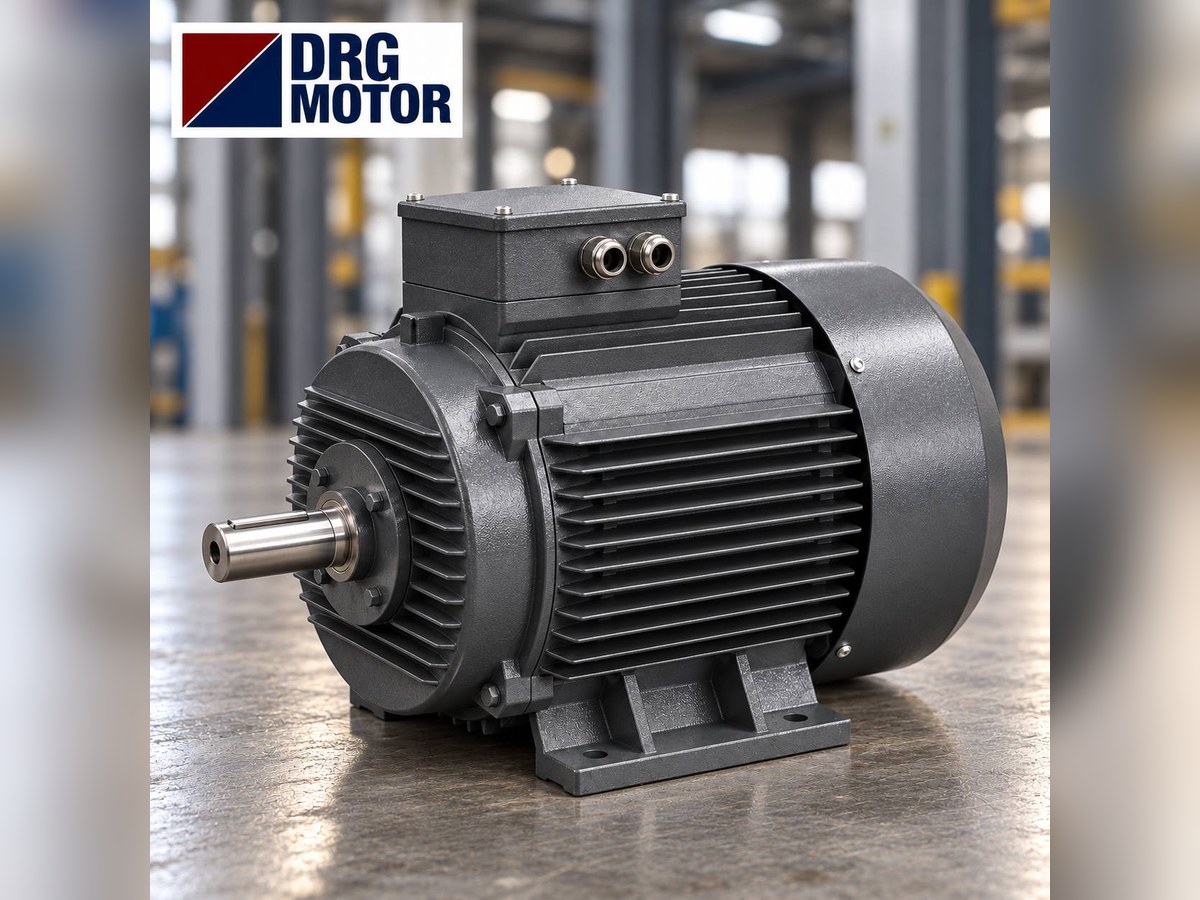
An apron feeder motor is the drive motor that moves chain-mounted steel pans at a very low speed, a few metres per minute; the job is done by a standard three-phase induction motor, a high-ratio gearbox and usually an inverter. The motor runs at about 1000 or 1500 rpm, the gearbox reduces this to a few revolutions per minute at the drive sprocket and multiplies torque by the same ratio. Because the feeder has to start with the hopper completely full, starting torque matters more than power when choosing the motor.
Below you will find the apron feeder's place in the plant, the power seen on market models, the distinction between gearbox output speed and motor speed, and a worked torque calculation. Suitable models are on Buy Electric Motors Online; for other motors in the plant see the Stone Crushing Plant Motors page.
What is an apron feeder and for which material is it chosen?
An apron feeder consists of two endless chains, similar to crawler tracks, with overlapping steel or manganese cast plates (pans) bolted to them. The chain runs on side rollers and the pans form a continuous floor under the hopper. Material is drawn from the hopper without sliding, carried on the pans; capacity is set by pan width, material depth and chain speed.
It is used ahead of the primary crusher, under the hopper that trucks dump into. One manufacturer recommends the apron feeder for wet, clayey, abrasive and sticky materials and large lumps, noting that it removes the problems of a vibrating feeder with these materials and gives high capacity at low speed [1]. Quarry rock, clayey limestone, ore and coal are typical materials. A vibrating feeder is a lighter, simpler solution for dry rock, while the belt of a hopper feeder cannot withstand large, sharp lumps. This distinction decides which machine is chosen for primary feeding.
How the motor drives the pans: gearbox, inverter and single or twin drive
The drive train is built similarly by every manufacturer:
- Motor: A standard three-phase induction motor, usually 4- or 6-pole. One manufacturer supplies the motor with forced ventilation [2]; a separate fan matters for motors that will run at low speed on an inverter for long periods.
- Gearbox: Planetary or bevel-helical. One manufacturer connects the gearbox output to the drive shaft with a shrink disk [2]; another couples motor and gearbox directly [1].
- Inverter: It adjusts feed speed to the crusher load; at one manufacturer the speed is managed by a frequency drive [2].
- Single or twin drive: On wide, long feeders a motor-gearbox is placed at each end of the drive shaft. In a Turkish manufacturer's series, small models have one motor (4–7.5 kW) and large models two (2 × 5.5 – 2 × 22 kW) [1]. On large mining types the drives can also be hydraulic [3].
On a twin-drive feeder both motors turn the same shaft. To share load, the two inverters are usually run together (master-follower); this setting belongs to the drive side and the exact arrangement comes from the machine manufacturer's design.
Motor power on market apron feeders
A) Values seen in catalogues
| Model group / capacity | Motor power | Single or total | Source |
|---|---|---|---|
| Maker B, 150–600 t/h series | 1.5–15 kW | Installed power | [2] |
| Maker A, 600 mm, 100–150 t/h | 4 kW | Single motor | [1] |
| Maker A, 900 mm, 200–275 t/h | 7.5 kW | Single motor | [1] |
| Maker A, 1300 mm, 380–600 t/h | 2 × 22 kW | Per motor; total 44 kW | [1] |
| Maker C, 2600 mm, 1500 t/h | 22 kW | Single drive | [3] |
| Maker C, 2600 mm, 1500 t/h | 2 × 120 kW | Per motor; total 240 kW | [3] |
| Maker C, 2400 mm, 4250 t/h | 2 × 315 kW | Per motor; total 630 kW | [3] |
| Maker C, 3100 mm, 12000 t/h | 2 × 710 kW | Per motor; total 1420 kW | [3] |
In this machine group, motor options of roughly 1.5–710 kW (per motor) are seen depending on the manufacturer's model and capacity [2][3]. Feeders in aggregate quarries stay in the upper half of the table, at 1.5–44 kW total; twin drives of hundreds of kW belong to mines and large ore processing plants.
Even at the same capacity, power can differ widely: of one manufacturer's two 1500 t/h feeders, one is supplied with 22 kW and the other with 2 × 120 kW [3]. The difference comes not from capacity but from feeder length, material and the load the hopper places on the feeder. A 6.6 m and a 10.6 m feeder may carry the same tonnage, but the longer one has much heavier chains and pans, more roller friction and a far larger shear resistance from the material column under the hopper. Inclined installation, sticky material and low temperature also raise power.
B) Where the DRG range applies
DRG Motor is an electric motor manufacturer, supplier and seller. Our range is 0.25–11 kW in aluminium and 0.55–355 kW in cast iron, 1000/1500/3000 rpm, 3-phase 230/400 V or 400/690 V; B3, B5, B14 and B35 mounting is supplied with an order note.
- All 1.5–44 kW single and twin drive motors of aggregate types are in this range.
- The 2 × 120, 2 × 200 and 2 × 315 kW motors of mining types can also be met with 4- or 6-pole cast iron motors.
- Drives above 355 kW per motor (such as 2 × 710 kW) and designs requiring 750 rpm motors are outside the DRG range.
| Model | Power / speed | Frame · current 400 V | Price |
|---|---|---|---|
| DRG-132S-47.5 HP | 5.5 kW · 1500 rpm | Cast iron 132S · 10.7 A | $342.01 (€305.44) Details & buy → |
| DRG-132M-410 HP | 7.5 kW · 1500 rpm | Cast iron 132M · 14.3 A | $394.89 (€352.66) Details & buy → |
| DRG-180L-620 HP | 15 kW · 1000 rpm | Cast iron 180L · 29.3 A | $834.75 (€745.48) Details & buy → |
| DRG-160L-420 HP | 15 kW · 1500 rpm | Cast iron 160L · 27.3 A | $678.13 (€605.61) Details & buy → |
| DRG-200L2-630 HP | 22 kW · 1000 rpm | Cast iron 200L · 42.5 A | $1,194.62 (€1,066.87) Details & buy → |
| DRG-180L-430 HP | 22 kW · 1500 rpm | Cast iron 180L · 39.7 A | $919.45 (€821.13) Details & buy → |
| DRG-200L-440 HP | 30 kW · 1500 rpm | Cast iron 200L · 53.8 A | $1,235.00 (€1,102.93) Details & buy → |
| DRG-250M-650 HP | 37 kW · 1000 rpm | Cast iron 250M · 68.1 A | $2,056.71 (€1,836.77) Details & buy → |
| DRG-225M-460 HP | 45 kW · 1500 rpm | Cast iron 225M · 80.2 A | $1,688.50 (€1,507.94) Details & buy → |
Click to see current electric motor prices and order nowSEE PRICES →
Gearbox output speed and motor speed are not the same thing
These are the two values most often confused on an apron feeder. The speed on the motor nameplate (e.g. 1470 rpm) is the motor shaft speed. The speed in the feeder data sheet is pan speed, given in m/min; in one manufacturer's table it is 6–24 m/min [3]. The gearbox is the bridge between them:
- If pan speed v (m/s) and the pitch diameter D (m) of the drive sprocket are known, output speed is n₂ = v × 60 / (π × D).
- Gearbox ratio i = n_motor / n₂.
- Output torque is approximately T₂ = T_motor × i × η_gear; η_gear is the gearbox efficiency and is taken from the gearbox manufacturer.
So if a motor with a different number of poles replaces the old one, pan speed changes in the same proportion: fitting a 1500 rpm motor instead of a 1000 rpm one speeds the feeder up by about fifty percent and overfeeds the crusher. Always check the input speed on the gearbox nameplate when replacing the motor. Run the numbers in the gearbox output speed and torque calculator.
Worked example: output torque and low speed on a 22 kW feeder
Assumption: a single-drive 22 kW feeder running at 20.8 m/min pan speed as in its catalogue [3]; drive sprocket pitch diameter assumed to be 0.9 m and gearbox efficiency 0.9. The motor chosen is the 4-pole DRG-180L-4 (1470 rpm, rated torque 142.9 Nm, Ts/Tn = 2.0).
- Pan speed: 20.8 / 60 ≈ 0.347 m/s.
- Sprocket speed: 0.347 × 60 / (π × 0.9) ≈ 7.36 rpm.
- Gearbox ratio: 1470 / 7.36 ≈ 200.
- Output torque: 142.9 × 200 × 0.9 ≈ 25,700 Nm.
- Since the motor's starting torque ratio is 2.0, a direct-on-line start can produce about 51,400 Nm briefly at the output. Chain, sprocket and gearbox must be sized for this; that check belongs to the machine manufacturer.
If the same feeder is slowed to 6 m/min with an inverter, frequency drops to 50 × 6 / 20.8 ≈ 14.4 Hz and motor speed to about 424 rpm. Torque demand does not fall with speed; it is a constant-torque load. At this speed the motor's own fan does not supply enough air. Feeders that will run below 20 Hz for long periods need a separately ventilated (force-cooled) motor or winding temperature monitoring by thermistor. Our standard catalogue motors are cooled by their own shaft-mounted fan; if a separate fan is needed, state this at the quotation stage.
Motor selection list: full-load start, starting method and environment
- Full-load start: The apron feeder sits under the hopper; when it stops, tonnes of material remain on it. The motor starts with this load every morning. Star-delta starting cuts starting torque to one third, so it is generally unsuitable on this machine; compare methods on our star-delta starting page.
- Inverter size: Since the motor goes above rated torque at start, the inverter's current capacity should be chosen above the motor's rated current. The 22 kW motor in the example has a rated current of 39.7 A at 400 V.
- Poles: If the gearbox input is designed for 1500 rpm, take 4 poles; for 1000 rpm, 6 poles. At the same power a 6-pole motor has higher rated torque (at 22 kW: 4-pole 142.9 Nm, 6-pole 214.4 Nm).
- Mounting: B5 if the motor is flanged to the gearbox, B3 or B35 if foot-mounted with a coupling. Confirm the exact type on the machine maker's drawing.
- Twin drive: Both motors must be the same model and speed; when one is replaced, check the other's nameplate too.
- Environment: The area under a primary hopper is dusty and often open; rain, mud and impact during truck dumping hit the feeder rather than the motor, but the motor and terminal box should be protected.
DRG motors for apron feeders
The models in the table were chosen from the power range seen on apron feeders. The 315L2-4 is an example for 200 kW twin drives on mining types.
| Model | Power / speed | Frame | Current 400 V |
|---|---|---|---|
| DRG-132M-4 | 7.5 kW / 1460 rpm | 132M cast iron | 14.3 A |
| DRG-160L-4 | 15 kW / 1465 rpm | 160L cast iron | 27.3 A |
| DRG-180L-4 | 22 kW / 1470 rpm | 180L cast iron | 39.7 A |
| DRG-200L2-6 | 22 kW / 980 rpm | 200L cast iron | 42.5 A |
| DRG-225M-4 | 45 kW / 1485 rpm | 225M cast iron | 80.2 A |
| DRG-315L2-4 | 200 kW / 1490 rpm | 315L cast iron | 334 A |
DRG MOTOR motors are guaranteed against material and manufacturing defects for 2 years from the date of delivery (warranty certificate). For the effect of starting current on the supply, read our article on motor starting (inrush) current; for motor supply on the crusher side, see crusher motor supply.
Motors in this power range
- DRG-160L-4 – 15 kW – 1465 rpm – 160L cast iron
- DRG-180L-4 – 22 kW – 1470 rpm – 180L cast iron
- DRG-200L2-6 – 22 kW – 980 rpm – 200L cast iron
- DRG-200L-4 – 30 kW – 1475 rpm – 200L cast iron
- DRG-225M-4 – 45 kW – 1485 rpm – 225M cast iron
Click to see current prices and order these motors nowSEE PRICES →
Apron feeder motor: FAQ
How many kW is an apron feeder motor?
On apron feeders in aggregate quarries, catalogues show 1.5–15 kW single motors or 2 × 5.5 – 2 × 22 kW twin motors. On large mining feeders it rises to 120–710 kW per motor. Read the exact figure from the feeder's plate.
Why is an apron feeder run on an inverter?
To adjust feed speed to the crusher load and to start smoothly but strongly with a full hopper. Unlike star-delta, an inverter does not reduce torque at start.
Can a 6-pole motor replace a 4-pole one on an apron feeder?
If it does, pan speed falls by about one third and capacity falls in the same proportion. If the gearbox ratio is not changed accordingly, choose a motor with the same number of poles as the nameplate.
How many amps does a 22 kW apron feeder motor draw?
The 4-pole DRG-180L-4 draws 39.7 A at 400 V and the 6-pole DRG-200L2-6 42.5 A at 400 V.
Send us the feeder nameplate and the motor and gearbox labels; we will confirm the right motor together. Phone +90 (542) 666 11 11, e-mail [email protected], contact page. For all models and current prices, visit Buy Electric Motors Online.
Sources
- MTM Kırma Eleme – Paletli Besleyiciler (MAF serisi) – MAF-0620–1350: 4 / 5.5 / 7.5 kW single, 2 × 5.5 / 2 × 15 / 2 × 22 kW twin; 100–600 t/h; coupled motor-gearbox.
- BSI – Primary Apron Feeder – 150–600 t/h, installed power 1.5–15 kW; force-ventilated motor, planetary gearbox, frequency drive.
- TAKRAF – Apron Feeders (broşür) – 22 kW (20.8 m/min) and 2 × 120 kW (6–24 m/min) for 1500 t/h; 2 × 315 and 2 × 710 kW for 4250–12000 t/h; single or twin drive.


