 English
 Le français
 Türkçe

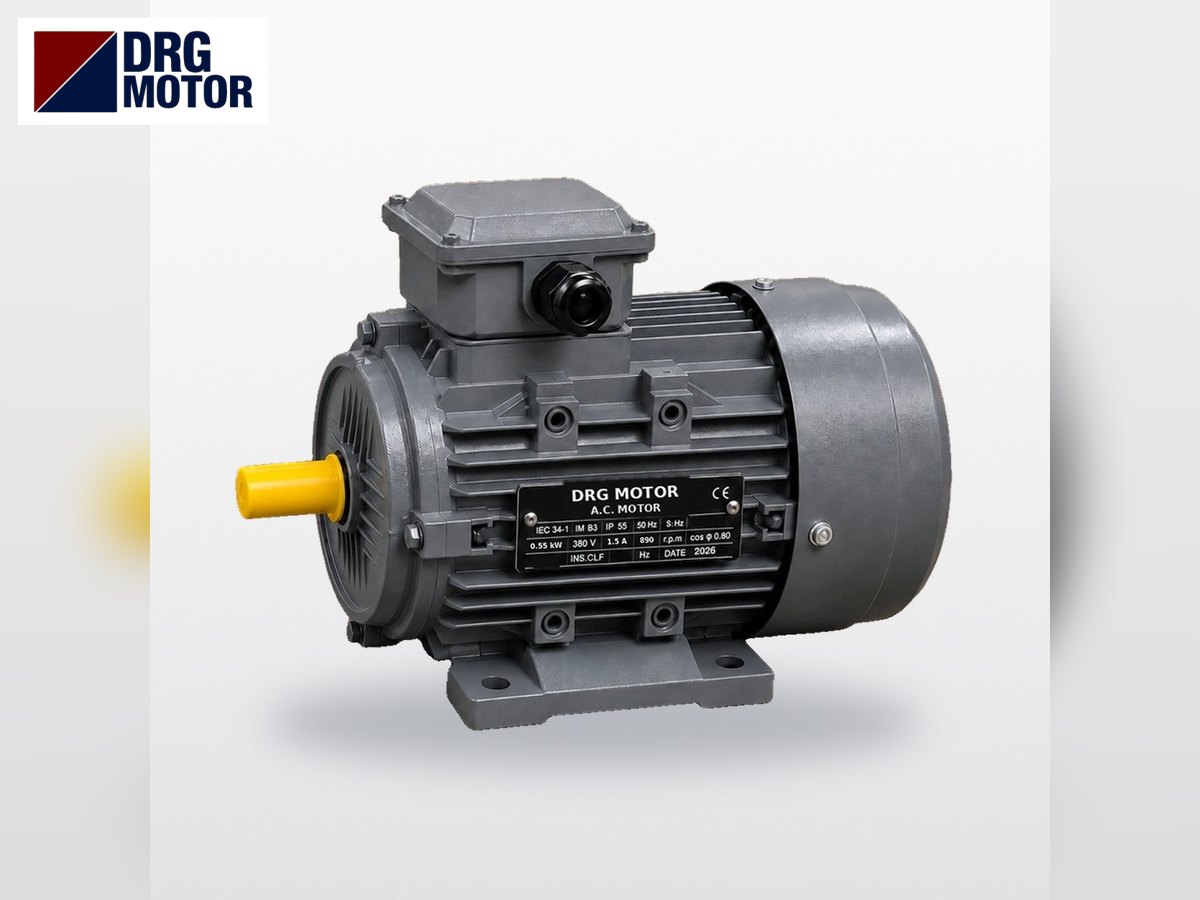
On a milk cooling tank, the agitator motor is a small unit sitting on the bridge or lid sheet at the top of the tank, turning the paddle through a gearbox at roughly 20–50 revolutions per minute. Its job is to carry milk to the cold wall and stop the cream separating; it does not cool the tank. The refrigeration compressor motor, condenser fan and milk pump are outside the scope of this page. Here we cover only the agitator drive and when aluminium housing electric motors are the right choice for it. How to measure flange and shaft when removing a failed agitator motor is handled separately in our article on milk tank agitator motor replacement.
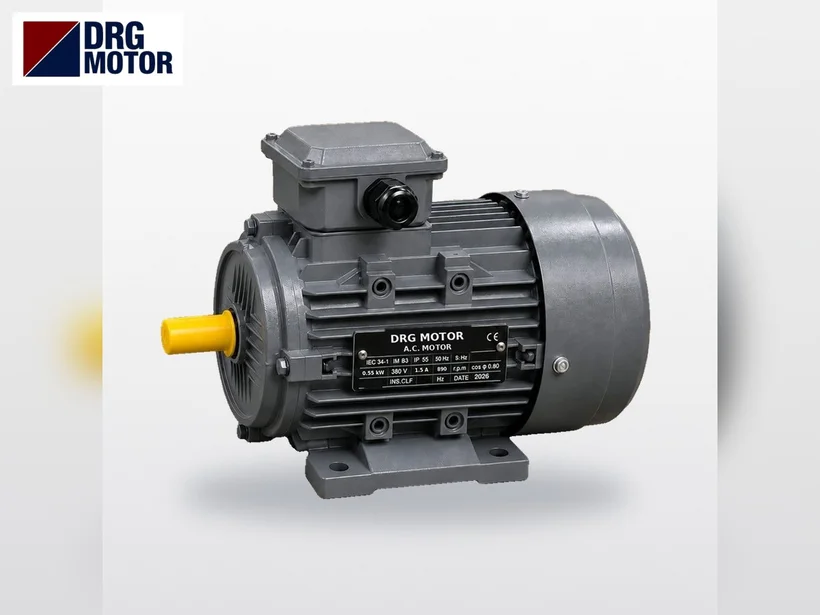
DRG Motor is a manufacturer, supplier and seller of electric motors. We do not sell the tank, refrigeration unit, agitator paddle, gearbox, washing automation or speed drive; what we deliver is the three-phase asynchronous motor on top of the agitator shaft. Every agitator motor listed here appears, with its price, on the Buy Electric Motors Online page.
Which part of the tank does the agitator drive?
Milk arrives from milking at around 35 °C and cools by touching the evaporator surface in the bottom. Without a turning paddle only the bottom layer cools, warm milk stays on top and fat gathers there. The controller therefore starts the agitator together with cooling and runs it in short bursts during storage. A few minutes of stirring before a milk sample is taken are also this motor’s work.
Open tank or closed tank: where does the motor sit?
On small open (lidded) tanks the motor is fixed to a bridge on the lid; when the lid opens the motor lifts with it or swings aside with the bridge. On closed cylindrical tanks the motor is bolted to a bracket welded to the top shell and the shaft runs down to the bottom through a long tube. In the first layout the motor moves every time the lid opens; in the second it stays put but is removed by climbing a ladder to the tank top.
One, two or three agitators
As volume grows a single paddle cannot keep all the milk moving. Large tanks run two or three agitators together; each comes with its own motor and gearbox, they all do the same job, they simply stir different zones of the tank. On replacement the motors must run at the same speed: if one is 4-pole and the other 6-pole, the paddles turn at different speeds and one end of the tank is stirred less.
Agitator power on tanks on the market
A) Values given for the agitator in tank makers’ sheets:
| Tank volume | Agitator motor | Number · agitator speed | Note |
|---|---|---|---|
| 250–850 L | 225 W, single-phase 230 V, 2-pole | 1 · 21–48 rpm | geared unit sheet; ratio 1/57–1/127 |
| 500 L | 0.75 kW | 1 · 25 rpm | first tank maker |
| 1000–3000 L | 1.1 kW | 1 · 35 rpm | first tank maker |
| 5000–10000 L | 1.1 kW × 2 | 2 · 43 rpm | same table; 2.2 kW in total |
| 300–10000 L | geared unit, power not stated | 1 · 28 rpm | small ones single-phase, 2000 L and up three-phase |
| 4000–9000 / 10000–25000 / over 30000 L | 1 × 220 V as standard | 1 / 2 / 3 agitators | third tank maker |
In this tank group, depending on maker and volume, motors of about 0.225–1.1 kW per agitator are found. On multi-agitator tanks or systems above 10,000 litres the power adds up with the number of agitators; the rating of a single motor stays the same.
B) Overlap with the DRG range: three-phase agitator motors of 0.25–1.1 kW match our aluminium models in 71, 80 and 90S frames. Outside our range: single-phase capacitor motors common on small tanks, special geared units with motor and gearing cast as one block, and the rare layouts that ask for a brake motor. A tank agitator needs no servo or precise position control.
What does an aluminium housing bring here?
Weight on the lid bridge
The agitator motor stands at the highest point of the tank, on thin stainless sheet or a lid bridge. Every kilogram counts there: a light motor loads the lid hinge and the bridge less, upsets the balance of an opening lid less and can be carried up a ladder by one person during service. We do not give a housing weight here; our model records have no weight field, so ask us if you need it.
Compact size and easy removal
In this power band the aluminium housing stays within 71, 80 and 90S frames; it fits a narrow bracket and leaves the cable entry and terminal box reachable from above. On replacement the motor comes off the gearbox by its flange bolts, without dismantling the bridge or bracket.
Where cast iron takes the lead
An agitator is lightly loaded and sees no heavy shocks or strong vibration, so there is no typical condition here that calls for a cast iron housing. Still, if the motor stands low on a frame where it can be knocked, or the existing bracket was built to cast iron dimensions, cast iron models can be chosen too; from 0.55 kW both housings are in the shop.
Click to see current electric motor prices and order nowSEE PRICES →
Dimensions checked during selection
Power, speed and gear ratio
Paddle speed is part of the tank design and comes from the gear ratio. A faster motor does not mix better; with the same ratio the paddle speeds up and the milk foams. Keeping the old gearbox means matching the pole count of the motor it came with. For a new agitator, the choice between 4 and 6 poles shows up in the gear ratio:
| Motor | Rated speed | Ratio for 25 rpm | Note |
|---|---|---|---|
| DRG-802-4 · 4-pole, 0.75 kW | 1420 rpm | i ≈ 56.8 | higher ratio, more stages |
| DRG-801-6 · 6-pole, 0.37 kW | 890 rpm | i ≈ 35.6 | lower ratio, same speed with less motor torque |
Paddle speed and torque for your own tank can be checked with the gearbox output speed calculator. If only the motor changes and the gearbox stays, our page on electric motors for worm gearboxes explains the connection side.
Voltage, mounting and shaft-flange
The motor runs vertically, shaft down; the order states V1 vertical mounting, and vertical duty requires the motor to be ordered for vertical mounting and the axial load to be confirmed by the gearbox maker. Every aluminium agitator model listed below, 0.25 to 1.1 kW, has a 230/400 V winding, so on a 400 V farm supply it is wired in star. Flange type, flange outer diameter, spigot diameter, shaft diameter and key follow the gearbox input; couplings and belts are rare here, the motor usually sits straight on the gearbox.
Duty cycle, moisture and washing
Intermittent running and stop-start
During storage the agitator cuts in at short intervals. Frequent starts do not strain a small motor’s winding, but the housing cools at every stop and moisture can condense inside. That is why a sound terminal box gasket and a cable gland pointing down matter. Starting a full tank is light; star-delta or a soft starter is not needed at this size, direct-on-line starting is enough. If speed control is wanted an inverter can be used; DRG does not supply drives.
Where IP55 is not enough during washing
The tank is cleaned inside by an automatic washing program, and the motor may run meanwhile; the real risk is cleaning from outside. DRG motors are IP55: they withstand dust build-up and low-pressure water sprayed from any direction. A pressure washer lance, steam cleaning or the motor standing in water are beyond that protection. When washing the tank exterior, cover the motor or keep the jet off it, and clear water and milk residue from the top of the fan cover.
Tanks standing outdoors
At collection centres a tank sometimes stands under an eave or in the open. The motor is rated for a −15…+40 °C surrounding; on tanks that freeze in winter or bake in the summer sun, cover the motor with a protective hood and keep the fan inlet clear. With a vertical motor the fan cover faces up, so rain and dust fall straight into the air inlet.
Tanks with single-phase motors
Many small farm tanks come with a single-phase agitator motor. Single-phase motors are outside our range in this category. Using a DRG motor requires a three-phase supply to the tank; where the refrigeration unit is already three-phase this is usually simple at the panel.
Worked example: an 8,000-litre tank with two agitators
Assumption: two agitators, each with a 1.1 kW 4-pole motor and a paddle speed of 43 rpm; 3 hours non-stop during cooling, then 3 minutes in every 30 during storage, 20 hours of storage a day. The figures are an example.
- Gear ratio: 1445 / 43 ≈ 33.6.
- Power drawn from the mains by one motor at rated load: √3 × 400 V × 2.48 A × 0.76 ≈ 1.31 kW (current and power factor from the DRG-90S-4 record).
- Daily running time: 3 + 20 × 3/30 = 5 hours; for both motors at most about 13.1 kWh.
- About 40 starts per motor per day; each start briefly draws 16.9 A.
Because the agitator runs below rated load, real consumption is lower than this upper bound. The sum shows that the fuse and overload setting in the panel, and the number of starts, are no issue for a small motor.
Suitable DRG aluminium models and prices
4- and 6-pole aluminium housing models matching the agitator drive (values from our product records):
| Model | Power · synchronous / rated speed | Aluminium frame · torque | Current 400 V |
|---|---|---|---|
| DRG-711-4 | 0.25 kW · 1500 / 1340 rpm | IEC 71 · 1.78 Nm | 0.66 A |
| DRG-712-4 | 0.37 kW · 1500 / 1340 rpm | IEC 71 · 2.64 Nm | 0.92 A |
| DRG-801-4 | 0.55 kW · 1500 / 1400 rpm | IEC 80 · 3.75 Nm | 1.31 A |
| DRG-802-4 | 0.75 kW · 1500 / 1420 rpm | IEC 80 · 5.04 Nm | 1.75 A |
| DRG-90S-4 | 1.1 kW · 1500 / 1445 rpm | IEC 90S · 7.27 Nm | 2.48 A |
| DRG-712-6 | 0.25 kW · 1000 / 855 rpm | IEC 71 · 2.79 Nm | 0.77 A |
| DRG-801-6 | 0.37 kW · 1000 / 890 rpm | IEC 80 · 3.97 Nm | 1.04 A |
| DRG-802-6 | 0.55 kW · 1000 / 890 rpm | IEC 80 · 5.9 Nm | 1.43 A |
Prices in the table below come live from the shop:
| Model | Power / speed | Frame · current 400 V | Price |
|---|---|---|---|
| DRG-712-60.37 HP | 0.25 kW · 1000 rpm | Aluminium 71 · 0.77 A | $88.07 (€78.65) Details & buy → |
| DRG-711-40.37 HP | 0.25 kW · 1500 rpm | Aluminium 71 · 0.66 A | $73.16 (€65.33) Details & buy → |
| DRG-801-60.5 HP | 0.37 kW · 1000 rpm | Aluminium 80 · 1.04 A | $99.32 (€88.70) Details & buy → |
| DRG-712-40.5 HP | 0.37 kW · 1500 rpm | Aluminium 71 · 0.92 A | $76.76 (€68.55) Details & buy → |
| DRG-802-60.75 HP | 0.55 kW · 1000 rpm | Aluminium 80 · 1.43 A | $102.12 (€91.20) Details & buy → |
| DRG-801-40.75 HP | 0.55 kW · 1500 rpm | Aluminium 80 · 1.31 A | $87.55 (€78.19) Details & buy → |
| DRG-802-41 HP | 0.75 kW · 1500 rpm | Aluminium 80 · 1.75 A | $97.30 (€86.90) Details & buy → |
| DRG-90S-41.5 HP | 1.1 kW · 1500 rpm | Aluminium 90S · 2.48 A | $118.44 (€105.78) Details & buy → |
DRG MOTOR motors are guaranteed against material and manufacturing defects for 2 years from the delivery date (warranty certificate).
Motors in this power range
- DRG-712-4 – 0.37 kW – 1340 rpm – 71 aluminium
- DRG-802-4 – 0.75 kW – 1420 rpm – 80 aluminium
- DRG-90S-4 – 1.1 kW – 1445 rpm – 90S aluminium
- DRG-801-6 – 0.37 kW – 890 rpm – 80 aluminium
Click to see current prices and order these motors nowSEE PRICES →
Browse the products, ask for a quote. Every model is on the Buy Electric Motors Online page. A quote is quick when we have: the agitator motor plate photo, litres and agitator count, the gearbox label or paddle speed, flange and shaft sizes, single- or three-phase supply, indoor or outdoor tank, and the daily running time and how often it switches on. Photos can go to our WhatsApp line; phone +90 (542) 666 11 11.
Frequently asked questions
Is the agitator motor the same motor as the refrigeration compressor?
No. The compressor runs on a separate motor inside a hermetic or semi-hermetic housing and is a refrigeration service job. The motor on this page only turns the paddle.
One of two agitators failed; can I replace only that one?
Yes, as long as the new motor matches the other in power, pole count and flange; otherwise the paddles turn at different speeds.
Does the agitator need an inverter?
On most tanks it does not; the speed is fixed by the gearbox. Tank makers who want adjustable paddle speed use a drive, which is sourced separately.
For questions: +90 (542) 666 11 11 · info@drgmotor.com · contact.


