 English
 Le français
 Türkçe

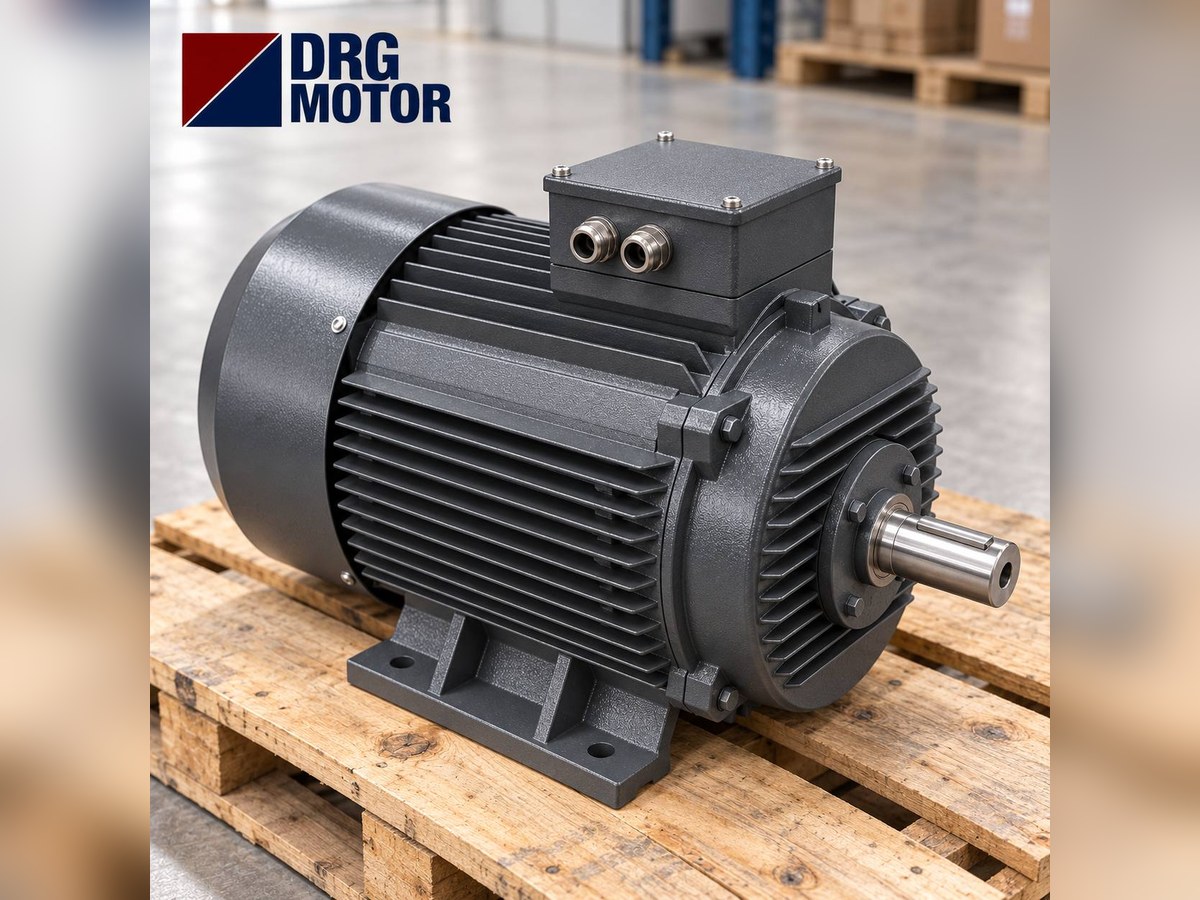
A feed conveyor motor is the drive motor of the chain (en-masse) or belt conveyor that moves grain, ground mash or pellets along a horizontal or slightly inclined line in a feed mill; it usually turns a gearbox mounted on the conveyor shaft. Manufacturer catalogues show 1.5–37 kW on enclosed chain conveyors for feed depending on length and capacity, 2.2–4 kW per drive on enclosed grain belt conveyors, and 0.55–1.75 kW on bag conveyors. This page covers transfer lines inside a feed mill: from raw material intake to the silo top, between the grinding and mixing sections, and on to packing.
The main difference between the open belts of a quarry and a feed line is the environment: feed dust is combustible, formulas must not mix and the conveyor usually runs inside a closed casing. Motor selection therefore depends as much on dust, cleanliness and monitoring as on power. Each suitable motor's current price is shown on Buy Electric Motors Online.
Which conveyors are used in a feed mill?
Chain (en-masse) conveyor
A chain with evenly spaced flights runs along the floor of a closed, rectangular casing. The feed is not pushed in front of the flights but moves as a continuous bed inside the casing, as a mass, hence the name en-masse. Chain speed is low; catalogues show values between 0.3 and 0.8 m/s. The casing is closed so dust stays inside, and one line can serve several silo cells through multiple intermediate outlets. It is the most common type from the intake pit to the elevator, between cells on the silo top and on long horizontal runs between sections.
Enclosed grain belt conveyor
A rubber belt runs on troughed idlers inside a covered casing. It has less friction than a chain conveyor and can travel further with a smaller motor at the same capacity. Since the belt surface is open, mash generates dust at loading and discharge points; this type is preferred for coarse material such as whole grain, cracked maize and pellets and for long runs between buildings.
Bag conveyor
Flat belts that carry filled bags from the packing machine under the bag closer to palletising or truck loading. They are short, light and low-powered; some have an upper belt that flattens the bag.
How many kW for a feed conveyor motor? Market values
A) Power values in manufacturer catalogues
| Conveyor / capacity | Motor power | Single or total | Note |
|---|---|---|---|
| Chain, 40 t/h, up to 10 m | 1.5 kW | Single motor | Maker catalogue, small model |
| Chain, 120 t/h, 43–50 m | 15 kW | Single motor | Same catalogue, large model |
| Chain, 65–256 m³/h | 5.5–22 kW max. | Single motor | Second maker, four sizes |
| Chain, 45–450 t/h, 40–100 m | 7.5–37 kW (max.) | Single motor | Third maker, grain |
| Sanitary chain, up to 200 t/h | 3–22 kW (max.) | Single motor | Same maker, clean line |
| Enclosed belt, 60–105 t/h, up to 100 m | 2.2–4 kW; 2 × 4 kW | Single or dual drive | Maker catalogue |
| Bag belt, 600 mm, 2–4 m | 0.55–1.75 kW | Single motor | Palletising line maker |
For this machine group, catalogues list motors of about 0.55–37 kW, according to each manufacturer's model and capacity. For chain conveyors the listed value is often the "maximum motor" the size can take; the actual motor is chosen below it according to the line length and tonnage. Long belt conveyors may use two separate drives: in the example, a 2 × 4 kW line has a total power of 8 kW while each motor is 4 kW. The intermediate outlet slides of a chain conveyor can also be motorised; in one catalogue these slide motors are 0.25 kW and are counted separately from the main drive.
B) What the DRG range covers
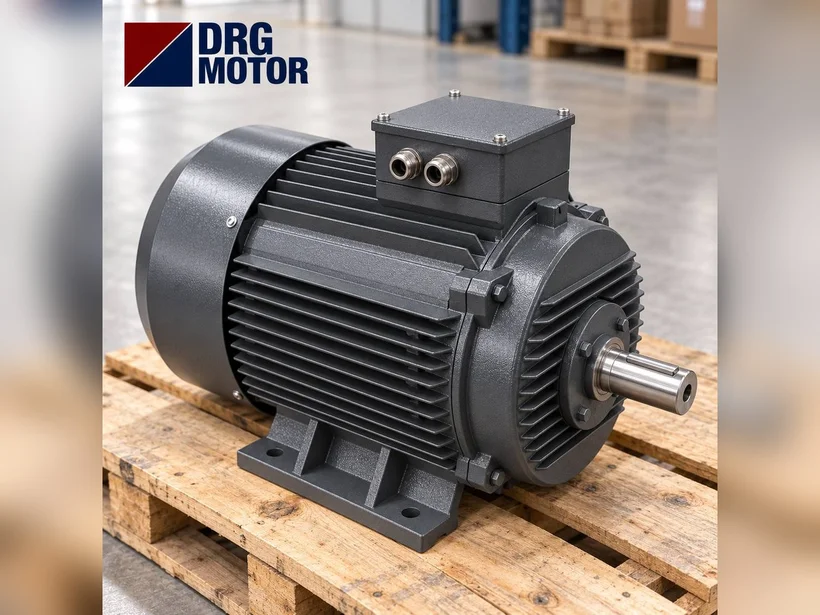
DRG Motor is a manufacturer, supplier and seller of electric motors. Cast iron motors run up to 355 kW (from 0.55 kW) and aluminium ones up to 11 kW (from 0.25 kW), with a synchronous speed of 3000, 1500 or 1000 rpm; every unit is three-phase, with a choice of two winding voltages. Mounting — B3, B5, B14 or B35 — is specified with the order. The whole 0.55–37 kW range seen on feed conveyors is available. The table below shows current values for feed mill conveyor motors:
| Model | Power / speed | Frame · current 400 V | Price |
|---|---|---|---|
| DRG-801-40.75 HP | 0.55 kW · 1500 rpm | Cast iron 80 · 1.31 A | $91.72 (€81.91) Details & buy → |
| DRG-90L-42 HP | 1.5 kW · 1500 rpm | Cast iron 90L · 3.3 A | $144.14 (€128.73) Details & buy → |
| DRG-100L2-44 HP | 3 kW · 1500 rpm | Cast iron 100L · 6.02 A | $203.84 (€182.05) Details & buy → |
| DRG-112M-45.5 HP | 4 kW · 1500 rpm | Cast iron 112M · 7.95 A | $254.38 (€227.18) Details & buy → |
| DRG-132S-47.5 HP | 5.5 kW · 1500 rpm | Cast iron 132S · 10.7 A | $342.01 (€305.44) Details & buy → |
| DRG-132M-410 HP | 7.5 kW · 1500 rpm | Cast iron 132M · 14.3 A | $394.89 (€352.66) Details & buy → |
| DRG-160M-415 HP | 11 kW · 1500 rpm | Cast iron 160M · 20.4 A | $568.76 (€507.94) Details & buy → |
| DRG-160L-420 HP | 15 kW · 1500 rpm | Cast iron 160L · 27.3 A | $678.13 (€605.61) Details & buy → |
| DRG-180L-430 HP | 22 kW · 1500 rpm | Cast iron 180L · 39.7 A | $919.45 (€821.13) Details & buy → |
| DRG-225S-450 HP | 37 kW · 1500 rpm | Cast iron 225S · 66.1 A | $1,527.18 (€1,363.87) Details & buy → |
How does dust explosion risk affect motor selection?
Flour, bran and ground grain dust can ignite once it reaches a sufficient concentration in air. For this reason feed mills divide the areas around conveyors, elevators and filters into zones through a risk assessment. The classification for dust uses zones 20, 21 and 22; zone 22 is a place where a dusty atmosphere is not expected in normal operation but may occur briefly. This assessment is made by the plant owner and a qualified specialist, and it also determines which certificate the motor must carry.
If an Ex certificate is required
If the risk assessment marks the location of the conveyor drive as a dust zone, a motor approved for explosive atmospheres (Ex-marked) must be fitted there. Catalogues show that some conveyor and elevator makers offer their drive units for zone 22 as a separate option. The DRG range does not include Ex-approved motors. Standard DRG motors can only be used in unclassified areas, i.e. where the risk assessment does not define a dust zone.
Points to watch where Ex is not required
Even without a certificate requirement, dust is the motor's enemy. A layer of flour on the frame fins spoils cooling and the motor runs hot, so regular cleaning is needed. Keep the terminal box cover closed tight, fit proper cable glands and leave no cable entry open.
Click to see current electric motor prices and order nowSEE PRICES →
How to read a selection table: chain conveyor example
Calculating chain conveyor power requires data such as chain weight, flight friction and the internal friction of the feed; manufacturers therefore give selection tables by length and capacity. The table in one chain grain conveyor catalogue, for grain at 750 kg/m³, reads as follows (selected rows):
| Motor | 40 t/h model | 80 t/h model | 120 t/h model |
|---|---|---|---|
| 3 kW | 19.1–30 m | 7.1–12 m | up to 6 m |
| 5.5 kW | 44.1–50 m | 19.1–29 m | 11.1–18 m |
| 7.5 kW | – | 29.1–43 m | 18.1–27 m |
| 11 kW | – | – | 35.1–43 m |
Example: from intake to the elevator
Consider a chain conveyor that draws 80 tonnes of maize per hour from under the intake pit and carries it 25 m to the elevator boot. In the table, the 80 t/h model at 25 m falls in the 19.1–29 m row: 5.5 kW. But if a capacity control slide is fitted at the pit inlet, the same catalogue states that it needs power equal to about 5 m of extra conveying; the equivalent length becomes 30 m and the 7.5 kW row applies. If side-inlet extensions are used along the conveyor, the catalogue multiplies the power demand by 1.5. As you can see, accessory choices on the same conveyor can raise the motor by one step.
In this example a 7.5 kW 4-pole DRG-132M-4 (1460 rpm, 14.3 A at 400 V) is suitable. With a chain speed of 0.6 m/s and a drive sprocket pitch diameter of 360 mm, the sprocket shaft turns at about 32 rpm and the gear ratio is about 46. The ratio is easy to confirm using the gearbox output speed and torque calculator. Mash is lighter than grain, so the same volume carries fewer tonnes; the table must be read with the density in mind. The final power comes from the conveyor maker.
Single and dual drive on belt conveyors
In one enclosed grain belt conveyor catalogue, the 500 mm belt model (105 t/h wheat) runs on 2.2 kW for 2–21 m, 3 kW for 22–35 m and 4 kW for 36–52 m. Beyond 53 m a second drive is added: 2 × 3 kW for 59–85 m and 2 × 4 kW for 86–100 m. A 60 m line, for example, has two 3 kW motors; the line's total power is 6 kW, but each motor is ordered separately as 3 kW.
Hygiene and formula changeover: the motor's indirect role
When a feed mill switches from one formula to the next, feed left in the conveyor contaminates the next batch. This matters especially between medicated and standard feed. Sanitary chain conveyors have deflection plates at the return end that prevent build-up and outlet slides that close flush with the floor, so little feed remains inside when the line is emptied. To empty the line fully, the conveyor keeps running for a while after the feed is cut. This run-out time lengthens the motor's daily running time and adds starts and stops.
The same designs fit a zero-speed detector on the return shaft: if the chain stops or breaks, the sensor detects it and stops the conveyor at once. This sensor belongs to the conveyor, not the motor; when the motor is replaced, check that it is still in place and connected. Upstream interlocks depend on it too: if a conveyor stops, the line feeding it must also stop.
Mounting, speed and starting
On feed conveyors the drive usually consists of a shaft-mounted gearbox with a flange-mounted motor. Catalogues show helical and bevel-helical geared motors; with bevel gearing the motor sits at 90° to the conveyor shaft and saves space. The gearbox input is mostly selected for a 4-pole motor, so 1500 rpm motors are the most common. The motor's flange type (B5 or B14) and shaft size should be taken from the old motor or the gearbox plate and confirmed on the conveyor maker's drawing.
When a loaded chain conveyor restarts, it must set the whole bed of feed in the casing moving at once. From 4 kW upwards DRG motors come with 400/690 V windings, so star-delta starting can be used; in star, however, the motor delivers only a third of its delta torque. Long chain lines that must restart with a full casing may therefore be better served by a soft starter or an inverter; the star-delta starting page compares the methods. Bag belts often use an inverter for speed control so that belt speed matches the packing machine.
Checklist for choosing a feed conveyor motor
- Conveyor type: chain, belt or bag belt. Capacity, length, incline and feed density.
- Accessories: capacity control slide, side-inlet extensions, motorised intermediate outlets. All of them affect power.
- Dust zone assessment: what is the classification at the drive? If an Ex certificate is required, a standard motor cannot be used.
- Gearbox: ratio, input flange and shaft diameter; whether the motor sits at 90° or in line.
- Starting: does it restart loaded, and how often? Starting method.
- Monitoring: speed detector, cover switch and upstream-downstream interlocks.
- Old motor's nameplate and current; for overload settings, the overload, fuse and contactor selection tool.
DRG motor options for feed conveyors
The table shows 4-pole cast iron models from the power range of feed conveyors:
| Model | Power / speed | Frame | Current 400 V |
|---|---|---|---|
| DRG-802-4 | 0.75 kW / 1420 rpm | 80 cast iron | 1.75 A |
| DRG-100L2-4 | 3 kW / 1450 rpm | 100L cast iron | 6.02 A |
| DRG-132S-4 | 5.5 kW / 1460 rpm | 132S cast iron | 10.7 A |
| DRG-132M-4 | 7.5 kW / 1460 rpm | 132M cast iron | 14.3 A |
| DRG-160L-4 | 15 kW / 1465 rpm | 160L cast iron | 27.3 A |
| DRG-200L-4 | 30 kW / 1475 rpm | 200L cast iron | 53.8 A |
DRG MOTOR motors are guaranteed against material and manufacturing defects for 2 years from the delivery date (warranty certificate). For open belts in quarries and crushing plants, see our separate belt conveyor motor page; for general conveyor selection, read electric motor selection for conveyors and belt lines.
Motors in this power range
- DRG-90S-4 – 1.1 kW – 1445 rpm – 90S cast iron
- DRG-112M-4 – 4 kW – 1450 rpm – 112M cast iron
- DRG-132M-4 – 7.5 kW – 1460 rpm – 132M cast iron
- DRG-160M-4 – 11 kW – 1465 rpm – 160M cast iron
- DRG-180L-4 – 22 kW – 1470 rpm – 180L cast iron
Click to see current prices and order these motors nowSEE PRICES →
Feed conveyor motor: frequently asked questions
What size motor does a chain conveyor need?
For enclosed chain conveyors handling feed and grain, manufacturer catalogues show values from 1.5 kW up to 37 kW. On the same model the motor grows as the line gets longer; the selection table is read with length and capacity.
Can a standard motor be used in a feed mill?
Yes, where the risk assessment does not define a dust zone. If the drive is inside a dust zone an Ex-approved motor is needed; the DRG range has no such motor.
Why can't the chain conveyor restart when full?
A packed bed of feed in the casing, damp and caked material, or starting torque reduced in star connection are the most common reasons. Empty the casing and check mechanically first, then review the starting method.
How many amps does a 7.5 kW conveyor motor draw?
At 400 V, the 4-pole DRG-132M-4 takes 14.3 A.
Share the conveyor type, length, capacity and the old nameplate; from there we size the motor together. Call +90 (542) 666 11 11, write to [email protected], or use the details on our contact page. Buy Electric Motors Online brings together the feed conveyor motor price list and every model.


