 English
 Le français
 Türkçe

In woodworking conveyors the electric motor turns, through a gearbox, the chains, rollers or belt that carry logs, sawn boards or furniture panels from one machine to the next. The load is not bulk material but individual pieces of different lengths; the motor therefore starts and stops often, takes impacts as pieces drop and usually has to match its speed to the machine it feeds. Manufacturer catalogues show 0.75–7.5 kW per motor on these conveyors; wide layouts such as log decks run two motors together.
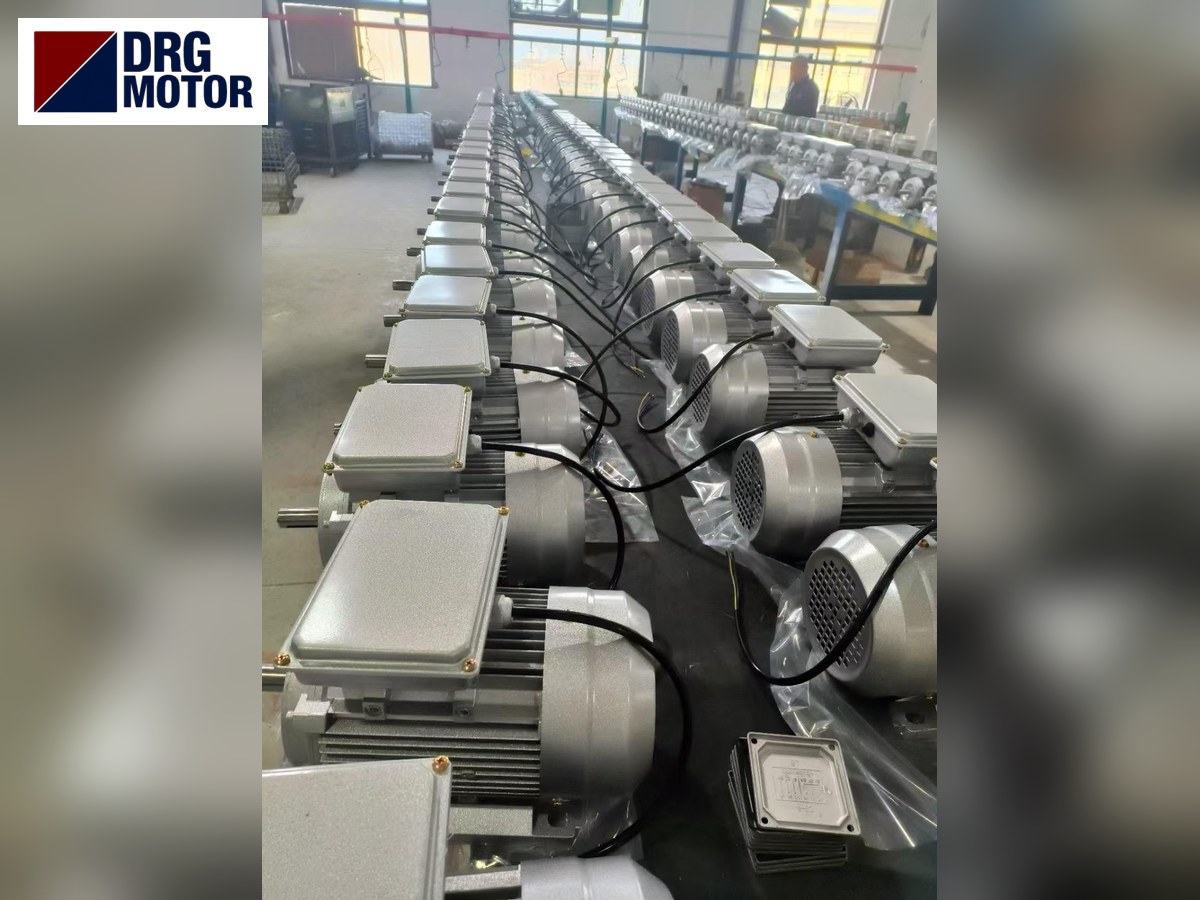
DRG Motor is a manufacturer, supplier and seller of electric motors. We do not sell conveyors, chains or rollers, and gearboxes, hydraulic units, inverters, spindles and servos are outside our sales too; we supply the three-phase induction motor that turns the conveyor. You can see the models on the Buy Electric Motors Online page.
The path of lumber and panels: which conveyor where?
From the sawmill to the furniture shop the material moves in this order: logs are fed from the yard to the headsaw, sawn lumber is transferred sideways and sorted, slabs and edgings leave on a separate line and boards are stacked. On the panel side, boards travel between machines on roller lines and the part leaving the edge bander returns to the operator. The motor load differs at every stop.
Log infeed deck and log chain conveyor
Logs roll to the front of the saw on parallel chains over an inclined or flat deck. In one manufacturer’s catalogue such a deck runs on two separate motors: the horizontal section at 3 metres per minute, the inclined section at 17. The weight of the log and its drop onto the deck is the hardest load for the motor; the chains turn with the same motor whether they carry one log or a full deck.
Cross transfer and sorting table
Sawn boards or battens arrive lengthwise and are then moved sideways by a multi-strand chain; the operator sorts them on this table by grade. Speed is low and the load light, but stops and starts are frequent. One manufacturer’s 3-metre cross transfer runs at about 11 metres per minute with a 1.1 kW motor and a worm gearbox.
Slab, edging and sawdust conveyors
Slabs (the outer bark-covered pieces) and edgings separated during sawing go to the chipper or fuel store on a separate chain conveyor. Sawdust from under the saw is carried by a scraper chain or belt conveyor. These lines run in dust and chips, so the motor fins and terminal box need more frequent cleaning.
Roller and return conveyors on a panel line
Particleboard, MDF and plywood panels move between machines on driven rollers. On an edge banding line the return conveyor brings a panel with one edge done back to the machine infeed, so a single operator can band all edges in turn. The speed of these conveyors must suit the feed speed of the machine they serve; catalogues show 10–25 metres per minute, set with an inverter.
What strains the motor on a wood conveyor
The irregular shape and length of timber keeps the conveyor motor load from staying constant. The same line may carry short battens one minute and long, wet planks the next; the motor rating is chosen for that heaviest case.
Impact, jamming and loaded start
When a log or plank drops onto the chain, a sudden torque reaches the gearbox and motor shaft. On the slab conveyor a long piece can turn crosswise and jam; when the operator stops and restarts the line, the conveyor starts loaded. That is why wood conveyor motors are sized not only by friction calculation but with a start and impact margin.
Speed matching with the machine
On a panel line, if the conveyor is slower than the feed speed of the machine before or after it, panels pile up; if it is faster, gaps open between them. The conveyor motor is therefore mostly run on an inverter. If the motor will turn at low frequency for long periods its own fan cools less; discuss the need for a separate fan when choosing the motor.
Braking at standstill
Where a load sliding back is dangerous, such as stacker lifts and inclined lines, a brake motor or a gearbox that blocks reverse rotation is used. We have no motor with a mechanical brake; ask us about such a case. On light horizontal conveyors stopping can be done with the inverter ramp or DC injection.
Click to see current electric motor prices and order nowSEE PRICES →
How many kW for a woodworking conveyor motor? Catalogue values
A) Timber and panel conveyor motors as listed by manufacturers:
| Conveyor | Motor power | Single / total | Note |
|---|---|---|---|
| Cross chain transfer for lumber, 3 m, 3–4 strands | 1.1 kW | single motor, worm gearbox | manufacturer catalogue; 0.19 m/s, 350 kg load |
| Panel roller conveyor, 3 m | 0.75 kW | single motor | second manufacturer; 15–23 m/min |
| Edge bander return conveyor | 1.5 kW | single motor | third manufacturer; 10–25 m/min |
| Slab and edging chain conveyor | 2.4 kW | single motor with gearbox | fourth manufacturer; 21 m/min |
| Inclined log infeed deck with chains | 2 × 2.4 kW | two motors; 4.8 kW in total | same catalogue; 3 and 17 m/min |
| Sawdust scraper chain conveyor, 45° incline | 7.5 kW | single motor, gear ratio 41.26 | fifth manufacturer; 1400 rpm motor |
| Belt sawdust conveyor beside a sawmill | 1.5 kW | single motor | sixth manufacturer; single-phase option |
Depending on model, load and incline this conveyor group shows roughly 0.75–7.5 kW per motor. The 4.8 kW of the log deck is the sum of two motors, not one. Power grows with conveyor length, number of strands, load weight and incline; two conveyors of the same type may come with different motors.
B) Overlap with DRG motors: from 0.75 to 7.5 kW we offer 4-pole and 6-pole motors in both aluminium and cast iron. For catalogue values such as 2.4 kW that are not in the IEC standard rating series, a standard rating is chosen using the old nameplate and the gearbox data. Single-phase options and mechanical brake motors are outside our range.
Worked example: inclined cross chain transfer
Take the 3-metre cross transfer from the catalogue: speed 0.19 m/s, lumber load 350 kg, incline 8°. We assume 150 kg for chains and arms, a friction coefficient of 0.25 for chain on steel rail, an overall factor of 0.75 for chain and gearbox losses and a 200 mm sprocket. These assumptions are for the example.
| Quantity | Calculation | Result | Explanation |
|---|---|---|---|
| Pulling force | 500 × 9.81 × (0.25 × cos 8° + sin 8°) | about 1897 N | friction + incline |
| Drive shaft power | 1897 × 0.19 / 0.75 | about 0.48 kW | with chain and gearbox losses |
| Sprocket speed | 0.19 × 60 / (π × 0.2) | about 18.1 rpm | 200 mm pitch diameter |
| Overall ratio | 1445 / 18.1 | about 80 | with DRG-90S-4 |
| Chosen motor | calculation + start and impact margin | 1.1 kW | same as the catalogue value |
The calculation gives about half a kilowatt; the 1.1 kW motor in the catalogue is more than twice that. The difference covers the impact of boards dropping onto the arms, the weight of wet lumber and starting with a full table. A ratio near eighty comes from a single-stage worm gearbox or a gearbox plus a chain sprocket. Our gearbox output speed calculator shows the resulting output speed.
Mounting and connection
On wood conveyors the motor is usually connected to the gearbox input with a B5 or B14 flange, and the gearbox sits on the drive shaft with a hollow shaft. Older lines also have foot-mounted B3 motors linked to the gearbox by chain or belt. Placing the motor away from where chips fall and turning the terminal box cable entry down or sideways lengthens maintenance intervals.
What to note when replacing the motor
From the old nameplate: kW, speed, voltage and star/delta connection; frame number, shaft diameter and key; flange type and size; whether the motor is coupled to the gearbox directly or by chain or belt. Checked against the documents of whoever built the conveyor or gearbox, these details let us agree the fit with you; we give no blanket compatibility guarantee. For flange dimensions see our technical drawings.
DRG motors for woodworking conveyors
Example models from our range for conveyor drives (current at 400 V):
| Model | Power / speed | Frame · shaft D×E | Current 400 V |
|---|---|---|---|
| DRG-802-4 | 0.75 kW / 1420 rpm | 80 cast iron · 19×40 | 1.75 A |
| DRG-90S-4 | 1.1 kW / 1445 rpm | 90S cast iron · 24×50 | 2.48 A |
| DRG-90L-4 | 1.5 kW / 1445 rpm | 90L cast iron · 24×50 | 3.3 A |
| DRG-100L1-4 | 2.2 kW / 1450 rpm | 100L cast iron · 28×60 | 4.52 A |
| DRG-100L2-4 | 3 kW / 1450 rpm | 100L cast iron · 28×60 | 6.02 A |
| DRG-112M-4 | 4 kW / 1450 rpm | 112M cast iron · 28×60 | 7.95 A |
| DRG-132M-4 | 7.5 kW / 1460 rpm | 132M cast iron · 38×80 | 14.3 A |
| DRG-90L-6 | 1.1 kW / 945 rpm | 90L cast iron · 24×50 | 2.69 A |
Aluminium-frame motors reach 11 kW and cast iron ones 355 kW; all are three-phase IEC induction motors built with 2, 4 or 6 poles. Conveyors mostly use 4 poles (1500 rpm); on log chains that need low speed and high torque, 6 poles (1000 rpm) reduce the gearbox ratio. Foot (B3), flange (B5, B14) and combined (B34, B35) versions are available, plus vertical mounting.
Live price table
Instant shop prices for motors in conveyor ratings:
| Model | Power / speed | Frame · current 400 V | Price |
|---|---|---|---|
| DRG-802-41 HP | 0.75 kW · 1500 rpm | Cast iron 80 · 1.75 A | $101.93 (€91.03) Details & buy → |
| DRG-90L-61.5 HP | 1.1 kW · 1000 rpm | Cast iron 90L · 2.69 A | $137.68 (€122.96) Details & buy → |
| DRG-90S-41.5 HP | 1.1 kW · 1500 rpm | Cast iron 90S · 2.48 A | $124.09 (€110.82) Details & buy → |
| DRG-90L-42 HP | 1.5 kW · 1500 rpm | Cast iron 90L · 3.3 A | $144.14 (€128.73) Details & buy → |
| DRG-100L1-43 HP | 2.2 kW · 1500 rpm | Cast iron 100L · 4.52 A | $188.32 (€168.18) Details & buy → |
| DRG-100L2-44 HP | 3 kW · 1500 rpm | Cast iron 100L · 6.02 A | $203.84 (€182.05) Details & buy → |
| DRG-112M-45.5 HP | 4 kW · 1500 rpm | Cast iron 112M · 7.95 A | $254.38 (€227.18) Details & buy → |
| DRG-132S-47.5 HP | 5.5 kW · 1500 rpm | Cast iron 132S · 10.7 A | $342.01 (€305.44) Details & buy → |
| DRG-132M-410 HP | 7.5 kW · 1500 rpm | Cast iron 132M · 14.3 A | $394.89 (€352.66) Details & buy → |
DRG MOTOR motors are guaranteed against material and manufacturing defects for 2 years from the delivery date (warranty certificate).
Motors in this power range
- DRG-802-4 – 0.75 kW – 1420 rpm – 80 cast iron
- DRG-90S-4 – 1.1 kW – 1445 rpm – 90S cast iron
- DRG-100L2-4 – 3 kW – 1450 rpm – 100L cast iron
- DRG-132M-4 – 7.5 kW – 1460 rpm – 132M cast iron
- DRG-90L-6 – 1.1 kW – 945 rpm – 90L cast iron
Click to see current prices and order these motors nowSEE PRICES →
Browse the products, ask for a quote: motor options for your conveyor line are on the Buy Electric Motors Online page. Photograph the old motor nameplate and the flange where it meets the gearbox and send them via WhatsApp, or call +90 (542) 666 11 11 and tell us the conveyor length and the material it carries.
Frequently asked questions
What motor rating suits a lumber conveyor?
Catalogues show 1.1 kW on light cross transfers and 2.4–7.5 kW on log and sawdust lines. The exact value is calculated from conveyor length, number of strands, load and incline; the worked example above shows the method.
Why is the conveyor motor on a panel line run on an inverter?
The conveyor speed has to match the feed speed of the machine it serves. An inverter makes that adjustment without changing the gearbox. You source the inverter from a drive maker; we supply the motor.
4 poles or 6 poles for a log chain?
Both are used. With 6 poles, the gearbox can have a lower ratio at equal chain speed; a 4-pole motor has a smaller frame for the same power. The choice follows the input flange and ratio of the existing gearbox.
For any other motor on the line, call +90 (542) 666 11 11, email info@drgmotor.com or fill in the contact form. The main motor of the band saw that cuts the logs is covered in Sawmill Band Saw Motor Selection.


