 English
 Le français
 Türkçe

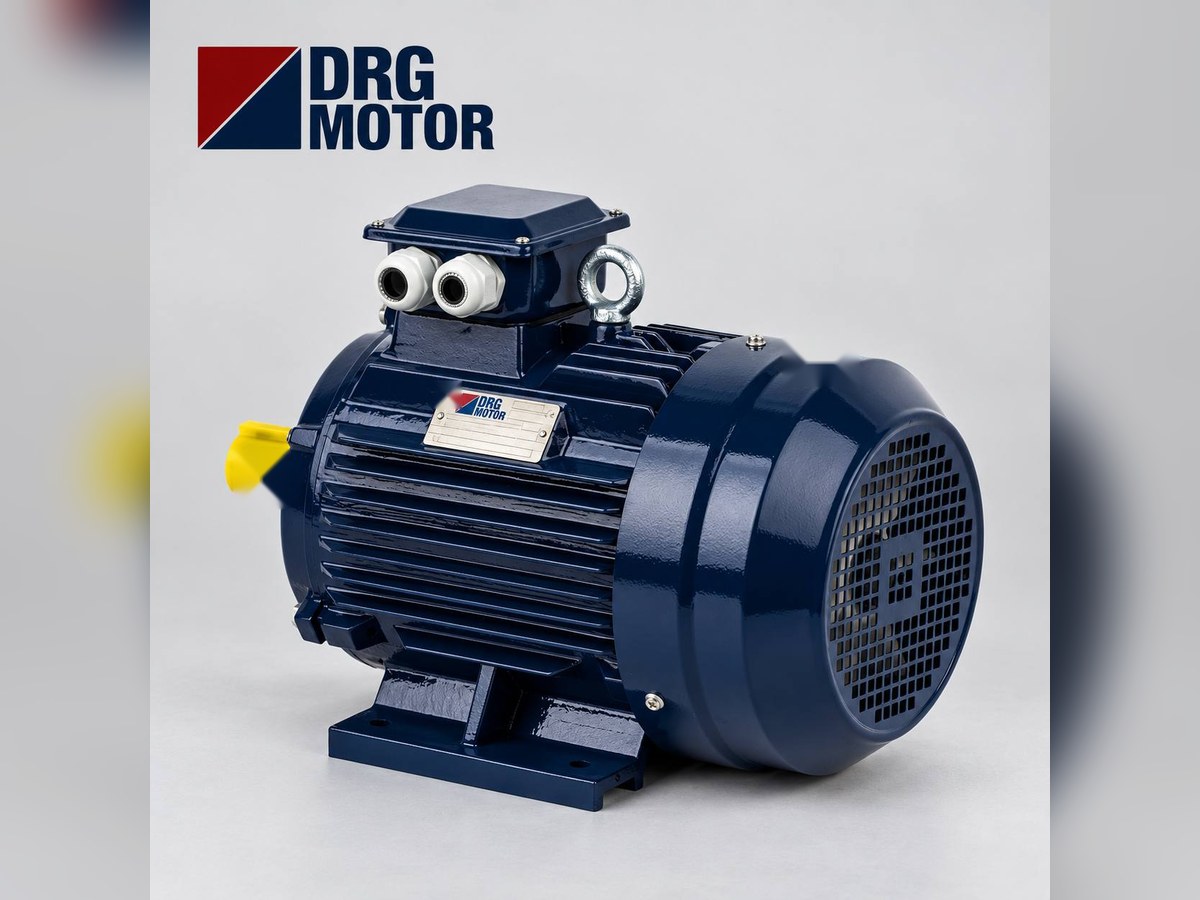
A marble ageing machine of the rotary drum type tumbles the stones loaded into it slowly with water and abrasive, breaks their edges, dulls the surface and gives each piece an antique look. The electric motor has a single job here: it turns the drum, through a gearbox and a chain or belt, at a speed far below what the motor itself runs at. Maker data sheets list 3–11 kW motors for rotary drum machines.
Let us state the scope first. DRG Motor is a manufacturer, supplier and seller of electric motors. We do not sell ageing machines, drums, gearboxes, chain sprockets, hydraulic units, water pump casings or drives (inverters); spindles and servo motors are not in our range either. We deal only with the three-phase induction motor that rotates the drum. The models are listed on Buy Electric Motors Online.
Ageing by tumbling: how the machine works
Small pieces cut from travertine, marble and limestone (pavers, kerbs, mosaic, wall cladding) are loaded into the drum. As the drum turns, the load climbs a little with the wall and then slides down under its own weight; the pieces rub against each other and the abrasive and lose their corners. Water binds the dust and carries the fine material away as slurry. The workshop running the machine sets time, speed and fill level according to the degree of wear wanted.
Rotary drum, vibratory bowl and brushing line
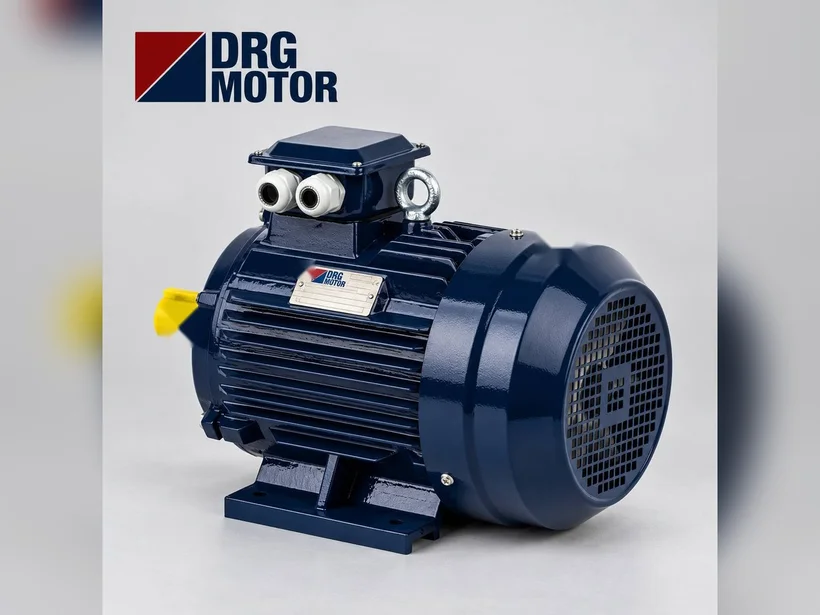
Three ageing methods are often named together. In a rotary drum the load turns about a horizontal axis and the drive is a standard motor plus gearbox; this page focuses on that type. In a vibratory bowl nothing rotates, the bowl is shaken, either by vibration motors or by an eccentric weight drive. A vibration motor belongs to a different product family from a standard motor, so keep the two apart; see our article Vibration Motors. Lines that age slabs with brush heads are another subject, covered on the Brushing, Bush Hammering and Surface Flaming Machines page.
What the drum load means for the motor
A drum is a heavy mass; with stone inside it can reach several tonnes, and it turns very slowly. For the motor this is a load where high torque meets low speed. The load slips from roughly the same point on every turn, so torque ripples gently around an average. No shock or sudden jam is expected, but lifting a full drum from standstill is the hardest moment in operation.
From motor to drum: the drive train
The motor runs at 1000 or 1500 rpm, whereas the drum, according to the data sheets, turns at 12.5 rpm or within 0–38 rpm. Bridging this gap takes a two-stage reduction. The right ratio follows from the drum speed and the motor’s rated speed; the gearbox output speed and torque calculator can be used for it.
Gearbox and chain sprocket
In the most common layout the motor drives a gearbox, and a small sprocket on the gearbox output turns the large girth gear or sprocket around the drum. A motor flanged to the gearbox is ordered as B5 or B35; with a separate coupling a foot-mounted B3 is used. The gearbox itself is not the subject of this page nor of our sales; the motor’s shaft diameter, key and flange are checked against the gearbox input dimensions.
Belt and pulley, driven rollers
Some drums sit on two pairs of rollers, one of which is driven. Here the motor is first belted to an intermediate shaft or gearbox. The belt softens the jolt at start and slips under overload, giving some protection; on the other hand, changing a pulley diameter changes the drum speed. Use the nameplate speed (for example 1465 rpm) in pulley calculations, not the synchronous speed.
How many kW does a marble ageing machine motor need?
A) What ageing machine makers list as motor power:
| Machine type / volume | Motor power | Single / total | Note |
|---|---|---|---|
| Rotary drum, 300 L, drum 0–38 rpm | 3 kW | Single motor | maker data sheet, small model |
| Rotary drum, 2 m³, drum 12.5 rpm | 11 kW | Total power | second maker, for blocks and pavers |
| Rotary drum, 4 m³ | 11 / 6 kW | Single drum motor | third maker; two values given in the sheet |
| Vibratory bowl, 200–1500 L | 3–11 kW | Total power | fourth maker; not a drum |
| Linear vibratory ageing unit, 1800 L | 2 × 9 kW | Total 18 kW | same maker; two vibration exciters |
| Linear vibratory ageing unit, parts up to 60 × 90 cm | 2 × 11 kW | Total 22 kW | fifth maker; vibration motors |
For rotary drum types the sheets point to roughly 3–11 kW, depending on the maker’s model and drum volume. Vibratory types reach 3 to 22 kW in total, but that power is usually split between two vibration exciters and has little in common with a drum drive. Even at the same volume the power can differ; stone type, fill level and drum speed all change the load.
B) Where DRG fits: the whole 3–11 kW band seen on rotary drums is covered by our 4- and 6-pole motors in cast iron and aluminium frames. Vibration motors used on vibratory bowls and linear vibratory units are not sold in our shop; for those, read the Vibration Motors page and write to us.
Click to see current electric motor prices and order nowSEE PRICES →
Starting full and load torque: a worked example
As the drum turns, the centre of gravity of the load shifts sideways from the axis. In a simplified approach the torque is load mass × gravity × this offset. The figures below are assumptions; real values come from the machine data sheet or the old motor’s nameplate.
Example: a drum with 2 tonnes of stone at 12.5 rpm
Take a 2000 kg load, a 0.35 m sideways shift of the centre of gravity and 0.90 overall efficiency for gearbox and chain:
| Step | Operation | Result | Meaning |
|---|---|---|---|
| 1 | 2000 × 9.81 × 0.35 | 6867 Nm | torque the load creates on the drum shaft |
| 2 | 6867 × 12.5 / 9550 | 8.99 kW | power at the drum shaft |
| 3 | 8.99 / 0.90 | 9.99 kW | with gearbox and chain losses added |
| 4 | next standard size | 11 kW | DRG-160M-4 |
| 5 | 1465 / 12.5 | 117.2 | overall reduction needed |
| 6 | 6867 / 117.2 / 0.90 | 65.1 Nm | torque needed at the motor shaft |
7.5 kW does not cover the 9.99 kW required, so 11 kW is chosen. The selected DRG-160M-4 has a rated torque of 71.7 Nm, above the 65.1 Nm needed.
Star-delta, soft starter or inverter?
The DRG-160M-4 starts with 2.2 times its rated torque, about 157.7 Nm on direct-on-line starting. In star connection torque drops to roughly one third, 52.6 Nm in this example, which is below the 65.1 Nm a full drum needs. In other words, a loaded drum may not start on star-delta. The options are to start the drum empty and fill it afterwards, to start direct-on-line, or to use an inverter that gives torque at start. A soft starter also lowers voltage and therefore torque; set it with care for a loaded start. Compare the methods with our Motor Starting Methods: Star-Delta tool.
Water, slurry and abrasive: protecting the motor
Motor position and splashing
Ageing is done wet; muddy water splashes from the drum mouth and the discharge chute. Our motors are IP55; even so, placing the motor at the far end from the discharge side and above floor level extends its life. During hose cleaning, water should not be aimed straight at the motor, and the terminal box cover and cable gland must be tight. Slurry caked on the cooling fins makes the motor run hot; washing it off regularly costs little and helps a lot.
Chain, gearbox and bearings
When abrasive slurry reaches the chain and sprocket, wear speeds up, the drive gets stiffer and motor current rises. If current creeps up over time, check chain tension, roller bearings and gearbox oil first; the motor is often not the cause. If the motor bearing is noisy or the frame overheats, the motor side is examined.
Information to prepare for motor selection
- A photo of the old motor nameplate: kW, speed, voltage, connection and frame size.
- Drum volume, the amount of stone per batch and drum speed.
- Drive layout: gearbox + chain, belt + rollers or direct gearbox.
- Mounting (B3, B5 or B35) plus shaft diameter, key and any flange size.
- Starting method and whether the drum starts full or empty.
- Distance of the motor from water and slurry.
With this data, power, speed, mounting and connection dimensions are compared with the machine builder’s documents. That comparison shows whether the motor fits; we do not give a blanket promise of fit.
DRG motors: models for drum drives
4- and 6-pole motors in the power sizes often used on geared drum drives (current at 400 V):
| Model | Power / speed | Frame · shaft D×E | Current 400 V |
|---|---|---|---|
| DRG-100L2-4 | 3 kW / 1450 rpm | 100L cast iron · 28×60 | 6.02 A |
| DRG-132S-4 | 5.5 kW / 1460 rpm | 132S cast iron · 38×80 | 10.7 A |
| DRG-160M-4 | 11 kW / 1465 rpm | 160M cast iron · 42×110 | 20.4 A |
| DRG-132M2-6 | 5.5 kW / 968 rpm | 132M cast iron · 38×80 | 12 A |
| DRG-160L-6 | 11 kW / 970 rpm | 160L cast iron · 42×110 | 22 A |
For drum duty you can pick a light aluminium motor up to 11 kW or a cast iron one, whose range starts at 0.55 and ends at 355 kW; each comes as 6-, 4- or 2-pole. Tell us whether the drum gearbox takes a footed B3, a flanged B5 or B14, a B34/B35 combination or a vertical layout. There is no 8-pole motor in the range, which is why the drum speed comes from the gearbox. The tabled sizes carry 400/690 V windings: delta on our 400 V grids.
Live price table
Current shop prices of our motors in the drum drive power range appear automatically below:
| Model | Power / speed | Frame · current 400 V | Price |
|---|---|---|---|
| DRG-100L2-44 HP | 3 kW · 1500 rpm | Cast iron 100L · 6.02 A | $203.84 (€182.05) Details & buy → |
| DRG-132M1-65.5 HP | 4 kW · 1000 rpm | Cast iron 132M · 8.99 A | $326.05 (€291.19) Details & buy → |
| DRG-112M-45.5 HP | 4 kW · 1500 rpm | Cast iron 112M · 7.95 A | $254.38 (€227.18) Details & buy → |
| DRG-132M2-67.5 HP | 5.5 kW · 1000 rpm | Cast iron 132M · 12 A | $423.04 (€377.80) Details & buy → |
| DRG-132S-47.5 HP | 5.5 kW · 1500 rpm | Cast iron 132S · 10.7 A | $342.01 (€305.44) Details & buy → |
| DRG-132M-410 HP | 7.5 kW · 1500 rpm | Cast iron 132M · 14.3 A | $394.89 (€352.66) Details & buy → |
| DRG-160L-615 HP | 11 kW · 1000 rpm | Cast iron 160L · 22 A | $668.92 (€597.39) Details & buy → |
| DRG-160M-415 HP | 11 kW · 1500 rpm | Cast iron 160M · 20.4 A | $568.76 (€507.94) Details & buy → |
DRG MOTOR motors are guaranteed against material and manufacturing defects for 2 years from the delivery date (warranty certificate).
Motors in this power range
- DRG-112M-4 – 4 kW – 1450 rpm – 112M cast iron
- DRG-132M-4 – 7.5 kW – 1460 rpm – 132M cast iron
- DRG-160M-4 – 11 kW – 1465 rpm – 160M cast iron
- DRG-132M1-6 – 4 kW – 968 rpm – 132M cast iron
- DRG-160L-6 – 11 kW – 970 rpm – 160L cast iron
Click to see current prices and order these motors nowSEE PRICES →
Browse the products, ask for a quote: compare motors for your ageing drum on Buy Electric Motors Online. Send the old nameplate and a photo of the drive layout via WhatsApp or reach us on +90 (542) 666 11 11.
Frequently asked questions
What speed should a stone tumbling machine motor have?
The drum speed comes from the gearbox; the motor is usually 4- or 6-pole. A 6-pole motor needs a smaller gearbox ratio. Which one to choose depends on the input speed and ratio of the existing gearbox; staying with the old motor’s speed is the safest path.
Why does the drum not start when it is full?
Star-delta or a soft starter set too low reduces starting torque. As in the example above, the star-step torque may not be enough to lift a loaded drum. A tight chain or a failing roller bearing also adds load.
Does a natural stone ageing machine need an inverter?
It is not mandatory; it helps if you want to change drum speed or start loaded. We do not sell inverters; our motors can run on a properly set drive.
Tumbling drum owners can reach us by dialling +90 (542) 666 11 11, writing to info@drgmotor.com or filling in our contact page. All marble ageing machine motor options are on Buy Electric Motors Online.


