 English
 Le français
 Türkçe

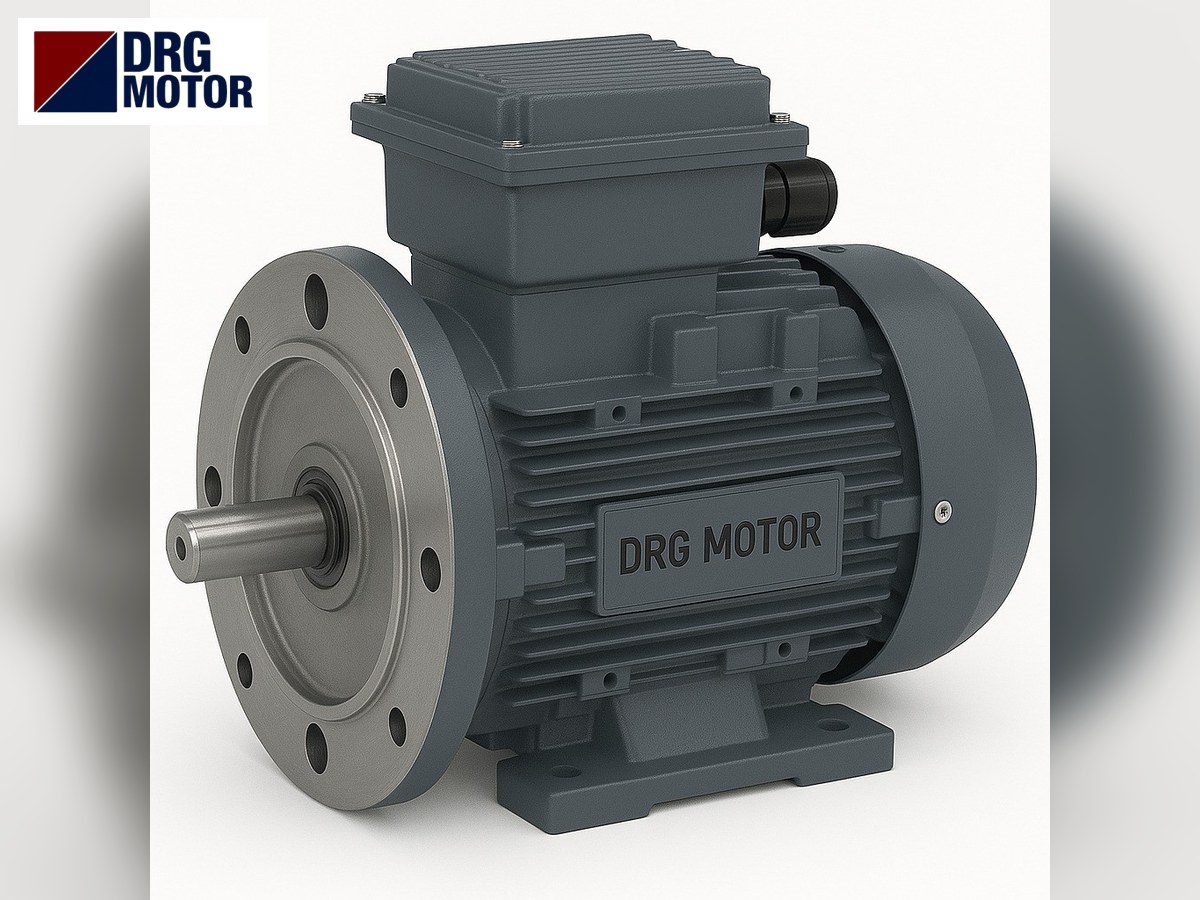
On a multi-spindle boring machine the electric motor turns the gear train inside the head; the gears share that single motor’s rotation among 21 or more spindles at 32 mm pitch, so dowel, shelf-pin and connector holes in a furniture panel are all drilled in one stroke. Maker catalogues mostly give 1.1–1.85 kW and 2,800–2,850 rpm for the head motor, which makes it a 2-pole induction motor. The movement that pushes the head into the panel comes, on most machines, from a pneumatic cylinder rather than from the motor.
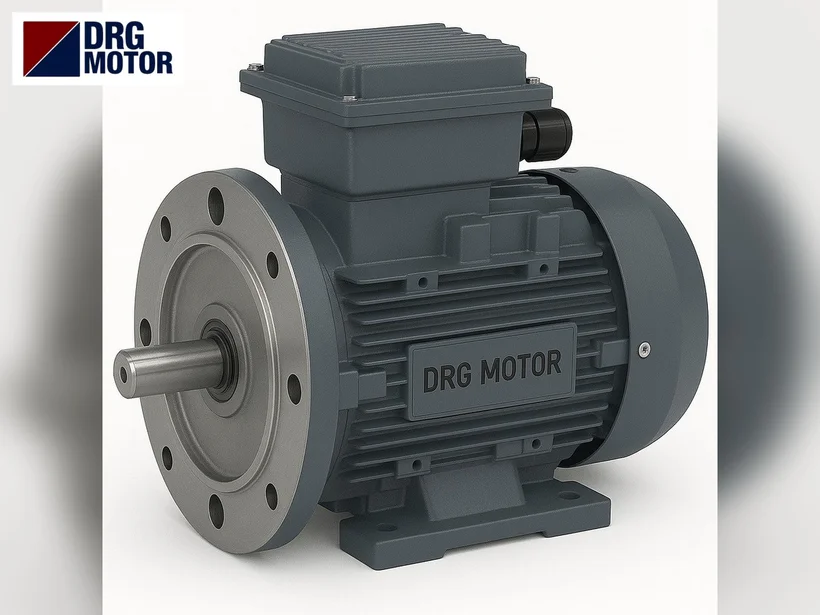
DRG Motor is a manufacturer, supplier and seller of electric motors. We do not sell boring machines or their head gear trains; reduction gearboxes, air or hydraulic units, inverters, electro-spindles and servo motors stay outside our offer as well. Our part is the three-phase motor that spins each head or runs the feed; the models are listed on Buy Electric Motors Online.
How a multi-boring machine is built and what the head motor does
A boring head is an aluminium or cast housing holding a row of gears; neighbouring spindles turn in opposite directions, so right-hand and left-hand drills are fitted alternately (usually marked red and black). The motor is attached at the back or top of the head and turns the first gear of the train. On most machines the head ratio is 1:1, so spindle speed is in practice motor speed.
Horizontal and vertical heads
The horizontal head bores dowel holes into the panel edge; vertical heads bore into the face from below or above. On single-head machines the same head tilts between 0 and 90° to do both jobs. On three-, four- or seven-head machines each head has its own motor and can be switched out separately from the control panel. On a vertical head the motor shaft points up or down; vertical operation requires the motor to be ordered for vertical mounting and the axial load to be confirmed by the machine maker.
Pneumatic feed and clamps
An air cylinder moves the head towards the panel and back, and pneumatic clamp pads hold the panel on the table. Data sheets quote a working pressure of 6–8 bar. The thrust is therefore the cylinder’s job; the motor only spins the drills. The compressor that makes the air is a separate motor; see our Compressor Motors category for it.
How many kW is a multi-boring machine motor? Catalogue values
A) Motor ratings from maker data sheets for multi-spindle and hinge boring machines:
| Machine layout | Motor power | Single / total · speed | Note |
|---|---|---|---|
| Single head, 21 spindles | 1.5 kW | single motor · 2,800 rpm | first maker, electronically set model |
| Single head, 21 spindles | 1.5 kW | single motor · 2,800 rpm | second maker, small model |
| Single head, 21 spindles, tilting horizontal-vertical | 1.85 kW | single motor · 2,800 rpm | third maker |
| Three heads (21+21+21) | 1.1 kW | motor power stated · 2,800 rpm | fourth maker |
| Three rows, 3×21 spindles | 1.5 kW | per head; total 4.5 kW · 2,840 rpm | fifth maker |
| 1 horizontal + 2 vertical heads | 1.5 kW horizontal; vertical 5.2 kW | horizontal single motor; vertical heads · 2,800 rpm | sixth maker |
| Six rows, 6×21 spindles | 9 kW | machine total · 2,840 rpm | seventh maker |
| Four heads, automatic belt feed | 7.1 kW | machine total | Turkish maker |
| Seven heads, automatic belt feed | 12 kW | machine total | Turkish maker, large model |
| Hinge cup boring | 1.1 kW | single motor · 2,850 rpm | Turkish maker |
Head motors on these borers run from about 1.1 to 1.85 kW each; multi-head and automatic feed machines reach 4.5 to 12 kW in total. A machine total adds feed belt, positioning and controls on top of the head motors, so it is never one motor’s rating. The more drills and the larger their diameter, the greater the share of load on the head motor.
B) Where DRG fits: 1.1 kW and 1.5 kW head motors match our 2-pole 80 and 90S frames, and 1.85 kW and above the 90L (2.2 kW). Our small 4-pole models suit belt feed and auxiliary drives. One detail matters: against the 2,800–2,850 rpm rated speed in the catalogues, our small 2-pole models are rated at 2,880–2,895 rpm, a difference of about two per cent that hardly changes drill cutting speed.
Click to see current electric motor prices and order nowSEE PRICES →
Worked example: drill peripheral speed and torque per spindle
Drill cutting speed follows v = π · d · n / 60. Below, the 2,895 rpm of the DRG-90S-2 is compared with the 2,840 rpm that appears often in catalogues:
| Drill diameter | Cutting speed, 2,895 rpm | Cutting speed, 2,840 rpm | Typical use |
|---|---|---|---|
| 5 mm | 0.76 m/s | 0.74 m/s | shelf pin, hinge screw |
| 8 mm | 1.21 m/s | 1.19 m/s | dowel |
| 15 mm | 2.27 m/s | 2.23 m/s | cam connector housing |
| 35 mm | 5.31 m/s | 5.20 m/s | hinge cup |
The second question is torque. Rated torque of the DRG-90S-2 is given as DRG-90S-2, 4.95 Nm. If all 21 spindles bore at once and losses are ignored, each gets roughly 0.24 Nm. In practice 21 holes are rarely drilled together, but in set-ups where a large hinge cup bit works alongside many dowel drills, motor current rises clearly. That is why the new motor should not be rated below the old nameplate.
Starting the head motor
The head motor starts unloaded; the drills spin clear of the panel before the cylinder feeds the head. Starting is therefore light and direct-on-line is enough at small ratings. If all heads of a multi-head machine are switched on together, starting currents add up; letting the heads come in a few seconds apart eases fuse selection. See our motor starting tool for the methods.
Shaft, flange and gear connection when replacing a head motor
On a boring head the motor mostly seats by its flange straight onto the head housing, and the shaft end drives the first gear through a key or a clamp. On some machines that shaft end is shorter than a standard IEC shaft or machined with a step; on others the motor flange is designed almost as part of the head housing. Such a motor cannot be swapped one-for-one with a standard frame and we have no equivalent for it. Remove the old motor first and measure shaft diameter, shaft length, key width, flange spigot and bolt circle; if they match the standard B5 or B14 table, the change is straightforward.
Items outside our range
Small bench boring and hinge machines often run on 230 V single-phase motors, which we do not carry. Servo and stepper motors driving the axes of CNC boring machines, high-speed electro-spindles and brake motors are also outside the range. If quick stopping is required, it is achieved by DC-injection electronic braking in the panel; we offer no mechanically braked motor. Tell us the machine model and we will point out where a standard three-phase motor still works on it.
Dust and chips
Boring leaves chips around the head and under the table; on machines without an extraction hose they pile up on the vertical head motor. Our IP55 motors are protected against dust, but if cooling fins are covered with chips the motor runs hot. For the extraction fan, see the Fan Motors category.
DRG motors for multi-boring machines
Suitable models from our range for head and feed drives (current at 400 V):
| Model | Power / speed | Frame · shaft D×E | Current 400 V |
|---|---|---|---|
| DRG-801-2 | 0.75 kW / 2880 rpm | 80 cast iron · 19×40 | 1.64 A |
| DRG-802-2 | 1.1 kW / 2880 rpm | 80 cast iron · 19×40 | 2.31 A |
| DRG-90S-2 | 1.5 kW / 2895 rpm | 90S cast iron · 24×50 | 3.06 A |
| DRG-90L-2 | 2.2 kW / 2895 rpm | 90L cast iron · 24×50 | 4.35 A |
| DRG-100L-2 | 3 kW / 2895 rpm | 100L cast iron · 28×60 | 5.71 A |
| DRG-801-4 | 0.55 kW / 1400 rpm | 80 cast iron · 19×40 | 1.31 A |
Boring heads mainly use 2-pole (3000 rpm class) motors, while belt or roller automatic feed usually has a small 4-pole motor with a gearbox. For boring heads the useful part of our range is the 80 to 100 frame sizes, available in aluminium or cast iron and in flange, foot or vertical mounting. An order goes faster with the plate data (kW, rpm, voltage, star or delta), the shaft and key size, the flange sizes and a note on how the motor sits on the head. Our team checks the figures against the boring machine’s papers before confirming; no fit is promised blind.
B5 flange dimensions
B5 values of frames matching boring head ratings (mm, from the DRG catalogue):
| Frame | Shaft D×E | Flange P / M / N | Hole S |
|---|---|---|---|
| 80 | 19×40 | 200 / 165 / 130 | 12 |
| 90S/90L | 24×50 | 200 / 165 / 130 | 12 |
| 100L/112M | 28×60 | 250 / 215 / 180 | 14.5 |
Flange outer diameter P must fit the recess in the head housing, and bolt circle M must line up with its tapped holes. If the sizes do not match, download our technical drawings and compare them with the head housing.
Live price table
Prices of our models in boring head and feed drive sizes are read live from the shop:
| Model | Power / speed | Frame · current 400 V | Price |
|---|---|---|---|
| DRG-712-40.5 HP | 0.37 kW · 1500 rpm | Aluminium 71 · 0.92 A | $76.76 (€68.55) Details & buy → |
| DRG-801-40.75 HP | 0.55 kW · 1500 rpm | Cast iron 80 · 1.31 A | $91.72 (€81.91) Details & buy → |
| DRG-801-21 HP | 0.75 kW · 3000 rpm | Cast iron 80 · 1.64 A | $87.39 (€78.04) Details & buy → |
| DRG-90S-41.5 HP | 1.1 kW · 1500 rpm | Cast iron 90S · 2.48 A | $124.09 (€110.82) Details & buy → |
| DRG-802-21.5 HP | 1.1 kW · 3000 rpm | Cast iron 80 · 2.31 A | $96.26 (€85.96) Details & buy → |
| DRG-90S-22 HP | 1.5 kW · 3000 rpm | Cast iron 90S · 3.06 A | $119.41 (€106.64) Details & buy → |
| DRG-90L-23 HP | 2.2 kW · 3000 rpm | Cast iron 90L · 4.35 A | $154.45 (€137.93) Details & buy → |
| DRG-100L-24 HP | 3 kW · 3000 rpm | Cast iron 100L · 5.71 A | $177.89 (€158.87) Details & buy → |
DRG MOTOR motors are guaranteed against material and manufacturing defects for 2 years from the delivery date (warranty certificate).
Motors in this power range
- DRG-802-2 – 1.1 kW – 2880 rpm – 80 cast iron
- DRG-90S-2 – 1.5 kW – 2895 rpm – 90S cast iron
- DRG-90L-2 – 2.2 kW – 2895 rpm – 90L cast iron
- DRG-100L-2 – 3 kW – 2895 rpm – 100L cast iron
- DRG-90S-4 – 1.1 kW – 1445 rpm – 90S cast iron
Click to see current prices and order these motors nowSEE PRICES →
Browse the products, ask for a quote: options for your boring machine are on Buy Electric Motors Online. A plate photo plus a picture of the bare shaft end, sent by WhatsApp, lets us answer quickly; by phone on +90 (542) 666 11 11, mention how many heads the machine has.
Frequently asked questions
What speed should a boring head motor have?
Almost every catalogue machine uses a 2-pole motor rated at 2,800–2,850 rpm. Fit a 4-pole motor and drill speed halves, with more tear-out at the hole edge.
Can a 2.2 kW motor replace 1.5 kW on a single-head machine?
Yes, if cable and protection are reselected; but the 90L frame is longer than the 90S, so measure whether there is room behind the head housing. Shaft and flange sizes are the same on both frames.
What does the price of a multi-boring machine motor depend on?
Rating, frame material and flange type set it; the table above shows current shop values.
For your boring line, reach us at +90 (542) 666 11 11, info@drgmotor.com or the contact page. For motor choice on the other machines in a furniture shop, see our woodworking motors article.


