 English
 Le français
 Türkçe

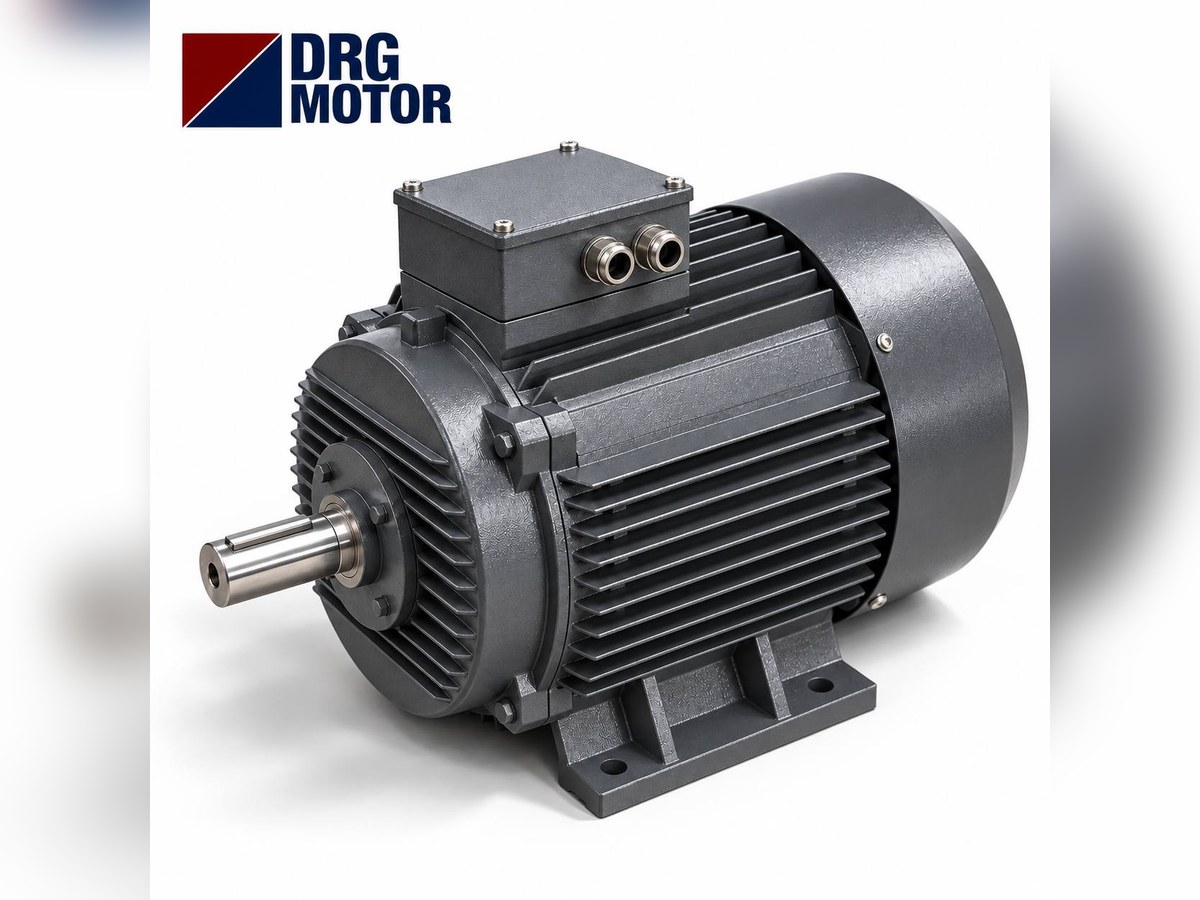
An irrigation pump motor is a standard three-phase induction motor that drives a surface pump in the field (a horizontal-shaft centrifugal or multistage pump) through a coupling or a close-coupled casing; its power follows from the flow and head the pump has to deliver. For example, a pump taking 90 m³/h from a pond and delivering it to a sprinkler line at 55 m head needs about 19.3 kW at the shaft if pump efficiency is taken as 0.70; with a 10% margin that is 21.2 kW, and a 22 kW 2-pole motor is chosen. The motor of a submersible pump lowered into a borehole is not covered here: it is a slim special motor that runs under water, and DRG does not sell submersible motors; we cover that subject in our article on deep well and submersible pump motors.
This page covers irrigation pumps whose motor stands outside the water: connection types, commercial power ranges, seasonal use and long cable runs. You can see suitable motors and current prices among the 120 models on the Buy Electric Motors Online page. For other pump applications: Pump Motors.
What is a surface irrigation pump and where does it sit?
The operating principle is centrifugal: the rotating impeller gives the water velocity and the volute turns it into pressure. The installation is horizontal: pump and motor sit on a frame at the edge of the water source or in a pump room. The purpose is agricultural irrigation; an "irrigation pump" is not a separate principle but a centrifugal pump used in the field.
A surface pump draws water from a pond, an irrigation canal, a tank or the top of a shallow well. The suction side has a physical limit: in one manufacturer's EN 733 close-coupled pump data sheet, manometric suction lift is limited to 7 m [1]. In deep wells where the water level drops below that limit a surface pump will not work; a submersible or vertical turbine pump is used there. That is why, in irrigation, the depth of the water source decides the pump type first and the motor comes after.
Common uses in the field:
- A pump in front of the filter group that feeds a drip line from a pond or canal.
- A high-pressure pump feeding sprinklers and hose-reel irrigation machines.
- A pump in greenhouses that supplies the fertigation unit and drip lines from a tank.
Which pump type, and how is the motor connected?
Three arrangements stand out in irrigation. The general picture of centrifugal, end-suction and multistage pump motors belongs to separate pages; here we cover only the differences in the field.
Single-stage centrifugal pump (high flow, medium pressure)
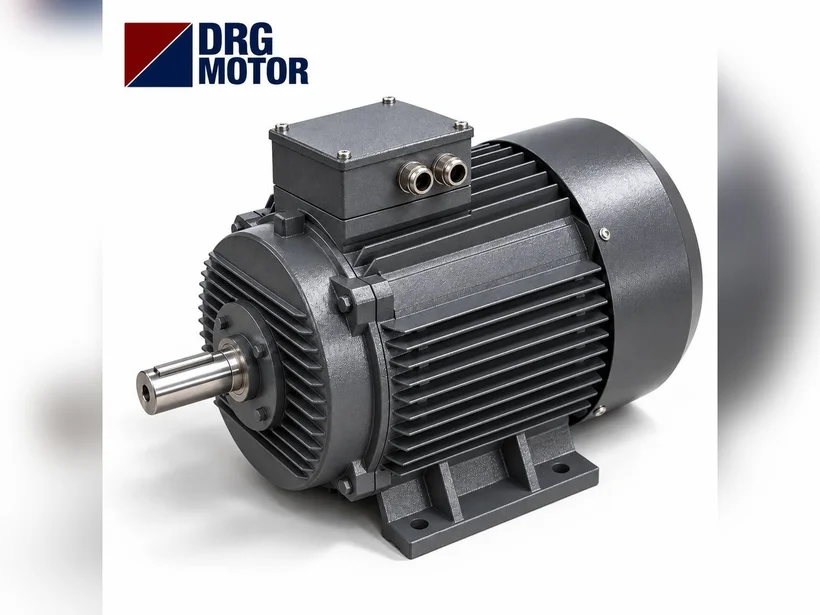
This is the most common type for drip and furrow irrigation. In the close-coupled version the impeller sits directly on the motor shaft; the motor is bolted to the pump casing by its flange and the shaft end follows the pump maker's dimensions. In the long-coupled version the pump stands on the frame with its own bearing housing and a foot-mounted (B3) standard motor is connected by a flexible coupling. In the coupled arrangement a motor of the same kW, speed and IEC frame can be fitted; with a close-coupled pump, check shaft and flange dimensions first.
Horizontal multistage pump (high pressure)
Impellers in series raise the pressure step by step. Long sprinkler lines, hose-reel machines and land at higher elevation need this pump. In one manufacturer's catalogue the horizontal multistage range is offered base-mounted and coupled, with tables matching it to standard enclosed motors [3]; the motor is again foot-mounted and coupled.
From tractor PTO to electric drive
Trailer-mounted tractor pumps are driven from the power take-off through a cardan shaft, and one manufacturer gives up to 120 kW in this range [2]. When a power line reaches the field, some of these pumps are converted to an electric motor. Watch two points: the pump's design speed (because of the gearbox in between, PTO speed and pump shaft speed may not be the same) and the element that will connect the motor shaft to the pump. Read the pump shaft speed from the pump label; if the motor speed matches it, use a coupling, otherwise a belt and pulley drive is needed. Connecting the cardan shaft straight to the motor shaft is not correct.
How many kW does an irrigation pump motor need?
A) Motor power seen in commercial pump models
| Model group / capacity | Motor power | Single / total | Source |
|---|---|---|---|
| Maker A, close-coupled, smallest | 1.5 kW | Single motor | [1] |
| Maker A, 65/160 casing, mid model | 15 kW | Single motor | [1] |
| Maker A, largest model | 75 kW | Single motor | [1] |
| Maker B, multistage, smallest | 3 kW (4-pole) | Single motor | [3] |
| Maker B, multistage, largest | 132 kW (4-pole) | Single motor | [3] |
| Maker B, single-stage, upper limit | 132 kW | Single motor | [2] |
In this pump group, motor options of about 1.5–132 kW are seen depending on the manufacturer's model and capacity [1][2][3]. Every row in the table has a single motor; an irrigation pump has no auxiliary motors. Even within one casing size, power changes with impeller diameter: on the 65/160 casing in the table the manufacturer offers three impeller-motor options of 9.2, 11 and 15 kW [1]. As flow and head grow together, power rises quickly; this is why the motor power cannot be given before the pump selection is finished.
A field-specific warning: in a centrifugal pump the motor load rises with flow. If more valves or sprinkler heads are opened during the season, head drops, flow rises and the motor can go above its nameplate power. Choosing the motor for the pump curve's power at maximum flow closes this risk. The speed-power relationship is explained in our affinity laws article.
B) Motors with a match in the DRG range
The whole 1.5–132 kW range above falls within DRG's 0.25–355 kW range, and the 1500 and 3000 rpm speeds that irrigation pumps need are in the range. The parts that do not overlap are about motor type, not power: borehole submersible motors, the own drives of diesel or tractor-driven pumps and the special-shaft motors of close-coupled pumps made by the pump manufacturer are outside DRG's scope.
Click to see current electric motor prices and order nowSEE PRICES →
Worked example and checklist for motor selection
The power the pump needs at the shaft is found from P = ρ·g·Q·H / η_pump (ρ kg/m³, Q m³/s, H m, P W). The steps of the example in the introduction:
- Flow: 90 m³/h = 0.025 m³/s.
- Head: elevation difference, pipe and filter losses and the pressure the sprinkler head needs, 55 m in total.
- Shaft power: 1000 × 9.81 × 0.025 × 55 / 0.70 ≈ 19,270 W, i.e. about 19.3 kW.
- With a 10% margin 21.2 kW; standard motor 22 kW.
If the pump is designed for 2 poles, DRG-180M-2 (22 kW, 2955 rpm, 38.5 A at 400 V) fits; if designed for 4 poles, DRG-180L-4 (22 kW, 1470 rpm, 39.7 A at 400 V) fits. Do not depart from the speed on the pump label. You can do the same calculation with your own values in the Pump & Fan Motor Power calculator.
Before asking for a motor for an irrigation pump, gather the following:
- Pump label: flow, head, speed; close-coupled or long-coupled.
- Old motor's nameplate: kW, rpm, IEC frame, mounting (B3 foot, B5 or B35 flange), shaft diameter.
- Water source: pond, canal or tank; how far the water level falls at the end of the season.
- Irrigation method: drip, sprinkler, hose-reel machine; the maximum number of lines open at once.
- Cable length between transformer and pump and the existing cable cross-section.
- Starting: direct-on-line, star-delta, soft starter or inverter.
- Where the motor will stand: open field, under a shelter or in a pump room.
Seasonal operation and voltage drop on long cable runs
An irrigation motor works hard for a few months and stands idle the rest of the year; its winding takes in moisture and condensation forms in the terminal box. At the start of the season, before running the motor, have an authorised electrician measure the winding insulation, turn the shaft by hand to see that it rotates freely, tighten the terminal connections and on first start compare the direction of rotation with the arrow on the pump.
In the field the transformer is often hundreds of metres from the pump. Voltage lost on the cable makes the motor draw the same power with higher current and makes starting harder. For copper cable the resistive effect is approximately ΔU ≈ √3 · I · (ρ_Cu · L / S) · cos φ (ρ_Cu = 0.0178 Ω·mm²/m). For the 22 kW motor in the example, with 38.5 A at 400 V and cos φ = 0.89 on a 300 m run, the results are:
| Cable size | Voltage drop | Ratio (400 V) | Note |
|---|---|---|---|
| 16 mm² | 19.8 V | 5.0% | High |
| 25 mm² | 12.7 V | 3.2% | Borderline |
| 35 mm² | 9.1 V | 2.3% | More comfortable |
At start, current and drop grow several times; for DRG-180M-2 the starting current ratio is 8.2. On a long line a large motor started direct-on-line struggles to start. This motor has a 400/690 V winding, so it suits star-delta starting on a 400 V network; see the star-delta starting page for details and the motor cable size calculator to find the cross-section for your own line. The acceptable drop is set by the project and the distribution company's conditions.
Matching DRG motors to irrigation pumps
DRG Motor is a manufacturer, supplier and seller of electric motors. Our range covers 0.25–11 kW in aluminium frames and 0.55–355 kW in cast iron; 1000, 1500 and 3000 rpm; 3-phase, 230/400 V or 400/690 V; mounting B3, B5, B14 and B35 (with an order note). For long-coupled surface pumps a foot-mounted B3 motor is the direct match; for close-coupled pumps a B5 or B35 motor is considered after the flange and shaft dimensions are confirmed. Example models for powers often seen in irrigation:
| Model | Power / speed | Frame | Current 400 V |
|---|---|---|---|
| DRG-112M-2 | 4 kW / 2905 rpm | 112M cast iron | 7.45 A |
| DRG-132S1-2 | 5.5 kW / 2930 rpm | 132S cast iron | 10.1 A |
| DRG-160M1-2 | 11 kW / 2945 rpm | 160M cast iron | 19.6 A |
| DRG-180M-2 | 22 kW / 2955 rpm | 180M cast iron | 38.5 A |
| DRG-200L1-2 | 30 kW / 2960 rpm | 200L cast iron | 52.1 A |
| DRG-160L-4 | 15 kW / 1465 rpm | 160L cast iron | 27.3 A |
| DRG-200L-4 | 30 kW / 1475 rpm | 200L cast iron | 53.8 A |
DRG MOTOR motors are guaranteed against material and manufacturing defects for 2 years from the delivery date (warranty certificate).
| Model | Power / speed | Frame · current 400 V | Price |
|---|---|---|---|
| DRG-112M-25.5 HP | 4 kW · 3000 rpm | Cast iron 112M · 7.45 A | $225.65 (€201.52) Details & buy → |
| DRG-132S1-27.5 HP | 5.5 kW · 3000 rpm | Cast iron 132S · 10.1 A | $338.72 (€302.50) Details & buy → |
| DRG-160M1-215 HP | 11 kW · 3000 rpm | Cast iron 160M · 19.6 A | $527.95 (€471.49) Details & buy → |
| DRG-160L-420 HP | 15 kW · 1500 rpm | Cast iron 160L · 27.3 A | $678.13 (€605.61) Details & buy → |
| DRG-160L-225 HP | 18.5 kW · 3000 rpm | Cast iron 160L · 32.5 A | $714.00 (€637.65) Details & buy → |
| DRG-180M-230 HP | 22 kW · 3000 rpm | Cast iron 180M · 38.5 A | $857.53 (€765.83) Details & buy → |
| DRG-200L-440 HP | 30 kW · 1500 rpm | Cast iron 200L · 53.8 A | $1,235.00 (€1,102.93) Details & buy → |
| DRG-200L1-240 HP | 30 kW · 3000 rpm | Cast iron 200L · 52.1 A | $1,273.02 (€1,136.88) Details & buy → |
| DRG-225M-260 HP | 45 kW · 3000 rpm | Cast iron 225M · 76.8 A | $1,761.85 (€1,573.44) Details & buy → |
DRG motors for irrigation pumps
- DRG-132S1-2 – 5.5 kW – 2930 rpm – 132S cast iron
- DRG-160M1-2 – 11 kW – 2945 rpm – 160M cast iron
- DRG-180M-2 – 22 kW – 2955 rpm – 180M cast iron
- DRG-200L1-2 – 30 kW – 2960 rpm – 200L cast iron
- DRG-160L-4 – 15 kW – 1465 rpm – 160L cast iron
- DRG-200L-4 – 30 kW – 1475 rpm – 200L cast iron
Click to see current prices and order these motors nowSEE PRICES →
Irrigation pump motor: FAQ
How many kW motor does an irrigation pump need?
The pump's flow and head decide. A pump delivering 90 m³/h at 55 m needs about 19.3 kW at the shaft and runs with a 22 kW motor; commercial surface pumps use motors from 1.5 kW up to 132 kW.
Can a standard motor replace the burnt motor of a submersible pump?
No. A borehole submersible motor is a special motor built to run under water; a standard dry-type motor cannot go into water. DRG does not sell submersible motors; it supplies motors only for surface pumps standing outside the water.
Can I convert a tractor-driven irrigation pump to an electric motor?
Often yes, but you need to read the pump shaft speed from the label, choose the motor accordingly and connect it with a coupling or a belt. Transformer capacity and the cable line should also be checked beforehand.
Why does a remote irrigation motor keep tripping its overload relay?
There are two common reasons: voltage drop due to a long, thin cable, and the pump sliding to high flow when more lines are opened. First have the voltage and current measured at the motor terminals, then check the valve arrangement.
Send us the pump label, the motor nameplate and the cable length, and we will confirm the right DRG model together. Phone +90 (542) 666 11 11, e-mail [email protected], contact page. For all models and current prices, visit Buy Electric Motors Online.
Sources
- Pedrollo – F, Centrifugal pumps standardized according to EN733, 50 Hz (veri föyü) – EN 733 close-coupled range, 1.5–75 kW; rows F 32/160C, F 65/160A, F 100/250A; irrigation listed as use; suction lift 7 m.
- Caprari – Products overview – upper limits: horizontal single-stage pumps 132 kW, trailer-mounted tractor pumps 120 kW, SAE-flanged pumps for diesel engines 150 kW.
- Caprari – MEC-MR, Multistage pumps with horizontal shaft (katalog) – base-mounted, coupled selection tables: standard motors from 3 kW (100L) to 132 kW (315M) at 4 poles and up to 110 kW (315S) at 2 poles.


