 English
 Le français
 Türkçe

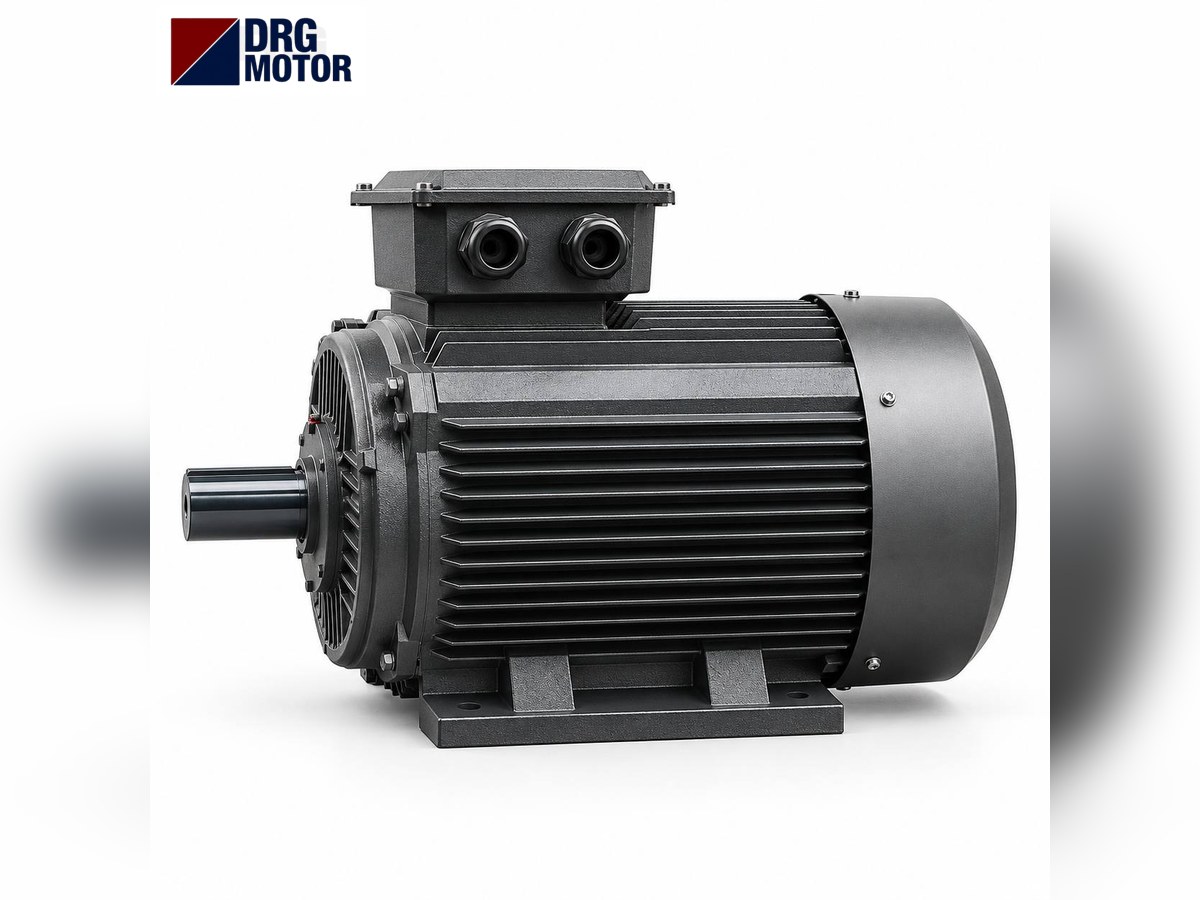
A fire pump motor is the three-phase motor that drives the electric main pump feeding the sprinkler and hose reel network; in commercial sets this motor is mostly between 11 kW and 315 kW, and it is sized not on the pump's duty point but on the highest power the pump can draw along its curve [1][2]. In a fire set the motor is never assessed on its own: the set must be approved or listed to the relevant standard (EN 12845 in Europe, NFPA 20 on US-based projects), and DRG motors carry no approval certificate in this scope.
This page explains the role of the three pumps in a fire set (electric main, diesel standby, jockey), how the main pump motor rating is determined, which motor ratings appear in commercial sets, and when a DRG motor can be supplied. You can see standard motors and current prices among the 120 models on Buy Electric Motors Online. Overview: Pump Motors.
What is a fire pump set and which pumps does it contain?
Fire pump is the name of an application. By operating principle the main pump is a centrifugal pump; by casing it is mostly an EN 733 end-suction pump, or a split case pump for large flows, coupled to its motor on a baseplate. The typical arrangement described in two manufacturers' catalogues is [1][2]:
- Jockey pump: A small pump, usually vertical multistage, that makes up small leaks and keeps network pressure at setpoint. It prevents needless starts of the main pump; it starts at a low pressure value and stops at a high one.
- Electric main pump: Starts when a sprinkler opens and pressure keeps falling, and delivers the system design flow.
- Standby pump: Takes over if the main pump fails to start or stops. Main and standby pumps are not fed from the same source: either both are electric pumps on separate supplies, or one is electric and the other diesel-driven.
What sets this system apart from a booster set is not the pressure boosting itself but the rules: the pump can only be stopped manually, the set does not stop even if the motor overheats and only signals a fault [1]; pump, motor and controller are designed as an approved set.
Where is it used?
- Sprinkler systems in factories, warehouses and logistics centres.
- Hose reel and sprinkler lines in shopping centres, hotels, hospitals and tall buildings.
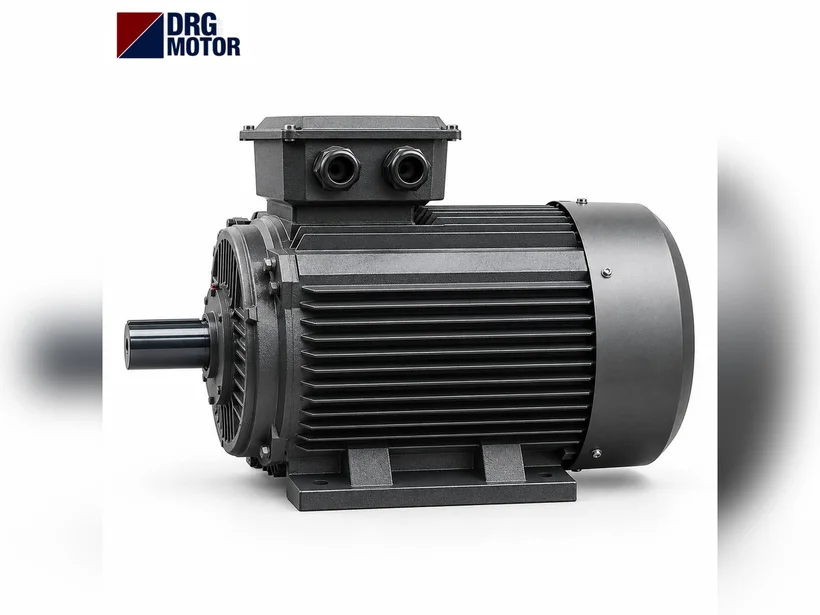
Approval and listing: where can a DRG motor be used?
Fire pump sets are required to be approved or listed to the relevant standards (e.g. EN 12845, NFPA 20). For NFPA 20, the source states that approved pumps meet requirements on flow vs. pressure, closed-valve pressure and motor power rating, and that the controller must be listed or approved by bodies such as UL and FM; the same catalogue notes that NEMA motors are used for NFPA compliance [2]. In EN 12845 sets the main pump motors are standard motors built to IEC 60034 [1].
DRG motors have no approval or listing certificate in this scope (EN 12845, NFPA 20, UL or FM). Therefore:
- Do not replace the motor of an approved or listed fire set with a DRG motor without the set manufacturer's approval; the set approval may be voided.
- A DRG motor may be offered for applications where no approval is required (for example in-plant water transfer outside the standard, test and flushing lines) or for motor supply within the set manufacturer's own approval process.
- According to the source, the jockey pump is not subject to specific NFPA requirements [2]; even so, motor replacement should be confirmed with the set manufacturer and the authority.
Our article on fire pump motor supply covers general motor features; this page focuses on set layout and power selection.
Main pump motor power: the curve rule and commercial sets
Why is the motor not sized on the duty point?
On an industrial pump the motor is chosen by adding a small margin to the power at the duty point. A fire pump is different: the number of sprinklers that open in a fire is unknown, and the pump can move to the right of its curve, to a larger flow. On a centrifugal pump shaft power rises with flow. The rules therefore require the motor to cover the highest power along the curve.
- On the EN 12845 side, a manufacturer's catalogue shows that, under the insurer body's rule, motor power is read at the point on the curve corresponding to a given NPSH value, and that excess power above the duty-point need is required [1].
- On the NFPA 20 side, motor current must not exceed full-load current times the service factor under any pump load; the manufacturer determines the maximum power at the point where power no longer rises with flow [2].
The same logic applies to speed. In the source, the small main pump comes with a 2-pole motor at about 2930–2950 rpm and the large main pump with a 4-pole motor at about 1480–1490 rpm [1]. Fitting a motor with a different speed from the pump's design speed invalidates the approved curve.
A) Motor power in fire pump sets on the market
| Model group / capacity | Motor power | Single / total | Source |
|---|---|---|---|
| Maker A, EN 12845, smallest model | 11–22 kW, 2-pole | Main pump, one motor | [1] |
| Maker A, EN 12845, largest model | 110–250 kW, 4-pole | Main pump, one motor | [1] |
| Maker A, NFPA 20 electric sets | 15–315 kW | Main pump, one motor | [2] |
| Maker B, EN 12845 compact set | 160 kW, 2980 rpm | Main pump, one motor | [3] |
| Maker A, jockey pump controller | 1.5–4 kW | Auxiliary pump | [1] |
In this equipment group, motor options of roughly 11–315 kW for the electric main pump are seen depending on the manufacturer's model and capacity [1][2]; the jockey pump motor is separate and small [1]. Within one pump model the motor grows with impeller diameter: the smallest model in the source has 11, 15, 18.5 and 22 kW steps by impeller size [1]. Power grows as flow (m³/h) and head rise. The set total is not main + standby + jockey added together; main and standby pumps do not run together, one replaces the other.
B) Power match within the DRG range
The part of range A that overlaps DRG's 0.25–355 kW, 1000/1500/3000 rpm range is 11–315 kW; jockey pump motors (1.5–4 kW) are within the range too. But this is only a power and speed match: replacing a motor in an approved or listed set requires the set manufacturer's approval, and NFPA 20 sets requiring NEMA motors, as well as the drive of the diesel standby pump, are outside the DRG range.
Click to see current electric motor prices and order nowSEE PRICES →
Worked example: reading motor power from the curve
Shaft power at the duty point is P = ρ·g·Q·H / η_pump (Q m³/s, H m, ρ kg/m³, g 9.81 m/s²; result in W). Example: the design point of a warehouse sprinkler system is 150 m³/h at 80 m head. With an assumed pump efficiency of 0.72, shaft power at the duty point is P = 1000 × 9.81 × (150/3600) × 80 / 0.72 ≈ 45.4 kW.
On a fire pump, however, the decision comes from the pump maker's power curve. If the power read on the same pump's curve at the point required by the standard is 51 kW, the motor stays at 55 kW; if it reads 57 kW, the motor moves up to 75 kW. A motor chosen on the duty point without reading the curve may be overloaded when many sprinklers open in a fire; in a fire set the pump is not stopped even if the motor overheats [1]. Power selection is therefore set by the pump maker's approved curve and the relevant rule of the standard. You can check your duty point with the Pump & Fan Motor Power calculator; the final value comes from the curve.
| Model | Power / speed | Frame · current 400 V | Price |
|---|---|---|---|
| DRG-160M1-215 HP | 11 kW · 3000 rpm | Cast iron 160M · 19.6 A | $527.95 (€471.49) Details & buy → |
| DRG-160M2-220 HP | 15 kW · 3000 rpm | Cast iron 160M · 26.5 A | $570.23 (€509.25) Details & buy → |
| DRG-180M-230 HP | 22 kW · 3000 rpm | Cast iron 180M · 38.5 A | $857.53 (€765.83) Details & buy → |
| DRG-200L1-240 HP | 30 kW · 3000 rpm | Cast iron 200L · 52.1 A | $1,273.02 (€1,136.88) Details & buy → |
| DRG-225M-260 HP | 45 kW · 3000 rpm | Cast iron 225M · 76.8 A | $1,761.85 (€1,573.44) Details & buy → |
| DRG-250M-275 HP | 55 kW · 3000 rpm | Cast iron 250M · 93.5 A | $2,180.99 (€1,947.76) Details & buy → |
| DRG-280S-2100 HP | 75 kW · 3000 rpm | Cast iron 280S · 127 A | $2,883.93 (€2,575.53) Details & buy → |
| DRG-280M-4125 HP | 90 kW · 1500 rpm | Cast iron 280M · 155 A | $3,268.56 (€2,919.03) Details & buy → |
| DRG-315S-4150 HP | 110 kW · 1500 rpm | Cast iron 315S · 187 A | $4,863.00 (€4,342.97) Details & buy → |
| DRG-315M-4180 HP | 132 kW · 1500 rpm | Cast iron 315M · 224 A | $5,621.72 (€5,020.55) Details & buy → |
Data needed for motor selection and starting
Flow and pressure come from the approved pump; the motor contributes only shaft power at the design speed. If a motor is requested for a fire set, the following is needed:
- The standard the set was built to and its approval/listing status; the set manufacturer's written approval for motor replacement.
- Pump nameplate and power curve: design flow, head, maximum power on the curve.
- Old motor nameplate: kW, speed, IEC frame, voltage, shaft and foot dimensions.
- Starting method: direct-on-line, star-delta or autotransformer; controller type.
- Power supply: separate sources for main and standby pumps, voltage drop and cable size.
There are two sourced examples on starting. One manufacturer's EN 12845 set controller starts direct-on-line up to 22 kW and star-delta above [3]. Another manufacturer offers fire pump controllers with star-delta or direct-on-line/autotransformer starting, and notes two cables to the motor for star-delta and one for direct-on-line [1]. If star-delta starting is used on a 400 V supply, the winding must be 400/690 V; in the DRG range motors of 4 kW and above are at this voltage. Details: star-delta starting. Wiring must be done by a qualified electrician.
Matching with DRG motors
DRG Motor is a manufacturer, supplier and seller of electric motors. Our range covers 0.25–11 kW in aluminium frames and 0.55–355 kW in cast iron; 1000, 1500 and 3000 rpm; 3-phase, 230/400 V or 400/690 V; mounting B3, B5, B14 and B35 (specified with the order). The table below shows 2-pole models matching ratings common on fire pump main pumps, as a power and speed match only; these motors have no EN 12845, NFPA 20, UL or FM approval.
| Model | Power / speed | Frame | Current 400 V |
|---|---|---|---|
| DRG-180M-2 | 22 kW – 2955 rpm | 180M cast iron | 38.5 A |
| DRG-200L1-2 | 30 kW – 2960 rpm | 200L cast iron | 52.1 A |
| DRG-225M-2 | 45 kW – 2965 rpm | 225M cast iron | 76.8 A |
| DRG-250M-2 | 55 kW – 2970 rpm | 250M cast iron | 93.5 A |
| DRG-280S-2 | 75 kW – 2975 rpm | 280S cast iron | 127 A |
For the 55 kW need in the example, the power and speed match is DRG-250M-2 (2970 rpm, 93.5 A at 400 V); for 75 kW, DRG-280S-2 (127 A at 400 V). DRG MOTOR motors are guaranteed against material and manufacturing defects for 2 years from the delivery date (warranty certificate).
DRG motors with a power match for fire pumps
- DRG-160M1-2 – 11 kW – 2945 rpm – 160M cast iron
- DRG-180M-2 – 22 kW – 2955 rpm – 180M cast iron
- DRG-225M-2 – 45 kW – 2965 rpm – 225M cast iron
- DRG-250M-2 – 55 kW – 2970 rpm – 250M cast iron
- DRG-280S-2 – 75 kW – 2975 rpm – 280S cast iron
- DRG-315S-4 – 110 kW – 1488 rpm – 315S cast iron
Click to see current prices and order these motors nowSEE PRICES →
Fire pump motor: frequently asked questions
What is a jockey pump and what kW is its motor?
A jockey pump is a small pump that makes up small leaks and holds network pressure; it prevents needless starts of the main pump. In one manufacturer's controllers the jockey pump motor is 1.5–4 kW.
When a fire pump motor burns out, can any three-phase motor be fitted?
Not on an approved or listed set; replacing the motor without the set manufacturer's approval may void the set approval. Talk to the set manufacturer and the authority first.
Why is a fire pump motor sized above the duty point?
The number of sprinklers that open in a fire is unknown and the pump may move to a larger flow; centrifugal pump power rises with flow. The rules require the motor to cover the highest power along the curve.
Why is there a diesel engine in a fire pump set?
Main and standby pumps are not fed from the same source. So that water can still be pumped during a power cut, the standby pump is often diesel-driven.
Send us the set standard, the pump curve and the old motor's nameplate; we will settle on a suitable DRG model for non-approval applications or for the set manufacturer's approval process. Phone +90 (542) 666 11 11, e-mail [email protected], contact page. For all models and current prices, see Buy Electric Motors Online.
Sources
- Grundfos – Fire NKF Data Booklet (EN 12845 / VdS) – one jockey + two fire pumps arrangement; smallest model 11–22 kW (2-pole, ~2930–2950 rpm), largest model 110–250 kW (4-pole, ~1480–1490 rpm); motor sized with excess power over the curve; jockey pump controller 1.5–4 kW; star-delta and direct-on-line cable note.
- Grundfos – Fire DNF, Fire HSEF Data Booklet (NFPA 20) – electrical NFPA 20 systems with 15–315 kW motors; motor current must not exceed full-load current times service factor; listed/approved pump and controller requirement; jockey pump not subject to specific NFPA requirements; NEMA motor note for NFPA compliance.
- Wilo – SiFire Easy 80/315-318/160EJ ürün sayfası – EN 12845:2015 + A1:2019 compact set: EN 733 main pump + vertical multistage jockey pump; main motor 160 kW, 2980 rpm; its own controller starts direct-on-line up to 22 kW and star-delta above.


