 English
 Le français
 Türkçe

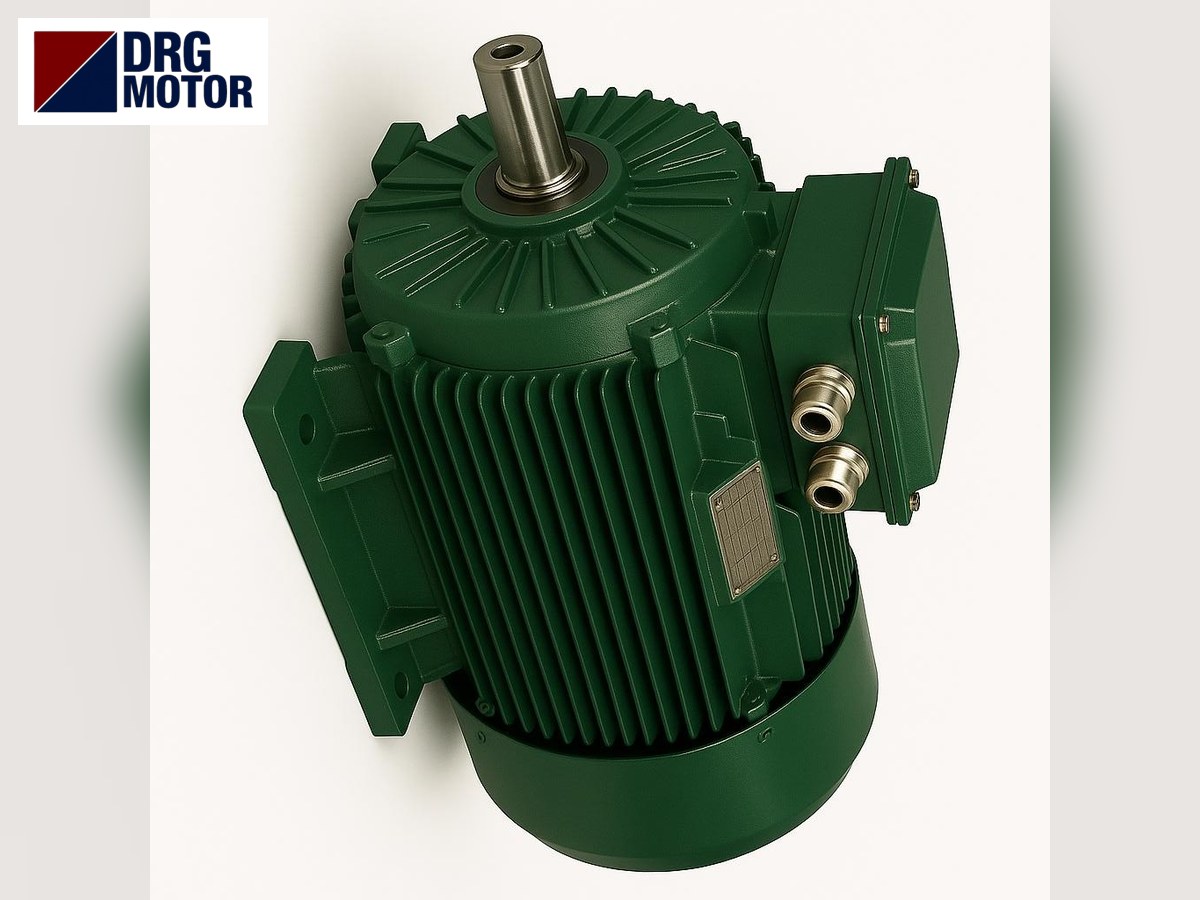
At a brickworks or tile plant, the clay mixer is a long trough with knives on two parallel shafts that wets the crushed and screened earth with water or steam and kneads it; in the filter type the clay is finally pushed by an auger through a perforated grid that holds back roots and stones. The electric motor turns both shafts at a few dozen revolutions per minute through a large pulley, belts and a gearbox. Maker catalogues list a single main motor of 11–110 kW on open mixers and 37–250 kW on mixer-extruders and filter mixers.
DRG Motor is a manufacturer, supplier and seller of electric motors. We do not sell the mixer, the knives, the grid, the gearbox or the pneumatic clutch; the hydraulic unit that changes the grid, inverters, dies and grinding balls are not ours either. Our share is the three-phase induction main motor turning the shafts and, where present, the small motor driving the hydraulic pump; the models are on the Buy Electric Motors Online page. If you are looking for feed, grain or concrete mixers, this page does not cover them; it deals only with clay and brick body.
Three mixer types in clay preparation
In a clay line the mixer stands after the screen and before the de-airing extruder. Its job is to bring dry and plastic clays, additives and cutting scrap to the same moisture. All three types come from the same twin-shaft body; the difference lies in what sits at the end of the trough.
Open double-shaft mixer: water and steam
In an open trough two counter-rotating shafts push the clay forward with knives whose angle can be adjusted. A water spray line is standard; in cold weather or with hard clay, steam is added to soften it. Catalogues show a belt and gearbox drive and shaft speeds of 15–30 rpm. On the open type the motor load swings with clay moisture and feed rate.
Knife mixer and mixer-extruder
A compression zone is added at the end of the trough: interlaced augers on the two shaft ends push the clay through a conical mouth, and star-shaped combs cut the column that comes out. Here the clay is kneaded and compressed, so for the same trough length the motor is clearly larger than on an open mixer.
Filter mixer: forcing clay through a grid
A perforated plate or bar grid is placed in front of the compression zone. As the clay passes, roots, bark and hard lumps stay behind, which reduces die blockages at the extruder. In one catalogue two grids sit on a hydraulic frame: as a grid fills, the machine draws more power, and when the system detects it, it shifts to the clean grid without stopping production. On a filter mixer the motor current is therefore also a measuring signal.
How many kW does a mixer motor need? Catalogue values
A) What clay mixer builders publish for the main drive:
| Machine / size | Motor power | Single / total | Note |
|---|---|---|---|
| Open double-shaft mixer, 8–10 t/h | 11 kW | single motor | first maker, smallest model |
| Open double-shaft mixer, 20–30 t/h | 18–26 kW | single motor | first maker |
| Open double-shaft mixer, 70–100 t/h | 75 kW | single motor | first maker, largest model |
| Double-shaft mixer, 3,600 mm trough | 37 kW | single motor | second maker |
| Double-shaft mixer, 4,500 mm trough | 90/110 kW | single motor, two options | second maker |
| Mixer-extruder, Ø400 mm auger | 37/45 kW | single motor | second maker |
| Mixer-extruder, Ø600 mm auger | 132 kW | single motor | second maker |
| Filter mixer, Ø450 mm compression auger | 55/75 kW | single motor | third maker, smallest |
| Filter mixer, Ø750 mm compression auger | 200/250 kW | single motor | third maker, largest |
| Filter mixer, ≥70 t/h, 32 rpm | 137 kW | installed power | fourth maker |
| Screen-plate pre-mixer, Ø720 mm | 132/160 kW | single motor | second maker |
Read together, the figures put open double-shaft mixers at 11–110 kW, mixer-extruders with a compression zone at 37–250 kW and filter mixers at 55–250 kW; one maker offers its extruder and filter versions with the same power options. Values separated by a slash are power options offered by the maker for the same machine; which one is needed depends on clay plasticity and the required tonnes per hour. The motor power of the hydraulic unit that shifts the grid is not published, so we give no figure; for that pump motor check the unit’s own nameplate.
B) Overlap with the DRG range: every main motor in the 11–250 kW span has a 4-pole cast iron match from frame 160M up to 355M, the 250 kW DRG-355M-4 being close to our upper limit. The 6-pole equivalents of the same powers are also available for those who want a smaller belt ratio.
Click to see current electric motor prices and order nowSEE PRICES →
Pulley, clutch and gearbox: how the motor is separated from the load
On large mixers the motor shaft is not tied directly to the gearbox. The motor pulley drives a large pulley through belts, a clutch sits inside or beside that pulley, and the gearbox drives both shafts together. This layout provides the first speed reduction and can also disconnect the motor from a full trough.
Starting through a pneumatic clutch
One maker supplies a maintenance-free pneumatic dry-disc clutch as standard on its mixers. With the clutch open the motor runs up unloaded; once at speed the clutch closes and the load passes to the motor. Even a low-torque method such as star-delta can then be used on a large motor. On a machine without a clutch the motor must lift the full trough directly, and a soft starter or an inverter is considered instead.
Hydraulic unit for grid change
On the filter type the cylinders that shift and clamp the grid are fed by a hydraulic unit. In that unit the motor only turns the pump; it is a standard flange or foot-mounted motor. To calculate its power from pump flow and pressure, see our hydraulic pump motor article.
Worked example: ratio and starting on a 132 kW filter mixer
Calculation with the DRG-315M-4 for a machine close to the catalogue figures of 32 rpm shaft speed and a 132 kW single motor (rated current 224 A, Is/In 7.0):
| Step | Operation | Result | Comment |
|---|---|---|---|
| Overall ratio, DRG-315M-4 | 1,488 / 32 | about 46.5 | belt × gearbox |
| Gearbox ratio with a 2.5 belt stage | 46.5 / 2.5 | about 18.6 | gearbox input about 595 rpm |
| Mixer shaft torque | 132 × 9,550 / 32 | about 39,390 Nm | shared by two shafts, losses ignored |
| Direct-on-line starting current | 224 × 7.0 | about 1,570 A | heavy for supply and transformer |
| Star-delta, clutch open | 1,568 / 3 | about 523 A | motor runs up unloaded, then the clutch closes |
Use the pulley and belt calculator for the belt stage and the gearbox output speed calculator for the gearbox side. The last two rows show why the clutch matters: the same motor strains the transformer with a direct start on a full trough, whereas with the clutch open it can start in star-delta at one third of the current. Locked-rotor torque on the DRG-315M-4 is twice its rated value, yet star connection leaves a third of it, too little for a loaded trough. Compare the methods in our starting methods tool.
Motor selection notes specific to mixers
Steam, moisture and IP55
On a steam mixer, hot and humid air rises from the trough. Place our IP55 motors on the belt side and away from the steam line rather than at the trough head, and choose a terminal box entry facing downwards. Wet clay slurry building up around the motor feet reduces cooling air.
Heavy load, shift work and speed control
A clay mixer works close to full load over long shifts, and the load changes with clay moisture. Judge motor power by measured current rather than by the nameplate; if the current keeps approaching the rated value, the next power size is considered. One catalogue lists a frequency inverter as an accessory for its mixers; drives are not among our products, and slow running for hours may require auxiliary ventilation.
What is outside our range
A brake motor, a single-phase or a servo unit on a mixer would be outside our range, as would giant main drives above 355 kW or at medium voltage. A clay line is not normally a hazardous area; should yours carry such a classification, the motor must hold Ex certification, which ours does not.
Clay mixers with DRG motors
Our 4-pole cast iron models suited to the mixer main drive (current at 400 V):
| Model | Power / speed | Frame · shaft D×E | Current 400 V |
|---|---|---|---|
| DRG-160M-4 | 11 kW / 1465 rpm | 160M cast iron · 42×110 | 20.4 A |
| DRG-180L-4 | 22 kW / 1470 rpm | 180L cast iron · 48×110 | 39.7 A |
| DRG-225S-4 | 37 kW / 1485 rpm | 225S cast iron · 60×140 | 66.1 A |
| DRG-250M-4 | 55 kW / 1485 rpm | 250M cast iron · 65×140 | 97.6 A |
| DRG-280S-4 | 75 kW / 1486 rpm | 280S cast iron · 75×140 | 129 A |
| DRG-315S-4 | 110 kW / 1488 rpm | 315S cast iron · 85×170 | 187 A |
| DRG-315M-4 | 132 kW / 1488 rpm | 315M cast iron · 85×170 | 224 A |
| DRG-355M-4 | 250 kW / 1490 rpm | 355M cast iron · 100×170 | 418 A |
The mixer’s main motor stands on its B3 feet over a belt-tensioning rail; when replacing, check the foot hole pattern, shaft height, shaft diameter and key, pulley hub and belt alignment. Voltage and connection (400 V delta or 690 V star) must match the old nameplate. Once we have checked them against our technical drawings, we agree the choice with you; no promise of fit is made without measurements.
Live price table
For the mixer main-drive sizes named above, the shop feeds these prices automatically:
| Model | Power / speed | Frame · current 400 V | Price |
|---|---|---|---|
| DRG-160M-415 HP | 11 kW · 1500 rpm | Cast iron 160M · 20.4 A | $568.76 (€507.94) Details & buy → |
| DRG-200L-440 HP | 30 kW · 1500 rpm | Cast iron 200L · 53.8 A | $1,235.00 (€1,102.93) Details & buy → |
| DRG-225S-450 HP | 37 kW · 1500 rpm | Cast iron 225S · 66.1 A | $1,527.18 (€1,363.87) Details & buy → |
| DRG-250M-475 HP | 55 kW · 1500 rpm | Cast iron 250M · 97.6 A | $2,065.73 (€1,844.82) Details & buy → |
| DRG-280M-4125 HP | 90 kW · 1500 rpm | Cast iron 280M · 155 A | $3,268.56 (€2,919.03) Details & buy → |
| DRG-315S-4150 HP | 110 kW · 1500 rpm | Cast iron 315S · 187 A | $4,863.00 (€4,342.97) Details & buy → |
| DRG-315M-4180 HP | 132 kW · 1500 rpm | Cast iron 315M · 224 A | $5,621.72 (€5,020.55) Details & buy → |
| DRG-315L2-4270 HP | 200 kW · 1500 rpm | Cast iron 315L · 334 A | $7,115.64 (€6,354.71) Details & buy → |
DRG MOTOR motors are guaranteed against material and manufacturing defects for 2 years from the delivery date (warranty certificate).
Motors in this power class
- DRG-200L-4 – 30 kW – 1475 rpm – 200L cast iron
- DRG-225M-4 – 45 kW – 1485 rpm – 225M cast iron
- DRG-280M-4 – 90 kW – 1486 rpm – 280M cast iron
- DRG-315S-4 – 110 kW – 1488 rpm – 315S cast iron
- DRG-315L1-4 – 160 kW – 1488 rpm – 315L cast iron
- DRG-315L2-4 – 200 kW – 1490 rpm – 315L cast iron
Click to see current prices and order these motors nowSEE PRICES →
Browse the products, ask for a quote: motors for your mixer are on the Buy Electric Motors Online page. A WhatsApp photo of the main motor plate and pulley end is enough to begin; by phone on +90 (542) 666 11 11, mention trough length and clutch.
Frequently asked questions
Why does the motor current rise on a filter mixer?
As the grid fills with roots and lumps, pushing clay through becomes harder and shaft torque increases. Rising current signals that the grid needs cleaning or changing; it should not be mistaken for a motor fault.
Can a smaller motor be chosen on a mixer with a clutch?
No. The clutch only eases starting; the running load is the same. Power should not be chosen below the value given by the machine builder.
Does pole count change the price of a clay mixer motor?
Yes; at equal power a 6-pole unit has a larger frame. Current figures are in the table above.
Questions: +90 (542) 666 11 11 · info@drgmotor.com · contact. For motors on the ceramic side, our ceramic plant article is a useful guide.


