 English
 Le français
 Türkçe

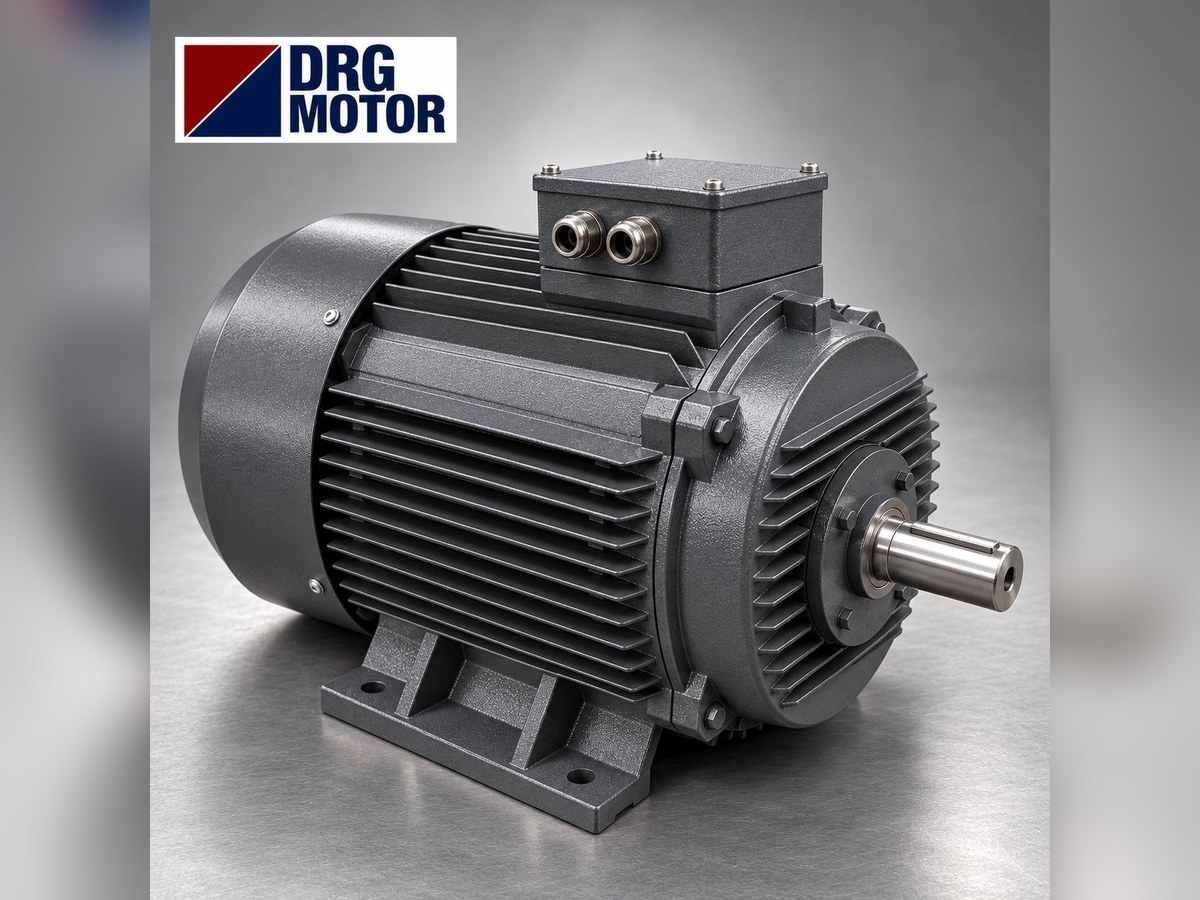
An end-suction pump motor is a B3 foot-mounted three-phase induction motor that drives a horizontal-shaft centrifugal pump of standard dimensions (EN 733 or ISO 2858) through a flexible coupling. Pump and motor sit on the same steel baseplate; motor power is chosen from the impeller diameter, the speed and the flow and head at the duty point. For example, an end-suction pump delivering 120 m³/h at 45 m needs about 19.6 kW of shaft power if pump efficiency is taken as 0.75, and runs on a 22 kW, 2-pole motor.
Because the casing dimensions of these pumps are standardised, pump and motor are often sourced separately; some pump makers also sell the pump bare-shaft, i.e. without a motor [5]. Fitting the right motor to the baseplate and the coupling axis is therefore the real work of motor selection, both after a failure and in a new installation. Suitable motors and current prices are on Buy Electric Motors Online; the pump group is on the Pump Motors page.
What is an end-suction pump and where does it sit in the system?
It takes its name from where the water enters: the suction port is at the end of the pump shaft, on its axis, while the discharge port points upward from the top of the casing. Its principle is centrifugal, its layout is horizontal-shaft, and its purpose depends on the application; the same pump may carry cooling water in a building, irrigation water on a farm or process water in a factory.
In a typical installation the pump sits after the valve and strainer on the suction line and before the check valve and valve on the discharge line. A coupling guard covers the space between pump and motor. Heavy pipe loads are not placed on the pump flanges; pipes are carried on their own supports.
What do EN 733 and ISO 2858 define?
Both standards fix the connection dimensions and performance class of the pump casing. One manufacturer's catalogue gives EN 733 pumps in the 10 bar class [1] and ISO 2858 pumps in the 16 bar class [2]. The practical consequence: pumps from two makers built to the same standard can replace each other in flange and foot dimensions. The numbers in the pump name follow this system; in a code such as "80-200" the first number is the nominal diameter of the discharge port (DN) and the second the nominal impeller diameter in mm [1].
- Water supply for buildings and sites, duty pump of booster sets.
- Heating, cooling-water and cooling-tower circuits.
- Irrigation lines and pool filtration.
- Process water, washing and transfer lines in industry.
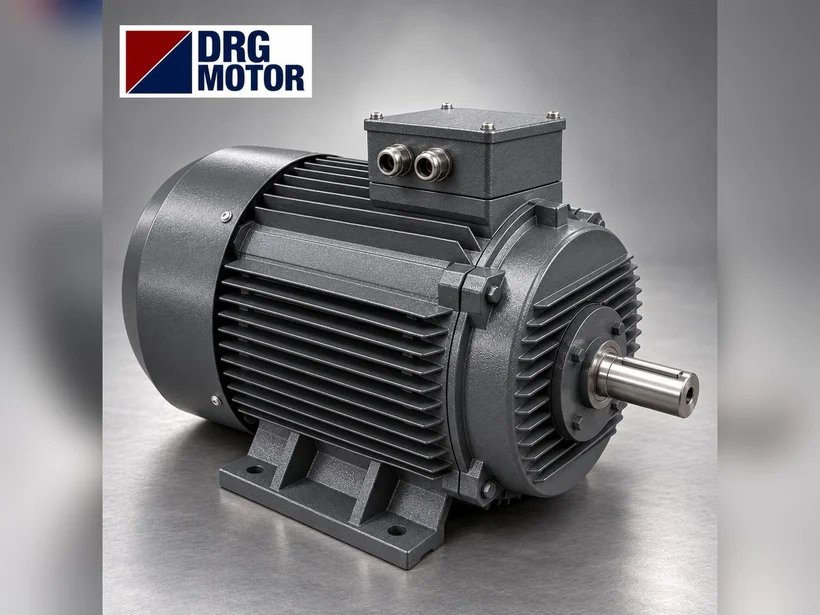
Coupling, baseplate and B3 motor: how the drive is built
End-suction pumps come in two designs. In the long-coupled (baseplate) design the pump has its own bearing housing and shaft and the motor stands separately. One manufacturer's catalogue supplies this design with a B3 (IM 1001) foot-mounted standard motor with IEC main dimensions [1]. In the close-coupled design the pump casing bolts to the motor flange; this page mainly covers the long-coupled design.
In the long-coupled design a flexible coupling transmits the motor power to the pump shaft. The coupling tolerates small misalignments but does not remove misalignment. The baseplate is a standardised steel carrier; an ISO 2858 catalogue describes it as a common base frame made in accordance with EN 23661 [2].
Coupling alignment
In a factory-assembled pump set the coupling halves arrive aligned, but alignment can be disturbed during transport. The manufacturer states that alignment is done by inserting shims under the pump or motor feet, that it must be checked after installation and that the final check is made once the pump has reached operating temperature [2]. This step is repeated when the motor is replaced. With a spacer coupling, the pump internals can be serviced without removing the motor [2]; when the motor itself is replaced, alignment is still set by measuring at the motor feet.
- Parallel offset: the two shaft axes are parallel but shifted.
- Angular misalignment: the two shaft axes form an angle.
- Soft foot: one motor foot does not sit fully on the baseplate and the frame flexes when the bolt is tightened.
How many kW is an end-suction pump motor? Market models
Standard casing families span from small to large ports and from small to large impellers; since one casing accepts different impeller diameters and motors of different poles, power varies over a wide band. Each row has a single motor per pump.
| Model group / capacity | Motor power | Single / total | Source |
|---|---|---|---|
| Maker A, DN 32 – 125 mm impeller, 4-pole | 0.25–0.37 kW | Single motor | [1] |
| Maker D, DN 40 baseplate pump, 4-pole | 0.37 kW | Single motor | [4] |
| Maker A, DN 80 – 200 mm impeller, 2-pole | 22–55 kW | Single motor | [1] |
| Maker A, DN 250 – 500 mm impeller, 4-pole | 160–315 kW | Single motor | [1] |
| Maker B, full ISO 2858 range | 0.25–362 kW | Single motor | [2] |
| Maker C, EN 733 close-coupled range | 1.5–75 kW | Single motor | [3] |
In this pump group, motor options of roughly 0.25–400 kW are seen depending on the manufacturer's model and capacity [1][2]. In the same "80-200" casing, trimming (reducing) the impeller lowers flow and head, and motor power drops by one or two steps; that is why one pump name corresponds to several motor ratings [1]. Power rises as flow or head rises. In a pumping station, the powers of pumps running in parallel are not added up to size a single pump's motor.
Overlap with the DRG range
Motors from 0.25 to 355 kW at 1000, 1500 and 3000 rpm have a counterpart in the DRG range; that is almost the whole range above. The largest casings needing more than 355 kW and close-coupled models using the pump maker's own special-shaft motor are outside the DRG range.
Click to see current electric motor prices and order nowSEE PRICES →
Worked example: 120 m³/h, 45 m
The end-suction pump selected for a food plant's washing-water line has a duty point of 120 m³/h and 45 m; pump efficiency read from the curve is 0.75. Shaft power P = ρ·g·Q·H / η_pump:
- Q = 120 / 3600 = 0.0333 m³/s
- P = 1000 × 9.81 × 0.0333 × 45 / 0.75 ≈ 19.6 kW
- About 10% margin, since the duty point moves right when the valve is fully open: 21.6 kW
- Selected standard rating: 22 kW, 2-pole
At this rating DRG-180M-2 runs at 2955 rpm and draws 38.5 A at 400 V. Its shaft height is 180 mm, shaft diameter 48 mm, shaft length 110 mm and foot-hole spacing 279 × 241 mm. If the old motor was also a 180M frame, the baseplate holes and coupling hub will most likely be reused as they are; with a different frame the baseplate needs an adapter plate or new holes. You can repeat the calculation with your own values in the Pump & Fan Motor Power Calculator.
What to check when selecting the motor
The hydraulic selection and curve of the pump are the job of the pump maker or designer; the motor supplier provides a motor matching the given shaft power, speed, mounting and ambient conditions. Checklist specific to end-suction pumps:
- Pump nameplate: DN–impeller code, actual impeller diameter, speed, rated flow and head.
- Old motor nameplate: kW, rpm, IEC frame (e.g. 160L, 180M), voltage and connection.
- Shaft height H and foot-hole dimensions A × B: compare with the holes in the baseplate.
- Shaft diameter D, shaft length E and key width F: must match the coupling hub bore.
- Coupling type: standard or spacer? With a spacer coupling the distance between shaft ends must be kept.
- Direction of rotation: per the arrow on the pump casing.
- Starting: at ratings like 22 kW usually star-delta or a soft starter.
Speed and mounting
EN 733 pumps are offered with 2-, 4- and 6-pole motors [1]. In small and medium casings 2900 rpm is common; with large impellers and with abrasive or hot water 1450 rpm is preferred because the impeller tip speed drops. The motor must have the same poles as the speed on the pump nameplate.
On a long-coupled end-suction pump the motor is fixed to the baseplate foot-mounted (B3) with a horizontal shaft; no flanged motor is needed. Close-coupled types use a flanged (B5 or B35) motor. The exact type comes from the pump maker's drawing; at DRG the mounting type is given with the order note and dimensions can be checked on the technical drawings page. In the DRG range, motors of 4 kW and above are wound 400/690 V; they are connected in delta on a 400 V supply and suit star-delta starting.
| Model | Power / speed | Frame · current 400 V | Price |
|---|---|---|---|
| DRG-112M-25.5 HP | 4 kW · 3000 rpm | Cast iron 112M · 7.45 A | $225.65 (€201.52) Details & buy → |
| DRG-132S2-210 HP | 7.5 kW · 3000 rpm | Cast iron 132S · 13.7 A | $369.43 (€329.92) Details & buy → |
| DRG-160M1-215 HP | 11 kW · 3000 rpm | Cast iron 160M · 19.6 A | $527.95 (€471.49) Details & buy → |
| DRG-160L-225 HP | 18.5 kW · 3000 rpm | Cast iron 160L · 32.5 A | $714.00 (€637.65) Details & buy → |
| DRG-180L-430 HP | 22 kW · 1500 rpm | Cast iron 180L · 39.7 A | $919.45 (€821.13) Details & buy → |
| DRG-180M-230 HP | 22 kW · 3000 rpm | Cast iron 180M · 38.5 A | $857.53 (€765.83) Details & buy → |
| DRG-200L-440 HP | 30 kW · 1500 rpm | Cast iron 200L · 53.8 A | $1,235.00 (€1,102.93) Details & buy → |
| DRG-200L1-240 HP | 30 kW · 3000 rpm | Cast iron 200L · 52.1 A | $1,273.02 (€1,136.88) Details & buy → |
Matching DRG motors
DRG Motor is a manufacturer, supplier and seller of electric motors. Range: aluminium frame 0.25–11 kW, cast iron 0.55–355 kW; 1000, 1500 and 3000 rpm; 3-phase, 230/400 V or 400/690 V; B3, B5, B14 and B35 (with order note). For baseplate-mounted end-suction pumps, B3 foot-mounted cast iron motors are a direct match. Ratings around the worked example:
| Model | Power / speed | Frame | Current 400 V |
|---|---|---|---|
| DRG-160L-2 | 18.5 kW / 2940 rpm | 160L cast iron | 32.5 A |
| DRG-180M-2 | 22 kW / 2955 rpm | 180M cast iron | 38.5 A |
| DRG-200L1-2 | 30 kW / 2960 rpm | 200L cast iron | 52.1 A |
| DRG-180L-4 | 22 kW / 1470 rpm | 180L cast iron | 39.7 A |
| DRG-200L-4 | 30 kW / 1475 rpm | 200L cast iron | 53.8 A |
DRG MOTOR motors are guaranteed against material and manufacturing defects for 2 years from the delivery date (warranty certificate). For general checks on water pump motors see our article on choosing a water pump motor.
DRG motors for end-suction pumps
- DRG-160M1-2 – 11 kW – 2945 rpm – 160M cast iron
- DRG-160L-2 – 18.5 kW – 2940 rpm – 160L cast iron
- DRG-180M-2 – 22 kW – 2955 rpm – 180M cast iron
- DRG-200L1-2 – 30 kW – 2960 rpm – 200L cast iron
- DRG-180L-4 – 22 kW – 1470 rpm – 180L cast iron
Click to see current prices and order these motors nowSEE PRICES →
End-suction pump motor: frequently asked questions
Which mounting type of motor is needed for an end-suction pump?
A baseplate (long-coupled) pump needs a B3 foot-mounted motor. If the pump casing is fixed directly to the motor (close-coupled), a flanged motor is needed; take the flange size from the old motor or the pump drawing.
Must the coupling be realigned after replacing the motor?
Yes. Even in the same frame, the new motor's foot surface and shaft height tolerances differ; align with shims and check again once the pump is warm.
What if the baseplate holes do not fit the new motor?
With the same IEC frame the holes fit. With a different frame, either an adapter plate is made that keeps the shaft height, or the baseplate is re-drilled; if the shaft height difference is too large to shim, choose a suitable frame.
How many amps does a 22 kW end-suction pump motor draw?
The 2-pole DRG-180M-2 draws 38.5 A at 400 V and 40.5 A at 380 V; the 4-pole DRG-180L-4 draws 39.7 A at 400 V.
Send us the pump nameplate, the old motor nameplate and the baseplate hole dimensions and we will determine the matching DRG model together. You can reach us on +90 (542) 666 11 11, at [email protected] or through our contact page. All models: Buy Electric Motors Online.
Sources
- Grundfos – NB, NBE, NK, NKE data booklet, single-stage end-suction pumps according to EN 733 – motor steps 0.25–400 kW; product range tables; NK long-coupled with B3 (IM 1001) motor; EN 733 (10 bar); DN–impeller designation.
- Grundfos – NBG, NKG data booklet, end-suction pumps according to ISO 2858 – motor sizes 0.25–362 kW; ISO 2858 (16 bar); EN 23661 base frame; alignment with shims and final check at operating temperature; spacer coupling.
- Pedrollo – F series, centrifugal pumps standardized according to EN 733 (50 Hz) – close-coupled range to EN 733 dimensions, 1.5–75 kW.
- Wilo – Atmos GIGA-N 40/160-0,37/4 product page – baseplate pump according to EN 733, 0.37 kW, 4-pole.
- KSB – Etanorm type series booklet – dimensions and ratings to EN 733; scope of supply options: bare-shaft pump, with baseplate, coupling and guard.


