 English
 Le français
 Türkçe

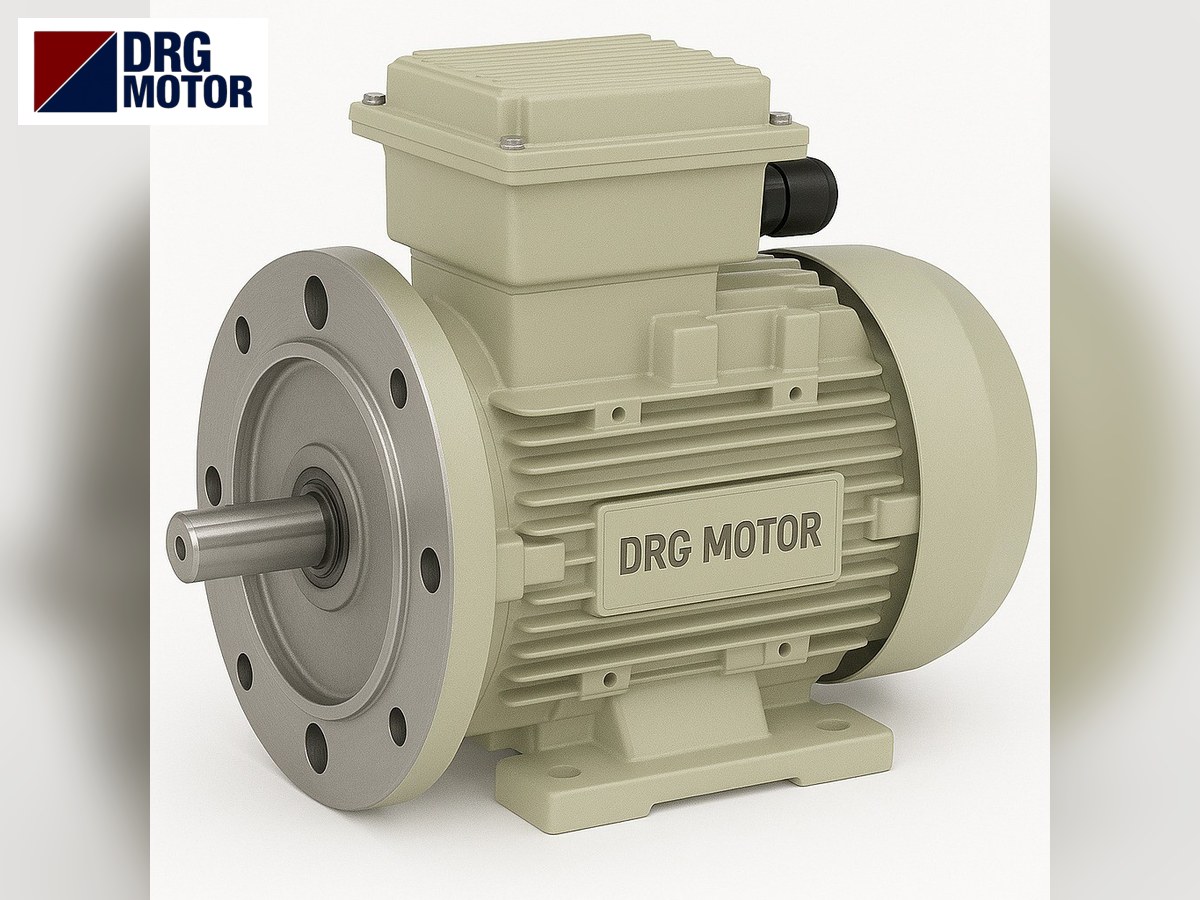
On a woodworking spindle moulder (shaper), the electric motor drives the vertical spindle that rises through the middle of the table, usually through a belt. A profile cutter or router bit spins on that spindle and cuts mouldings, grooves, rebates or tenons along the edge of the workpiece. Manufacturer catalogues list main motors of roughly 2.2–10 kW for these machines, while the power feeder that pushes the workpiece has its own small motor. This page covers only the motors of the table-type spindle moulder; CNC routers are a separate subject.
DRG Motor is a manufacturer, supplier and seller of electric motors. We do not sell the moulder itself, the spindle unit, cutters, the power feeder unit, gearboxes, inverters, electrospindles or servo motors; what we supply is the three-phase asynchronous IEC motor that turns the main spindle and the auxiliary drives. Models are listed on the Buy Electric Motors Online page.
What does the motor do on a spindle moulder?
The operator pushes the piece along the fence or on a sliding carriage into the cutter. The motor sits in the cabinet under the table and is linked to the spindle bearing unit by a flat belt or a poly-V belt. Larger cutter diameters and deeper profiles demand more torque: a motor that runs easily with a small rounding cutter can approach its current limit when shaping a solid door frame profile.
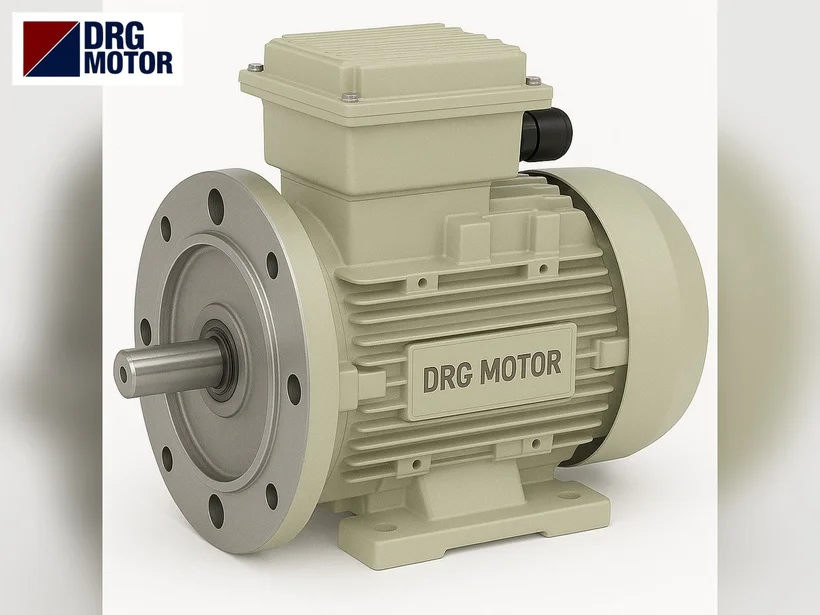
Spindle moulder versus CNC router
On a spindle moulder the tool turns on a fixed axis, a hand or a feeder moves the workpiece, and the spindle speed is picked from a few fixed belt steps. On a CNC router the panel is held by vacuum, the electrospindle carrying the tool travels on servo-driven axes and its speed is raised by a drive to tens of thousands of revolutions. That is why the main motor of a spindle moulder can be replaced with a standard IEC motor while the tool motor of a CNC cannot. The CNC auxiliaries we can cover are explained on a separate page.
Fixed and tilting spindle machines
On a fixed spindle machine the spindle always stays vertical. On a tilting machine the spindle, motor and belt sit on a common cradle that leans up to 45°, and the motor is bolted to this moving carrier. Foot hole spacing, cable slack and terminal box orientation then matter, because the motor must not hit the cabinet wall or the extraction duct while the cradle swings. Choosing the same frame and the same foot dimensions as the old motor is therefore essential.
Spindle speed, pulley steps and the speed ceiling
On a 50 Hz supply a two-pole induction motor turns at about 2,900 rpm under load, yet catalogues give spindle steps between 3,000 and 10,000 rpm. Pulleys close the gap: a large motor pulley and a small spindle pulley step the speed up, and moving the belt across the grooves yields four or five fixed speeds. In short, the high spindle speed of a moulder comes from the belt arrangement, not from the motor.
How does the pulley ratio change torque?
A ratio that raises speed lowers the usable spindle torque by the same factor. With the motor power unchanged, the torque available at the 3,000 rpm step falls to roughly one third at the 10,000 rpm step. Large cutters therefore run on low steps and small cutters on high ones, and the maximum speed marked on the cutter body is never exceeded. To try pulley diameters and belt length you can use the pulley and belt calculator.
Two-speed motors, inverters and very high speeds
Some machines use a pole-changing (two-speed) motor to add steps, and others vary the speed steplessly with an inverter. Pole-changing motors are not in the DRG range; if your machine has a two-speed switch and more than six motor leads, tell us so we can assess together what moving to a single-speed motor means for the controls. With an inverter we supply the motor and the panel side supplies the drive. Special motors turning 18,000 rpm directly and high-frequency motors fed at 200–300 Hz are not in our range either.
How many kW for a spindle moulder? Catalogue values
A) What spindle moulder and feeder catalogues state as motor output:
| Machine class | Motor power | Single / total | Note |
|---|---|---|---|
| Light fixed spindle moulder, 4 steps | 3 kW (options 2.2 and 3.7 kW) | main motor | manufacturer catalogue; motor speed 2,865 rpm |
| Fixed spindle workshop moulder, 3,000–8,000 rpm | 4 kW | main motor | second manufacturer, three-phase |
| Heavy moulder with two or four steps | 3.7 kW | main motor | third manufacturer, with brake |
| Tilting spindle, mid-size | 4 kW (options 5.5 and 7.3 kW) | main motor | fourth manufacturer; a 3 kW single-phase option also exists |
| Tilting spindle, large model | 5.5 kW (options 7.3 and 10 kW) | main motor | same manufacturer; star-delta start as standard |
| Heavy production moulder | 7.5 kW | main motor | fifth manufacturer; motor speed 2,900 rpm |
| Four-roller power feeder | 0.50 kW | separate small motor | sixth manufacturer; feed 2–22 m/min, inverter driven |
In this machine group, depending on the model and table size, main motors of roughly 2.2–10 kW and feeder motors around 0.5 kW are seen. The main motor and the feeder are separate circuits; the machine total is the sum of both. A 230 V single-phase variant appears in some catalogues too, and that is a motor type DRG does not supply.
B) Overlap with the DRG range: the 2.2–7.5 kW main motor band falls on our cast iron two-pole frames 90L, 100L, 112M and 132S, while a 0.5 kW-class feeder motor matches the four-pole frame 80 model. For non-standard ratings such as 3.7 and 7.3 kW the next standard size (4 and 7.5 kW) is chosen; the 10 kW option becomes 11 kW, with the panel and cable checked again. On most feeders the motor and gearbox form one unit, so replacing only the motor requires matching flange and shaft dimensions.
Click to see current electric motor prices and order nowSEE PRICES →
Braking, starting and a chip-laden cabinet
Quick stopping: DC injection electronic brake
A heavy moulding cutter keeps turning for a long time after switch-off, and many machines require the spindle to stop quickly. This is done either with a mechanical brake or electronically. With the electronic method, a brief DC pulse goes into the stator once the stop button is pressed, and the moulder spindle winds down far sooner; the motor does not have to change, a brake module is added to the panel. A motor with a built-in friction brake is something DRG does not offer; if the old motor carries a brake unit on its rear end, be sure to tell us.
Direct on line or star-delta
Small moulders start direct on line; catalogues of larger models list star-delta starting as standard. For that, the moulder motor must carry a 400/690 V winding (delta on a 400 V supply); read the voltage line on the old plate before ordering. Details are on the star-delta starting tool page. If an electronic brake and star-delta are combined, ask the panel builder how the brake module is wired.
Dust, chips and motor cooling
The motor sits in the cabinet right under the cutter. Weak extraction lets fine dust settle in the cabinet, where it blankets the fan cover grille and the frame fins so the motor heats up more for the same cut. Check that the extraction line pulls enough air from the cutter hood and from under the table, and clean the cabinet regularly. Our motors are IP55 protected: they are dust protected, but cooling still suffers in a cabinet buried in chips.
Worked example: pulley ratio and remaining spindle torque
Take a two-pole 5.5 kW main motor (DRG-132S1-2, 2,930 rpm; rated torque DRG-132S1-2, 17.9 Nm) and a 200 mm cutter. Belt losses are ignored:
| Spindle speed | Pulley ratio | Spindle torque | Cutter rim speed |
|---|---|---|---|
| 3,000 rpm | 3,000 / 2,930 ≈ 1.02 | 9,550 × 5.5 / 3,000 ≈ 17.5 Nm | about 31.4 m/s |
| 6,000 rpm | about 2.05 | about 8.75 Nm | about 62.8 m/s |
| 8,000 rpm | about 2.73 | about 6.57 Nm | about 83.8 m/s |
| 10,000 rpm | about 3.41 | about 5.25 Nm | about 104.7 m/s |
The same motor gives far less torque on the high step, and a 200 mm cutter on the top step risks exceeding its own speed limit while also straining the motor. That is why the step comes down as the cutter grows. If torque is short, try a shallower cut and a slower feed before moving to a bigger motor; if more power is really needed, ask the machine maker whether the spindle bearings and belt can carry the extra torque.
DRG motors for wood spindle moulders
Models from our range for the moulder main motor and the feeder (current at 400 V):
| Model | Power / speed | Frame · shaft D×E | Current 400 V |
|---|---|---|---|
| DRG-801-4 | 0.55 kW / 1400 rpm | 80 cast iron · 19×40 | 1.31 A |
| DRG-90L-2 | 2.2 kW / 2895 rpm | 90L cast iron · 24×50 | 4.35 A |
| DRG-100L-2 | 3 kW / 2895 rpm | 100L cast iron · 28×60 | 5.71 A |
| DRG-112M-2 | 4 kW / 2905 rpm | 112M cast iron · 28×60 | 7.45 A |
| DRG-132S1-2 | 5.5 kW / 2930 rpm | 132S cast iron · 38×80 | 10.1 A |
| DRG-132S2-2 | 7.5 kW / 2930 rpm | 132S cast iron · 38×80 | 13.7 A |
Moulder motors mostly stand on their feet (B3), bolted to the cradle or a belt tensioning plate, although flange (B5) and foot-plus-flange (B35) versions turn up on some machines. The DRG range is three-phase asynchronous IEC: aluminium bodies stop at 11 kW, cast iron ones climb to 355 kW, speeds are 3000, 1500 or 1000 rpm, and foot, flange or vertical forms are written on the order. Before removal, photograph the nameplate (kW, speed, voltage, connection) and measure the shaft, key, pulley seat length and foot hole spacing. We set those values beside the machine manual and agree the match with you before ordering; skipping that step means no promise of fit.
Live price table
Current shop prices for motors in moulder and feeder power ratings:
| Model | Power / speed | Frame · current 400 V | Price |
|---|---|---|---|
| DRG-801-40.75 HP | 0.55 kW · 1500 rpm | Cast iron 80 · 1.31 A | $91.72 (€81.91) Details & buy → |
| DRG-90L-23 HP | 2.2 kW · 3000 rpm | Cast iron 90L · 4.35 A | $154.45 (€137.93) Details & buy → |
| DRG-100L-24 HP | 3 kW · 3000 rpm | Cast iron 100L · 5.71 A | $177.89 (€158.87) Details & buy → |
| DRG-112M-25.5 HP | 4 kW · 3000 rpm | Cast iron 112M · 7.45 A | $225.65 (€201.52) Details & buy → |
| DRG-132S1-27.5 HP | 5.5 kW · 3000 rpm | Cast iron 132S · 10.1 A | $338.72 (€302.50) Details & buy → |
| DRG-132S2-210 HP | 7.5 kW · 3000 rpm | Cast iron 132S · 13.7 A | $369.43 (€329.92) Details & buy → |
DRG MOTOR motors are guaranteed against material and manufacturing defects for 2 years from the delivery date (warranty certificate).
Motors in this power range
- DRG-90L-2 – 2.2 kW – 2895 rpm – 90L cast iron
- DRG-112M-2 – 4 kW – 2905 rpm – 112M cast iron
- DRG-132S1-2 – 5.5 kW – 2930 rpm – 132S cast iron
- DRG-132S2-2 – 7.5 kW – 2930 rpm – 132S cast iron
Click to see current prices and order these motors nowSEE PRICES →
Browse the products, ask for a quote: all models for your moulder are on the Buy Electric Motors Online page. A WhatsApp picture of the moulder motor plate, its pulley end and its feet is enough to begin; by phone on +90 (542) 666 11 11, simply read out the spindle speed steps of your machine.
Frequently asked questions
Can a 3 kW single-phase moulder motor be replaced with a three-phase one?
Where a three-phase line reaches the workshop it can be done, though more than the motor changes on the moulder: the switch, the motor protection relay, the control circuit and any brake module are also renewed for three-phase. An electrician should do this conversion. We do not sell single-phase motors; we can propose the three-phase equivalent from our range.
How is the direction of rotation reversed?
Many spindle moulders have a forward-reverse switch because some cutters run the other way. On a three-phase motor the direction changes when two phases are swapped. After connecting a new motor, check the direction before mounting the cutter.
What does the price of a spindle moulder motor depend on?
Output, pole count, cast iron or aluminium housing and the mounting arrangement set it; the live table above reads the shop figures directly.
Send your questions about your moulder to +90 (542) 666 11 11, info@drgmotor.com or through the contact form. For spindle and table feed motors on metal milling machines see milling machine motor selection, and for general motor topics on woodworking machines see motor selection for woodworking machines.


