 English
 Le français
 Türkçe

In a jaw crusher, the flywheel meets the peak load of each crushing stroke with its stored energy and keeps the motor from being strained on every stroke. The belt drive sets the eccentric shaft speed, partly damps the impacts and creates the side force acting on the motor shaft. Matching these two elements is as much part of the selection as the motor power.
Flywheel: softens the impact, lengthens the start
The moving jaw applies a large force on the crushing stroke and is almost idle on the return stroke. The flywheel evens out this fluctuation with its own rotational energy, so the motor runs at a load close to the average power. The price is higher inertia: while bringing the flywheel from standstill to rated speed, the motor draws a high starting current for a long time and the winding heats up quickly during this period. That is why the order should state the flywheel inertia, or the starting time foreseen by the crusher manufacturer, together with the planned starting method. Whether the start is acceptable for the motor is assessed with an inertia and acceleration time calculation.
Belt drive: speed, damping and shaft load
- Speed: The eccentric shaft speed is set by the motor speed and the pulley diameters; departing from the value given by the crusher manufacturer changes capacity and product size.
- Damping: The belts absorb part of the impact by stretching; during a jam, brief slipping protects the motor and shaft from a sudden reaction.
- Shaft load: A small motor pulley and over-tensioned belts put a large side force on the shaft end; this is one of the main causes of shortened bearing life.
Information to prepare for selection
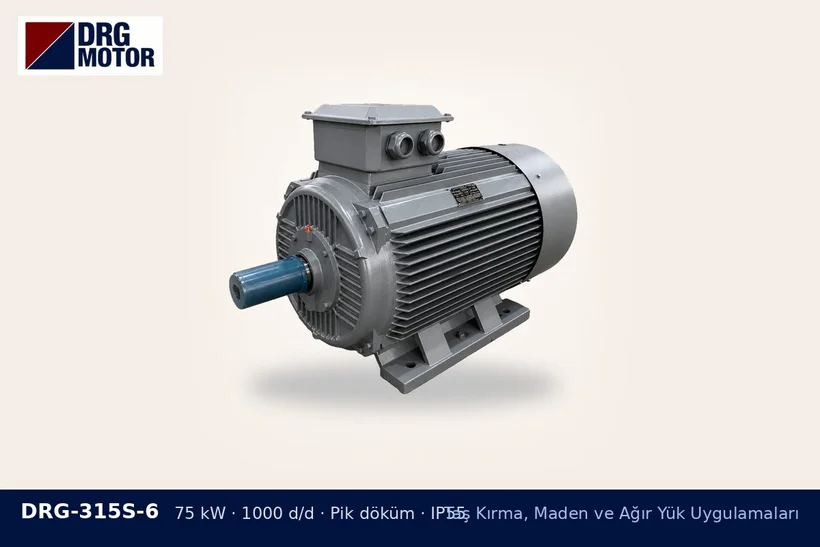
Crusher model and feed opening, eccentric shaft speed, flywheel and pulley diameters, belt type and number, the material to be fed and the planned starting method. Lower-speed motors are often used on jaw crushers because the reduction ratio needed to reach the large flywheel pulley becomes smaller; the final choice, however, depends on the pulley arrangement and the existing baseframe. For example, the DRG-315S-6-GG model in the 75 kW 1000 rpm class has an 85×170 mm shaft; the existing motor pulley may need to be re-machined to suit this shaft.
You can check the pulley ratio with the pulley and belt calculation tool and review suitable power ratings for primary crushing on the jaw crusher motor page.