 English
 Le français
 Türkçe

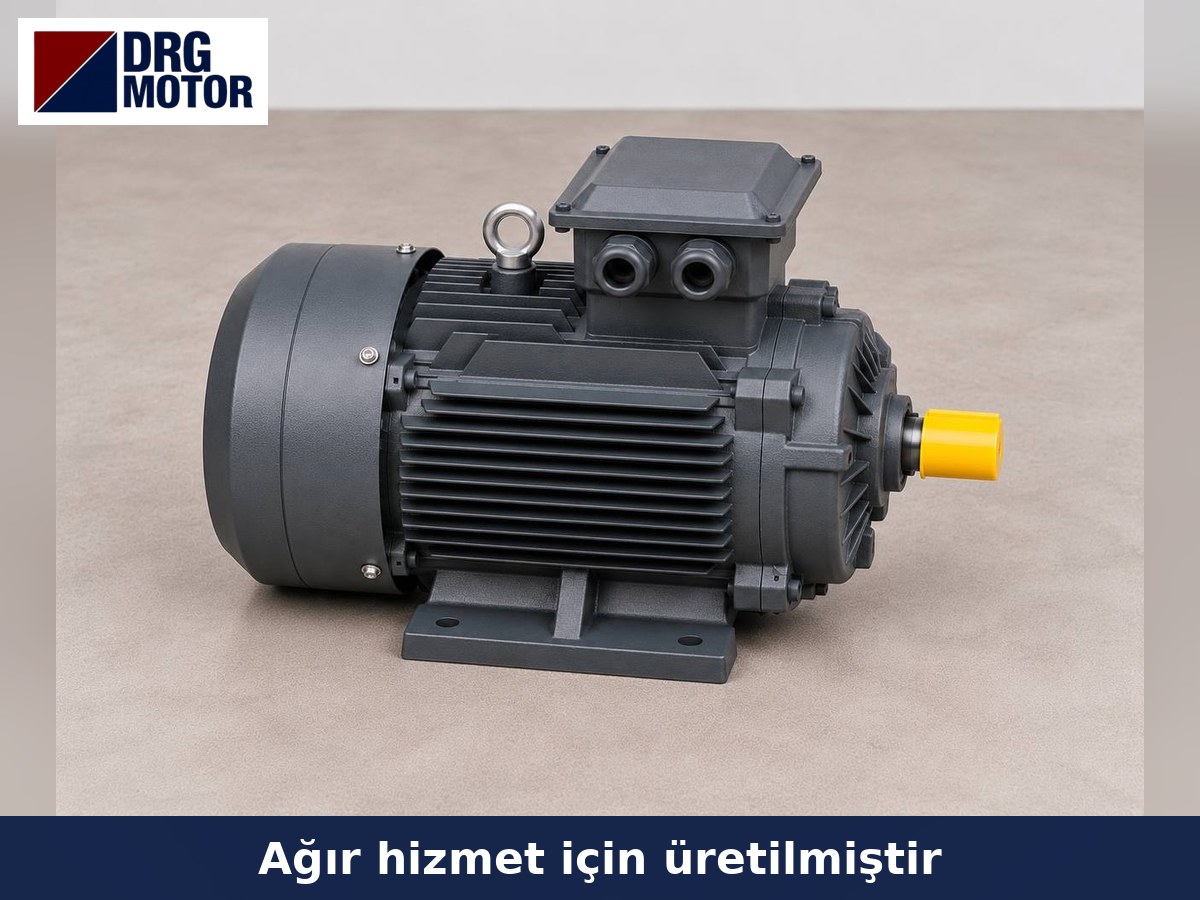
A wire saw drives an endless steel rope threaded with diamond beads (diamond wire) round a large drive wheel at 20–40 metres per second and cuts the stone by abrasion. Here the electric motor simply spins the drive wheel; wire tension and feed into the cut come from a separate feed motor, a hydraulic cylinder or the machine travelling back along its rails. The same principle applies from the single-wire quarry saw that frees blocks from the bench, through the stationary monowire that squares blocks in the factory, to the multi-wire machine that cuts slabs with dozens of wires; what changes is wheel diameter and motor power.
DRG Motor is a manufacturer, supplier and seller of electric motors. We do not sell wire saws, diamond wire, gearboxes, hydraulic tensioning units, drives (inverters), servos or electrospindles; our part is the standard three-phase induction motor on the wheel and on the auxiliary axes. Models by power are on Buy Electric Motors Online.
How does diamond wire cut, and where is the motor?
The wire leaves the drive wheel, loops round the stone or through a hole drilled into it, and returns to the wheel. As the wheel turns, the beads abrade the stone; water sprayed along the cut cools the beads and carries away the dust. As the cut deepens, the loop gets shorter; either the machine travels back or the wheel arm extends to keep the wire taut. Too little tension and the wire slips, too much and it breaks.
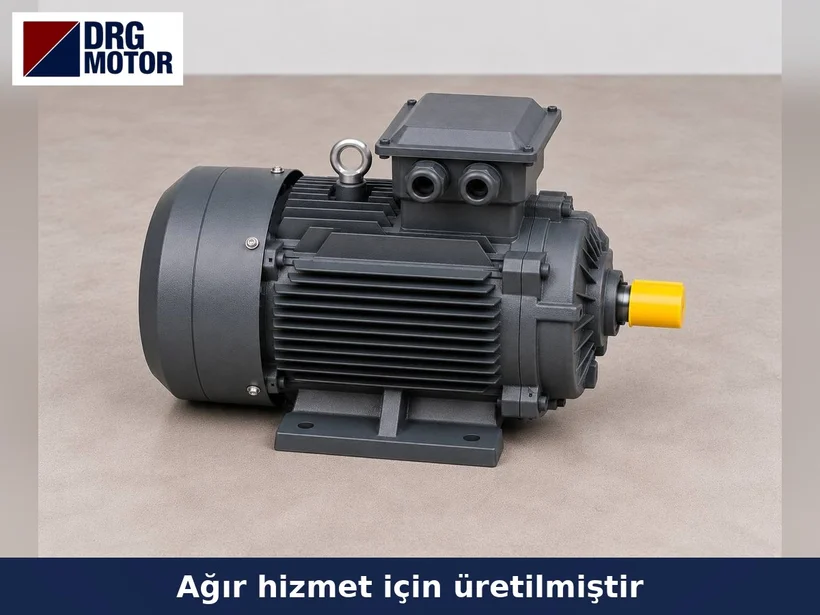
Drive wheel motor
This is the motor that uses most of the power. On quarry saws the motor and an 800–830 mm wheel share the same head, which can rotate ±180° for horizontal, vertical and inclined cuts. On multi-wire machines the wheel exceeds 2 metres and there is a belt or gear transmission between motor and wheel.
Feed and wire tension
On a quarry saw a feed motor of about 1.5 kW pulls the machine back along the rails to keep the wire taut. The controller watches main motor current and wire speed; if current rises, it slows the feed. On stationary and multi-wire machines tension is often applied per wire by a hydraulic cylinder, while the head or the block trolley is moved up and down by a separate motor.
Quarry saw, stationary monowire, profiling and multi-wire
Quarry diamond wire saw
Used on the quarry bench to free blocks from the rock. The machine sits on rails and works outdoors in dust, rain and heat. Data sheets give main motors of 37–110 kW; some makers put the motor pole count into the model name. Some newer series come with permanent magnet motors; that motor type is not in our range, so ask us about replacing motors on induction-motor machines.
Stationary single-wire machine and block squaring
Used in the factory to trim block faces (squaring) and to cut thick slabs or steps. There is one wire, the wheels sit on a fixed gantry and the block is placed on a trolley. One data sheet lists a 15 kW main motor, a 2.25 kW fast up-down motor and 0.75–1.5 kW trolley and swing motors.
CNC wire profiling machine
These machines cut curved parts such as columns, arches and letters, and their wire motor is small (7.5 kW in one data sheet). The path of the wire is set by servo axes; axis servos are not in our range, while the wire drive motor can be a standard induction motor.
Multi-wire machine
Taking over from the gang saw, this machine splits the block into slabs with 10 to 72 wires at once. A single large motor turns the common drive wheel; in data sheets power rises with the number of wires from 75 kW to 280 kW. A gang saw flywheel turns to create reciprocating motion, whereas the multi-wire wheel runs continuously in one direction; at start the mass being accelerated is wheel and wire.
How many kW is a wire saw motor? Catalogue values
A) Drive motor powers stated in wire saw makers’ data sheets:
| Machine type | Drive motor | Single / total | Note |
|---|---|---|---|
| Quarry diamond wire saw | 37 / 45 / 55 / 75 kW | Main motor | maker catalogue, four models |
| Quarry type, large series | 37–110 kW | Main motor; total 40–115 kW | second maker |
| Quarry type with 6-pole motor | 55–75 kW | Main motor + 1.5 kW feed | third maker |
| Stationary single wire (block squaring) | 15 kW | Main motor; total 21.75 kW | fourth maker |
| CNC single-wire profiling machine | 7.5 kW | Main motor; total 11 kW | fifth maker |
| Multi-wire, 10 / 15 wires | 75 / 90 kW | Main motor | sixth maker |
| Multi-wire, 21–72 wires | 95–280 kW | Main motor | seventh maker series |
Depending on model and number of wires, drive motor power in this machine group is 7.5 kW on the single-wire profiling machine, 37–110 kW on quarry saws and 75–280 kW on multi-wire machines. Auxiliary motors (feed, lifting, trolley) are 0.75–2.25 kW and are chosen separately, not added to the main motor. On a quarry saw power grows with cut area and stone hardness; on a multi-wire machine it grows with the number of wires.
B) Wire saw ratings inside our range
Every single motor rating in the table lies within the DRG range of 0.25–355 kW. Ratings from 7.5 to 132 kW are available in our 4 and 6-pole cast iron motors, 160–250 kW in large 4-pole frames. 280 kW is not one of our standard steps; moving to 315 kW and checking that the larger frame fits must be agreed with the machine maker; a machine needing more than 355 kW or a medium-voltage drive is outside our range. Since we have no 8-pole motors, replacing one on a quarry saw whose data sheet lists an 8-pole motor must be assessed together with the wheel and drive settings.
Click to see current electric motor prices and order nowSEE PRICES →
Wire speed, wheel diameter and motor speed
Wire speed is the peripheral speed of the wheel: v = π × D × n / 60. From the wire speed and wheel diameter in a data sheet, the required speed can be worked out:
| Case | Calculation | Result | Comment |
|---|---|---|---|
| Quarry saw, 800 mm wheel, 40 m/s | 40 × 60 / (π × 0.8) | ≈ 955 rpm | close to a 6-pole motor speed |
| DRG-280S-6 directly on the wheel | π × 0.8 × 985 / 60 | ≈ 41.3 m/s | near the top wire speed; the drive sets it |
| Multi-wire, 2,200 mm wheel, 35 m/s | 35 × 60 / (π × 2.2) | ≈ 304 rpm | a transmission is needed between motor and wheel |
| Ratio with a 4-pole motor | 1490 / 304 | ≈ 4.9 | belt or gear ratio |
On a quarry saw with an 800 mm wheel, the speed of a 6-pole motor is very close to the 40 m/s upper limit, which is why quarry machines can carry the wheel directly on the motor. On a multi-wire machine the wheel turns slowly and a ratio is needed in between; that transmission belongs to the machine builder.
Why is an inverter essential?
Wire speed is set to stone hardness and wire wear; at the start, while the wire works on a short arc, it runs slowly, then faster once the cut has settled. Machines with two drives for constant tension control are common in data sheets: one drives the wheel motor, the other the feed motor. A motor run by a drive has no fixed speed; when choosing a new motor, besides plate power you need to know the frequency range the drive uses. The drive is outside DRG’s scope.
Wire breakage and braking
When the wire breaks, wheel and motor must stop quickly. Data sheets show a braking resistor on the drive and a breakage sensor for this; the motor in that layout is standard. Where the design has a mechanical brake on the motor itself, a brake motor is needed; a braked motor is something we do not offer, and we will tell you so.
Operating conditions in the quarry and in the factory
A quarry saw motor works in sun, rain and rock dust, with cutting water splashing around it. Our motors are IP55; keep them out of direct water jets and route the cable so the rotating head cannot crush it. Supply lines in quarries are long; check the distance between motor and panel with our motor cable size calculator. On a multi-wire machine in the factory the motor usually sits outside the wire chamber on a closed frame; there the issue is not water but humid, dusty air and sludge building up in the wheel guard.
DRG motors suitable for wire saws and squaring machines
Sample models for the drive wheel and larger auxiliary drives (current at 400 V):
| Model | Power / speed | Frame · shaft D×E | Current 400 V |
|---|---|---|---|
| DRG-132M-4 | 7.5 kW / 1460 rpm | 132M cast iron · 38×80 | 14.3 A |
| DRG-160L-4 | 15 kW / 1465 rpm | 160L cast iron · 42×110 | 27.3 A |
| DRG-250M-6 | 37 kW / 985 rpm | 250M cast iron · 65×140 | 68.1 A |
| DRG-280M-6 | 55 kW / 985 rpm | 280M cast iron · 75×140 | 98.1 A |
| DRG-315S-6 | 75 kW / 985 rpm | 315S cast iron · 85×170 | 136 A |
| DRG-315L1-4 | 160 kW / 1488 rpm | 315L cast iron · 85×170 | 271 A |
Our motors are three-phase and IP55; foot-mounted B3, flange-mounted B5 and combined B35 are available. On a quarry saw head the motor is often flange-mounted; take the flange and shaft dimensions from the old motor with a caliper. Some of these machines carry the wheel on a motor with a special long shaft or special flange; we compare any dimensions outside standard IEC shafts and flanges with our catalogue and tell you if there is no match. The decision weighs drive power and pole count, the 400/690 V winding, frame and fixing style, shaft and key, how the flange seats the wheel and wet running together; without comparing the old plate with the machine documents no definite fit is promised.
Live price table
Current shop prices for wire saw power steps appear here automatically:
| Model | Power / speed | Frame · current 400 V | Price |
|---|---|---|---|
| DRG-132M-410 HP | 7.5 kW · 1500 rpm | Cast iron 132M · 14.3 A | $394.89 (€352.66) Details & buy → |
| DRG-160L-420 HP | 15 kW · 1500 rpm | Cast iron 160L · 27.3 A | $678.13 (€605.61) Details & buy → |
| DRG-225M-640 HP | 30 kW · 1000 rpm | Cast iron 225M · 56.2 A | $1,487.70 (€1,328.61) Details & buy → |
| DRG-250M-650 HP | 37 kW · 1000 rpm | Cast iron 250M · 68.1 A | $2,056.71 (€1,836.77) Details & buy → |
| DRG-280S-660 HP | 45 kW · 1000 rpm | Cast iron 280S · 81.6 A | $2,568.23 (€2,293.59) Details & buy → |
| DRG-280M-675 HP | 55 kW · 1000 rpm | Cast iron 280M · 98.1 A | $2,805.93 (€2,505.87) Details & buy → |
| DRG-315S-6100 HP | 75 kW · 1000 rpm | Cast iron 315S · 136 A | $3,889.23 (€3,473.33) Details & buy → |
| DRG-315L1-4200 HP | 160 kW · 1500 rpm | Cast iron 315L · 271 A | $6,135.24 (€5,479.15) Details & buy → |
DRG MOTOR motors are guaranteed against material and manufacturing defects for 2 years from the delivery date (warranty certificate).
Motors in this power range
- DRG-160L-4 – 15 kW – 1465 rpm – 160L cast iron
- DRG-225M-6 – 30 kW – 980 rpm – 225M cast iron
- DRG-280S-6 – 45 kW – 985 rpm – 280S cast iron
- DRG-315S-6 – 75 kW – 985 rpm – 315S cast iron
- DRG-355M-4 – 250 kW – 1490 rpm – 355M cast iron
Click to see current prices and order these motors nowSEE PRICES →
Browse products, request a quote: the ratings used on quarry and multi-wire machines are on Buy Electric Motors Online. Share pictures of the plate and of the flange end on WhatsApp, or ring +90 (542) 666 11 11; we will choose the model together from the plate values.
Frequently asked questions
Can I switch a quarry wire saw to a 4-pole motor?
If the motor carries the wheel directly, a 4-pole motor tries to drive the wire much faster; even if the drive limits it, the motor then runs at low frequency and its torque changes. The safest choice is the same number of poles as before.
Is a squaring machine motor the same as a quarry saw motor?
No. On a stationary single-wire machine power is mostly in the 15 kW class and the motor sits fixed on the gantry; on a quarry saw power is several times larger and the motor works outdoors on a rotating head.
When a multi-wire motor burns out, is only the motor replaced?
Usually yes; if wheel, transmission and drive are sound, only the motor changes. First find the cause of failure (overload, drive setting, cooling), then choose the new motor from plate power and speed.
Quarry or factory, any wire saw motor question is welcome on +90 (542) 666 11 11, by e-mail at info@drgmotor.com or via our contact page.


