 English
 Le français
 Türkçe

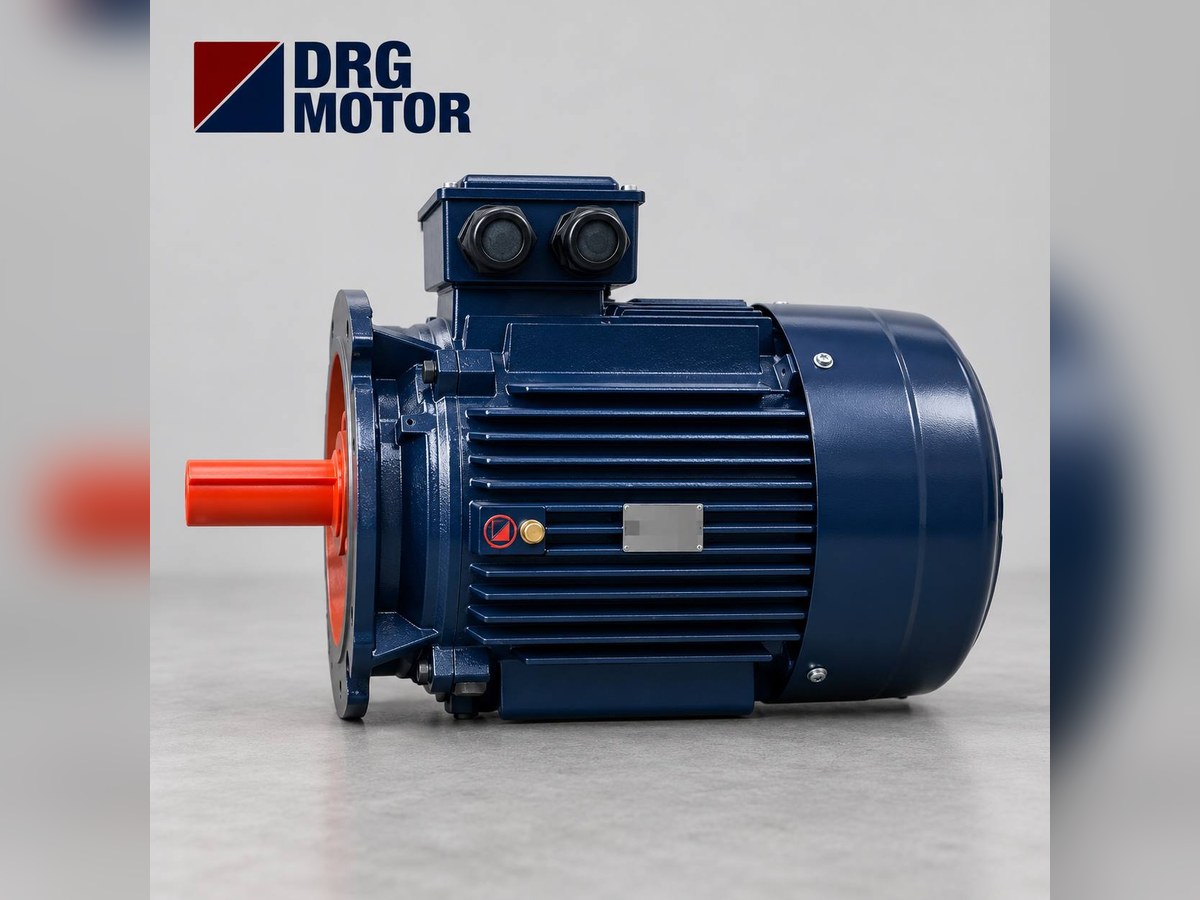
On a calibrating and honing machine the electric motor turns the heads, fitted with diamond segments or abrasive plates, that bring the slab to an even thickness and flatten its face; smaller motors drive the conveyor belt and raise or lower the heads. Maker catalogues list 18.5–22 kW per calibrating head and 0.37–2.2 kW for the belt and head movements. This page covers only the calibrating and honing machine; the polishing line is a separate subject.
DRG Motor is a manufacturer, supplier and seller of electric motors. We do not sell the calibrating machine itself, head plates, segments, gearboxes, hydraulic units, the pump body of a water pump, inverters, electro-spindles or servo motors; our part of the machine is the three-phase induction motor alone. The models are listed on Buy Electric Motors Online.
What does the motor do on a calibrating machine?
A slab coming from the saw (or a cut-to-size tile) travels on the belt under the heads. The first heads take off surplus stone with coarse diamond segments and bring the slab down to the set thickness; the following heads remove saw marks with finer tools. The load on a head motor depends on how much stone that head removes: the first calibrating head works hardest, the last honing head least.
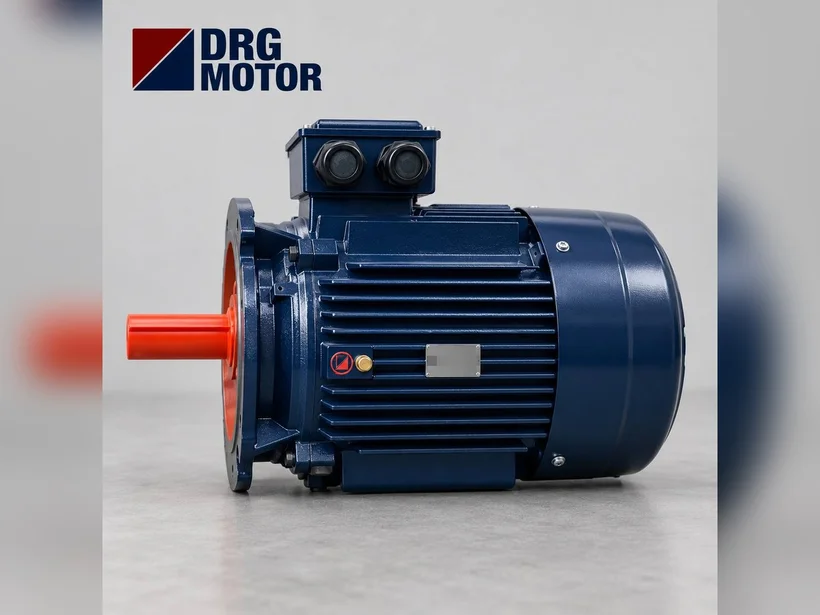
Calibrating versus honing
Calibrating (thickness levelling) removes material: both faces become parallel and every piece ends at the same size. Honing hardly changes thickness; it clears lines and waviness and prepares the face for polishing. That is why a calibrating head and a honing head on the same machine may carry different motor sizes. The polishing heads that give gloss usually sit on a separate line or at the end of the line and have a quite different load pattern.
Motors found on a calibrating machine
A typical machine carries a head motor for each head, a lift (up-down) motor for each head, a belt drive motor and often a guide motor that aligns the stone on the belt. The head motor is large and is fed direct-on-line or by star-delta; the others are small, most run through a gearbox, and the belt speed is set by an inverter.
Head motor: vertical mounting, shaft and power transmission
The calibrating head spindle is vertical; the segmented plate is pressed onto the stone from above and the spindle runs in bearings inside the head housing. Two layouts are common: the motor sits by its flange directly on top of the head housing, or it is fixed beside the head and transmits power through pulleys. The position of the old motor, the direction of its terminal box and the pulley guard on the head show which one you have.
Points to check with V1 vertical mounting
A vertical motor with the shaft pointing down is designated V1 and is flange mounted. Vertical operation requires the motor to be ordered for vertical mounting and the axial load to be confirmed by the machine maker: you need to know whether plate weight and pressing force land on the motor bearing or on the head’s own bearings. Where pulleys are used, the belt pulls sideways on the motor shaft; mount the pulley right against the shaft shoulder to keep that bending load small.
Head height setting and changing load
The head is lowered step by step by its lift motor; on some machines sensors at the infeed read slab thickness and the control decides how far each head goes down. If a head is lowered one step too far, the head motor current rises at once. Where the panel shows current, the setting is made by watching that value; the motor should not run above its nameplate current for long. The lift motor is small but switches on often and works through a gearbox that carries the head weight.
How many kW is a calibrating machine motor? Catalogue values
A) Head and auxiliary motor ratings published by calibrating machine builders:
| Machine layout | Motor power | Single / total | Note |
|---|---|---|---|
| 2 calibrating heads, 710 mm plate | 18.5 kW | per head; machine total 39.6 kW | maker catalogue, small model |
| 4 calibrating heads, 710 mm plate | 18.5 kW | per head; machine total 77.7 kW | same catalogue, large model |
| 3 calibrating heads, 650 mm width | 22 kW | per head; machine total 68.6 kW | second maker |
| 2 calibrating + 4 bush-hammer heads | 22 kW | per head; machine total 51 kW | third maker |
| Line with 2–4 calibrating + 6–14 polishing heads | 22 kW | per calibrating head; line total 94.5–243.5 kW | fourth maker, polishing heads included |
| Head up-down (lift) motor | 0.55 kW | per head | first and second maker |
| Belt drive motor | 0.75–2.2 kW | single motor | data of four makers |
| Slab guide motor | 0.37 kW | single motor | second maker |
In this machine group, depending on model and plate diameter, a calibrating head carries roughly 18.5–22 kW and the auxiliary motors 0.37–2.2 kW. Total machine power grows with the number of heads; the totals in the table are not the rating of a single motor and may include the polishing heads of the line. On hard material such as granite or quartzite the same machine runs at lower belt speed, which is one way of keeping head motor load within limits.
B) Where DRG fits: for the 18.5 and 22 kW heads we offer the 4-pole cast iron 180M and 180L; the 0.37–2.2 kW auxiliaries match our small aluminium and cast iron frames. If the machine maker used its own long shaft or a non-standard flange on the head, that dimension does not exist on a standard IEC motor; do not order before comparing the old shaft and flange with our catalogue.
Click to see current electric motor prices and order nowSEE PRICES →
Worked example: starting current on a three-head machine
Take a machine with three 22 kW heads. If the heads start in the raised position without touching the stone, the starting load is light; the real concern is the current drawn from the supply. The figures use DRG-180L-4 catalogue data (rated torque: DRG-180L-4, 142.9 Nm):
| Case | Operation | Result | Comment |
|---|---|---|---|
| Rated current of one motor | DRG-180L-4, 400 V | 39.7 A | catalogue value |
| One motor, direct-on-line start | 39.7 × 7.8 | about 310 A | Is/In = 7.8 |
| Three motors started together DOL | 3 × 309.7 | about 929 A | situation to avoid |
| One motor, star-delta | 309.7 / 3 | about 103 A | in the star step |
| Total while the third head starts | 103.2 + 2 × 39.7 | about 183 A | heads switched on one after another |
The message is clear: starting the heads a few seconds apart and using star-delta greatly reduces the shock on the main breaker and the transformer. Motor torque also drops in the star step, so a head must always be raised before it starts. Details are in our star-delta starting tool.
Belt motor and gear ratio
One catalogue gives a belt speed range of 0–5.5 m/min. With a 300 mm drive drum, the drum turns at about 5.8 rpm at top speed; a 0.75 kW motor running at 1420 rpm therefore needs roughly 243:1 between motor and drum. The gearbox, and a chain stage if needed, provides that ratio, while speed is set by the inverter. You can try the ratio yourself with the gearbox output speed calculator. The warning in our catalogue applies here as well: if the motor turns slowly for long periods, its own shaft fan may not cool enough and a separate fan may be needed.
Water, slurry and protecting the calibrating motor
A calibrating machine runs with plenty of water; maker data sheets quote around 120–240 litres per minute per machine. Mixed with the fine stone powder, it turns to a grey slurry that the spinning plates throw outwards. Our motors are IP55: protected against dust and against water splashed from any direction, but not designed to run in slurry or under pressure washing.
Precautions at installation
Fit a splash cover over the head motor, place the terminal box with its cable entry facing down or sideways, and clean slurry from the cooling fins regularly. Fins packed with slurry make the motor run hotter at the same load. On a vertical motor, the seals and wipers on the head side that keep water away from the shaft entry should be renewed as the machine maker’s maintenance instructions require.
DRG motors for calibrating and honing machines
4-pole models from our range for head and auxiliary drives (current at 400 V):
| Model | Power / speed | Frame · shaft D×E | Current 400 V |
|---|---|---|---|
| DRG-712-4 | 0.37 kW / 1340 rpm | 71 aluminium · 14×30 | 0.92 A |
| DRG-801-4 | 0.55 kW / 1400 rpm | 80 cast iron · 19×40 | 1.31 A |
| DRG-802-4 | 0.75 kW / 1420 rpm | 80 cast iron · 19×40 | 1.75 A |
| DRG-90L-4 | 1.5 kW / 1445 rpm | 90L cast iron · 24×50 | 3.3 A |
| DRG-100L1-4 | 2.2 kW / 1450 rpm | 100L cast iron · 28×60 | 4.52 A |
| DRG-180M-4 | 18.5 kW / 1470 rpm | 180M cast iron · 48×110 | 33.5 A |
| DRG-180L-4 | 22 kW / 1470 rpm | 180L cast iron · 48×110 | 39.7 A |
For the calibrating head a cast iron frame (from our 0.55–355 kW span) is the usual choice, while small belt and lift drives often use aluminium frames (0.25–11 kW); all are three-phase IEC induction motors, ordered with 2, 4 or 6 poles (3000/1500/1000 rpm). If the head motor stands vertically, write V1 in the order note; foot B3, flange B5/B14, combined B34/B35 and V3/V5/V6 are also possible. Before removing the old head motor, note the kW, speed, voltage and star/delta data on its plate, the shaft diameter and key size, the flange spigot and whether it drives the head by belt or coupling; we review this together with the machine maker’s documents and confirm the match with you. We give no blanket compatibility guarantee.
B5 flange dimensions
B5 values of frames common on calibrating machines, from the DRG catalogue (mm):
| Frame | Shaft D×E | Flange P / M / N | Hole S |
|---|---|---|---|
| 80 | 19×40 | 200 / 165 / 130 | 12 |
| 90S/90L | 24×50 | 200 / 165 / 130 | 12 |
| 100L/112M | 28×60 | 250 / 215 / 180 | 14.5 |
| 180M/180L | 48×110 | 350 / 300 / 250 | 18.5 |
When replacing a head motor, shaft diameter D and shaft length E decide the head coupling, while spigot diameter N decides how the motor seats on the head housing. For more dimensions see the technical drawings page and our article on flange motor selection.
Live price table
Prices of our models in calibrating head and auxiliary motor sizes are taken live from the shop:
| Model | Power / speed | Frame · current 400 V | Price |
|---|---|---|---|
| DRG-712-40.5 HP | 0.37 kW · 1500 rpm | Aluminium 71 · 0.92 A | $76.76 (€68.55) Details & buy → |
| DRG-801-40.75 HP | 0.55 kW · 1500 rpm | Cast iron 80 · 1.31 A | $91.72 (€81.91) Details & buy → |
| DRG-802-41 HP | 0.75 kW · 1500 rpm | Cast iron 80 · 1.75 A | $101.93 (€91.03) Details & buy → |
| DRG-90S-41.5 HP | 1.1 kW · 1500 rpm | Cast iron 90S · 2.48 A | $124.09 (€110.82) Details & buy → |
| DRG-90L-42 HP | 1.5 kW · 1500 rpm | Cast iron 90L · 3.3 A | $144.14 (€128.73) Details & buy → |
| DRG-100L1-43 HP | 2.2 kW · 1500 rpm | Cast iron 100L · 4.52 A | $188.32 (€168.18) Details & buy → |
| DRG-180M-425 HP | 18.5 kW · 1500 rpm | Cast iron 180M · 33.5 A | $873.49 (€780.08) Details & buy → |
| DRG-180L-430 HP | 22 kW · 1500 rpm | Cast iron 180L · 39.7 A | $919.45 (€821.13) Details & buy → |
DRG MOTOR motors are guaranteed against material and manufacturing defects for 2 years from the delivery date (warranty certificate).
Motors in this power range
- DRG-801-4 – 0.55 kW – 1400 rpm – 80 cast iron
- DRG-90S-4 – 1.1 kW – 1445 rpm – 90S cast iron
- DRG-100L1-4 – 2.2 kW – 1450 rpm – 100L cast iron
- DRG-180M-4 – 18.5 kW – 1470 rpm – 180M cast iron
- DRG-180L-4 – 22 kW – 1470 rpm – 180L cast iron
Click to see current prices and order these motors nowSEE PRICES →
Browse the products, ask for a quote: the full choice of motors for your calibrating machine is on Buy Electric Motors Online. To start, a picture of the head motor plate and its flange face on WhatsApp will do; or call +90 (542) 666 11 11 and tell us the number of heads and the plate diameter.
Frequently asked questions
Can a 22 kW motor replace an 18.5 kW calibrating head motor?
On the electrical side, panel, cable and protection must be reselected for 22 kW; on the mechanical side, the machine maker must confirm that the head spindle, belt and plate can carry that torque. A stronger motor allows the head to cut deeper, but the machine structure may not have been designed for it.
Is the honing head motor the same as the calibrating head motor?
On some machines they share the same rating, on others the honing heads are smaller. Read each head’s nameplate separately; heads added to a line later may carry different motors.
What does the price of a calibrating machine electric motor depend on?
On power, frame material and mounting type; the table above is updated from shop data.
Any question about your calibrating line can go to +90 (542) 666 11 11, to info@drgmotor.com or through the contact form. For motors on the cooling water side, see our Pump Motors category.


