 English
 Le français
 Türkçe

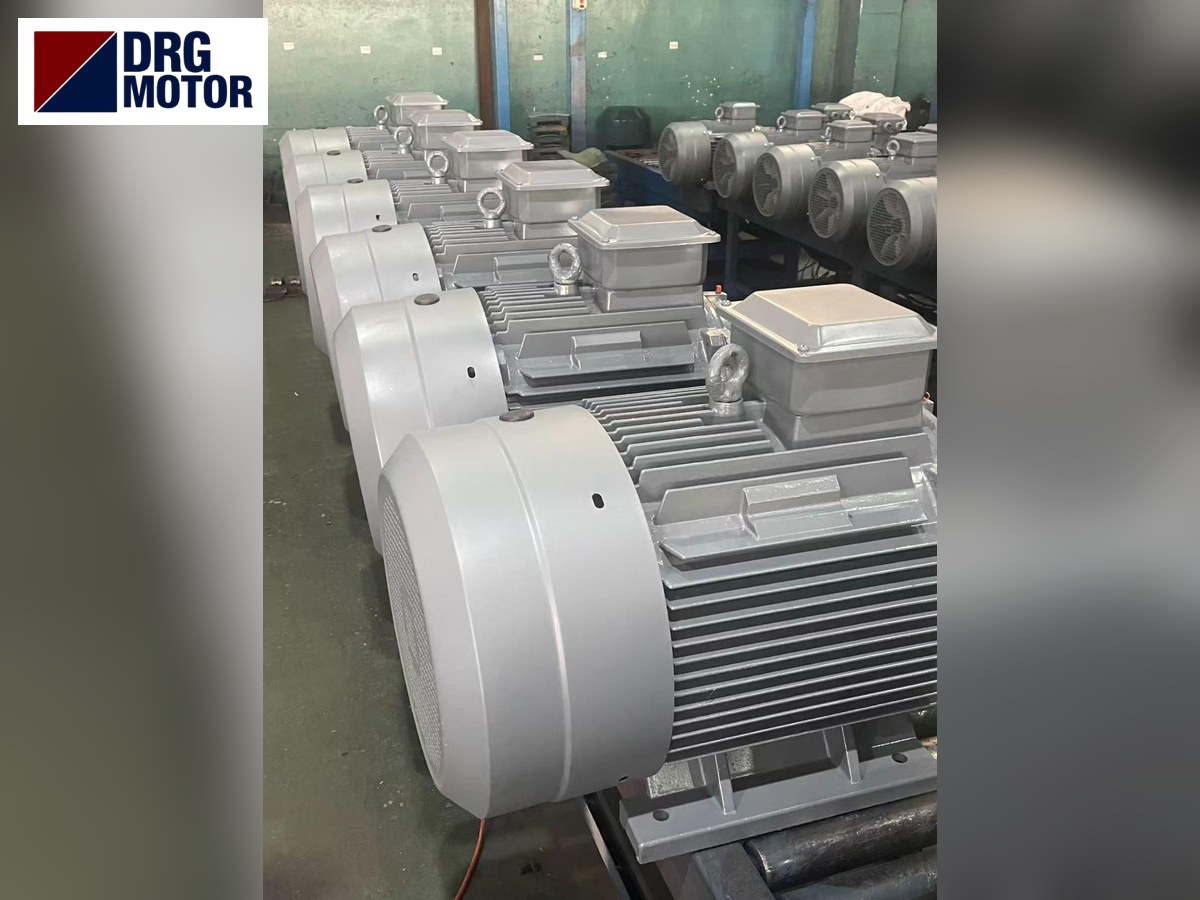
A car wash site never runs on a single motor. Every token-operated self-service bay has a motor turning its high-pressure pump; rollover and tunnel washes add brush, vehicle transport and drying motors; and behind the scenes foam and chemical pumps, vacuum turbines and water reclaim pumps keep working. Choosing a motor for one pressure pump is covered step by step in our article on three-phase motor selection for a pressure car wash machine. This page looks at the whole facility: which point uses which kind of motor, what a standard IEC motor can cover, and what it cannot.
DRG Motor is a manufacturer, supplier and seller of electric motors. We do not sell the wash machine itself, plunger pumps, brushes, gearboxes, dryer fan impellers, vacuum turbines, water treatment units or speed drives; we supply the three-phase asynchronous motors that turn them. Suitable models, from pumps to dryers, are listed on the Buy Electric Motors Online page.
Where motors work in a car wash facility
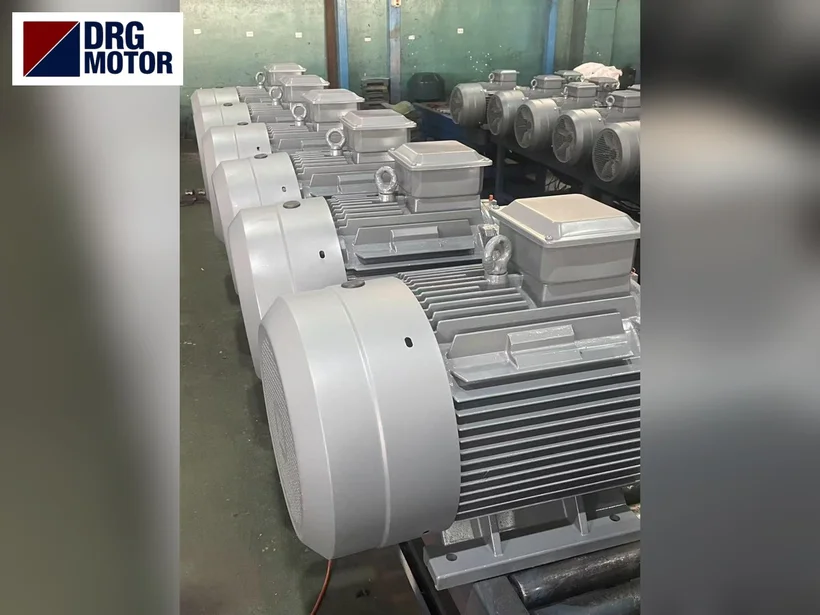
Token-operated self-service bays
Each bay gets its own high-pressure unit: plunger pump, motor, pressure regulating valve and foam line share one frame. The units usually stand in a row in the plant room and start on a signal from the token or card reader. There are as many pump motors as bays, and they are the motors that start most often on the site.
Rollover (gantry) wash
The vehicle stands still and the gantry moves back and forth over it. The top brush, two side brushes and wheel brushes turn on separate motors; gantry travel on its rails, opening and closing of the brush arms, and raising and lowering of the top brush are done by small drives. Drying fans run on the final pass.
Tunnel wash
Here the vehicle is pulled by a chain past fixed stations. The chain turns either on a hydraulic motor or on an electric motor coupled to a gearbox. Pre-wash arches, brush stations, wax and rinse arches and the exit dryer are lined up along one track.
Vacuum and water reclaim
Token vacuum stations draw suction from a turbine motor. On larger sites wash water passes through a settling pit and filters before reuse; surface pumps or pumps sitting inside the pit drive that loop.
How many kW are car wash motors? Values from maker sheets
A) Motor ratings given in car wash equipment catalogues:
| Facility / unit | Motor power | Number / layout | Note |
|---|---|---|---|
| High-pressure pump set, 15 L/min – 200 bar | 5.5 kW | one set per bay | pump-motor set catalogue |
| Same catalogue, 25–30 L/min – 200–250 bar | 11 kW | heavy-duty set | truck and bus washing |
| Rollover wash: brush rotation | 0.37–0.75 kW | top brush 1, side brushes 2, small brushes 2 | first rollover sheet |
| Same rollover: drying fans | 5.5 kW × 4 | 2 on top, 2 on the sides | machine total 30.5 kW |
| Another rollover: drying | 3 kW × 4 | 12 kW in total | second rollover maker |
| Tunnel wash: conveyor and drying | 1.5 kW conveyor; 5.5 kW × 4 drying | single line | tunnel sheet; pumps 1.5 / 2.2 / 4 kW |
| Two-station vacuum unit | 3 kW × 2 | one turbine per station | token vacuum catalogue |
| Water reclaim unit | 7.5 kW × 4 | cut in one after another with flow | large-site unit |
The table splits into two groups: brushes, travel and arm movements stay small at 0.18–0.75 kW, while pump and drying motors rise to 3–11 kW. The values belong to sample machines; the motor rating of your own machine is set by the machine maker’s plate and documents.
B) Overlap with the DRG range: 3–11 kW pump, drying, vacuum and reclaim motors match our cast iron models in 100L, 112M, 132S, 132M and 160M frames; 0.55–0.75 kW drives match the 80 frame. Outside our range: the wash units with motor and gear train in one housing that make up most brush drives, lifting axes that need a brake, axes positioned by servo, and submersible pumps lowered into the pit.
High-pressure pump: belt or coupling?
A plunger pump connects to the motor in three ways. On small and mid-size sets a hollow-shaft pump sits directly on the motor flange; the motor is then B5 or B35 and its shaft diameter must equal the pump bore. Larger sets put a bell housing and flexible coupling in between. Older station machines use a foot-mounted B3 motor driving the pump through pulleys and a belt; the pulley ratio sets pump speed, so the maximum speed on the pump plate is never exceeded.
Rough check of pump power
The pump plate gives pressure (bar) and flow (L/min). For a rough check use kW ≈ pressure × flow / 600 / η, where η stands for the pump’s own losses and is assumed here at 0.85–0.90:
| Pump plate | Hydraulic power | Shaft power (η 0.90–0.85) | Next standard motor |
|---|---|---|---|
| 12 L/min – 160 bar | 3.2 kW | 3.56–3.76 kW | 4 kW · DRG-112M-4 |
| 18 L/min – 180 bar | 5.4 kW | 6.00–6.35 kW | 7.5 kW · DRG-132M-4 |
The formula gives a range, not an exact figure. Drawn power drifts as nozzles wear and pressure settings change, so the top of the range is rounded up to the next standard motor. The machine maker’s value always governs; the formula is a check for a pump whose plate is unreadable. You can enter your own values in our pump motor power calculator.
Pump speed and pole count
Car wash pumps are built for 1450 or 2900 rpm. A 1450 rpm pump pairs with a 4-pole motor, a 2900 rpm pump with a 2-pole one; a belt drive can bridge the difference through its pulley ratio, a direct flange-mounted pump cannot. For general pump motor choice see our Pump Motors category.
Click to see current electric motor prices and order nowSEE PRICES →
Brush, conveyor and dryer drives
Brush motors and the gearbox
Rollover and tunnel brushes turn at around a hundred revolutions per minute, so the brush shaft is driven through a gear unit rather than straight from the motor. On most machines motor and gear unit arrive as one water-resistant block that is a spare part of the machine maker. DRG does not sell gearboxes. Where a brush drive consists of a separate gearbox and a separate motor, a standard IEC motor can be fitted to that gearbox with a B5 flange; flange, shaft and speed are compared with the old motor. See our Electric Motors for Gearboxes page for details. Axes that raise the top brush and must hold it under load need a brake motor, which is not in our range.
Vehicle pulling chain
If the tunnel conveyor runs on a hydraulic motor, the electric motor only turns the hydraulic unit’s pump; motor choice for such units is on our Hydraulic Power Unit Electric Motors page. If the chain runs through a gearbox, the motor is chosen to the gearbox input.
Drying fans
Rollover and tunnel dryers are fans of 3–5.5 kW turned directly by 2-pole motors, running at full load for a few minutes per vehicle. The impeller sits on the motor shaft, so shaft diameter and key must stay the same. For other jobs that need pressurised air, see our Air Blower Electric Motors page.
Foam, vacuum and water reclaim
Foam and chemical pumps
Dosing pumps on foam, shampoo and wax lines are mostly small units supplied with their own motor; the whole pump is replaced. If a chemical surface pump is coupled to a separate IEC motor, the motor can be changed; keep it out of the zone where foam splashes.
Vacuum units
Token vacuums have one turbine per station. High-speed motors built as one piece with the turbine are not in our range. On side channel suction units coupled or flanged to a standard 2-pole IEC motor, the motor can be replaced with a DRG model.
Reclaim and treatment pumps
A submersible pump in the settling pit is outside our range. Centrifugal surface pumps standing outside the pit, however, run on standard motors. For the treatment side see our Water Treatment Plant and Wastewater Treatment Plant pages; for industrial machines that recirculate wash water in a similar way, see the Glass Washing and Crate and Pallet Washer pages.
Worked example: current of a four-bay self-service site
Assumption: in each of four bays a 12 L/min – 160 bar pump at 1450 rpm; a 3 kW turbine at each of two vacuum stations; one 2.2 kW reclaim pump. The figures are an example:
| Point | DRG equivalent | Current 400 V | Connection |
|---|---|---|---|
| Bay pump 4 kW, 1450 rpm (4 off) | DRG-112M-4 | 7.95 A × 4 | delta |
| Vacuum turbine 3 kW, 2-pole (2 off) | DRG-100L-2 | 5.71 A × 2 | star |
| Reclaim pump 2.2 kW | DRG-90L-2 | 4.35 A | star |
| All at once | — | 47.57 A | — |
With everything running at once the motors draw about 47.57 A. In practice bays do not all run together, but the panel and cables are sized for that case. Wound for 400/690 V, the 4 kW pump motors are connected in delta on 400 V mains; the smaller 230/400 V motors go in star.
Starting the bay pump
The 4 kW model has a starting current of 7.8 times rated current; direct-on-line it draws about 62.0 A. Star-delta starting brings that down to roughly a third, about 20.7 A. Systems that stop the motor when the gun trigger is released raise the number of starts; our star-delta tool shows the options side by side.
Small businesses with a 220 V supply
A small site with one bay and one vacuum may have only a single-phase 220 V line. All models on this page are three-phase, and we do not recommend single-phase motors in this category. There are two honest routes: apply to the grid operator for a three-phase supply, or feed a small motor with 230/400 V windings, connected delta, through a converter taking single-phase in and giving three-phase out. The second route only works up to the drive’s power limit, and DRG does not sell drives; pumps of 4 kW and above need a three-phase line.
DRG motors for car wash facilities
Models matching pump, drying, vacuum and small drive points:
| Model | Power / speed | Frame · shaft D×E | Current 400 V |
|---|---|---|---|
| DRG-801-4 | 0.55 kW / 1400 rpm | 80 cast iron · 19×40 | 1.31 A |
| DRG-90L-2 | 2.2 kW / 2895 rpm | 90L cast iron · 24×50 | 4.35 A |
| DRG-100L-2 | 3 kW / 2895 rpm | 100L cast iron · 28×60 | 5.71 A |
| DRG-112M-4 | 4 kW / 1450 rpm | 112M cast iron · 28×60 | 7.95 A |
| DRG-132S1-2 | 5.5 kW / 2930 rpm | 132S cast iron · 38×80 | 10.1 A |
| DRG-132S-4 | 5.5 kW / 1460 rpm | 132S cast iron · 38×80 | 10.7 A |
| DRG-132M-4 | 7.5 kW / 1460 rpm | 132M cast iron · 38×80 | 14.3 A |
| DRG-160M-4 | 11 kW / 1465 rpm | 160M cast iron · 42×110 | 20.4 A |
For direct flange-mounted pumps and coupling bells the flange size decides. B5 flange and shaft values:
| Frame | Shaft D×E | Flange P / M / N | Hole S |
|---|---|---|---|
| 100L/112M | 28×60 | 250 / 215 / 180 | 14.5 |
| 132S/132M | 38×80 | 300 / 265 / 230 | 14.5 |
| 160M/160L | 42×110 | 350 / 300 / 250 | 18.5 |
DRG motors carry IP55 protection against dust and water splashed from any direction. The motor should never be the target of a wash gun; place it in the plant room or a closed cabinet with the cable gland facing down.
Live price table
The table below fetches current store prices for these models on every page load:
| Model | Power / speed | Frame · current 400 V | Price |
|---|---|---|---|
| DRG-801-40.75 HP | 0.55 kW · 1500 rpm | Cast iron 80 · 1.31 A | $91.72 (€81.91) Details & buy → |
| DRG-90L-23 HP | 2.2 kW · 3000 rpm | Cast iron 90L · 4.35 A | $154.45 (€137.93) Details & buy → |
| DRG-100L-24 HP | 3 kW · 3000 rpm | Cast iron 100L · 5.71 A | $177.89 (€158.87) Details & buy → |
| DRG-112M-45.5 HP | 4 kW · 1500 rpm | Cast iron 112M · 7.95 A | $254.38 (€227.18) Details & buy → |
| DRG-132S-47.5 HP | 5.5 kW · 1500 rpm | Cast iron 132S · 10.7 A | $342.01 (€305.44) Details & buy → |
| DRG-132S1-27.5 HP | 5.5 kW · 3000 rpm | Cast iron 132S · 10.1 A | $338.72 (€302.50) Details & buy → |
| DRG-132M-410 HP | 7.5 kW · 1500 rpm | Cast iron 132M · 14.3 A | $394.89 (€352.66) Details & buy → |
| DRG-160M-415 HP | 11 kW · 1500 rpm | Cast iron 160M · 20.4 A | $568.76 (€507.94) Details & buy → |
DRG MOTOR motors are guaranteed against material and manufacturing defects for 2 years from the delivery date (warranty certificate).
Motors in this power range
- DRG-100L-2 – 3 kW – 2895 rpm – 100L cast iron
- DRG-112M-4 – 4 kW – 1450 rpm – 112M cast iron
- DRG-132S1-2 – 5.5 kW – 2930 rpm – 132S cast iron
- DRG-132M-4 – 7.5 kW – 1460 rpm – 132M cast iron
Click to see current prices and order these motors nowSEE PRICES →
Browse the products, ask for a quote: all models are on the Buy Electric Motors Online page. Tell us where the motor works (bay pump, dryer, vacuum, reclaim) and send a plate photo via WhatsApp; we will check power, speed, flange and connection together. Phone: +90 (542) 666 11 11.
Frequently asked questions
A brush motor burned out; can I buy just the motor?
Yes if motor and gear unit are separate parts; if they form one block, the unit comes from the machine maker.
For questions: +90 (542) 666 11 11 · info@drgmotor.com · contact.


