 English
 Le français
 Türkçe

In an impact crusher, the decisive quantity is the peripheral speed of the rotor; this speed determines the impact energy of the stone, the product size and the wear of the blow bars and plates. Motor selection works backwards from this speed: first, which motor speed and pulley ratio will reach the required rotor speed, then how the large rotor will be accelerated by the motor.
Peripheral speed and rotor speed
Peripheral speed is found from v = π × D × n / 60 (D: rotor diameter, m; n: rotor speed, rpm). For example, if a rotor 1.2 m in diameter turns at 600 rpm, the peripheral speed is about 37.7 m/s. Crusher manufacturers recommend different speed ranges for primary and secondary crushing; on secondary and tertiary crushers, where a fine product is wanted, the speed is generally higher. As speed rises the product gets finer, but wear and crusher load also increase.
Motor speed and pulley ratio
Rotor speed is almost always below motor speed, and the difference is bridged by the belt and pulley drive. A 4-pole motor gives a high ratio with a small motor pulley; a 6-pole motor reaches the same rotor speed with a lower ratio, but needs a bigger frame at equal power. For example, in DRG records the 185 kW 1500 rpm model is in the 315L frame and the 185 kW 1000 rpm model in the 355M frame. The choice is made according to pulley diameter limits, belt speed and the existing baseframe.
Rotor inertia and starting
A heavy rotor behaves like a flywheel: it evens out the impacts, but the motor takes a long time to reach rated speed. During this time the starting current stays high and the winding heats up. That is why the order should state the rotor inertia (or the run-up time the manufacturer specifies), the pulley ratio and the starting method; whether the start is acceptable for the motor is checked with these data. If material is left on the rotor, starting becomes even heavier; where possible, start with the crushing chamber emptied.
Information needed for selection
- Crusher model, rotor diameter and recommended rotor speed range
- Motor power and pulley diameters recommended by the crusher manufacturer
- Rotor inertia or starting time, starting method
- Whether it will be used for primary or secondary crushing, and the hardness of the stone to be fed
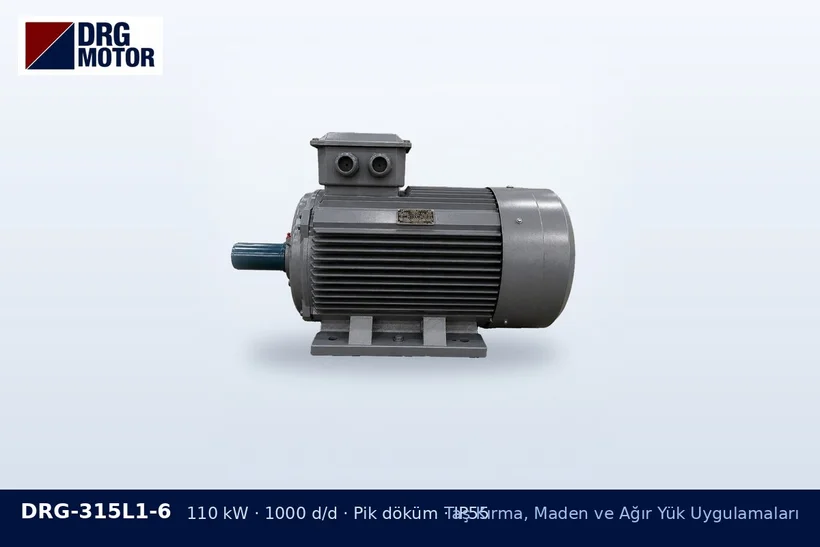
DRG crusher motors rated 75 kW or more are offered with SF 1.15. Depending on the application, see the primary impact crusher motor and secondary impact crusher motor pages, and for dimensions the 185 kW 315L cast iron model record.