 English
 Le français
 Türkçe

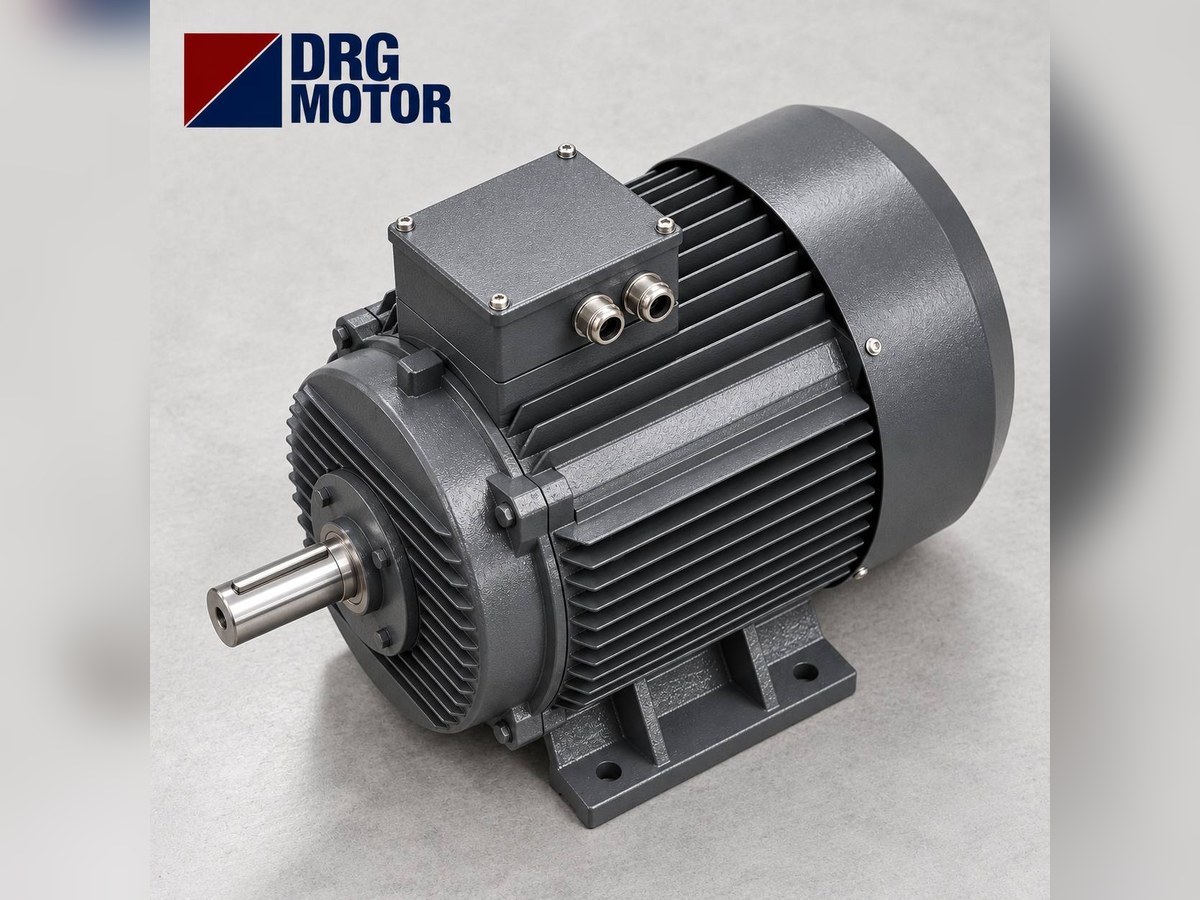
An agricultural machine electric motor is the drive motor of the stationary machines that receive, clean, separate, dry, convey and store crops after harvest. Almost all of these machines use a standard three-phase induction motor; power starts at 0.25 kW on small screens and augers and reaches up to 37 kW per motor on dryer fans. The motor's job changes with the machine: turning a drum slowly, shaking a screen box, spinning a fan impeller at high speed or lifting a loaded elevator.
Below is the route the crop takes on a farm, at a grain receiving point and in a seed plant, with the motor's duty at each stop. Matching motors, with live prices, are listed under Buy Electric Motors Online.
From harvest to silo: the machines the crop passes through
Wheat, barley, maize or sunflower from the combine always follows the same order before storage. At least one electric motor runs at each stop:
- Intake: The trailer or truck tips into the intake pit. A chain conveyor or auger under the pit carries the crop to the elevator boot.
- Pre-cleaning: Most of the straw, cobs, soil clods, stones and dust are removed in a drum screen and an air-channel cleaner.
- Screening and grading: Seed or milling grain is separated from broken kernels, weed seeds and light kernels by size, length and specific weight.
- Drying: Maize and paddy harvested wet are brought down to storage moisture in a tower or batch dryer.
- Conveying: The elevator lifts the crop, augers and conveyors distribute it horizontally.
- Silo and storage: The silo top distributor, unloading auger and bin sweep auger fill and empty the bins.
Each link of this chain has its own subpage in the series: Grain and Seed Cleaning, Grain Screening and Grading, Grain Drying, Agricultural Elevator and Agricultural Auger and Conveyor motors.
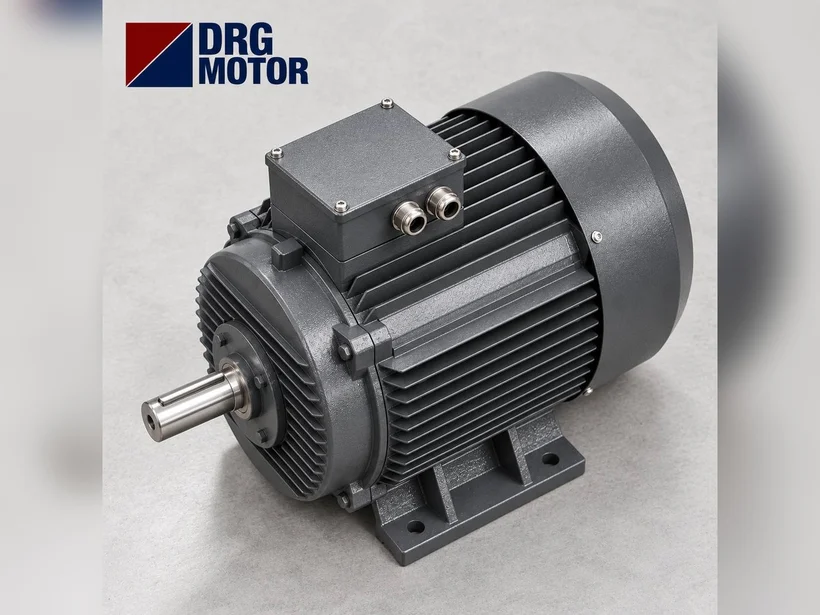
What does the motor do in each machine?
Cleaning and screening machines
In a drum pre-cleaner the motor turns a perforated cylinder through a gearbox at a few tens of revolutions per minute; the load is low, but it does not stop during a harvest day. In an aspirator cleaner and a destoner the main motor is the fan: it sucks away light straw, husks and dust and takes most of the power. On graders, indented cylinders and gravity tables the motors are small, but speed setting decides separation quality, so running them on an inverter is common.
Dryer fans and auxiliaries
Most of the installed power of a dryer is in the fans. Next to several large fans, a tower dryer also has small motors on the loading auger, discharge conveyor and metering roll. For the technical detail of fan motors, see our Fan Motors category.
Elevators, augers and conveyors
These machines work with a motor and gearbox and often start loaded: when power is lost they are full of grain. A backstop is fitted to the bucket elevator gearbox, while on an auger the fill level and slope decide the power. For the calculation detail see our bucket elevator motor and auger motor articles.
Click to see current electric motor prices and order nowSEE PRICES →
Motor power in agricultural machines: market values
A) Power values seen in manufacturer catalogues
| Machine / capacity | Motor power | Single or total | Note |
|---|---|---|---|
| Drum pre-cleaner, 50–100 t/h | 0.55–1.5 kW drum | Single drum motor | Two manufacturer catalogues |
| Aspiration fan of the same drum | 4–11 kW | Separate fan motor | Manufacturer catalogue |
| Aspirator, 12–60 t/h | 0.75–7.5 kW | Single fan motor | Manufacturer catalogue |
| Indented cylinder, 4–25 t/h | 1.1–5.5 kW | Single motor | Manufacturer catalogue |
| Gravity table, 2–15 t/h | 3–15 kW fan | Fan + 0.55–1.1 kW drive | Manufacturer catalogue |
| Bucket elevator, largest bucket | 1.1–30 kW | Single drive | Manufacturer catalogue |
| Chain conveyor, 40–120 t/h | 1.5–15 kW | Single drive | Table by length |
| Mixed-flow dryer fan | 15–50 HP (≈11–37 kW) | Per fan, 2–6 fans | Manufacturer catalogue |
Across post-harvest plant machines, single motors range from about 0.25 to 37 kW with model and throughput; the smallest value is the 0.25 kW motor of the waste auger under a drum, the largest is a dryer fan. These figures are single-motor ratings. On a large six-fan dryer the fans alone add up to 240 HP (about 179 kW); do not read that as the power of one motor.
A different quantity sets the power on each machine: height on an elevator, length on a conveyor, airflow and pressure on a fan. The same 60 t/h chain conveyor needs 2.2 kW at 10 metres and 7.5 kW at 50 metres.
B) The match in the DRG range
DRG Motor is a manufacturer, supplier and seller of electric motors. Our range covers 0.25–11 kW in aluminium frames and 0.55–355 kW in cast iron frames, 1000/1500/3000 rpm, 3-phase 230/400 V or 400/690 V; B3, B5, B14 and B35 mounting is specified with the order note. All single motors of 0.25–37 kW in the table above fall inside this range. Machines that come with their own integrated drive, such as optical sorters, and points that need an Ex-certified motor for an explosive dust zone are outside our range.
| Model | Power / speed | Frame · current 400 V | Price |
|---|---|---|---|
| DRG-801-40.75 HP | 0.55 kW · 1500 rpm | Cast iron 80 · 1.31 A | $91.72 (€81.91) Details & buy → |
| DRG-90L-42 HP | 1.5 kW · 1500 rpm | Cast iron 90L · 3.3 A | $144.14 (€128.73) Details & buy → |
| DRG-100L2-44 HP | 3 kW · 1500 rpm | Cast iron 100L · 6.02 A | $203.84 (€182.05) Details & buy → |
| DRG-112M-45.5 HP | 4 kW · 1500 rpm | Cast iron 112M · 7.95 A | $254.38 (€227.18) Details & buy → |
| DRG-132S1-27.5 HP | 5.5 kW · 3000 rpm | Cast iron 132S · 10.1 A | $338.72 (€302.50) Details & buy → |
| DRG-132M-410 HP | 7.5 kW · 1500 rpm | Cast iron 132M · 14.3 A | $394.89 (€352.66) Details & buy → |
| DRG-160M-415 HP | 11 kW · 1500 rpm | Cast iron 160M · 20.4 A | $568.76 (€507.94) Details & buy → |
| DRG-160L-420 HP | 15 kW · 1500 rpm | Cast iron 160L · 27.3 A | $678.13 (€605.61) Details & buy → |
| DRG-180L-430 HP | 22 kW · 1500 rpm | Cast iron 180L · 39.7 A | $919.45 (€821.13) Details & buy → |
| DRG-200L1-240 HP | 30 kW · 3000 rpm | Cast iron 200L · 52.1 A | $1,273.02 (€1,136.88) Details & buy → |
Four conditions that all selections share
Dust and chaff
Grain dust sticks to the motor's cooling fins and fan cover, blocks airflow and heats the winding. The motor should be placed away from the machine's dust outlet and where it can be cleaned; the terminal box cover and cable glands must be tight. In closed silo and elevator heads where dust forms an explosive atmosphere, an Ex motor matching the plant's zone classification is required.
Heavy in season, idle out of season
During harvest weeks the machines run day and night without a break, and for the rest of the year they wait for months. In a standing motor the bearing grease dries out and moisture gets into the winding. Before the season, turn the motors by hand, measure insulation resistance and clean the fan cover. This check prevents a failure on the first night of harvest.
Open air and rain
Fit a rain cover on motors at the intake pit and silo top, and bring the cable in from below.
Grid capacity and starting
In rural plants the transformer is limited and the line is long. If motors start together the voltage drops and contactors drop out. That is why machines are started one by one against the flow direction and large fans are started with a soft starter or inverter. On long cable runs, check the cross-section with the motor cable size calculator.
Example: current and starting order on a small intake line
Consider four motors on the same supply at a grain receiving point. Current and starting values are taken from the DRG catalogue:
| Model | Power / speed | Frame | Current 400 V |
|---|---|---|---|
| DRG-90L-4 | 1.5 kW / 1445 rpm | 90L cast iron | 3.3 A |
| DRG-132S1-2 | 5.5 kW / 2930 rpm | 132S cast iron | 10.1 A |
| DRG-112M-4 | 4 kW / 1450 rpm | 112M cast iron | 7.95 A |
| DRG-100L2-4 | 3 kW / 1450 rpm | 100L cast iron | 6.02 A |
- In order: drum (1.5 kW), aspiration fan (5.5 kW, 2-pole), elevator (4 kW) and intake auger (3 kW).
- Sum of the four rated currents: 3.3 + 10.1 + 7.95 + 6.02 ≈ 27.4 A.
- If all four start direct-on-line at once, the starting currents (Is/In: 7.0; 8.3; 7.8; 7.6) add up: about 215 A.
- With sequential starting, the hardest moment is the fan starting while the other three run: 10.1 × 8.3 + 17.3 ≈ 101 A.
So the right starting order cuts the momentary current drawn from the grid by more than half with the same motors. Adding an inverter or soft starter to the fan lowers that peak further. Methods are compared on the star-delta starting page.
From PTO to electric drive: when does it make sense?
Portable augers, field cleaners and mobile dryers driven by a tractor power take-off (PTO) are outside the scope of this page. Converting them to an electric motor is not always right: if the machine moves from field to field and there is no grid nearby, the tractor is the most practical power source.
Switching to an electric motor makes sense in plants where the machine's location is fixed: the intake pit, a silo group, a stationary dryer or a seed processing line. There, instead of a tractor idling for hours, the motor runs only when needed, can be tied into automation and can be started in sequence. When converting, motor power is chosen from what the machine really draws, not from the tractor's horsepower; the pulley or gearbox ratio is recalculated for the 540 rpm PTO speed.
Irrigation pumps are not part of this category; for them, the Pump Motors category has an agricultural irrigation pump page. Grinding, mixing and pellet machines on a feed mill line are covered in a separate category, Feed Machine Electric Motors.
Information to prepare when buying an agricultural machine motor
- Machine name and duty: drum, aspirator, elevator, dryer fan, auger.
- Old motor nameplate: kW, speed, voltage, current and frame size.
- Mounting: foot (B3), flange (B5 or B14) or both (B35); flange motors are common on fans.
- Connection: direct impeller, belt and pulley or gearbox; gearbox ratio and input flange.
- Starting method, and whether the machine starts while full.
- Environment: open or closed area, dust zone class.
Some common power ratings:
- DRG-90L-4 – 1.5 kW – 1445 rpm – 90L cast iron
- DRG-112M-4 – 4 kW – 1450 rpm – 112M cast iron
- DRG-132S1-2 – 5.5 kW – 2930 rpm – 132S cast iron
- DRG-160M-4 – 11 kW – 1465 rpm – 160M cast iron
- DRG-180L-4 – 22 kW – 1470 rpm – 180L cast iron
- DRG-200L1-2 – 30 kW – 2960 rpm – 200L cast iron
Click to see current prices and order these motors nowSEE PRICES →
DRG MOTOR motors are guaranteed against material and manufacturing defects for 2 years from the delivery date (warranty certificate). Our general approach to supplying farms is described in the motor supply for agriculture article.
Frequently asked questions about agricultural machine motors
Which motor is used in agricultural machines?
Stationary post-harvest machines use a standard three-phase squirrel-cage induction motor. Fans mostly use 2-pole motors; elevators, augers and drums use 4-pole motors with a gearbox.
Is a single-phase motor enough for an agricultural machine?
It can be on small farm augers, but machines of several kW such as an intake line and a dryer need three-phase. The DRG range consists only of three-phase motors.
How many kW should a dryer fan motor be?
Manufacturer catalogues show 15–50 HP (about 11–37 kW) per fan on mixed-flow dryers. The exact value depends on dryer capacity and number of fans; go by the nameplate.
What should be checked on motors before harvest season?
Insulation resistance, bearing noise, dust on the fan cover and cooling fins, terminal connections and the overload setting. Turn a standing motor by hand and run it unloaded to measure its current.
A nameplate photo is usually enough for us to name the replacement. Phone +90 (542) 666 11 11, e-mail [email protected], contact page. The full 120-model shop: Buy Electric Motors Online.


