 English
 Le français
 Türkçe

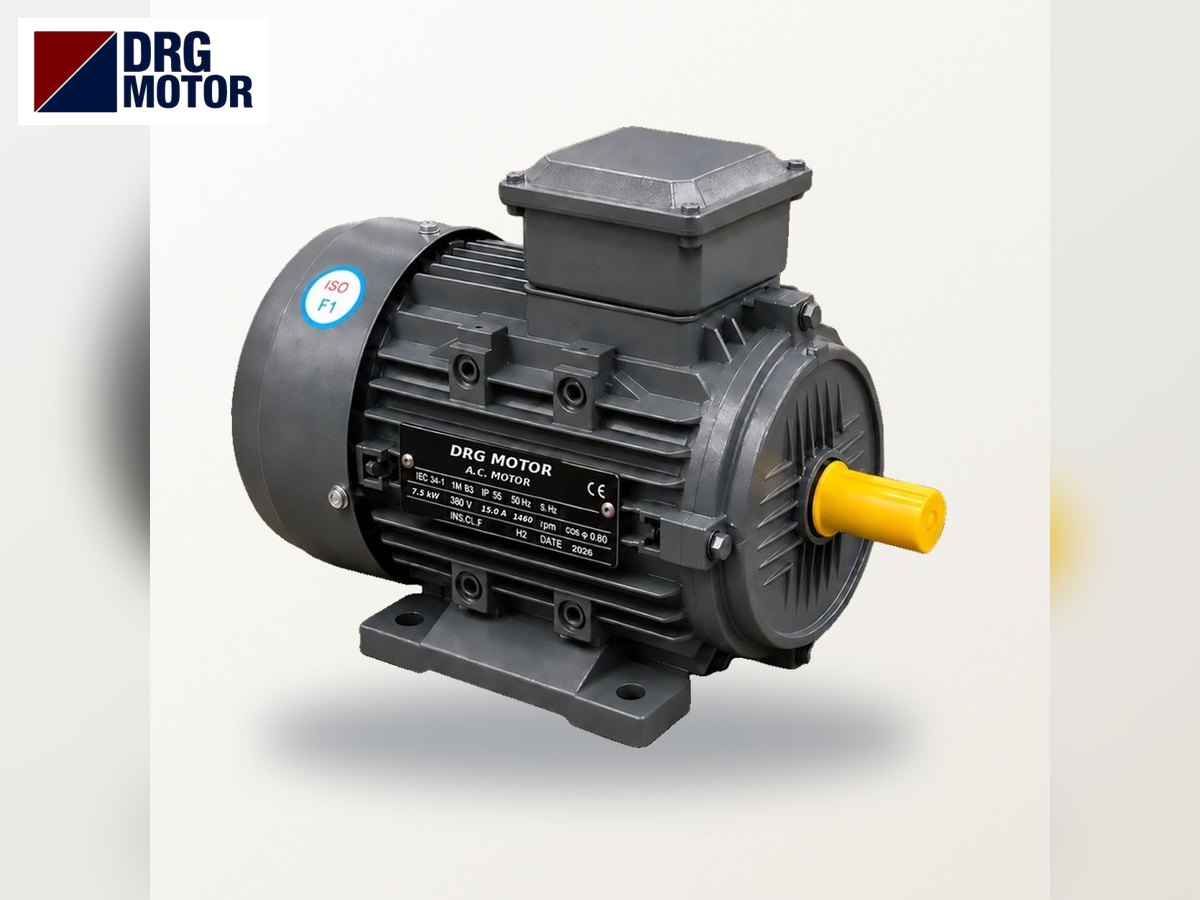
On a conventional metal lathe the electric motor’s main job is to turn the headstock spindle, and with it the chuck and the workpiece. The motor sits in the lathe stand and drives the headstock gearbox by belt; speed steps are chosen with the gear levers, not with the motor. Next to it there is a coolant pump and, on larger lathes, a rapid traverse motor that moves the carriage quickly. Maker catalogues mostly show main motors of 1.1–7.5 kW on workshop and universal lathes, a band covered by our aluminium housing electric motors.
DRG Motor is a manufacturer, supplier and seller of electric motors. We do not sell the lathe, the headstock gearbox, belts and pulleys, inverters, CNC drives, servo motors or motor spindles. We supply the standard three-phase motor used for the main spindle and auxiliary points of a conventional lathe.
How the motors share the work on a lathe
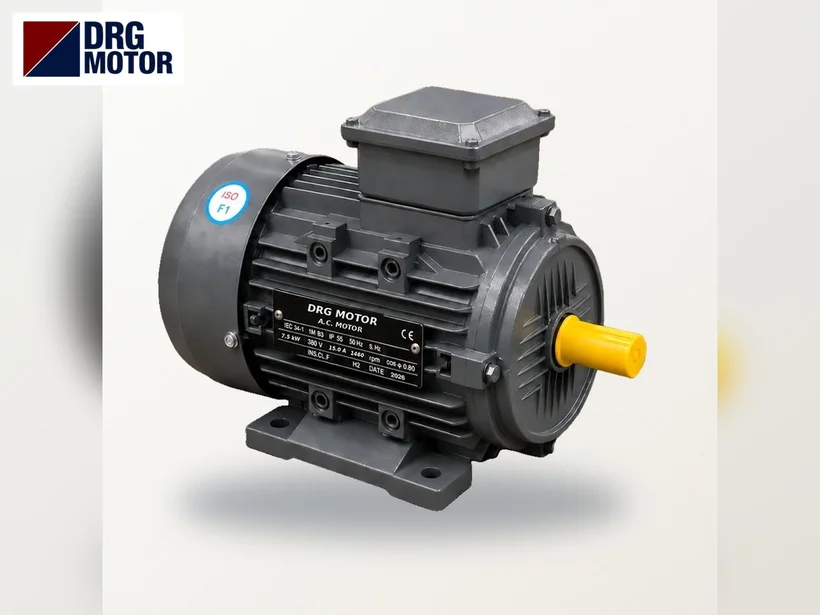
Main spindle motor
All the cutting power comes from this motor. It rests on an adjustable plate in the lower part of the stand; the plate slides to set belt tension. Most lathes use a 4-pole motor, because pulley diameters and gear ratios are worked out for the 1500 rpm class.
Two-speed main motors
Many universal lathes have a two-speed main motor: a pole-changing (Dahlander) design switching between 4 and 2 poles in one frame, or a motor with two separate windings, doubles the number of gearbox steps. No two-speed motor is offered by DRG. If a single-speed motor goes onto such a lathe, the steps belonging to the high-speed winding are lost; whether that suits the way the lathe is used is the owner’s call, and the machine maker’s motor data and mounting dimensions are checked.
Coolant pump and rapid traverse
The coolant pump is very small; product sheets show values such as 0.125 kW, and on most lathes it is a unit dipped into the tank and built in one piece with its pump. That pump motor is outside our range; the pump is replaced as a whole. The rapid traverse motor is also usually around 0.12–0.37 kW; for ratings of 0.25 kW and up, our aluminium models can be considered.
CNC lathes
On a CNC lathe the spindle is driven by a servo or a dedicated inverter-fed spindle motor and the axes by servo motors. These are outside the DRG range. What we can cover on a CNC machine are auxiliaries running on standard IEC motors, such as a chip conveyor or a hydraulic unit pump.
Lathe motor ratings in maker catalogues
A) Values taken from conventional lathe catalogues:
| Lathe class | Main spindle motor | Auxiliary motors | Note |
|---|---|---|---|
| Bench type, 300 mm swing | 1.1 kW | none | first maker’s catalogue |
| Workshop type, 330–356 mm | 1.5 kW and 2.4 kW | coolant system standard | first maker’s catalogue |
| Variable speed, 356 mm | 4 kW | coolant system standard | inverter version |
| Universal, 460–560 mm | 5.5 kW; top version 7.5 kW | rapid feed motor on top version | first maker’s catalogue |
| Universal, second maker | 4 / 5.5 / 7.5 kW | coolant pump 0.125 kW, rapid traverse 0.12 kW | product sheet |
| Heavy type, 850–1000 mm | 18.5–22 kW | rapid feed on X and Z | above the aluminium range |
As swing and centre distance grow, so does the main motor: from 1.1 kW on a bench lathe to 5.5–7.5 kW in the 460–560 mm class. Heavy lathes at 18.5–22 kW sit above the aluminium range. The figures come from sample models; on your own lathe the plate value and the machine maker’s data apply.
B) Overlap with the DRG range: main spindle motors from 1.1 to 7.5 kW match our aluminium models in 90, 100, 112 and 132 frames, and 11 kW main motors match the 160M frame. Lathes needing more than 11 kW are outside the aluminium housing range; for them see the cast iron models on our General Purpose Electric Motors page.
Click to see current electric motor prices and order nowSEE PRICES →
Where an aluminium housing helps on a lathe
The motor compartment inside the lathe stand is narrow and low; the motor is often slid in on its side through a side cover. A light, compact aluminium housing makes it easier for one person to fit it there and set belt tension. Moving a lathe within the shop or overhauling an old machine also becomes lighter work. In heavy roughing the real load is carried by the gearbox and the cast bed, not by the motor’s outer shell. Even so, cast iron motors fit better on large lathes above 11 kW and in constantly interrupted cutting.
Dimensions checked at replacement
Power, speed, voltage and connection
Plate power and speed are kept as they are. Older lathes often carry motors wound for 380 V delta; our models up to 3 kW are wound 230/400 V and connect in star on 400 V mains, while our 4 kW and larger models are wound 400/690 V and run in delta on 400 V. On a lathe started star-delta the motor must be able to run in delta at 400 V.
Feet, shaft and pulley
A lathe motor is mostly foot-mounted B3; where it bolts to the gearbox housing by flange, B35 is used. Where the bolt pattern of the feet or the centre height is not the same as before, an intermediate plate solves it. As the pulley moves from the old shaft to the new one, shaft diameter and key size must be identical.
Brake and reversing
On some lathes the main motor has an electromagnetic brake that stops the spindle quickly on emergency stop. Brake motors are not in our range; on such a lathe no change to a standard motor is made without discussing the brake’s function with the machine maker. Frequent reversing when threading is done by contactors in the panel and heats the winding; if the lathe runs back and forth often, the power is not reduced.
Small single-phase lathes
Some hobby and bench lathes come with a single-phase 230 V motor. We have no single-phase model for these; running one of our three-phase motors there takes a 400 V three-phase line, or a drive fed from one phase that outputs three.
Environment
Coolant and fine chips can creep into the motor compartment. IP55 covers dust and low-pressure water jets; high-pressure washing of the lathe, or steam cleaning, goes beyond that protection. Turn the terminal box so its gland points to the floor, and keep swarf from packing the grille of the fan cowl.
Example: spindle speeds with the new motor
Assumption: the old main motor runs at 1400 rpm, the motor pulley is 100 mm and the top spindle step is 1600 rpm. A 4 kW DRG-112M-4 (1450 rpm) goes in:
| Case | Motor speed | Highest spindle step | Motor pulley |
|---|---|---|---|
| Old motor | 1400 rpm | 1600 rpm | 100 mm |
| New motor, old pulley | 1450 rpm | about 1657 rpm | 100 mm |
| New motor, reduced pulley | 1450 rpm | 1600 rpm | 96.6 mm |
With the same pulley every step rises by the ratio 1450/1400, roughly 36 rpm for each 1000 rpm. For most jobs this is negligible; if the lathe’s top speed is already at its limit, reducing the motor pulley to about 96.6 mm keeps the old speeds. For cutting power and torque checks before a change, see our article on lathe motor power and speed selection.
Information needed for a quote
- Photo of the main motor plate; single or two-speed?
- Swing diameter and centre distance of the lathe
- Mounting: foot or flange; foot hole spacing and shaft size
- Panel: direct-on-line, star-delta or inverter?
- Does the motor have a brake?
- Daily running time
Aluminium frame DRG models and prices
4-pole models matching the spindle power of conventional lathes (values from the product records):
| Model | Power / speed | Current 400 V · torque | Aluminium frame · shaft D×E |
|---|---|---|---|
| DRG-90S-4 | 1.1 kW · 1500 → 1445 rpm | 2.48 A · 7.27 Nm | 90S · 24×50 |
| DRG-90L-4 | 1.5 kW · 1500 → 1445 rpm | 3.3 A · 9.91 Nm | 90L · 24×50 |
| DRG-100L2-4 | 3 kW · 1500 → 1450 rpm | 6.02 A · 19.8 Nm | 100L · 28×60 |
| DRG-112M-4 | 4 kW · 1500 → 1450 rpm | 7.95 A · 26.3 Nm | 112M · 28×60 |
| DRG-132S-4 | 5.5 kW · 1500 → 1460 rpm | 10.7 A · 36 Nm | 132S · 38×80 |
| DRG-132M-4 | 7.5 kW · 1500 → 1460 rpm | 14.3 A · 49.1 Nm | 132M · 38×80 |
| DRG-160M-4 | 11 kW · 1500 → 1465 rpm | 20.4 A · 71.7 Nm | 160M · 42×110 |
For example DRG-132S-4 gives 36 Nm and DRG-132M-4 49.1 Nm rated torque; both come with a 38×80 mm shaft.
Live price table
Prices in this table are taken from the shop the moment you open the page:
| Model | Power / speed | Frame · current 400 V | Price |
|---|---|---|---|
| DRG-90S-41.5 HP | 1.1 kW · 1500 rpm | Aluminium 90S · 2.48 A | $118.44 (€105.78) Details & buy → |
| DRG-90L-42 HP | 1.5 kW · 1500 rpm | Aluminium 90L · 3.3 A | $137.59 (€122.88) Details & buy → |
| DRG-100L2-44 HP | 3 kW · 1500 rpm | Aluminium 100L · 6.02 A | $194.58 (€173.77) Details & buy → |
| DRG-112M-45.5 HP | 4 kW · 1500 rpm | Aluminium 112M · 7.95 A | $242.82 (€216.85) Details & buy → |
| DRG-132S-47.5 HP | 5.5 kW · 1500 rpm | Aluminium 132S · 10.7 A | $326.47 (€291.56) Details & buy → |
| DRG-132M-410 HP | 7.5 kW · 1500 rpm | Aluminium 132M · 14.3 A | $376.94 (€336.63) Details & buy → |
| DRG-160M-415 HP | 11 kW · 1500 rpm | Aluminium 160M · 20.4 A | $542.91 (€484.85) Details & buy → |
DRG MOTOR motors are guaranteed against material and manufacturing defects for 2 years from the delivery date (warranty certificate).
Motors in this power range
- DRG-100L2-4 – 3 kW – 1450 rpm – 100L aluminium frame
- DRG-132S-4 – 5.5 kW – 1460 rpm – 132S aluminium frame
- DRG-160M-4 – 11 kW – 1465 rpm – 160M aluminium frame
Click to see current prices and order these motors nowSEE PRICES →
Browse the products, ask for a quote: all ratings are on the Buy Electric Motors Online page. Send photos of your lathe and the motor plate via WhatsApp; we will look at two-speed, brake and mounting questions together. Wood lathes are covered separately on our Wood Lathe Motors page.
Frequently asked questions
Why is a lathe motor 4-pole?
The gearbox and pulleys are designed for a 1500 rpm class motor; a 2-pole motor roughly doubles every step and leaves too little torque at low speed.
The motor runs, but the chuck slows under load; is the motor too small?
Check belt tension and belt wear first; a slipping belt gives this symptom. If motor current approaches the plate value, the load really is high.
If I fit an inverter to my old lathe, can I remove the gearbox?
No. At low frequency the motor delivers less power; the torque needed on large diameters comes from the gearbox’s low steps. The inverter is used to refine the steps.
For questions: +90 (542) 666 11 11 · info@drgmotor.com · contact.


