 English
 Le français
 Türkçe

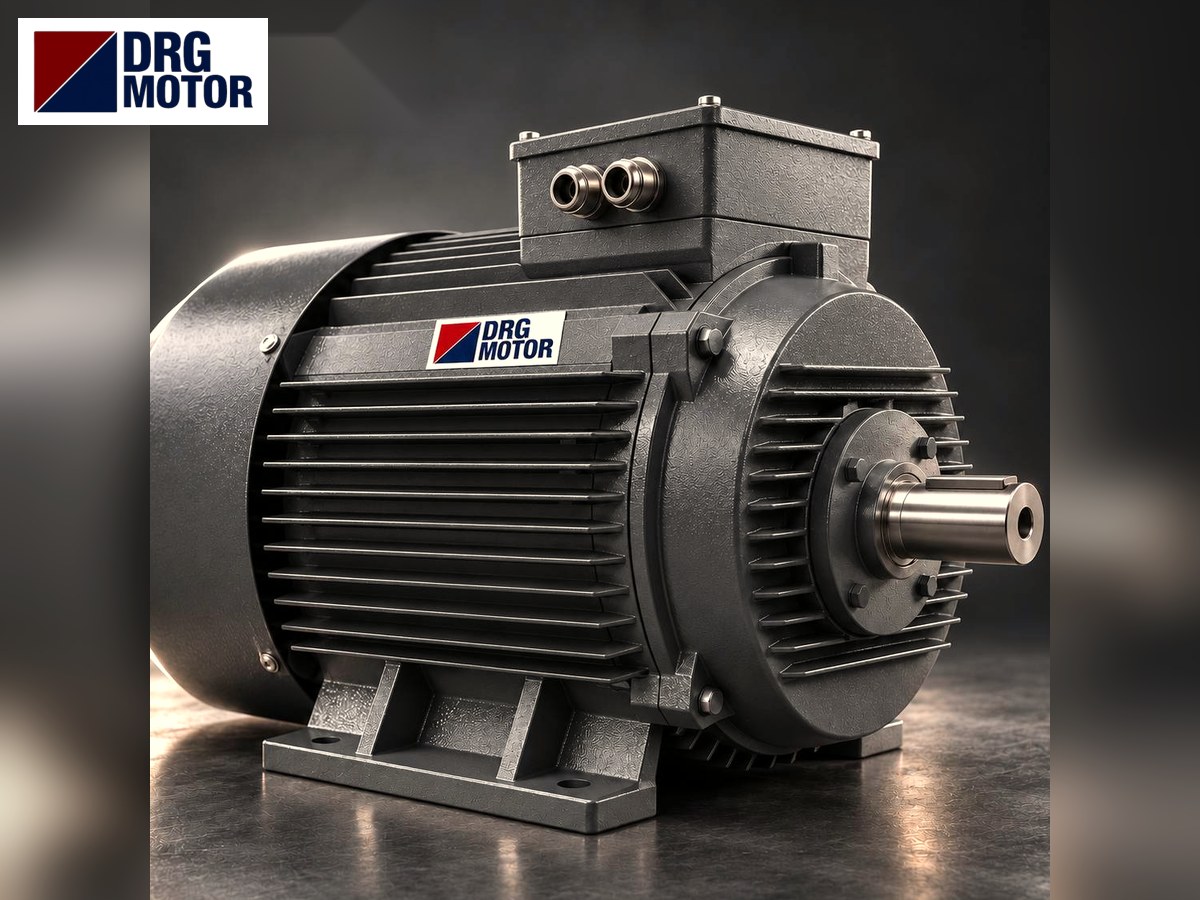
When people say plastic extruder or pelletizing machine motor, they usually mean the main motor turning the screw; yet a recycling pelletizing line runs at least five other motors: the knife rotor of the compactor (agglomerator), the feed belt or screw, the force feeder, the second-stage extruder and the cutter that makes the pellets. This page maps the motors of a line producing pellets from washed flakes or dirty film and explains how each one is chosen.
On this line DRG Motor supplies only the electric motor. Extruders, gearboxes, cutting units and inverters are not part of our range; see the Buy Electric Motors Online page for our own motors.
The motor map of a pelletizing line
A recycling pelletizing line densifies loose, bulky plastic, melts it, filters it, degasses it and cuts it into small, regular pellets. Which motors are present depends on how the material is fed into the line.
Compactor-fed line
Light material such as film, sacks and raffia drops from a belt conveyor into a vertical drum. A knife rotor at the bottom cuts it, heats it by friction, densifies it and pushes it into the mouth of the extruder screw beside it. So the line has at least three large motors: the compactor, the main extruder and, if needed, a second stage.
Force-fed line
Instead of a compactor there is a feed hopper with a vertical or inclined screw inside, pressing flakes that tend to bridge into the extruder throat. Its motor is small, usually with a gearbox and an inverter; one catalogue lists force feeder motors at 5–10 HP. For hard, dense flakes a feed screw may be enough.
Two-stage lines
With printed or moist material, the melt leaving the first extruder passes a filter and enters a second, short extruder where it is degassed again. Because the second screw is short, its motor is roughly a third to a half of the main motor.
Main drive: motor, gearbox and screw
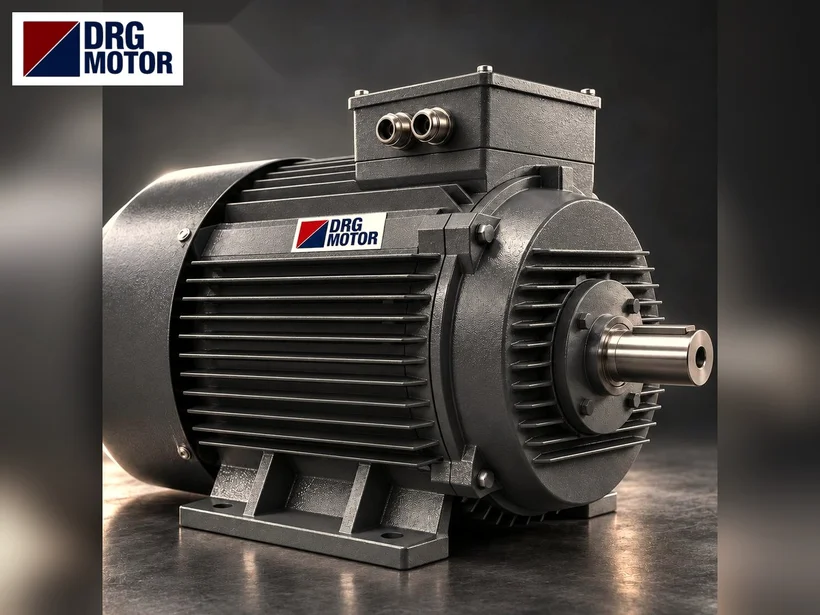
The main motor usually turns the screw through a gearbox connected by belts and pulleys or a coupling. At the gearbox output a thrust bearing carries the screw's back pressure; that load sits on the gearbox bearing, not on the motor. On the motor side, what counts is the constant-torque character: the screw asks for roughly the same torque at any speed.
Speed control and the drive
Screw speed is set by an inverter according to output and melt temperature. DRG Motor does not sell drives; you or the machine builder choose the drive. To parameterise it correctly, enter the rated power, voltage, current, frequency, speed and power factor from the motor nameplate; these values are on our data sheet and nameplate. Inverter mode, low-frequency heating and forced cooling are covered in detail in our extruder motor selection article.
Starting and restarting
An extruder is never started with a cold, full screw: heaters first bring the barrel to melt temperature, then the screw is turned at low speed. Starting with frozen material after a power cut strains the gearbox and the motor. This is a matter of heating sequence and the drive's current limit rather than the motor itself, and it belongs in the operator instructions.
Compactor and feeding motors
Compactor rotor
The compactor motor is one of the hardest-working motors on the line: the rotor cuts and frictionally heats every new pile of film that falls into the drum. In the catalogues we reviewed, the compactor motor is close in size to the main extruder motor of the same line (75–90 kW on the Ø130 mm screw model). Starting with a full drum, wet film and foreign objects make motor current spike. Knife sharpness and the amount of material fed matter as much as motor power.
Feed belt and dosing screw
The speed of the belt conveyor feeding the compactor is set by an inverter according to the level in the drum; on some lines the compactor motor current automatically slows the belt. These motors are small, usually 4-pole with a gearbox. Lines with a roll unwinder for film have a separate small motor for it as well.
Vacuum pump and screen changer
The vacuum pump at the degassing zone and the power pack of the hydraulic screen changer also run on electric motors. In the hydraulic unit the motor turns the pump; the screen changer's cylinder and valves are not part of the motor.
Pellet cutting motors
After leaving the die, the melt is turned into pellets in one of three ways. Each method's cutter motor works on a different logic.
Strand pelletizer
Melt strands from the die cool in a water bath, are dried and fed by a pull-in roller to a knife rotor. Pellet length is set by the relation between strand speed and the rotor's cuts per second, which is why the cutter motor runs on an inverter. In one catalogue we reviewed, cutter motors range from 1.6 to 7.5 kW for cutting widths of 180–260 mm.
Water-ring die-face cutter
Knives turn directly on the die face and the cut pellets fall into a spinning water ring. It is common for film and PE pellets. The cutter motor sits in front of the die, in a hot and humid area; the water pump has its own motor. The catalogue lists the cutter at 1.5–5.5 kW, and on the large model a 7.5 kW cutter with a 5.5 kW water pump.
Underwater pelletizer
Cutting happens at the die face inside a chamber filled with pressurised water; it is usually chosen for high-capacity lines needing precise pellets. The cutter motor is coupled directly to the knife shaft, and the force pressing the knives against the die is often adjusted separately. The motor and control package of these units is specific to the machine maker; always ask for the maker's technical data when replacing the motor.
Click to see current electric motor prices and order nowSEE PRICES →
Motor power in pelletizing lines on the market
The table is compiled from values published in catalogues of pelletizing line manufacturers. Main motor, compactor and auxiliaries are listed separately in each row; they are not line totals.
| Machine / model group | Motor power | Single motor or total | Note |
|---|---|---|---|
| Compactor line, Ø85 mm screw | 30–37 kW main; 37–45 kW compactor; 15–22 kW 2nd stage | each a separate motor | maker catalogue, smallest model |
| Compactor line, Ø130 mm screw | 90–132 kW main; 75–90 kW compactor; 37–45 kW 2nd stage | each a separate motor | same catalogue, mid model |
| Compactor line, Ø200 mm screw | 200–280 kW main; 132–185 kW compactor; 75–90 kW 2nd stage | each a separate motor | same catalogue, largest model |
| Compactor line, Ø80 mm screw, 150–250 kg/h | 55–75 kW main; 45 kW compactor | two main motors, separate | second maker, small model |
| Compactor line, Ø180 mm screw, 950–1300 kg/h | 355–400 kW main; 200–250 kW compactor | two main motors, separate | second maker, large model |
| Force-fed line, Ø100–Ø175 mm | 5–10 HP feeder; 125–350 HP main | separate motors | third maker, given in HP |
| Strand pelletizer, 180–260 mm | 1.6–7.5 kW | single motor | maker catalogue, 150–1000 kg/h |
| Water-ring die-face cutter | 1.5–5.5 kW cutter; 7.5 kW + 5.5 kW water pump on the large model | cutter and pump separate | same maker |
Read together, these catalogues put the main extruder motor at about 30–400 kW, the compactor at 37–250 kW and the cutter at 1.5–7.5 kW; bigger models and outputs sit at the top end. Screw diameter, output, moisture and print coverage decide the power. Values in HP convert at 1 HP ≈ 0.746 kW: 125 HP is about 93 kW and 350 HP about 261 kW.
Two worked examples
Pellet length and cutter speed on a strand pelletizer
Strands are pulled at 60 m per minute, the cutter rotor has 24 teeth and 3 mm pellets are wanted. Cuts per minute = strand speed / pellet length = 60,000 mm / 3 mm = 20,000. Rotor speed = 20,000 / 24 ≈ 833 rpm. When strand speed changes, rotor speed must change by the same ratio to keep pellet length constant; that is why the cutter motor is inverter-driven. A 4-pole motor (about 1450 rpm) is reduced to this speed by a belt or gear ratio.
Checking installed power against line energy
One manufacturer gives 0.3–0.4 kWh/kg energy use for its entire compactor line. For 400 kg of pellets per hour, average draw is between 0.3 × 400 = 120 kW and 0.4 × 400 = 160 kW. In the same catalogue, the model matching this output has a 55–75 kW compactor, a 110–132 kW main motor and a 37 kW second stage; with the upper values, total motor power is 244 kW. Installed power being higher than average draw is normal: motors leave margin for starting, dirty material and output increases. Heaters are not included in this calculation.
DRG motors matching the line
DRG Motor is a manufacturer, supplier and seller of electric motors. We cover most motors on a pelletizing line: three-phase induction motors starting at 0.25 kW in aluminium (up to 11 kW) and reaching 355 kW in cast iron (from 0.55 kW), built as 6-, 4- or 2-pole machines and mounted B3, B5, B14, B34, B35 or vertically. Our upper limit is 355 kW: on one large line we reviewed the main motor is in the 355–400 kW range, and models above 355 kW as well as drives requiring medium voltage are outside our range. We do not offer servo, DC or integrated-drive motors either.
| Model | Power / speed | Frame · shaft D×E | Current 400 V |
|---|---|---|---|
| DRG-100L2-4 | 3 kW / 1450 rpm | 100L cast iron · 28×60 | 6.02 A |
| DRG-132M-4 | 7.5 kW / 1460 rpm | 132M cast iron · 38×80 | 14.3 A |
| DRG-225S-4 | 37 kW / 1485 rpm | 225S cast iron · 60×140 | 66.1 A |
| DRG-250M-4 | 55 kW / 1485 rpm | 250M cast iron · 65×140 | 97.6 A |
| DRG-280M-4 | 90 kW / 1486 rpm | 280M cast iron · 75×140 | 155 A |
| DRG-315M-4 | 132 kW / 1488 rpm | 315M cast iron · 85×170 | 224 A |
| DRG-315L1-4 | 160 kW / 1488 rpm | 315L cast iron · 85×170 | 271 A |
Matching begins with the old nameplate (power, speed, supply voltage, star or delta) and continues with frame and mounting type; shaft diameter and key; flange size if any; and whether it drives the gearbox through a coupling or pulley, together with the machine maker's document. For an extruder main motor we also ask for the drive data; no exact-fit guarantee is given before this information is confirmed.
Live price table
Prices of our motors in the ratings used on pelletizing lines come live from the store:
| Model | Power / speed | Frame · current 400 V | Price |
|---|---|---|---|
| DRG-90L-42 HP | 1.5 kW · 1500 rpm | Cast iron 90L · 3.3 A | $144.14 (€128.73) Details & buy → |
| DRG-112M-45.5 HP | 4 kW · 1500 rpm | Cast iron 112M · 7.95 A | $254.38 (€227.18) Details & buy → |
| DRG-132M-410 HP | 7.5 kW · 1500 rpm | Cast iron 132M · 14.3 A | $394.89 (€352.66) Details & buy → |
| DRG-225S-450 HP | 37 kW · 1500 rpm | Cast iron 225S · 66.1 A | $1,527.18 (€1,363.87) Details & buy → |
| DRG-250M-475 HP | 55 kW · 1500 rpm | Cast iron 250M · 97.6 A | $2,065.73 (€1,844.82) Details & buy → |
| DRG-280M-4125 HP | 90 kW · 1500 rpm | Cast iron 280M · 155 A | $3,268.56 (€2,919.03) Details & buy → |
| DRG-315S-4150 HP | 110 kW · 1500 rpm | Cast iron 315S · 187 A | $4,863.00 (€4,342.97) Details & buy → |
| DRG-315M-4180 HP | 132 kW · 1500 rpm | Cast iron 315M · 224 A | $5,621.72 (€5,020.55) Details & buy → |
| DRG-315L1-4200 HP | 160 kW · 1500 rpm | Cast iron 315L · 271 A | $6,135.24 (€5,479.15) Details & buy → |
DRG MOTOR motors are guaranteed against material and manufacturing defects for 2 years from the delivery date (warranty certificate).
Motors in this power range
- DRG-132M-4 – 7.5 kW – 1460 rpm – 132M cast iron
- DRG-225S-4 – 37 kW – 1485 rpm – 225S cast iron
- DRG-250M-4 – 55 kW – 1485 rpm – 250M cast iron
- DRG-280M-4 – 90 kW – 1486 rpm – 280M cast iron
- DRG-315M-4 – 132 kW – 1488 rpm – 315M cast iron
Click to see current prices and order these motors nowSEE PRICES →
Browse products, request a quote: the models are on the Buy Electric Motors Online page. Send the main motor, compactor and cutter nameplates via WhatsApp and we will prepare the motor quote for your line together.
Frequently asked questions
How many kW is a recycling extruder motor?
It depends on screw diameter and output. In the catalogues we reviewed, the main motor is 30–37 kW on a Ø85 mm screw, 90–132 kW on Ø130 mm and 200–280 kW on Ø200 mm.
Are the compactor and extruder motors chosen at the same speed?
Both are usually 4-pole, but the compactor rotor runs fast, directly or by belt, while the screw turns slowly through a gearbox. Speed and connection come from the machine drawing.
Why does the pellet cutter motor run on an inverter?
To keep pellet length constant, cutter speed is adjusted to strand or melt speed. A fixed-speed motor cannot make that adjustment.
Plastic pelletizing motor price: where is it shown?
The live table above shows today's figure for each rating, and every product page carries its own price too.
Contact us to select or replace the motors on your pelletizing line: phone +90 (542) 666 11 11, e-mail [email protected], contact page.


