 English
 Le français
 Türkçe

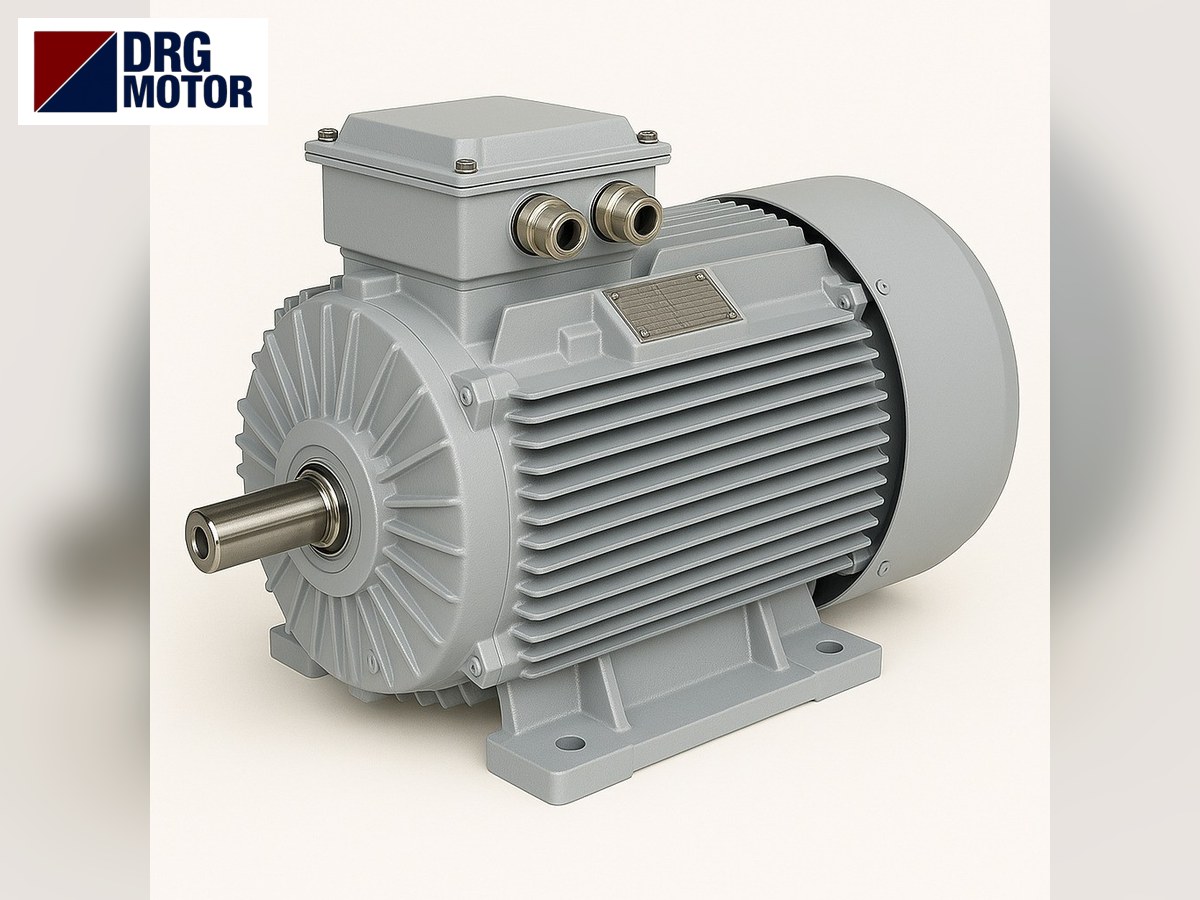
On a surface planer (jointer) the electric motor has one job: spinning the cutterblock at high speed. The operator pushes the board by hand across the table, the knives flatten its underside and square one edge. Maker catalogues list 2.2–5.5 kW for surface planers with 310–610 mm tables and 5.5–10 kW for combined planer-thicknessers. This page covers the motor of the surface planer only; the thicknesser, which brings a board down to size with parallel faces, and the four-sided planer, which machines all four faces in a single pass, are separate subjects.
DRG Motor is a manufacturer, supplier and seller of electric motors. We do not sell planers, blocks, knives, belts, inverters or brake modules, and gearboxes, hydraulic units, electro-spindles and servo motors are outside our catalogue as well. Our share of a jointer is just the three-phase induction motor behind its block. Suitable models are on Buy Electric Motors Online.
Where does the motor sit on a surface planer, and how does it work?
The machine has two tables: the infeed table sits lower by the chosen depth of cut, the outfeed table is level with the knife tips. The cutterblock turns in the gap between them. The motor is usually mounted inside the base, below or beside the block, on an adjustable plate; a belt and two pulleys carry the power to the block. The plate slides to tension the belt, which is why a foot-mounted (B3) motor is the layout met most often on these machines.
How it differs from a thicknesser
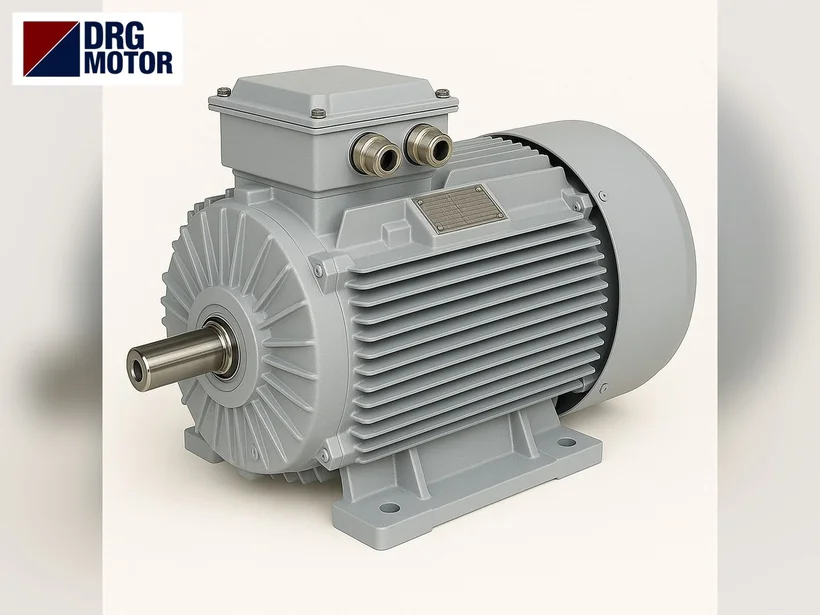
On a surface planer the board passes over the block and only the underside and one edge are trued; no thickness is set. On a thicknesser the block sits above the board, powered rollers pull it through and the table height sets the dimension. A surface planer therefore has one motor, while a thicknesser adds feed and table motors. The order of work is always the same: face and edge on the surface planer first, then the piece goes through the thicknesser.
The combined planer-thicknesser
To save floor space many workshops buy both functions in one frame: the same block planes on top as a surface planer and underneath as a thicknesser, and the tables are lifted to switch mode. There is still one main motor, but in thicknessing mode the rollers take their drive from it or from a small separate motor. That is why a combined machine carries a main motor one step larger than a plain surface planer of the same width and, at higher ratings, is offered with star-delta starting.
Cutterblock speed, pulleys and the 2-pole motor
Catalogue figures put cutterblock speeds around 5000–6000 rpm. On a 50 Hz supply the fastest induction motor is a 2-pole one, running at about 2900 rpm under load, so the block speed is reached only by stepping up through the pulleys: large pulley on the motor, small one on the block. Reaching the same block speed with a 4-pole motor pushes the ratio towards 3.5; the belt then wraps less of the small pulley and slips more. A 2-pole motor is therefore the natural choice on a planer, but always go by the speed on the old nameplate.
How table width drives the power figure
In one maker’s four-model range, motor power climbs from 2.2 kW to 5.5 kW as the table grows from 310 mm to 610 mm, about 1.1 kW on average for every extra 100 mm. The reason is simple: the knife cuts the full width of the board at the same depth, so on wide, hard timber such as oak or hornbeam the cutting force, and with it the torque, goes up. If one of two machines of equal width has a helical block with carbide inserts, the motor load is spread differently from a straight-knife block; the machine catalogue still sets the rating.
How many kW does a planer motor need? Catalogue values
A) Motor ratings published by surface planer and combination machine builders:
| Machine | Motor power | Single / total | Note |
|---|---|---|---|
| Surface planer, 310 mm table | 2.2 kW | single motor (cutterblock) | maker catalogue, smallest model |
| Surface planer, 410 mm table | 3 kW | single motor | same catalogue |
| Surface planer, 510 mm table | 4 kW | single motor | same catalogue |
| Surface planer, 610 mm table | 5.5 kW | single motor | same catalogue, widest model |
| Surface planer, 410–520 mm class | from 5 kW | single motor | second maker, standard fit |
| Combined planer-thicknesser, 510 mm | 5.5 kW; 7.35 or 10 kW on request | single motor, star-delta | third maker |
Across the planers listed, ratings run from about 2.2 kW to 10 kW with table width and machine type deciding; the upper figure is the optional large motor of combined machines. Each figure in the table is the cutterblock motor itself, not the total installed power. Hobby and small-workshop planers with single-phase 230 V motors are also common; DRG has no single-phase motors, so please contact us about those machines.
B) Overlap with the DRG range: surface planer motors from 2.2 kW to 7.5 kW are covered by our 2-pole models in 90L, 100L, 112M and 132S frames. The 7.35 kW figure on combined machines matches our 7.5 kW step, while the 10 kW option maps to 11 kW; in that case cable, contactor and overload protection are re-sized, and shaft and pulley fit are checked.
Click to see current electric motor prices and order nowSEE PRICES →
Worked example: pulley ratio on a 310 mm planer
Take the smallest catalogue model (2.2 kW, 5060 rpm, Ø102 mm block) and drive it with a DRG-90L-2:
| Step | Operation | Result | Comment |
|---|---|---|---|
| Motor speed | DRG-90L-2 nameplate | 2895 rpm | 2-pole, 2.2 kW |
| Required cutterblock speed | catalogue value | 5060 rpm | 310 mm table machine |
| Pulley ratio | 5060 / 2895 | about 1.75 | large pulley on motor, small on block |
| Example pulley diameters | 140 mm / 80 mm | 1.75 | if the block pulley is 80 mm |
| Knife tip speed | π × 0.102 m × 5060 / 60 | about 27 m/s | Ø102 mm block |
| Cutter mark pitch | 6000 mm/min ÷ (4 × 5060) | about 0.3 mm | 4 knives, assumed hand feed 6 m/min |
The cutter mark pitch is a guide to surface finish: feed faster or let block speed fall and the ripples open up. When replacing a motor whose speed differs from the old one, correct the pulley diameter to suit; to try ratios yourself, use the pulley and belt calculator. Seat the pulley against the shaft shoulder and do not over-tension the belt; side load wears the motor bearing.
Fast stopping, starting and the chip environment
Braking
On a hand-fed machine a cutterblock that keeps spinning long after switch-off is an accident risk, so current machines bring the block to rest quickly. This is mostly done with an electronic brake: at switch-off a short pulse of direct current is fed into the winding (DC injection) and the rotor is slowed magnetically. The method works with a standard induction motor; the brake module sits in the panel. A mechanically braked motor (with friction lining) is not in the DRG range; if your machine came with one, note it clearly and we will look at the alternative together.
Star-delta and the supply
Motors of 2.2–4 kW start direct-on-line in most workshops. From 5.5 kW upward, especially on combined machines, builders offer star-delta starting so the current drawn while the heavy block accelerates stays lower. For that the motor winding has to run in delta at 400 V; the star-delta starting page explains the wiring.
What chips do to the motor
A planer throws coarse shavings rather than fine dust; when the extraction hood clogs, shavings pack into the base. A motor housed in the base can end up with shavings over its fan cowl and fins, and then it heats up more for the same planing work. Weekly cleaning and a clear extraction line matter for that reason. For the motor side of extraction systems, see our dust and extraction motor article and the Fan Motors category.
DRG motors for surface planers
2-pole models for cutterblock drive (current at 400 V):
| Model | Power / speed | Frame · shaft D×E | Current 400 V |
|---|---|---|---|
| DRG-90L-2 | 2.2 kW / 2895 rpm | 90L cast iron · 24×50 | 4.35 A |
| DRG-100L-2 | 3 kW / 2895 rpm | 100L cast iron · 28×60 | 5.71 A |
| DRG-112M-2 | 4 kW / 2905 rpm | 112M cast iron · 28×60 | 7.45 A |
| DRG-132S1-2 | 5.5 kW / 2930 rpm | 132S cast iron · 38×80 | 10.1 A |
| DRG-132S2-2 | 7.5 kW / 2930 rpm | 132S cast iron · 38×80 | 13.7 A |
For a jointer the useful corner of our range is the 2-pole column; beyond it, our three-phase IEC aluminium frames stop at 11 kW (starting from 0.25), cast-iron ones climb to 355 kW (starting from 0.55), 4- and 6-pole speeds exist too, and mounting can be B3, B5, B14, B34, B35 or vertical. Before removing the old motor, note kW, speed, voltage and connection from the plate, the shaft diameter and key, the foot hole spacing or flange, and the pulley diameter. We compare these with the machine documentation and confirm fit with you; we give no blanket guarantee that a motor suits every machine.
B5 flange dimensions
B5 dimensions from the DRG catalogue for flange-mounted versions (mm):
| Frame | Shaft D×E | Flange P / M / N | Hole S |
|---|---|---|---|
| 90S/90L | 24×50 | 200 / 165 / 130 | 12 |
| 100L/112M | 28×60 | 250 / 215 / 180 | 14.5 |
| 132S/132M | 38×80 | 300 / 265 / 230 | 14.5 |
All foot and flange dimensions are on the technical drawings page.
Live price table
Current shop prices for motors in the surface planer power range:
| Model | Power / speed | Frame · current 400 V | Price |
|---|---|---|---|
| DRG-90L-23 HP | 2.2 kW · 3000 rpm | Cast iron 90L · 4.35 A | $154.45 (€137.93) Details & buy → |
| DRG-100L-24 HP | 3 kW · 3000 rpm | Cast iron 100L · 5.71 A | $177.89 (€158.87) Details & buy → |
| DRG-112M-25.5 HP | 4 kW · 3000 rpm | Cast iron 112M · 7.45 A | $225.65 (€201.52) Details & buy → |
| DRG-132S-47.5 HP | 5.5 kW · 1500 rpm | Cast iron 132S · 10.7 A | $342.01 (€305.44) Details & buy → |
| DRG-132S1-27.5 HP | 5.5 kW · 3000 rpm | Cast iron 132S · 10.1 A | $338.72 (€302.50) Details & buy → |
| DRG-132S2-210 HP | 7.5 kW · 3000 rpm | Cast iron 132S · 13.7 A | $369.43 (€329.92) Details & buy → |
DRG MOTOR motors are guaranteed against material and manufacturing defects for 2 years from the delivery date (warranty certificate).
Motors in this power range
- DRG-90L-2 – 2.2 kW – 2895 rpm – 90L cast iron
- DRG-112M-2 – 4 kW – 2905 rpm – 112M cast iron
- DRG-132S1-2 – 5.5 kW – 2930 rpm – 132S cast iron
- DRG-132S2-2 – 7.5 kW – 2930 rpm – 132S cast iron
Click to see current prices and order these motors nowSEE PRICES →
Browse the models, ask for an offer: a photo of the planer motor nameplate and one showing the pulley side, sent by WhatsApp, is enough. Further options are on Buy Electric Motors Online; by phone (+90 (542) 666 11 11), the table width is the first thing we will ask.
Frequently asked questions
Should a planer motor be 3000 rpm or 1500 rpm?
Whichever speed the machine was pulleyed for. On most surface planers the block runs faster than the motor and a 2-pole motor is used; moving to a 4-pole motor means changing pulleys, which should not be done without the machine maker’s approval.
Can a single-phase planer be converted to a three-phase motor?
If the workshop has a 400 V three-phase supply the motor can be changed, but the switch, capacitor circuit and protection change too; compare foot and shaft dimensions with the old motor. On a single-phase supply a three-phase motor will not run directly.
Why does a planer motor run hot?
The usual causes are blunt knives, too deep a cut, a slack or over-tight belt and cooling surfaces buried in shavings. If the motor is drawing more than its nameplate current, check these first.
For questions about your surface planer, write to info@drgmotor.com or use the channels on our contact page. Our woodworking motor article also helps with general motor choice on wood machines.


