 English
 Le français
 Türkçe

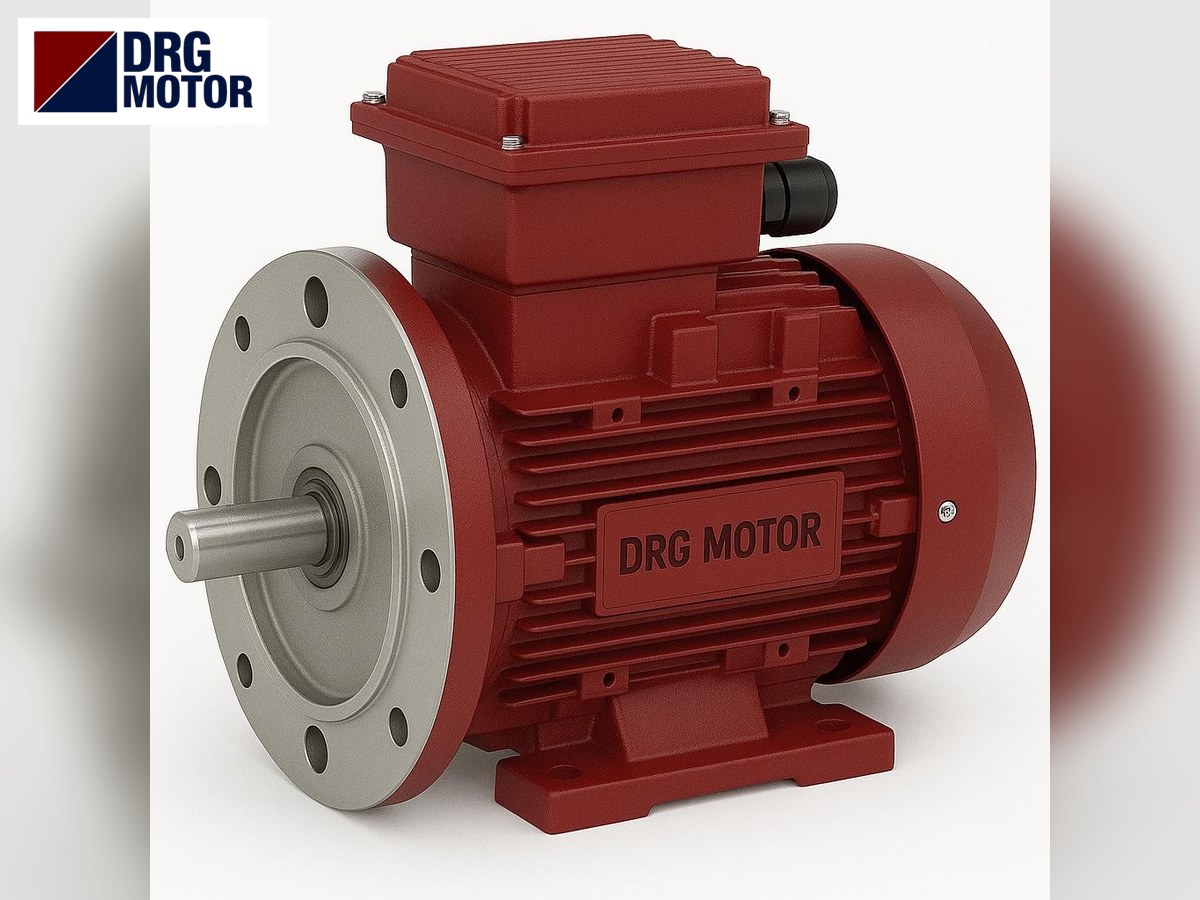
A cooling tower electric motor works in two places: it turns the fan on top of or beside the tower to pass air over the water, and it drives the circulation pump that sends the cooled water back to the process. Manufacturer catalogues start fan motors at 0.18 kW on small FRP round towers; they reach 22 kW on large round towers and around 37 kW per cell on field-erected towers. Pump motor power depends not on the tower but on the flow and head of the water circuit.
DRG Motor is a manufacturer, supplier and seller of electric motors. We do not sell the tower, the fan propeller, the gearbox and drive shaft, the pump itself or the frequency inverter; we provide the induction motor behind either of them. Browse kW and rpm options on the Buy Electric Motors Online page.
Two motors on a tower: fan and circulation pump
Two articles on tower fan motors are already on our site: cooling tower fan motor selection covers humidity, protection and maintenance, and cooling tower motor supply lists the information needed at quotation stage. This page does not repeat them; it looks at catalogue motor powers by tower type, the fan drive arrangement and how the two motors of a tower cell are sized together.
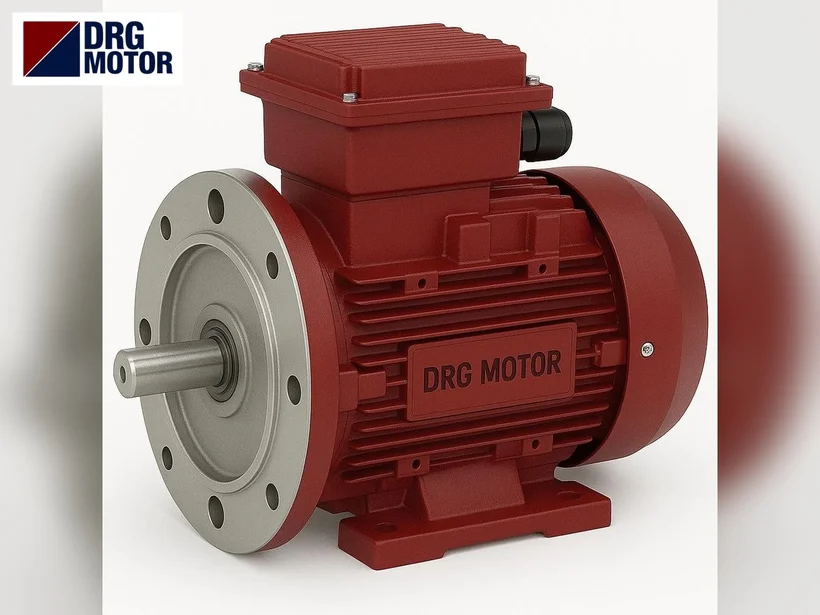
Tower fan: the motor that pulls the air
Most industrial towers are induced draft: the fan sits on top of the tower and draws air upwards through the fill. On compact towers a centrifugal fan beside the tower pushes air in. The fan motor load depends on propeller diameter, blade angle and speed; when the heat load falls, the fan is slowed or switched off.
Circulation pump: the motor that moves the water
The pump sends cold water from the tower basin to a heat exchanger, a condenser or the cooling channels of a machine, and the warmed water returns to the tower distribution pipe. In this circuit the pump motor usually drives an end-suction or inline centrifugal pump through a coupling. Pump selection in closed circuits is explained separately on our circulation pump motor page.
Fan drive arrangements and motor position
Direct drive: small and medium round towers
A typical FRP round tower carries its propeller on the motor shaft itself, with the motor standing upright at the top. Here the motor sits in the humid air stream, and the weight and thrust of the propeller act on the motor bearing. For vertical operation in this arrangement the motor must be ordered for vertical mounting and the axial load confirmed by the tower maker. As propeller diameter grows, speed drops; that is why 6-pole motors are common on small towers.
Belt drive
On medium packaged towers the motor stands beside the fan housing and turns the propeller with a belt and pulleys. The pulley ratio sets fan speed; if the old motor’s speed is kept on replacement, the pulleys stay in place. Belt tension and pulley alignment are the most frequent cause of vibration.
Gearbox and drive shaft: motor outside the fan stack
On large towers the fan sits on a gearbox, while the motor stands horizontally (B3) outside the fan stack and connects to the gearbox through a long drive shaft. This keeps the motor out of the humid air stream. In a plant described in a published case study, a 5.5 m fan runs through an 8.5:1 gearbox; the motor is a standard motor connected to the gearbox. Gearbox maintenance and oil belong to the tower side.
What kW does a cooling tower motor need? Values from manufacturer catalogues
A) Fan motor powers taken from three documents:
| Tower type / model | Fan motor | Single / total | Note |
|---|---|---|---|
| FRP round tower, 7.8 m³/h water, Ø600 mm fan | 0.18 kW | single fan | first maker, smallest model |
| FRP round tower, 78.1 m³/h, Ø1410 mm fan | 2.2 kW | single fan | first maker |
| FRP round tower, 312.1 m³/h, Ø2745 mm fan | 11 kW | single fan | first maker |
| FRP round tower, 781.2 m³/h, Ø3700 mm fan | 22 kW | single fan | first maker, largest model |
| Packaged tower, about 1,400 kW heat load | 15 kW | tower fan | second maker |
| Two towers compared at the same heat load | 22 kW and 30 kW | tower fan | second maker’s brochure |
| Field-erected cell, 5.5 m fan, gear ratio 8.5:1 | 50/12.5 HP (≈ 37.3/9.3 kW), 1765/885 rpm | per cell, two-speed | third document, 60 Hz site |
Put side by side, these documents show tower fan motors of about 0.18–37 kW: 0.18–22 kW on small and medium FRP round towers, 15–30 kW on packaged towers and around 37 kW per cell on field-erected towers. On multi-cell towers total fan power is multiplied by the number of cells; the values in the table are the motor of a single fan. Catalogues give no tower-related power for the circulation pump; pump power is found from application data, that is from flow, head and the pump curve.
B) The part that overlaps the DRG range: every power listed sits inside what we build in aluminium (up to 11 kW) or cast iron (up to 355 kW). Only the smallest 0.18 kW fan motor falls outside our range. We have no pole-changing two-speed version; on these towers a single-speed motor can be used together with a frequency inverter. The circulation pump motor is chosen from the same range.
Click to see current electric motor prices and order nowSEE PRICES →
Humidity, outdoor installation and vibration
Wet air and condensation
DRG motors are IP55 protected, have class F insulation and cool themselves with their own fan to IC411. A direct-drive motor on top of the tower is constantly exposed to saturated air; the terminal box cover seal, cable glands facing downwards and an insulation test after a long standstill matter for that reason. In a fan switched off for the winter, condensation can form inside the frame. Nameplate power is available between −15 °C and +40 °C ambient and below 1000 m; in colder regions mention this in your enquiry.
Vibration cut-out switch and balance
Tower makers’ brochures state that the vibration cut-out switch is wired together with the fan motor at a single point. A broken or iced blade unbalances the propeller; the switch stops the motor and protects the gearbox, shaft and motor bearings. After a motor replacement the fan should not be brought to full speed before propeller balance and blade angles are checked.
An inverter instead of a two-speed motor
Older towers use two-speed motors that drop the fan to half speed when the heat load falls. Fan power follows speed cubed, so running at half speed needs just an eighth of the full-speed figure. The same result can be obtained steplessly with a single-speed motor and an inverter; with a fan load the torque also drops at low speed, so the motor’s own fan usually remains sufficient. For the 37 kW of the example cell the calculation looks like this (calculated in python):
| Fan speed (share of rated) | Power (P = 37 × n³) | Fan speed with 8.5:1 gear | Note |
|---|---|---|---|
| full speed | 37 kW | about 207.6 rpm | motor 1765 rpm (60 Hz site) |
| nine tenths | about 27 kW | about 186.9 rpm | summer night |
| four fifths | about 18.9 kW | about 166.1 rpm | mid-season |
| seven tenths | about 12.7 kW | about 145.4 rpm | low heat load |
| half speed | about 4.6 kW | about 103.8 rpm | low step of the two-speed motor |
Example: the motors of a tower cell and the panel current
Assumption: the tower cell has a gearbox-driven fan and the old two-speed 37 kW motor is to be replaced by a single-speed motor with an inverter; the circulation pump of the same cell delivers 312.1 m³/h of water at 18 m head with a pump η of 0.75. With P = ρ · g · Q · H / η the pump needs 1000 × 9.81 × 0.0867 × 18 / 0.75 ≈ 20.4 kW at the shaft; the next standard power is 22 kW. If the gearbox was designed for a 1765 rpm motor at 60 Hz, the fan turns slightly slower with a 4-pole motor on a 50 Hz supply; discuss this difference with the tower maker.
| Consumer | Value / assumption | DRG match | Current 400 V |
|---|---|---|---|
| Tower fan (with gearbox) | 37 kW nameplate, single speed + inverter | DRG-225S-4 · 1485 rpm | 66.1 A |
| Circulation pump | 312.1 m³/h, 18 m, pump η = 0.75 → about 20.4 kW shaft power | DRG-180L-4 · 22 kW | 39.7 A |
| Cell total | fan + pump together | — | 105.8 A |
The panel and supply cable are sized for the 105.8 A that both motors draw together. The fan starts softly on the inverter; if the pump starts direct-on-line or star-delta, its starting current is taken into account as well. See the overload-fuse-contactor selection tool for contactor and overload values, and the pump and fan motor power calculator to try the pump power with other values.
DRG motors for cooling towers
Models covering the power steps from the fan of a small round tower to the gearbox of a large cell:
| Model | Power / speed | Frame · shaft D×E | Current 400 V |
|---|---|---|---|
| DRG-712-6 | 0.25 kW / 855 rpm | 71 aluminium · 14×30 | 0.77 A |
| DRG-90S-6 | 0.75 kW / 935 rpm | 90S cast iron · 24×50 | 1.93 A |
| DRG-112M-6 | 2.2 kW / 955 rpm | 112M cast iron · 28×60 | 5.09 A |
| DRG-132M2-6 | 5.5 kW / 968 rpm | 132M cast iron · 38×80 | 12 A |
| DRG-160L-6 | 11 kW / 970 rpm | 160L cast iron · 42×110 | 22 A |
| DRG-180L-4 | 22 kW / 1470 rpm | 180L cast iron · 48×110 | 39.7 A |
| DRG-200L2-6 | 22 kW / 980 rpm | 200L cast iron · 55×110 | 42.5 A |
| DRG-225S-4 | 37 kW / 1485 rpm | 225S cast iron · 60×140 | 66.1 A |
Direct-drive fans mostly use 6-pole motors, gearbox fans and pumps mostly 4-pole motors; a replacement keeps the pole count of the motor it replaces. Foot mounting B3, flange B5, the combined B35 and vertical V1/V3 are available; dimensions are on the technical drawings page. For other options on the pump side see the Pump Motors category.
Not in our range: brake motors, single-phase motors, Ex motors, two-speed motors, low-speed direct-drive motors that replace the gearbox, above 355 kW and medium voltage. On small wet-rotor circulation pumps the motor is replaced together with the pump.
Live price table
The price of the models matching tower fan and pump powers is fetched from the shop on every visit:
| Model | Power / speed | Frame · current 400 V | Price |
|---|---|---|---|
| DRG-712-60.37 HP | 0.25 kW · 1000 rpm | Aluminium 71 · 0.77 A | $88.07 (€78.65) Details & buy → |
| DRG-90S-61 HP | 0.75 kW · 1000 rpm | Cast iron 90S · 1.93 A | $109.90 (€98.15) Details & buy → |
| DRG-112M-63 HP | 2.2 kW · 1000 rpm | Cast iron 112M · 5.09 A | $237.30 (€211.93) Details & buy → |
| DRG-132M2-67.5 HP | 5.5 kW · 1000 rpm | Cast iron 132M · 12 A | $423.04 (€377.80) Details & buy → |
| DRG-160L-615 HP | 11 kW · 1000 rpm | Cast iron 160L · 22 A | $668.92 (€597.39) Details & buy → |
| DRG-180L-430 HP | 22 kW · 1500 rpm | Cast iron 180L · 39.7 A | $919.45 (€821.13) Details & buy → |
| DRG-200L-440 HP | 30 kW · 1500 rpm | Cast iron 200L · 53.8 A | $1,235.00 (€1,102.93) Details & buy → |
| DRG-225S-450 HP | 37 kW · 1500 rpm | Cast iron 225S · 66.1 A | $1,527.18 (€1,363.87) Details & buy → |
DRG MOTOR motors are guaranteed against material and manufacturing defects for 2 years from the delivery date (warranty certificate).
Motors in this power range
- DRG-112M-6 – 2.2 kW – 955 rpm – 112M cast iron
- DRG-132M2-6 – 5.5 kW – 968 rpm – 132M cast iron
- DRG-160L-6 – 11 kW – 970 rpm – 160L cast iron
- DRG-180L-4 – 22 kW – 1470 rpm – 180L cast iron
- DRG-225S-4 – 37 kW – 1485 rpm – 225S cast iron
Click to see current prices and order these motors nowSEE PRICES →
Check the products and ask for a quote: send a photo of the motor nameplate, whether the fan is direct, belt or gearbox driven, whether the motor stands vertically or horizontally, shaft and flange size, daily running hours and switching frequency to our WhatsApp line; you can also call +90 (542) 666 11 11. All models are on the Buy Electric Motors Online page.
Questions about cooling tower motors
Why is a tower fan motor often 6-pole?
On a direct-drive fan the propeller speed equals the motor speed. Because the tip speed of a large propeller is kept limited, a low-speed motor is preferred; the exact value is in the tower maker’s data.
Can the fan motor and the pump motor be fed from the same panel?
Yes; the panel and cable are sized for the sum of both rated currents and for the starting arrangement. The fan inverter is controlled separately from the pump.
Can the motor be changed without changing the gearbox?
Yes, if power, speed, shaft diameter and coupling side match the old motor. If the speed differs, the fan speed changes too; in that case the tower maker’s approval is obtained.
For questions: +90 (542) 666 11 11 · info@drgmotor.com · contact.


