 English
 Le français
 Türkçe

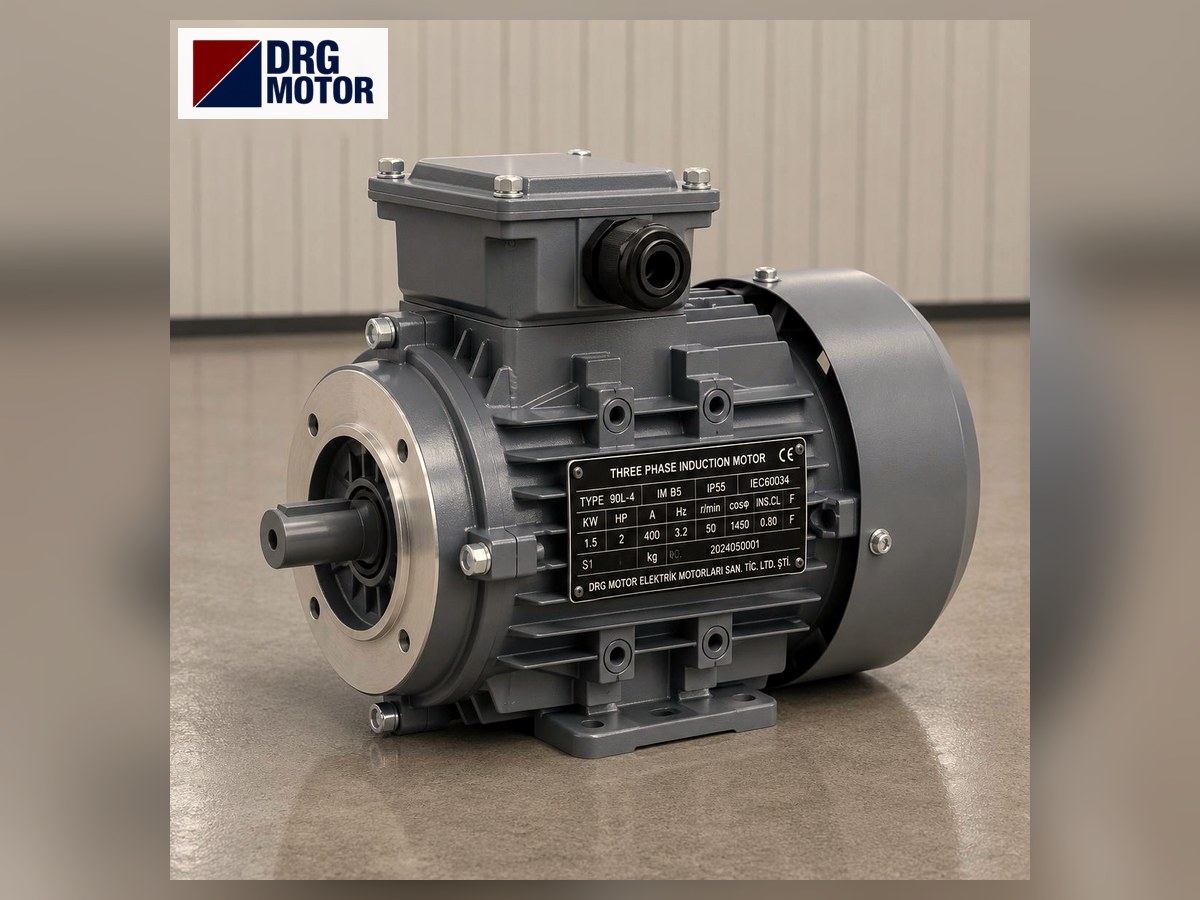
A worm gearbox motor is a three-phase electric motor that turns the worm and, in most cases, sits directly on the B14 or B5 input flange of the gearbox. Two points dominate the selection: the motor flange and shaft must match the gearbox input exactly, and the power must include a margin for the losses of the worm gearing. That margin grows with the ratio; for the same output work, a worm with i = 100 needs a noticeably stronger motor than one with i = 7.5.
Our job is the motor at the end of this gearbox: DRG Motor does not sell worm gearboxes; it provides the electric motor that fits the input of the gearbox you already have or are about to buy. Suitable models are on our Buy Electric Motors Online page.
What is a worm gearbox and where is it used?
The steel worm turned by the motor drives a bronze wheel set at right angles to its axis. This gives a high ratio in a single stage, and the output shaft is turned 90° to the input. In small and medium sizes the housing is die-cast aluminium, compact and light; in one manufacturer's catalogue sizes 025–110 have aluminium alloy housings and sizes 130 and 150 cast iron housings. The output is usually a hollow shaft that slides onto the driven shaft with a key.
Typical applications
Light and medium-duty belt and roller conveyors, packaging and filling machines, mixers, door and shutter drives, screw feeders, turntables and the dosing units of agricultural machines are where they appear most often. What they share is low output speed, small to medium power and limited mounting space.
Which power range?
In the same manufacturer's catalogue the smallest size starts with a frame 56 motor flange and the largest goes up to a frame 160 B5 flange. In the selection tables with motors fitted, powers are listed from 0.09 kW to 4.8 kW. For larger powers, helical or bevel helical gearboxes are usually preferred over the worm type.
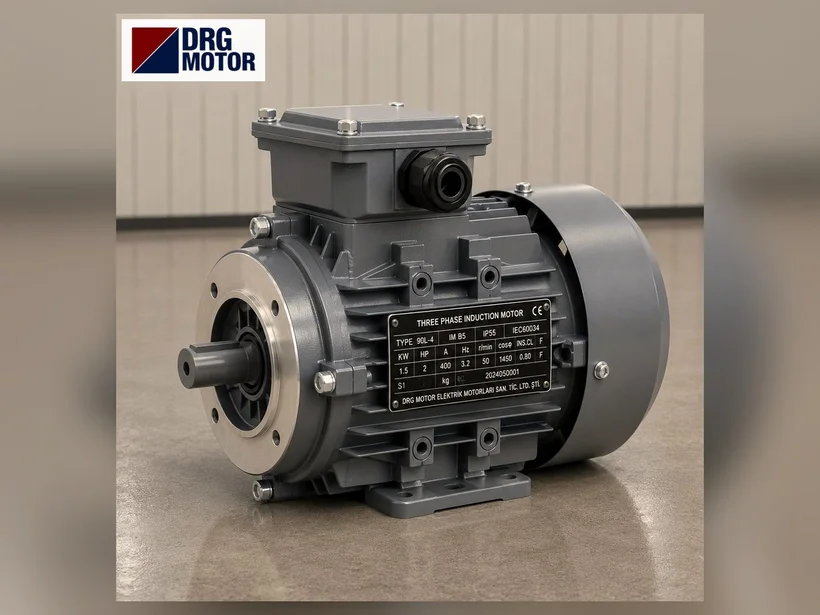
Input side: B14 and B5 flange motors
The input cover of an aluminium worm gearbox can be machined for several motor flanges within one size. The motor flange table in the catalogue lists, for each gearbox size, the available B5 and B14 options and the ratios with which they can be used. Size 063, for example, offers flanges for frames 71, 80 and 90, while sizes 130 and 150 are supplied with B5 flanges only.
B14 small flange
B14 is the most frequent input on aluminium worm gearboxes: the flange has a smaller diameter and the bolts screw directly into threaded holes in the flange. We supply B14 motors, but our catalogue prints no B14 dimension sheet; for that reason a B14 order is matched with you to the actual input cover of your worm unit.
B5 large flange dimensions
On a gearbox with a B5 input, the large motor flange has clearance holes. From the B5 table in the DRG catalogue, the frames most used on worm gearboxes (mm):
| Frame | Shaft D×E | Flange P / M / N | Hole S |
|---|---|---|---|
| 71 | 14×30 | 160 / 130 / 110 | 10 |
| 80 | 19×40 | 200 / 165 / 130 | 12 |
| 90S/90L | 24×50 | 200 / 165 / 130 | 12 |
| 100L/112M | 28×60 | 250 / 215 / 180 | 14.5 |
| 132S/132M | 38×80 | 300 / 265 / 230 | 14.5 |
Input bore, shaft and key
The gearbox input bore is machined to the motor shaft diameter: 14 mm for frame 71, 19 mm for 80, 24 mm for 90, 28 mm for 100/112. The motor shaft should enter the bore without force, with a thin layer of assembly paste or grease; if the key is too high the shaft will not seat. Spigot, bolt circle and key checks are walked through in flange motor for a gearbox: B5 and B14.
Click to see current electric motor prices and order nowSEE PRICES →
Motor power: why does efficiency drop as the ratio rises?
In a worm gear, power is transmitted by teeth sliding over one another. As the lead angle of the worm gets smaller, that is, as the ratio rises, the sliding share increases and so do the losses. The values given by one manufacturer's catalogue for size 063 show this clearly. The last column shows the power the motor must deliver to the gearbox to obtain 1 kW of work at the output (with a 4-pole motor at 1445 rpm):
| Ratio i | Output speed (1445 rpm) | Efficiency dynamic / static | Input per 1 kW output |
|---|---|---|---|
| 7.5 | 192.7 rpm | 0.89 / 0.71 | 1.12 kW |
| 15 | 96.3 rpm | 0.84 / 0.6 | 1.19 kW |
| 30 | 48.2 rpm | 0.75 / 0.45 | 1.33 kW |
| 40 | 36.1 rpm | 0.71 / 0.4 | 1.41 kW |
| 60 | 24.1 rpm | 0.63 / 0.33 | 1.59 kW |
| 100 | 14.4 rpm | 0.52 / 0.24 | 1.92 kW |
The catalogue states that these values apply after running-in, at 25 °C ambient and with standard lubricant. A new gearbox has lower efficiency during its first hours of operation, which is why a slightly high motor current in the first days is normal.
Worked example: 250 Nm at about 36 rpm
Assume a roller conveyor needs 250 Nm at the output shaft and about 36 rpm. With size 063 and i = 40, a 1445 rpm motor gives an output speed of 1445 / 40 ≈ 36.1 rpm.
- Power at the output: 250 × 36.1 / 9550 ≈ 0.95 kW.
- Worm dynamic efficiency 0.71 → power required from the motor ≈ 1.33 kW. The next standard step is 1.5 kW: DRG-90L-4 (1445 rpm, 9.91 Nm).
- Check: 9.91 × 40 × 0.71 ≈ 281 Nm theoretical output torque, above the required 250 Nm.
- The same work on a two-stage helical gearbox with efficiency 0.96 needs ≈ 0.99 kW; a 1.1 kW motor would be enough there.
The difference is not in the motor but in the losses of the gear type. Size 063 at i = 40 can be used with frame 90 B5 and B14 flanges. The service factor and rated output torque of the gearbox are still checked in the gearbox catalogue. You can try your own ratio and power values with the Gearbox Output Speed and Torque Calculator.
Self-locking: a common misconception
"A worm never runs back, so no brake is needed" is a very common belief on site, but catalogue data do not support it in every case. The same catalogue defines two separate concepts: dynamic irreversibility means the output shaft stops at once when the drive is removed, and it requires a dynamic efficiency below 0.5; static irreversibility means that, with the gearbox at standstill, a load applied to the output does not turn the worm, and it requires a static efficiency below 0.5.
What does the table say?
Look at the size 063 values above: even at i = 100 the dynamic efficiency is 0.52, so the output may keep turning for a while after the drive is cut. Static efficiency falls below 0.5 from i = 30 onwards, but the catalogue clearly notes that vibration and shocks can cancel irreversibility. Wherever there is hoisting, an inclined belt or a load to be held in position, self-locking cannot be relied on; a separate brake is needed.
If a brake is required
DRG does not build brake motors. Discuss any braking requirement with us before you order; whether the brake is solved on the gearbox side or the machine side depends on the machine design.
Heating, oil and mounting position
Losses turn into heat
The power lost in a worm gear heats the housing directly. In the example above, if 1.5 kW runs at full load with efficiency 0.71, about 0.44 kW of heat stays in the gearbox. The aluminium housing spreads this heat well, but the motor's fan air also passes close to the gearbox housing. Leave space behind the motor and gearbox for air to circulate, and do not let paint or dust layers cover the housing.
Oil and position
In the catalogue we reviewed, the aluminium sizes come filled for life with synthetic oil and can be used in any catalogue position up to size 075. For sizes 090 and 110, as well as the cast iron sizes 130 and 150, the mounting position must be stated in the order so the oil quantity can be set accordingly. The same catalogue flags the vertical V5 position, with the motor at the bottom, as an application to be checked on the larger sizes at input speeds of 1500–3000 rpm.
Vertical motor operation
Even if the gearbox output stays horizontal, the worm axis may be vertical, putting the motor in a vertical position. Vertical motor versions exist per frame, so just write "vertical" in the order note. With the motor on top and the shaft pointing down, sealing the terminal box cover and cable gland properly is important.
Motor selection checklist
- Size, ratio and input designation from the gearbox nameplate (for example "063 · 80 B14").
- For B14: flange outside diameter, bolt circle, spigot diameter and thread size; for B5: comparison with the table above.
- Input bore diameter and key width.
- Torque and speed required at the output; motor power calculated with the efficiency of the ratio.
- Loaded start? Our small 4-pole motors (0.25–3 kW) give 2.1 to 2.4 times rated torque at start.
- Mounting position, horizontal or vertical motor operation.
- Brake requirement: if any, ask us first.
- Voltage: 230/400 V winding up to 3 kW, 400/690 V from 4 kW.
DRG motors: frames suited to worm gearboxes
DRG Motor is a manufacturer, supplier and seller of electric motors. Worm drives use small powers, where we have light aluminium housings (0.25–11 kW) next to cast iron ones starting at 0.55 kW; all are IP55, three-phase, 1000/1500/3000 rpm. Our range starts at 0.25 kW and our smallest 4-pole motor is frame 71; the smallest gearboxes that need frame 56 or 63 4-pole motors, and powers of 0.09–0.18 kW, are outside our range. The sizes in the last column are the gearbox sizes for which that frame's flange is offered in the catalogue we reviewed:
| Model | Power / speed | Frame · shaft D×E | Gearbox sizes with this flange |
|---|---|---|---|
| DRG-711-4 | 0.25 kW / 1340 rpm | 71 · 14×30 | 040 · 050 · 063 · 075 |
| DRG-802-4 | 0.75 kW / 1420 rpm | 80 · 19×40 | 050 · 063 · 075 · 090 · 110 |
| DRG-90L-4 | 1.5 kW / 1445 rpm | 90L · 24×50 | 063 · 075 · 090 · 110 · 130 |
| DRG-100L2-4 | 3 kW / 1450 rpm | 100L · 28×60 | 075 · 090 · 110 · 130 · 150 |
| DRG-112M-4 | 4 kW / 1450 rpm | 112M · 28×60 | 075 · 090 · 110 · 130 · 150 |
| DRG-132S-4 | 5.5 kW / 1460 rpm | 132S · 38×80 | 110 · 130 · 150 |
The B5, B35 or B14 mounting option is stated in the order note. One frame may appear on several gearbox sizes; the ratios with which it can be used are confirmed from the flange table of the gearbox catalogue. With a 6-pole motor (about 940 rpm) the output speed drops by one third at the same ratio; for example DRG-90L-6 is 1.1 kW at 945 rpm.
Live price table
Prices of our motors in the powers fitted to worm gearbox inputs come live from the shop:
| Model | Power / speed | Frame · current 400 V | Price |
|---|---|---|---|
| DRG-711-40.37 HP | 0.25 kW · 1500 rpm | Aluminium 71 · 0.66 A | $73.16 (€65.33) Details & buy → |
| DRG-712-40.5 HP | 0.37 kW · 1500 rpm | Aluminium 71 · 0.92 A | $76.76 (€68.55) Details & buy → |
| DRG-801-40.75 HP | 0.55 kW · 1500 rpm | Cast iron 80 · 1.31 A | $91.72 (€81.91) Details & buy → |
| DRG-802-41 HP | 0.75 kW · 1500 rpm | Cast iron 80 · 1.75 A | $101.93 (€91.03) Details & buy → |
| DRG-90L-61.5 HP | 1.1 kW · 1000 rpm | Cast iron 90L · 2.69 A | $137.68 (€122.96) Details & buy → |
| DRG-90S-41.5 HP | 1.1 kW · 1500 rpm | Cast iron 90S · 2.48 A | $124.09 (€110.82) Details & buy → |
| DRG-90L-42 HP | 1.5 kW · 1500 rpm | Cast iron 90L · 3.3 A | $144.14 (€128.73) Details & buy → |
| DRG-100L1-43 HP | 2.2 kW · 1500 rpm | Cast iron 100L · 4.52 A | $188.32 (€168.18) Details & buy → |
| DRG-100L2-44 HP | 3 kW · 1500 rpm | Cast iron 100L · 6.02 A | $203.84 (€182.05) Details & buy → |
| DRG-112M-45.5 HP | 4 kW · 1500 rpm | Cast iron 112M · 7.95 A | $254.38 (€227.18) Details & buy → |
DRG MOTOR motors are guaranteed against material and manufacturing defects for 2 years from the delivery date (warranty certificate).
Motors in this power range
- DRG-712-4 – 0.37 kW – 1340 rpm – 71 aluminium
- DRG-802-4 – 0.75 kW – 1420 rpm – 80 cast iron
- DRG-90L-4 – 1.5 kW – 1445 rpm – 90L cast iron
- DRG-100L2-4 – 3 kW – 1450 rpm – 100L cast iron
- DRG-112M-4 – 4 kW – 1450 rpm – 112M cast iron
Click to see current prices and order these motors nowSEE PRICES →
Frequently asked questions
What kW motor should be fitted to a worm gearbox?
Work out the output kW, divide by the worm's dynamic efficiency at your ratio, pick the next standard motor and make sure its frame is listed among the gearbox's input flanges.
Is a 2-pole motor acceptable on a worm unit?
It can if the flange fits, but the input speed roughly doubles. The catalogue we reviewed treats some sizes and positions at high input speed as applications to be checked; get the gearbox manufacturer's approval.
Why does a worm gearbox motor get hot?
What heats up is often the gearbox housing: worm losses turn into heat. If the motor current is above the nameplate value, power selection, ratio and oil level should be checked together.
How can I find the price of a worm gearbox motor?
Only the motor is priced here: kW, speed and housing drive the figure, which the live table above shows.
Share the worm unit's label or the measured input cover and we will match a motor to it: phone +90 (542) 666 11 11, e-mail [email protected], contact page. For all models and the worm gearbox motor price list, see Buy Electric Motors Online.


