 English
 Le français
 Türkçe

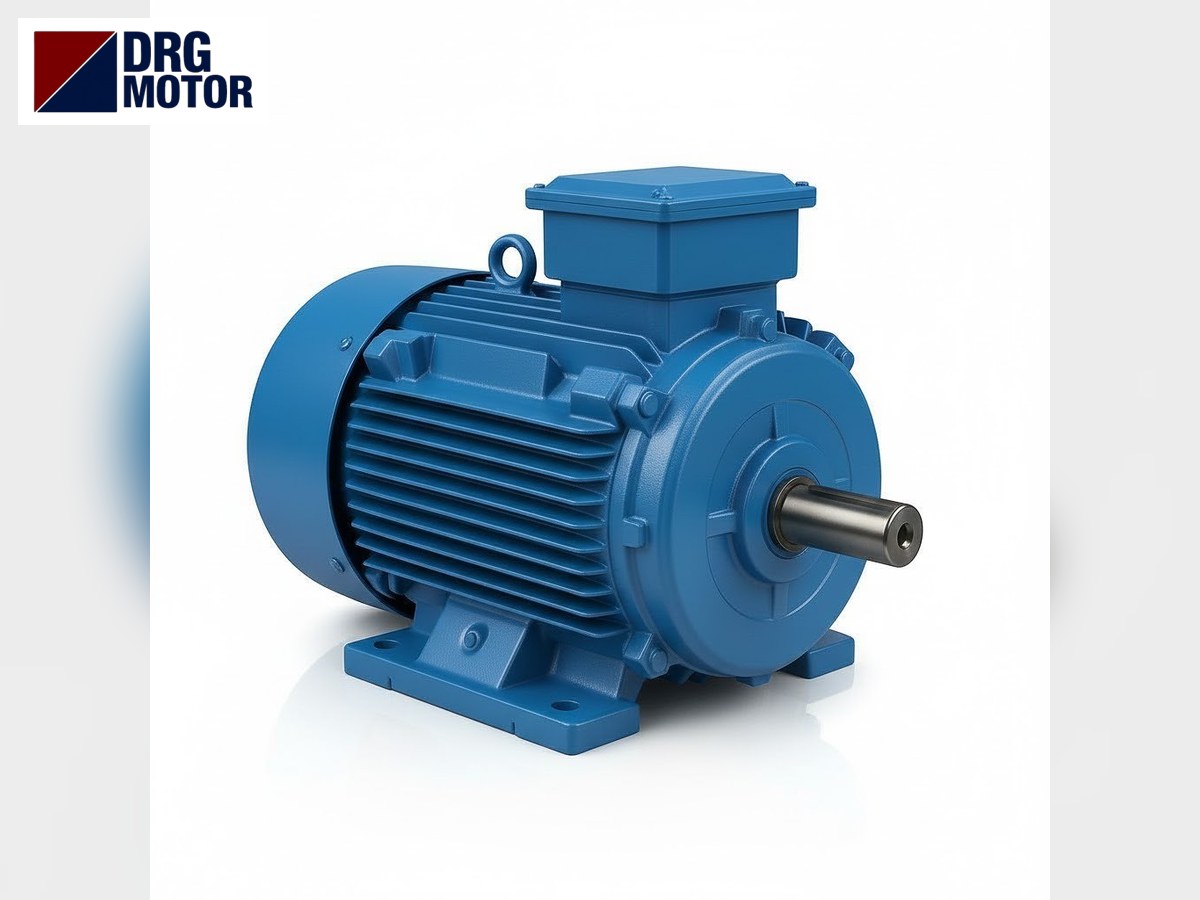
On a roof tile press the electric motor produces the movement that squeezes the clay slug coming from the extruder between the lower and upper dies. On a mechanical revolver press the motor turns a flywheel and a crank or eccentric shaft through belts and gears; on a hydraulic roof tile press the motor only drives the hydraulic pump and a cylinder does the pressing. Maker catalogues show 18.5–55 kW main drives on mechanical revolver presses and 22–46 kW installed power on hydraulic presses for accessory tiles.
DRG Motor is a manufacturer, supplier and seller of electric motors. We do not sell the press, the mould sets, gearboxes, hydraulic units and pumps, flywheels or inverters; what we supply is the motor turning them, a three-phase induction unit. The models are listed on Buy Electric Motors Online.
How does a revolver tile press work and where is the motor?
On a revolver press the lower dies sit on the faces of a pentagonal or hexagonal drum. The drum indexes one face per stroke; the upper die comes down with the crankshaft and presses the slug into a tile. On most machines the step-by-step drum rotation is taken from the main shaft by an intermittent mechanism such as a Geneva (Maltese cross) drive, so one main motor drives both the pressing and the indexing. The slug feed belt, the mould lubrication or soaping pump and the take-off belt for pressed tiles each run on their own small motors.
Main motor, flywheel and crank
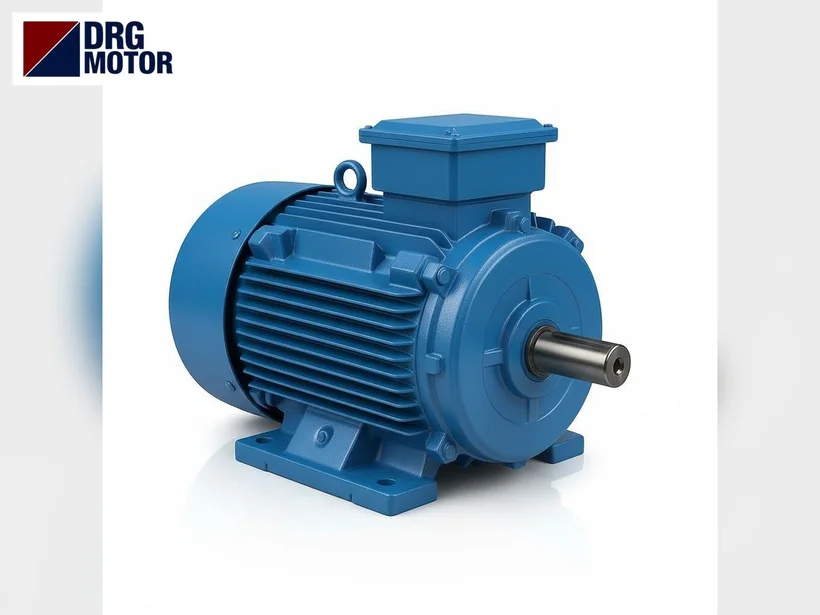
The main motor stands beside or above the machine, foot-mounted (B3) and belted to the flywheel. The flywheel covers the short, very high torque demand at the moment of pressing from its stored energy; between strokes the motor brings back the speed the flywheel has lost. The main motor rating is therefore not calculated straight from pressing force; the machine maker sets it together with stroke rate and flywheel inertia. The first maker’s table states installed power as “AC + inverter”: the motor is fed from a drive and the stroke rate follows its speed.
Braking and positioning
For mould changes and faults the drum has to stop at a defined position. One press redesign describes a direct gear motor drive with brake together with a disc brake. Brake motors are not in our range; this function stays with the machine’s disc brake or the maker’s drive.
Hydraulic roof tile press: the motor drives the pump
On a hydraulic press a large cylinder carries the upper die. The electric motor sits on or beside the power pack tank, with a bellhousing and flexible coupling between motor and pump; pressing force comes from pump pressure and speed from flow. Stroke rates are lower than on mechanical revolver presses (10–12 per minute on the second maker’s data sheet), but deep and complex parts such as ridge tiles, ventilation tiles or three- and four-way fittings can be pressed.
Why is installed power given with decimals?
Data sheets show values like 21.75 kW or 31.87 kW. They are not the plate rating of one motor: main pump motor, cooling or filter pump, table rotation and tile take-off motors have been added up. When replacing a motor read the plate of the motor you remove and do not order the installed total as one motor. To find motor power from pump flow and pressure, use our hydraulic pump motor kW calculation article.
Click to see current electric motor prices and order nowSEE PRICES →
How many kW is a roof tile press motor? Catalogue values
A) What roof tile press builders state for their main drives and power packs:
| Press type / model group | Installed power | Single / total | Note |
|---|---|---|---|
| Mechanical revolver press, one mould, 100 t, 25 strokes/min | 18.5 kW | main drive (motor + drive) | first maker’s catalogue, small model |
| Mechanical revolver press, two moulds, 150–180 t | 30 kW | main drive | first maker, mid model |
| Mechanical revolver press, three moulds, 220 t, 22 strokes/min | 45 kW | main drive | first maker |
| Mechanical revolver press, three to four moulds, 330 t | 55 kW | main drive | first maker, large model |
| Mechanical press for fitting tiles, 100 t | 18.5 kW | main drive | first maker |
| Hydraulic press for accessory tiles, 90 t | 22 kW | installed power incl. power pack | first maker |
| Hydraulic press for accessory tiles, 130 t | 46 kW | installed power, may be several motors | first maker |
| Hydraulic roof tile press, 1,000 kN, 10–12 strokes/min | 21.75 kW | total installed power | second maker’s data sheet |
| Hydraulic roof tile press, 2,400 kN, two tables | 31.87 kW | total installed power | second maker’s data sheet |
| Small revolver press, five-die drum | 5 kW | single motor or engine | third maker |
Depending on model, number of moulds and pressing force, mechanical revolver presses use roughly 18.5–55 kW main drives and hydraulic presses 22–46 kW installed power; small and older presses also show values such as 5 kW. Rating grows with the number of moulds and the pressing force; even with the same mould count, a model with higher force needs a stronger drive.
B) Where DRG fits: 18.5–55 kW main drive motors match our 4-pole cast iron 180M to 250M frames, and power pack pump motors fall in the same steps. Every value in the table lies inside our range. One maker does not publish the motor rating of its new 400-tonne generation, so we give no figure for that class; the motor is chosen from the plate and the machine documents.
Worked example: stroke rate, overall ratio and starting
Take a two-mould revolver press with 25 strokes per minute and a 30 kW main drive, using our DRG-200L-4 (1,475 rpm, 53.8 A at 400 V, Is/In 7.3; rated torque: DRG-200L-4, 194.2 Nm):
| Step | Operation | Result | Comment |
|---|---|---|---|
| Overall ratio | 1,475 / 25 | about 59 | belt + gear stages together |
| Ideal torque at the crankshaft | 194.2 × 59 | about 11,460 Nm | before losses, upper bound |
| Motor speed for 22 strokes/min | 1,475 × 22 / 25 | about 1,298 rpm | inverter output about 44 Hz |
| Direct-on-line starting current | 53.8 × 7.3 | about 393 A | flywheel at rest |
| Star-delta starting current | 392.7 / 3 | about 131 A | flywheel run up unloaded |
The crank torque in the table is a loss-free upper bound; the real peak at pressing comes from the energy stored in the flywheel. Lowering the stroke rate to 22 with an inverter reduces motor speed, but flywheel energy falls with the square of speed, so do not take the stroke rate outside the range given by the maker. A heavy flywheel means a long start: star-delta or a soft start through the drive protects the supply. Compare methods on our star-delta starting page and try pulley ratios with the pulley and belt calculator.
Wet clay, release fluid and motor protection
The press area gets dirty with release fluid and splashes of wet clay. IP55 protection suits this environment; still, keep the motor away from the splash direction, clean clay off the fan cowl regularly and check the terminal box lid gasket.
DRG motors for roof tile presses
Our 4-pole cast iron models matching main drive and power pack ratings (current at 400 V):
| Model | Power / speed | Frame · shaft D×E | Current 400 V |
|---|---|---|---|
| DRG-180M-4 | 18.5 kW / 1470 rpm | 180M cast iron · 48×110 | 33.5 A |
| DRG-180L-4 | 22 kW / 1470 rpm | 180L cast iron · 48×110 | 39.7 A |
| DRG-200L-4 | 30 kW / 1475 rpm | 200L cast iron · 55×110 | 53.8 A |
| DRG-225M-4 | 45 kW / 1485 rpm | 225M cast iron · 60×140 | 80.2 A |
| DRG-250M-4 | 55 kW / 1485 rpm | 250M cast iron · 65×140 | 97.6 A |
| DRG-160L-4 | 15 kW / 1465 rpm | 160L cast iron · 42×110 | 27.3 A |
| DRG-132S-4 | 5.5 kW / 1460 rpm | 132S cast iron · 38×80 | 10.7 A |
Each DRG motor is a three-phase IEC induction machine. Cast iron bodies start at 0.55 kW and climb to 355 kW, aluminium bodies run from 0.25 up to 11 kW; with 2, 4 or 6 poles they turn near 3000, 1500 or 1000 rpm, on feet, on a flange, both, or vertically. Single-phase motors, servo motors and medium-voltage motors are outside our range. For a replacement note plate power, speed, 400/690 V delta connection, shaft diameter and key, foot hole spacing and shaft height, and pulley diameter; we compare these with the press documents and confirm the fit with you, and we make no fit promise without dimensions. See our technical drawings.
Live price table
Prices of models in roof tile press main drive and power pack sizes come live from the shop:
| Model | Power / speed | Frame · current 400 V | Price |
|---|---|---|---|
| DRG-132S-47.5 HP | 5.5 kW · 1500 rpm | Cast iron 132S · 10.7 A | $342.01 (€305.44) Details & buy → |
| DRG-160L-420 HP | 15 kW · 1500 rpm | Cast iron 160L · 27.3 A | $678.13 (€605.61) Details & buy → |
| DRG-180M-425 HP | 18.5 kW · 1500 rpm | Cast iron 180M · 33.5 A | $873.49 (€780.08) Details & buy → |
| DRG-180L-430 HP | 22 kW · 1500 rpm | Cast iron 180L · 39.7 A | $919.45 (€821.13) Details & buy → |
| DRG-200L-440 HP | 30 kW · 1500 rpm | Cast iron 200L · 53.8 A | $1,235.00 (€1,102.93) Details & buy → |
| DRG-225S-450 HP | 37 kW · 1500 rpm | Cast iron 225S · 66.1 A | $1,527.18 (€1,363.87) Details & buy → |
| DRG-225M-460 HP | 45 kW · 1500 rpm | Cast iron 225M · 80.2 A | $1,688.50 (€1,507.94) Details & buy → |
| DRG-250M-475 HP | 55 kW · 1500 rpm | Cast iron 250M · 97.6 A | $2,065.73 (€1,844.82) Details & buy → |
DRG MOTOR motors are guaranteed against material and manufacturing defects for 2 years from the delivery date (warranty certificate).
Motors in this power range
- DRG-180M-4 – 18.5 kW – 1470 rpm – 180M cast iron
- DRG-200L-4 – 30 kW – 1475 rpm – 200L cast iron
- DRG-225M-4 – 45 kW – 1485 rpm – 225M cast iron
- DRG-250M-4 – 55 kW – 1485 rpm – 250M cast iron
- DRG-180L-4 – 22 kW – 1470 rpm – 180L cast iron
Click to see current prices and order these motors nowSEE PRICES →
Browse the products, ask for a quote: suitable motors for your press are on Buy Electric Motors Online. To start, a nameplate picture of the main motor plus one of its flywheel side over WhatsApp is enough; on the phone (+90 (542) 666 11 11) mould count and strokes per minute narrow the choice quickly.
Frequently asked questions
Does a bigger motor raise the stroke rate of a revolver press?
Not by itself. Drum, dies and slug feed timing limit the stroke rate; the question is whether the motor can bring the flywheel back up at that rate.
How do I tell a motor fault on a hydraulic tile press?
If pressure drops while motor current is normal, the cause is usually pump or valve; if current is high and the motor runs hot, check motor, connections and coupling alignment.
What does the price of a roof tile press motor depend on?
Rating, pole number and frame size; the live table pulls current figures straight from our online store.
For motor choice across the plant, our ceramic plant motor article also helps. Contact: +90 (542) 666 11 11 · info@drgmotor.com · contact page.


