 English
 Le français
 Türkçe

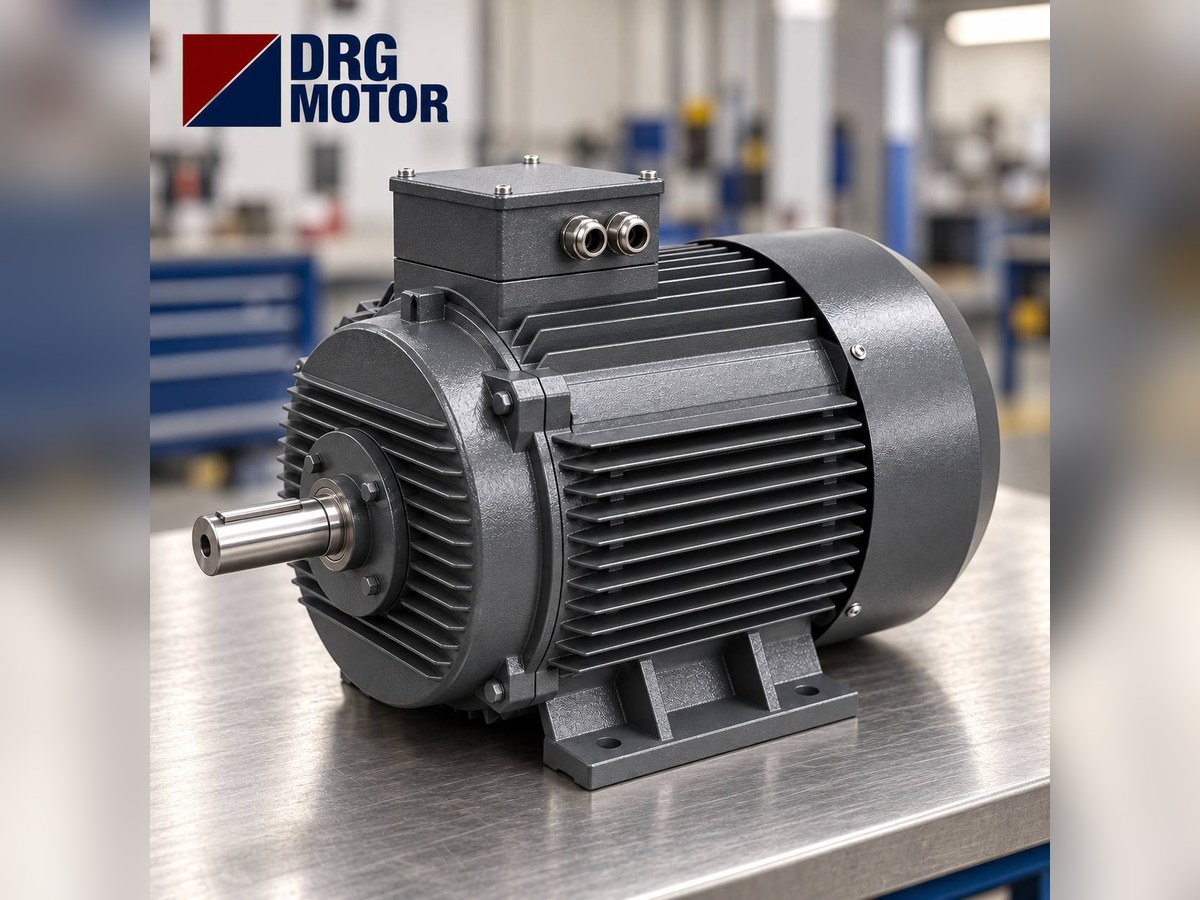
Feed dosing and feeder motors are low-power three-phase motors that set the amount of material going to a machine or a scale: they turn the dosing screw under a scale bin, the cell rotor of a rotary feeder, the roll of a mill feeder and the feed screw of a pellet press. Catalogue data for such feeders runs from 0.37 to 5.5 kW, and the bulk of them fall between 0.55 and 3 kW. What matters here is less the power than the ability to adjust speed: the motor almost always works with a gearbox and a frequency inverter, and stops and starts hundreds of times a day.
This page describes the feeding and dosing devices of a feed production line one by one, gives sourced power values and shows inverter settings through a batch dosing example. Conveying augers are a separate subject; here the screw turns not to move material but to meter it. Compare current models and prices in our Buy Electric Motors Online store.
Which feeders are found in a feed line?
Scale bin dosing screws
In a batch feed mill each ingredient sits in its own bin. The dosing screw under the bin runs until the recipe quantity reaches the scale, then stops, and the sequence moves to the next ingredient. High-share ingredients such as maize, wheat and soybean meal are dosed by large-diameter screws, while small shares such as vitamin-mineral premix and amino acids are dosed in micro-dosing cells. One manufacturer's micro-dosing system has up to 34 cells, each with its own screw feeder, and weigh hoppers of 5, 10 and 50 kg.
Rotary feeder (cell wheel)
A rotor divided into pockets turns inside a housing and releases a set volume into the line below on each turn. It has two jobs: acting as an airlock under cyclones, filters and coolers, and providing volumetric feed under a bin. The rotor turns slowly; catalogues show rotor speeds such as 10, 20 and 30 rpm. Going from a 1450 rpm motor down to 20 rpm needs a gearbox ratio of about 72. The rotary feeder under the pellet cooler also balances the amount of pellets entering the cooler and the pellet bed height inside it.
Mill and press feeders
In front of a hammer mill sits a roll or screw feeder that spreads the material evenly across the mill inlet. In front of a pellet press runs a variable-speed feed screw that supplies the conditioner. Both have one thing in common: the feed rate is adjusted to the load on the main machine. The conditioner's own mixing motor is separate from the feeder and belongs to the press's motor arrangement.
Why an inverter? Dosing accuracy and speed control
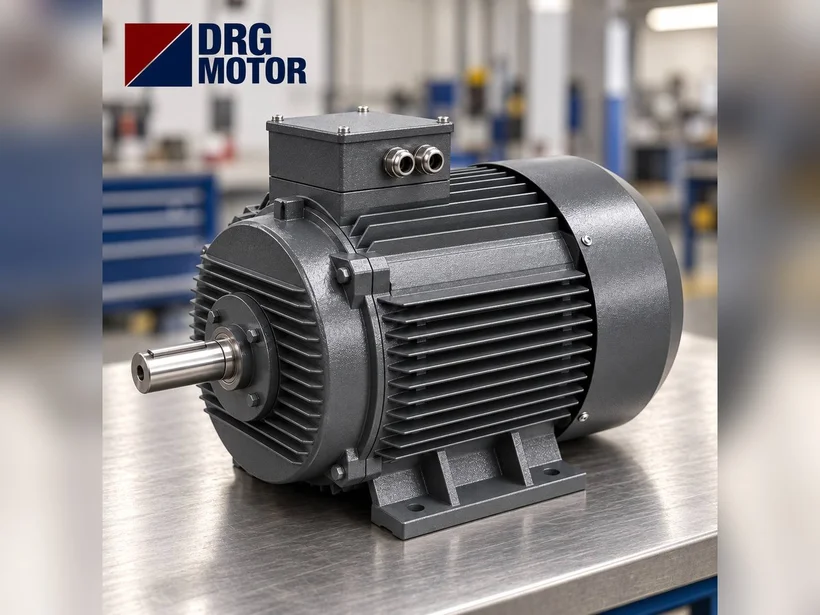
The volume a feeder delivers is almost directly proportional to its speed, and the most practical way to change speed is to drive the motor with a frequency inverter. Catalogues offer frequency control as an option for process feed screws and as part of the operating principle for dosing screws.
Coarse and fine dosing
If the screw keeps running at full speed as the scale approaches its target, material falling from the pipe after the stop command overshoots. Dosing is therefore done in two steps: coarse dosing at high speed, then fine dosing at low speed just before the target. Some makers do this with two nested screws: in one catalogue a 35 mm fine screw sits inside a 100 mm coarse screw, both driven by a single 2.2 kW geared motor. Another maker offers a shut-off valve that cuts the flow when dosing ends.
Feeding to main machine load
On mill and press feeders the inverter has a different job: the main motor current is monitored and the feeder speed is adjusted to hold that current at a target value. If the main motor is lightly loaded the feeder speeds up; if it starts to overload the feeder slows down. One maker supplies its mill feeder with a 1.5 kW frequency-controlled geared motor, another its load-dependent screw feeder with a frequency inverter. In this arrangement the feeder motor is small, but it effectively sets the line's capacity.
How many kW for a feed feeder or dosing motor? Market values
A) Power values in manufacturer catalogues
| Feeder / size | Motor power | Single or total | Note |
|---|---|---|---|
| Rotary feeder, 10–30 rpm | 0.37–2.2 kW | Single motor | Maker catalogue, five sizes |
| Rotary feeder 200–800 mm, 20 rpm | 0.75–5.5 kW | Single motor | Second maker, discharge type |
| Scale dosing screw, 100 mm | 2.2 kW | Single motor | Maker catalogue, 8.7–87 Hz |
| Process feed screw, 8–30 t/h | 1.5–3 kW | Single motor | Maker catalogue, three sizes |
| Mill roll feeder, up to 60 t/h | 1.5 kW | Single motor | Maker data, frequency-controlled |
| Press feeder, small press (1–4 t/h) | 0.75 kW | Separate from main motor | Maker catalogue, small model |
| Press feeder, 1–35 t/h presses | 0.55–2.2 kW | Separate from main motor | Maker data sheet, nine models |
Feeder catalogues from different makers span motors of roughly 0.37–5.5 kW, according to model and capacity. Each value is the motor of one feeder. A batch mill has as many dosing screws as ingredients; a dosing floor with fifteen bins has fifteen separate motors, and their total must not be read as the power of a single feeder. The press feeder is also counted separately from the press main motor: on the same data sheet, presses with 22–315 kW main motors have 0.55–2.2 kW feeders.
For a feeder without a catalogue value, power is set from the application data. The maker should be given: bulk density and flow behaviour of the material, the minimum and maximum required rate, screw diameter or rotor volume, bin height and material load on the feeder, and the speed range.
B) What the DRG range covers
DRG Motor is a manufacturer, supplier and seller of electric motors. All the small sizes a feeder drive needs are in our range: aluminium frames start at 0.25 kW and cast iron at 0.55 kW (upper limits 11 and 355 kW). The motors are three-phase, available at 1000, 1500 or 3000 rpm, and the B5 or B14 flange matching the gearbox is requested on the order. The whole 0.37–5.5 kW range seen on feeders is covered; the smallest 0.37 kW size has an aluminium frame. The feeder's gearbox and inverter do not come with the motor and are selected separately. Current values for feed dosing motors are below:
| Model | Power / speed | Frame · current 400 V | Price |
|---|---|---|---|
| DRG-712-40.5 HP | 0.37 kW · 1500 rpm | Aluminium 71 · 0.92 A | $76.76 (€68.55) Details & buy → |
| DRG-801-40.75 HP | 0.55 kW · 1500 rpm | Cast iron 80 · 1.31 A | $91.72 (€81.91) Details & buy → |
| DRG-802-41 HP | 0.75 kW · 1500 rpm | Cast iron 80 · 1.75 A | $101.93 (€91.03) Details & buy → |
| DRG-90S-41.5 HP | 1.1 kW · 1500 rpm | Cast iron 90S · 2.48 A | $124.09 (€110.82) Details & buy → |
| DRG-90L-42 HP | 1.5 kW · 1500 rpm | Cast iron 90L · 3.3 A | $144.14 (€128.73) Details & buy → |
| DRG-100L1-43 HP | 2.2 kW · 1500 rpm | Cast iron 100L · 4.52 A | $188.32 (€168.18) Details & buy → |
| DRG-100L2-44 HP | 3 kW · 1500 rpm | Cast iron 100L · 6.02 A | $203.84 (€182.05) Details & buy → |
| DRG-112M-45.5 HP | 4 kW · 1500 rpm | Cast iron 112M · 7.95 A | $254.38 (€227.18) Details & buy → |
| DRG-132S-47.5 HP | 5.5 kW · 1500 rpm | Cast iron 132S · 10.7 A | $342.01 (€305.44) Details & buy → |
Click to see current electric motor prices and order nowSEE PRICES →
Example: speed and frequency on a soybean meal dosing screw
Let soybean meal make up 25 % of a 2,000 kg batch, i.e. 500 kg. To fit the batch time, this ingredient must reach the scale in about 90 seconds. A feed industry publication likewise calculates each feeder's running time in a batch system from the recipe share and the target time.
- Required rate: 500 / 90 ≈ 5.6 kg/s, about 20 t/h. With a bulk density of 0.64 t/m³ for soybean meal, this is about 31 m³/h.
- In one maker's screw table a 300 mm screw carries 22 m³/h at 0.3 m/s and 37 m³/h at 0.5 m/s. 31 m³/h needs about 0.42 m/s; with a 300 mm pitch this is a screw speed of about 84 rpm.
- If the gear ratio is chosen so that the screw turns at 100 rpm with the motor at 50 Hz, the ratio for a 1450 rpm motor is 14.5. For 84 rpm the inverter is set to about 42 Hz.
- Fine dosing for the last 10 kg: at 10 Hz the screw turns at 20 rpm and the rate drops to about 1.3 kg/s. Fine dosing takes about 8 seconds, coarse dosing about 88 seconds; about 96 seconds in total.
The power of this screw depends on the material load under the bin and cannot be found with the conveying auger formula; one engineering guide also states that screw feeders need additional considerations. Since similar sizes in catalogues show 1.5–3 kW, a 2.2 kW 4-pole DRG-100L1-4 (1450 rpm, 4.52 A at 400 V) is a reasonable starting point in this example; the exact value comes from the screw maker. For the torque left at the screw shaft, enter motor data into our gearbox output speed and torque calculator.
Cooling at low frequency
The cooling fan of a standard motor sits on the motor shaft. At 10 Hz the fan also turns at one fifth of its speed and cooling drops markedly. A few seconds at low speed, as in fine dosing, is no problem; but if a feeder runs for hours below 15–20 Hz at full torque the motor may overheat. In such an application it is better to choose the gear ratio so that the motor mostly runs between 35 and 50 Hz.
Running above 50 Hz
One dosing screw catalogue gives the same screw's rate between 8.7 Hz and 87 Hz. Going up to 87 Hz is a special arrangement in which a motor wound for 230/400 V is connected in delta and the inverter is set accordingly; in the DRG range motors up to 3 kW are 230/400 V. Motor shaft speed rises in this arrangement too, so the suitability of the gearbox and screw must be confirmed with their maker.
Frequent stop-start: what stresses the motor?
A dosing screw changes speed and stops at least once per batch, several times with the coarse-fine switch. The more batches, the more starts. A direct-on-line motor draws a starting current several times its nameplate current at each start, which heats the winding; on small 4-pole DRG motors the starting current ratio Is/In is given in the catalogue. With an inverter-driven motor the frequency rises from zero, so starting current is limited; this is one reason inverters are so common on dosing feeders.
On rotary feeders the problem is jamming rather than start count: a hard object caught between rotor and housing locks the motor instantly. Rotary feeders therefore use a speed monitor, current limiting with inverter drive and a correctly set overload relay. Their sizes follow from the motor current on the overload, fuse and contactor selection page.
Checklist for choosing a feeder motor
- Feeder type: dosing screw, rotary feeder, roll feeder or press feed screw.
- Duty: dosing to a scale, load-dependent feeding to a main machine, or airlock?
- Rate range: minimum and maximum rate and the matching screw or rotor speed.
- Gear ratio and input flange; the motor is usually B5 or B14 flanged, the exact type comes from the feeder maker's drawing.
- Inverter operating band: at what frequency will the motor mostly run? Any long periods at low frequency?
- Start count: how many batches per hour, how many speed changes per batch?
- Environment: dust, steam (near the conditioner), hot pellets (under the cooler). Sealing of terminal box and cable entries.
- Old motor's nameplate: power, speed, flange, shaft diameter. For dimensions see the technical drawings page.
DRG motor options for feed feeders
These 4-pole models cover the feeder power band. 0.37 kW comes in an aluminium frame; from 0.55 kW cast iron can also be chosen.
| Model | Power / speed | Frame | Current 400 V |
|---|---|---|---|
| DRG-712-4 | 0.37 kW / 1340 rpm | 71 aluminium | 0.92 A |
| DRG-801-4 | 0.55 kW / 1400 rpm | 80 cast iron | 1.31 A |
| DRG-90S-4 | 1.1 kW / 1445 rpm | 90S cast iron | 2.48 A |
| DRG-90L-4 | 1.5 kW / 1445 rpm | 90L cast iron | 3.3 A |
| DRG-100L1-4 | 2.2 kW / 1450 rpm | 100L cast iron | 4.52 A |
| DRG-112M-4 | 4 kW / 1450 rpm | 112M cast iron | 7.95 A |
DRG MOTOR motors are guaranteed against material and manufacturing defects for 2 years from the delivery date (warranty certificate). For the main machine served by the mill feeder, see hammer mill motor selection; for the main motor behind the press feeder, see pellet mill main motor.
Motors in this power range
- DRG-802-4 – 0.75 kW – 1420 rpm – 80 cast iron
- DRG-90L-4 – 1.5 kW – 1445 rpm – 90L cast iron
- DRG-100L1-4 – 2.2 kW – 1450 rpm – 100L cast iron
- DRG-100L2-4 – 3 kW – 1450 rpm – 100L cast iron
- DRG-132S-4 – 5.5 kW – 1460 rpm – 132S cast iron
Click to see current prices and order these motors nowSEE PRICES →
Feed dosing and feeder motor: frequently asked questions
Can a dosing screw run without an inverter?
It can, but accuracy suffers. A fixed-speed screw cannot do coarse and fine dosing, and material falling after the stop overshoots the target. Accurate recipes use an inverter or a two-speed arrangement.
What speed should a rotary feeder motor have?
The motor is usually 4-pole, about 1450 rpm, while the rotor turns at 10–30 rpm in catalogues. The gap is covered by a gearbox with a ratio of roughly 48 to 145.
Why is the press feeder adjusted to the main motor?
Press capacity is limited by the main motor load. With feeder speed adjusted to the main motor current, the press runs at maximum output without choking; a feeder left too fast chokes the press.
How many amps does a 2.2 kW dosing motor draw?
On a 400 V supply the rated current of the DRG-100L1-4 is 4.52 A.
Feeder type, rate range, gearbox label and a photo of the old nameplate are all we need to select the motor. Send them by WhatsApp or phone to +90 (542) 666 11 11, by e-mail to [email protected], or write to us. Current prices of feeder and dosing motors are listed in the Buy Electric Motors Online store.


