 English
 Le français
 Türkçe

In a beverage plant refilling returnable glass bottles, the largest motor of the bottle washer is the main drive that turns the endless chain carrying hundreds of bottle pockets; alongside it, the pumps feeding hot caustic and rinse water, the label removal belts, brush units, fans and the bottle infeed and discharge mechanisms each run on their own motor. Maker data sheets give 3–7.5 kW for the main drive and 0.37–3 kW for pumps and brushes; installed power of large machines reaches the 30–70 kW band.
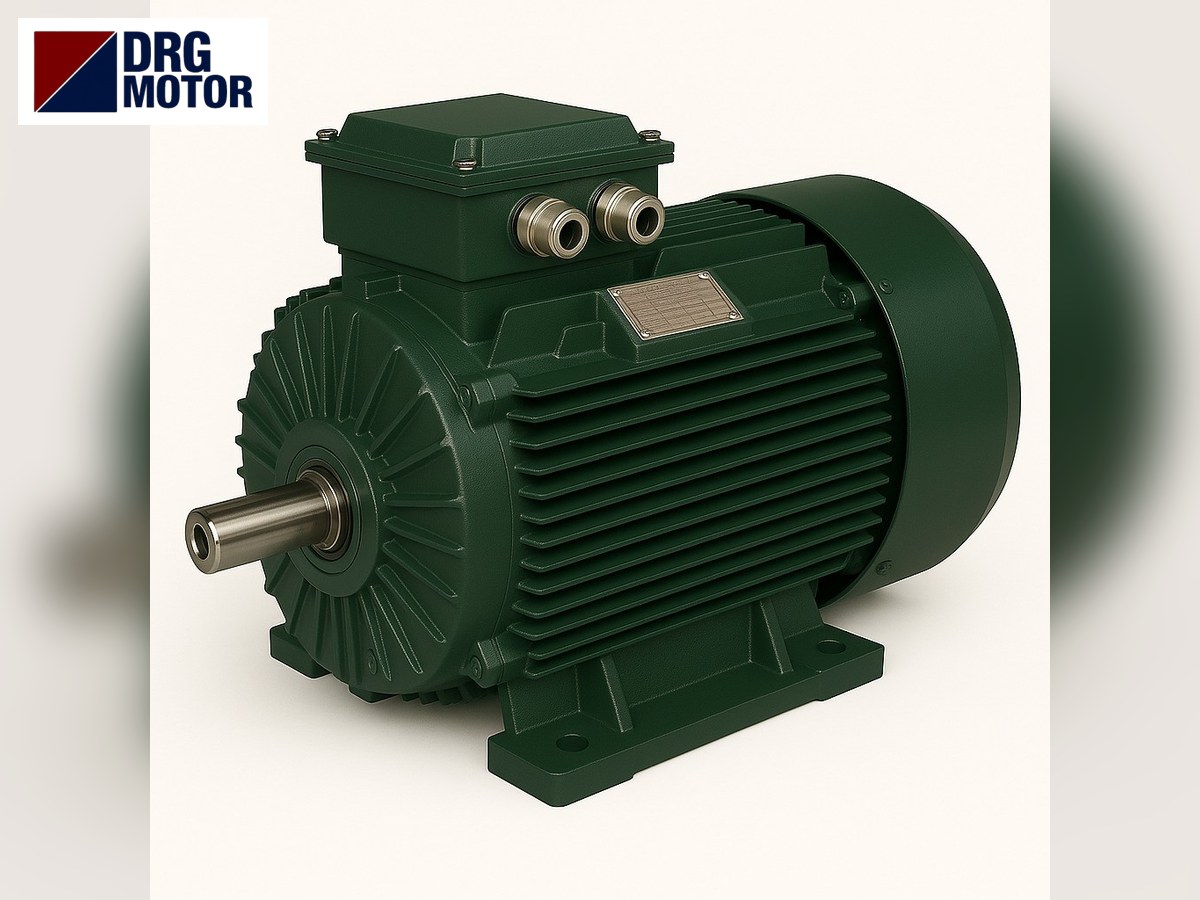
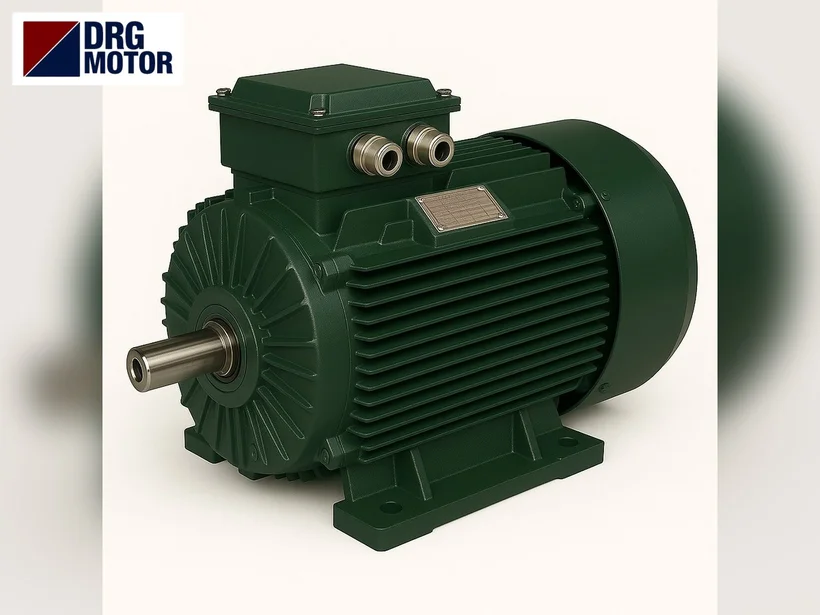
DRG Motor is a manufacturer, supplier and seller of electric motors. We do not sell the bottle washer, its chain, bottle pockets, pump casings, gearboxes or inverters. What we deliver for it are the three-phase motors that run its chain, pumps and brushes; models are on Buy Electric Motors Online.
Where are the motors in a soaker bottle washer?
Bottles are picked from the infeed table into pockets, carried by the chain into the pre-soak tank and then through one or more hot caustic baths, pass internal and external sprays, are rinsed with hot, warm and fresh water and leave at the same end or the opposite one. On a single-end machine infeed and discharge share one side; a double-end machine separates the dirty and clean sides. The second maker’s parts list gives the motor map of this flow: main drive, bottle infeed and outfeed motors, a label removal motor for each caustic tank, brush motor and bottle unscrambler motor, plus fans for blowing bottle bottoms, steam exhaust, label blowing and hydrogen exhaust.
Main drive and chain
The main drive turns the chain that carries heavy pockets, with full or half-full bottles, along the whole tank. On the first maker’s 8,000 bottles/h machine this motor is 7.5 kW; machine speed is set by inverter between 6,000 and 8,500 bottles/h. To protect motor and gearbox if the chain jams, the drive side has an overload clutch and electronic overload protection; those parts belong to the machine.
Label removal and brushes
Paper labels loosened in the caustic are lifted from the tank bottom by a rotating wire-mesh belt; a small geared motor turns that belt, and a pump draws water from under the mesh to wash the labels onto it. Aluminium foil labels react with caustic and release hydrogen, so enclosed machines have a separate fan to vent the gas. Lines built for heavily soiled bottles add internal and external brush units; on the third maker’s line the external brush takes 0.75 kW and the internal brush 3 kW.
Pumps, fans and the rotary rinser
Every bath and rinse zone has its own circulation pump, drawing from the tank and delivering to spray pipes aimed at the bottle mouths. On small external washers the fourth maker lists two 0.75 kW pumps, and on its large model two 2.2 kW pumps plus one 1.5 kW. For the pumps of large soaker machines we found no per-motor value; the second maker’s 20,000 bottles/h washer is given only as total installed power (about 68 kW). On such a machine the pump motor is chosen from application data: the flow and head on the pump plate, the old motor’s rating and speed and the flange type. When only flow and head are known, the pump and fan motor power calculator gives a first estimate.
Rotary rinser for PET bottles
New PET bottles are not washed in caustic; just before filling they are inverted in a rotary rinser and flushed with water or air. The rinser usually sits in one block with filler and capper and turns on a single main motor: on the fifth maker’s 24-head rinser that motor is 3 kW. The rinser’s own pump is small; on the sixth maker’s 4,000 bottles/h block the rinse pump is 0.37 kW. Small semi-automatic rinsers and rinsing benches are often fed from a 230 V single-phase socket; for those, note that we carry no single-phase motor.
Wet, hot and caustic surroundings
Around a bottle washer the air is steamy and wet, with caustic splashes. Motors are placed outside the tank body, under or beside the service platform, behind splash covers. IP55 means splash protection; still, no pressure jet or caustic washing jet should be aimed at the motor housing, and terminal box lid and cable gland should be checked at every service. A stainless steel housing demanded at the wet end is not in our range either; talk to us before ordering.
Click to see current electric motor prices and order nowSEE PRICES →
How many kW is a bottle washer motor? Catalogue values
A) Ratings printed by washer makers for each section:
| Machine / section | Motor power | Single / total | Note |
|---|---|---|---|
| Soaker glass bottle washer, 8,000 bottles/h: main drive | 7.5 kW | single motor | first maker’s data sheet |
| Same machine: installed power | 32.04 kW | machine total | first maker’s data sheet |
| Washer with three caustic tanks, 20,000 bottles/h | about 68 kW installed, 54 kW consumed | machine total; no per-motor values | second maker |
| 12,000 bottles/h line: external brush unit | 0.75 kW | unit | third maker |
| Same line: internal brush unit | 3 kW | unit | third maker |
| Same line: bottle conveyor, 8 m | 1.5 kW | single motor | third maker |
| External washer, small models | conveying 0.75 kW; pumps 2 × 0.75 kW | per motor | fourth maker |
| External washer, large model | pumps 2 × 2.2 kW + 1.5 kW | per motor | fourth maker |
| Rotary rinser, 24 heads, 6,000–7,000 bottles/h | 3 kW | main motor | fifth maker |
| Rinser-filler-capper block, 4,000 bottles/h: rinse pump | 0.37 kW | single motor | sixth maker |
Depending on maker and capacity, this machine group uses roughly 3–7.5 kW for the main drive, 0.37–2.2 kW per pump, 0.75–3 kW per brush unit and 0.75–1.5 kW for conveyors. The 32.04 kW and 68 kW figures are machine totals that count heating, pumps, fans and drive together, not one motor.
B) Where DRG fits: For the pumps (0.37–2.2 kW) the 2-pole 71–90L frames apply; drive, brushes and conveyors (0.75–7.5 kW) fall on 4-pole 80–132M frames. Large machines have no published per-motor values, so their replacements are chosen from the old motor plate.
Worked example: main drive and caustic time when capacity changes
The first maker’s data sheet gives 16 pockets per row and 8.3 minutes in caustic at 8,000 bottles/h. With the gearbox ratio of the main drive unchanged, chain speed follows motor frequency; assuming 8,000 bottles/h corresponds to 50 Hz:
| Capacity setting | Row rhythm | Time in caustic | Main drive (example) |
|---|---|---|---|
| 6,000 bottles/h | 375 rows/h, 9.6 s | about 11.1 min | 37.5 Hz |
| 8,000 bottles/h | 500 rows/h, 7.2 s | 8.3 min (data sheet) | 50 Hz |
| 8,500 bottles/h | 531 rows/h, about 6.8 s | about 7.8 min | about 53 Hz |
In practice, slowing the machine keeps bottles longer in caustic, and speeding it up shortens that time. Past 50 Hz the available torque shrinks as frequency rises, so a heavy pocket chain can overheat the motor at only 53 Hz or so. If faster running is needed, it is safer to obtain the speed at 50 Hz through the gearbox ratio. For a quick ratio check, enter motor rpm and chain sprocket speed in the gearbox output speed calculator.
The machine’s motors and their currents
Matching the data sheet ratings with motors from our range (rated torque: DRG-132M-4, 49.1 Nm):
| Motor | Duty | Rated current (400 V) | Note |
|---|---|---|---|
| DRG-132M-4, 7.5 kW | main drive | 14.3 A | Is/In = 7.5 → about 107 A |
| DRG-100L2-4, 3 kW | internal brush | 6.02 A | starts under load |
| DRG-90L-2, 2.2 kW | spray pump | 4.35 A | per pump |
| DRG-802-4, 0.75 kW | external brush / conveying | 1.75 A | geared |
The main drive starts with the loaded pocket chain, so the start is heavy; an inverter ramp eases both chain and supply better than star-delta. Pumps should start with a full tank, never an empty one, as dry running ruins the seal. Compare DOL, star-delta and soft start on our star-delta tool.
DRG motors for bottle washing machines
Our models matching the pump, brush and drive duties of the washer, with 400 V current:
| Model | Power / speed | Frame · shaft D×E | Current 400 V |
|---|---|---|---|
| DRG-711-2 | 0.37 kW / 2750 rpm | 71 aluminium · 14×30 | 0.89 A |
| DRG-801-2 | 0.75 kW / 2880 rpm | 80 cast iron · 19×40 | 1.64 A |
| DRG-90S-2 | 1.5 kW / 2895 rpm | 90S cast iron · 24×50 | 3.06 A |
| DRG-90L-2 | 2.2 kW / 2895 rpm | 90L cast iron · 24×50 | 4.35 A |
| DRG-802-4 | 0.75 kW / 1420 rpm | 80 cast iron · 19×40 | 1.75 A |
| DRG-100L2-4 | 3 kW / 1450 rpm | 100L cast iron · 28×60 | 6.02 A |
| DRG-132M-4 | 7.5 kW / 1460 rpm | 132M cast iron · 38×80 | 14.3 A |
Pumps are mostly 2-pole close-coupled types with a flange (B5 or B35); main drive, label belt and brushes run on 4-pole motors flanged to a gearbox. Pump-size motors are available in aluminium up to 11 kW; heavier duties go to cast iron, which our range offers up to 355 kW, all three-phase IEC. When replacing, write down kW, speed, voltage and connection from the removed motor’s plate, plus shaft diameter, key, flange size P and the spigot on the gearbox side; with the washer’s manual beside them we confirm the swap together; without measurements we do not promise a fit.
B5 dimensions for geared drives
B5 flange values of frames common on label belt, brush and bottle infeed/outfeed drives, mm:
| Frame | Shaft D×E | Flange P / M / N | Hole S |
|---|---|---|---|
| 71 | 14×30 | 160 / 130 / 110 | 10 |
| 80 | 19×40 | 200 / 165 / 130 | 12 |
| 90S/90L | 24×50 | 200 / 165 / 130 | 12 |
A motor entering a worm gearbox needs a shaft D × E and spigot N identical to the gearbox input bore. For the motors of conveyors bringing bottles to the washer and on to the filler see our filling line conveyor motor article, and for pump motor models the Pump Motors category.
Live price table
Prices of models sized for the duties on a bottle washer are pulled live from the shop:
| Model | Power / speed | Frame · current 400 V | Price |
|---|---|---|---|
| DRG-711-20.5 HP | 0.37 kW · 3000 rpm | Aluminium 71 · 0.89 A | $74.44 (€66.48) Details & buy → |
| DRG-802-41 HP | 0.75 kW · 1500 rpm | Cast iron 80 · 1.75 A | $101.93 (€91.03) Details & buy → |
| DRG-801-21 HP | 0.75 kW · 3000 rpm | Cast iron 80 · 1.64 A | $87.39 (€78.04) Details & buy → |
| DRG-90L-42 HP | 1.5 kW · 1500 rpm | Cast iron 90L · 3.3 A | $144.14 (€128.73) Details & buy → |
| DRG-90L-23 HP | 2.2 kW · 3000 rpm | Cast iron 90L · 4.35 A | $154.45 (€137.93) Details & buy → |
| DRG-100L2-44 HP | 3 kW · 1500 rpm | Cast iron 100L · 6.02 A | $203.84 (€182.05) Details & buy → |
| DRG-112M-45.5 HP | 4 kW · 1500 rpm | Cast iron 112M · 7.95 A | $254.38 (€227.18) Details & buy → |
| DRG-132M-410 HP | 7.5 kW · 1500 rpm | Cast iron 132M · 14.3 A | $394.89 (€352.66) Details & buy → |
DRG MOTOR motors are guaranteed against material and manufacturing defects for 2 years from the delivery date (warranty certificate).
Motors in this power range
- DRG-801-2 – 0.75 kW – 2880 rpm – 80 cast iron
- DRG-90L-2 – 2.2 kW – 2895 rpm – 90L cast iron
- DRG-802-4 – 0.75 kW – 1420 rpm – 80 cast iron
- DRG-100L2-4 – 3 kW – 1450 rpm – 100L cast iron
- DRG-132M-4 – 7.5 kW – 1460 rpm – 132M cast iron
Click to see current prices and order these motors nowSEE PRICES →
Browse the products, ask for a quote: suitable motors for your bottle washer are on Buy Electric Motors Online. Tell us which section’s motor you are replacing (main drive, pump, label belt, brush) and send the plate photo by WhatsApp, or call +90 (542) 666 11 11.
Frequently asked questions
What speed is the main drive motor of a bottle washer?
Most data sheets list kW only. Since the gearbox turns motor speed into chain speed, a replacement with a different speed would change both bottles per hour and soak time, so match the old plate.
Why does the caustic pump motor burn out often?
Frequent causes are dry running, a blocked suction strainer and splashes reaching the motor. Clean the strainer, run the pump with a full tank and check the terminal box seal.
Where can I see what a bottle washer motor costs?
Pick the kW and speed of the old plate; the live table above and each product page in the shop then show the figure.
Questions: +90 (542) 666 11 11 · info@drgmotor.com · contact page.


