 English
 Le français
 Türkçe

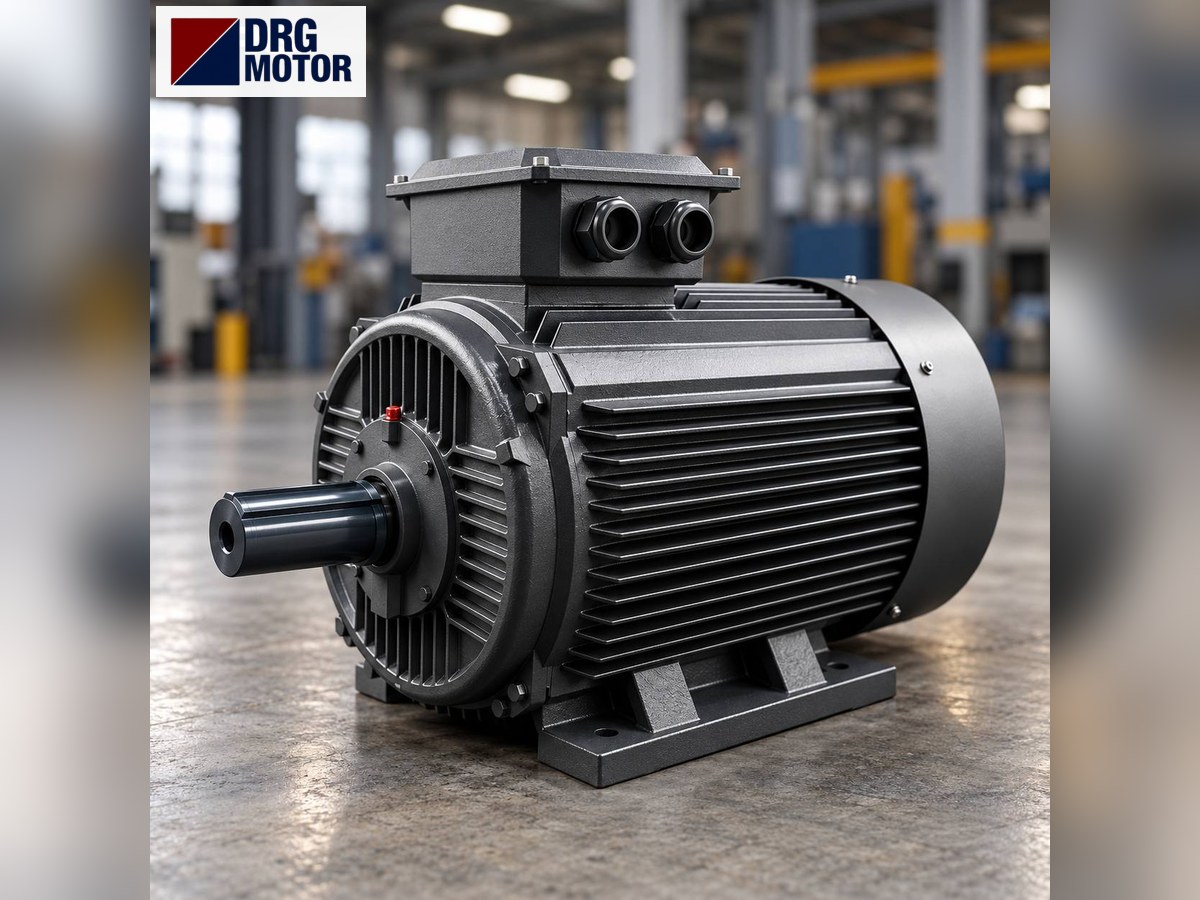
A secondary impact crusher is the second-stage machine that takes rock of up to 200–500 mm from the primary crusher, flings it with a horizontal-shaft rotor against breaker plates and turns it into cubical aggregate. The electric motor drives this rotor through V-belts and supplies all of the crushing energy. In models on the market, the single motor rating is roughly 110–355 kW [1][2][3]. The motor is usually a 4- or 6-pole, foot-mounted three-phase induction motor, and rotor speed is set by the pulley ratio.
This page explains where the impact crusher used in secondary crushing differs from the primary type, which data determine motor power and which DRG motors match this machine. You can see suitable models and current prices among the 120 models in our online shop. For the other machines of a crushing and screening plant, see Stone Crushing Plant Motors.
What is a secondary impact crusher and where does it sit in the plant?
The first machine in a crushing line reduces the large blocks coming from the quarry. The secondary impact crusher takes this pre-crushed material, breaks it a second time and gives it an angular, cubical shape. Inside is a heavy rotor with four blow bars [2]. As the rotor turns, the blow bars strike the rock and throw it onto the breaker plates above the rotor. The rock splits along its own weak planes. The gap between plate and rotor sets the product size. One manufacturer catalogue states that this machine can deliver a 0–80 mm product in a single pass and often makes a third crusher unnecessary [2].
The impact principle works well on soft to medium-hard rock with low abrasiveness. In quartz-rich, highly abrasive rock the blow bars wear quickly; there, a cone crusher is usually preferred at the secondary stage.
Where is it used?
- Concrete and asphalt aggregate production in limestone and dolomite quarries, behind a jaw crusher.
- Small single-crusher plants that produce fractions such as 0–5, 5–12 and 12–22 mm directly.
- Recycling of demolition concrete and asphalt planings; the open rotor design tolerates rebar pieces better [2].
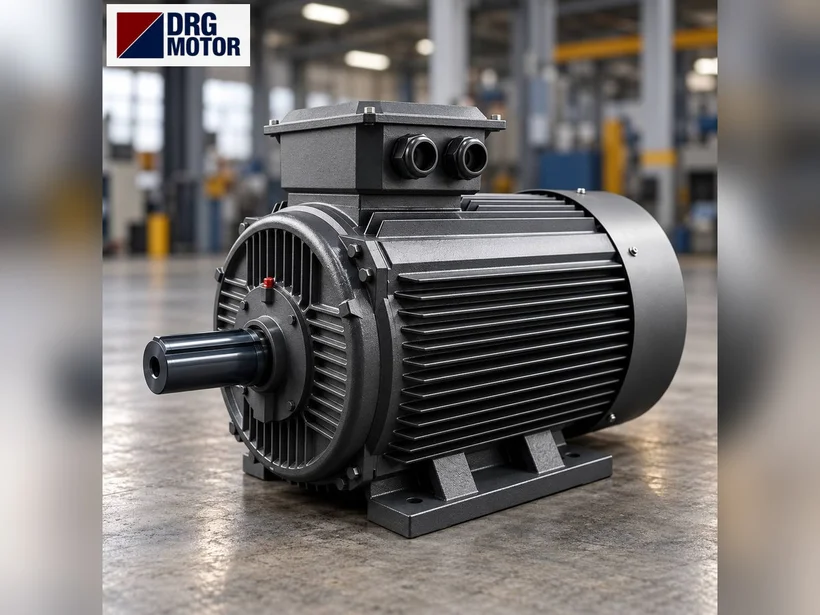
How it differs from the primary impact crusher: feed, rotor speed and power
Although they work on the same principle, primary and secondary impact crushers are designed for different loads. The primary machine swallows quarry rock; the secondary machine refines a controlled, smaller feed with a faster rotor. This difference carries straight into motor selection.
| Feature | Primary impact | Secondary impact | For the motor |
|---|---|---|---|
| Maximum feed size | 1,000–1,300 mm [1] | 200–500 mm [1][2][3] | Lower load per blow |
| Rotor peripheral speed | 31–37 m/s [4] | 40–48 m/s [4] | Pulley ratio changes |
| Shaft line, similar rotor | 7,880 kg, Ø1,370 mm [1] | 6,070 kg, Ø1,307 mm [1] | Lower inertia |
| Single motor power | 200–355 kW [1] | 110–355 kW [1][2][3] | Lower bottom end |
The upper ends of the power ranges overlap, because 355 kW is the ceiling one manufacturer gives for a single-motor drive [1]. The real difference is in the load character. The secondary crusher receives an even flow of rock from a feeder, with no large block impacts, but its rotor turns faster. The Cone Crusher works by compression at the same stage and is preferred in abrasive rock; the Tertiary Crusher produces fine material from feed of up to 150 mm; the Vertical Shaft Impactor (VSI) is aimed at sand production.
How the motor drives the rotor: belts, pulleys and rotor speed
The standard drive of secondary impact crushers is a V-belt drive [2]. The motor sits on a separate slide base beside the crusher; its pulley is connected by belts to the large pulley on the rotor shaft. Belt flexibility damps impact loads to some extent and allows the rotor speed to be changed simply by changing a pulley [2].
Rotor speed follows from the target peripheral speed: n = v·60 / (π·D). A 1,300 mm rotor at 42 m/s turns at about 617 rpm. With a 4-pole motor running at 1490 rpm the pulley ratio is about 2.41; with a 6-pole motor at 990 rpm it is about 1.60. The smaller the ratio, the smaller the rotor pulley; this is why some machines use a 6-pole motor. You can check your own pulley diameters with the pulley and belt calculator.
The belt also multiplies torque by the ratio. A 200 kW motor delivers about 1,282 Nm at 1490 rpm; on the rotor shaft at 617 rpm this rises to about 3,095 Nm. Raising rotor speed gives a finer product but more wear and more energy per tonne [2]; after any pulley change, motor current must be monitored again.
Apart from the main motor, there is a hydraulic unit that adjusts the breaker plates and opens the housing; its pump runs on its own small motor [2]. One manufacturer asks for a supply to the hydraulic unit that is separate from the main motor [1]. This motor's rating is listed separately in the crusher data sheet and is not added to the main motor power.
Click to see current electric motor prices and order nowSEE PRICES →
How many kW does a secondary impact crusher motor need?
A) Motor power seen in models on the market
| Model group / capacity | Motor power | Single / total | Source |
|---|---|---|---|
| Maker A, small, Ø1,100 mm rotor | 110–250 kW | Single motor | [1] |
| Maker B, small, 100–150 t/h | 132–160 kW | Single motor | [2] |
| Maker C, medium, 120–150 t/h | 200 kW | Single motor | [3] |
| Maker B, large, 250–350 t/h | 250–315 kW | Single motor | [2] |
| Maker A, large, Ø1,307 mm rotor | 250–355 kW | Single motor | [1] |
| Maker A, largest, Ø1,516 mm | 355–630 kW | Total, dual drive | [1] |
| Auxiliary: hydraulic adjustment | Listed separately | Separate motor | [1][2] |
In this machine group, single motor options of roughly 110–355 kW are seen, depending on the manufacturer's model and capacity [1][2][3]. In the largest models the figure rises to 630 kW; this is the total of two motors and must not be read as the single motor of one machine [1]. Capacity drives power: one manufacturer keeps the rotor diameter at 1,100 mm and widens the rotor from 1,100 mm to 1,500 mm, raising capacity from 60–100 t/h to 200–250 t/h and power from 160 kW to 250 kW [3]. Catalogue tonnages refer to a bulk density of 1.6 t/m³; moisture, clay and rock crushability lower the real capacity [2].
B) Motors with a match in the DRG range
All single motors in the 110–355 kW band have a match in the DRG cast iron range at 1000 and 1500 rpm. On large dual-drive models, two DRG motors can be used if each motor does not exceed 355 kW; the per-motor value is taken from the crusher manufacturer's drawing. Machines that need more than 355 kW on a single motor, or that require a 750 rpm motor, are outside the DRG range.
What data are needed for motor selection?
When requesting a motor for a secondary impact crusher, send the following together:
- Crusher model, rotor diameter × width and the installed power on the nameplate.
- Diameters of the motor pulley and rotor pulley, target rotor speed or peripheral speed.
- Old motor nameplate: kW, rpm, IEC frame, voltage; shaft diameter and length (the pulley hub fits these).
- Hole spacing of the motor slide base and the belt tensioning arrangement.
- Largest rock from the primary; if it exceeds the crusher's allowed feed, current peaks occur.
- Material: limestone, dolomite or recycled concrete containing steel pieces.
- Existing panel: soft starter, star-delta or inverter; transformer rating.
- Environment: open site, dust and rain; whether the motor stands in shade or sun.
Starting: the rotor starts empty
An impact crusher is started empty; the feeder is opened after the rotor reaches full speed. One manufacturer states that start-up and shut-down sequences are integrated into its crusher automation [1]. Even without load, the heavy rotor takes a long time to accelerate. In direct-on-line starting, the DRG-315L2-4 provides 2.0 times rated torque and draws 7.1 times rated current. In star-delta, starting torque drops to one third, about 0.67 Tn; with a heavy rotor this lengthens acceleration time. The starting method should be chosen with the crusher manufacturer according to the supply and rotor inertia. For details see the star-delta starting tool and our article on starting current.
Speed and mounting
A 1,300 mm rotor at 40–48 m/s turns at about 590–705 rpm while the motor turns at 990 or 1490 rpm; the pulleys bridge the difference. The motor is usually foot-mounted (B3) on the slide base. The exact mounting type and base dimensions are taken from the crusher manufacturer's drawing. If the number of poles is to be changed (e.g. from 6 to 4 poles), the motor pulley must be recalculated; otherwise rotor speed and power draw change.
Example: reading motor power from a selection table and matching DRG
A limestone quarry wants 200 tonnes of aggregate per hour from 0–250 mm material coming from a jaw crusher. In one manufacturer's secondary crusher table, the 150–250 t/h row shows 200 kW installed power and the 250–350 t/h row shows 250–315 kW [2]. The target is in the middle of the first row and the rock is dry, so the 200 kW row is chosen. If the material were clayey and moist, the same tonnage would call for the next row up, because table values refer to dry, clean rock.
Rotor 1,300 mm, target peripheral speed 42 m/s: the rotor turns at about 617 rpm, and with a 4-pole motor the pulley ratio is about 2.41. The DRG-315L2-4 suits this duty: 200 kW, 1490 rpm, 315L frame, 334 A at 400 V. Starting current is about 7.1 × 334 ≈ 2,370 A; cable, switchgear and transformer are chosen accordingly. If the slide base allows a larger frame, the 6-pole DRG-355M2-6 (200 kW, 990 rpm, 355M, 346 A) gives the same rotor speed with a smaller pulley ratio.
DRG Motor is a manufacturer, supplier and seller of electric motors. Our range covers 0.25–11 kW in aluminium housing and 0.55–355 kW in cast iron; 1000, 1500 and 3000 rpm; 3-phase, 230/400 V or 400/690 V; mounting B3, B5, B14 and B35 (with an order note). Motors in the secondary impact crusher band are wound for 400/690 V.
| Model | Power / speed | Frame | Current 400 V |
|---|---|---|---|
| DRG-315L1-4 | 160 kW / 1488 rpm | 315L cast iron | 271 A |
| DRG-315L2-4 | 200 kW / 1490 rpm | 315L cast iron | 334 A |
| DRG-355M-4 | 250 kW / 1490 rpm | 355M cast iron | 418 A |
| DRG-355L-4 | 315 kW / 1490 rpm | 355L cast iron | 526 A |
| DRG-355M2-6 | 200 kW / 990 rpm | 355M cast iron | 346 A |
| Model | Power / speed | Frame · current 400 V | Price |
|---|---|---|---|
| DRG-315L2-6180 HP | 132 kW · 1000 rpm | Cast iron 315L · 232 A | $5,691.81 (€5,083.14) Details & buy → |
| DRG-315M-4180 HP | 132 kW · 1500 rpm | Cast iron 315M · 224 A | $5,621.72 (€5,020.55) Details & buy → |
| DRG-355M1-6200 HP | 160 kW · 1000 rpm | Cast iron 355M · 281 A | $6,285.89 (€5,613.69) Details & buy → |
| DRG-315L1-4200 HP | 160 kW · 1500 rpm | Cast iron 315L · 271 A | $6,135.24 (€5,479.15) Details & buy → |
| DRG-355M2-6270 HP | 200 kW · 1000 rpm | Cast iron 355M · 346 A | $9,015.18 (€8,051.11) Details & buy → |
| DRG-315L2-4270 HP | 200 kW · 1500 rpm | Cast iron 315L · 334 A | $7,115.64 (€6,354.71) Details & buy → |
| DRG-355L-6340 HP | 250 kW · 1000 rpm | Cast iron 355L · 433 A | $12,004.86 (€10,721.09) Details & buy → |
| DRG-355M-4340 HP | 250 kW · 1500 rpm | Cast iron 355M · 418 A | $9,826.77 (€8,775.92) Details & buy → |
| DRG-355L-4430 HP | 315 kW · 1500 rpm | Cast iron 355L · 526 A | $11,417.31 (€10,196.37) Details & buy → |
| DRG-400M-4480 HP | 355 kW · 1500 rpm | Cast iron 400M · 593 A | $11,803.58 (€10,541.33) Details & buy → |
DRG MOTOR motors are guaranteed against material and manufacturing defects for 2 years from the delivery date (warranty certificate). General background on torque demand in crushing: why stone crushing needs high torque.
DRG motors for secondary impact crushers
- DRG-315M-4 – 132 kW – 1488 rpm – 315M cast iron
- DRG-315L1-4 – 160 kW – 1488 rpm – 315L cast iron
- DRG-315L2-4 – 200 kW – 1490 rpm – 315L cast iron
- DRG-355M-4 – 250 kW – 1490 rpm – 355M cast iron
- DRG-355L-4 – 315 kW – 1490 rpm – 355L cast iron
- DRG-355M2-6 – 200 kW – 990 rpm – 355M cast iron
Click to see current prices and order these motors nowSEE PRICES →
Secondary impact crusher motor: frequently asked questions
How many kW should a secondary impact crusher motor be?
The installed power in the crusher model's catalogue is the basis. In single-motor models on the market the figure is roughly 110–355 kW; power rises with capacity and rotor width.
Are 4-pole or 6-pole motors used on secondary impact crushers?
Both are seen. Because the rotor is belt-driven, the number of poles only changes the pulley ratio. If the existing pulleys are kept, choose the same number of poles as the old motor.
Can a secondary crusher motor start in star-delta?
It is possible if the crusher starts empty, but because torque drops to one third in star, acceleration of the heavy rotor takes longer. The method is chosen together with the crusher manufacturer's recommendation and the supply capacity.
How many amps does a 200 kW crusher motor draw?
The DRG-315L2-4 draws 334 A at 400 V and 352 A at 380 V. In direct-on-line starting, about 7.1 times this current is seen.
Send us the crusher nameplate, rotor size, pulley diameters and the old motor nameplate; we will confirm the right DRG model with you. Phone +90 (542) 666 11 11, e-mail [email protected], contact page. For all models and current prices, see Buy Electric Motors Online.
Sources
- Metso – Nordberg NP Series HSI crushers (broşür) – power range per model, feed size, rotor diameter, shaft line weight; 355 kW maximum on single drive, 630 kW on dual drive; separate supply for the hydraulic unit.
- MEKA – MSI Series Secondary Impact Crusher (katalog) – MSI 1210/1312/1315: rotor size, maximum feed 250–350 mm, 100–350 t/h, 132–315 kW; V-belt drive, motorised hydraulic unit.
- Constmach – Secondary Impact Crushers (CSI serisi) – CSI-1210/1212/1215: 1,100 mm rotor diameter, width 1,100–1,500 mm, 60–250 t/h, 160/200/250 kW.
- MEKA – What Is a Tertiary Impact Crusher? (teknik yazı, Tablo 3) – rotor peripheral speed by crusher type: primary 31–37 m/s, secondary 40–48 m/s.


